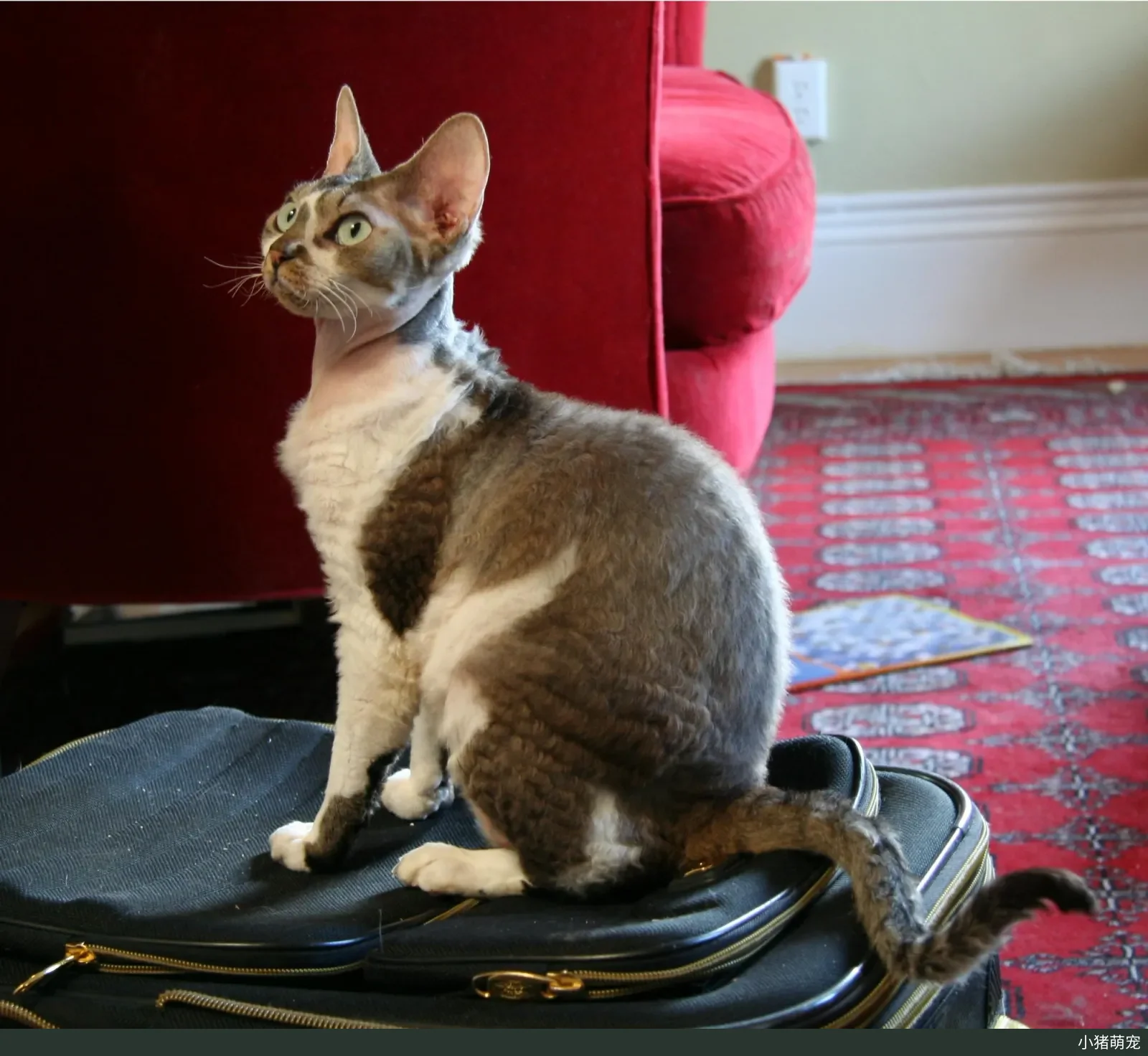
A brown-and-white Devon Rex named Izzy. Photo: Pathfinder Linden (originally posted on Flickr; Commons version cropped at the edges), source: Wikimedia Commons, license: CC BY 2.0.

The Devon Rex is a natural-mutation breed discovered around 1959–1960 in Devon, England. It is known for oversized, low-set ears, large eyes, and a soft wavy coat, and is often described as a “pixie.” Devons are smart, active, and very people-oriented; shedding is not heavy, but they are not hypoallergenic. If you want one, focus first on hereditary myopathy testing, blood type, and heart screening.
Breed origins
The Devon Rex story starts in Buckfastleigh, a small town in Devon in southwest England. Per the UK’s Governing Council of the Cat Fancy (GCCF), on 15 July 1959 a non-pedigree queen produced a litter in which only one kitten—a black smoke tom—had a curly coat; his sire is unknown and is generally thought to have been a large black curly tom from a nearby abandoned tin mine. Miss Beryl Cox adopted the kitten and named him Kirlee. Associations do not agree fully on the year: CFA also writes 1959; TICA writes 1960.
Neighboring Cornwall had already produced the Cornish Rex in 1950, so people first assumed Kirlee was the same mutation. When he was bred to Cornish Rex cats, however, all the 1961 kittens were straight-haired, proving two incompatible, independent mutations: the Cornish Rex was called “Gene 1” and the Devon Rex “Gene 2,” and the lines have been bred separately ever since (GCCF). To fix the curl, early breeders mated Kirlee to his own offspring, then outcrossed to other breeds to widen the gene pool (CFA). TICA notes that every Devon Rex traces to Kirlee, who died in a road accident in 1970.
GCCF recognized the breed in 1967; FIFe’s current standard lists recognition in 1968. The same year it was introduced to the United States; ACFA recognized it in 1972 and CFA in 1983 (GCCF). In 2010 a UC Davis team published in Mammalian Genome that the Devon Rex comes from a variant in KRT71 (keratin 71)—the same gene that carries the Sphynx hairlessness mutation—which also explains why TICA calls the two breeds “close relatives.”
Looks, coat, and temperament
Against CFA and FIFe standards, the Devon Rex’s recognition comes mainly from the head: a short, broad wedge; prominent cheekbones; a short muzzle and strong chin; a pair of large, wide, very low-set ears; and large oval eyes—the “pixie” look. Size is small to medium; CFA gives adult weight usually as 6–9 pounds (about 2.7–4.1 kg), males slightly larger; TICA writes females 5–7 pounds and males 7–9 pounds. The body is sturdy and muscular, with a broad chest, hind legs longer than the front, and a fine long tail; almost all colors and patterns are accepted.
The coat is the most distinctive feature. Guard hairs are few and short; overall the coat falls in loose waves or curls and feels like velvet. It is also fragile: whiskers and eyebrows often curl and break easily; during coat change hair may break off in patches, and some cats develop sparse or nearly bare areas. The FIFe standard allows bald patches only in cats under 12 months; CFA also lists bald patches on adults as a serious fault. Because the coat insulates poorly, Devons feel especially warm to the touch, though body temperature is the same as other cats (TICA, GCCF).
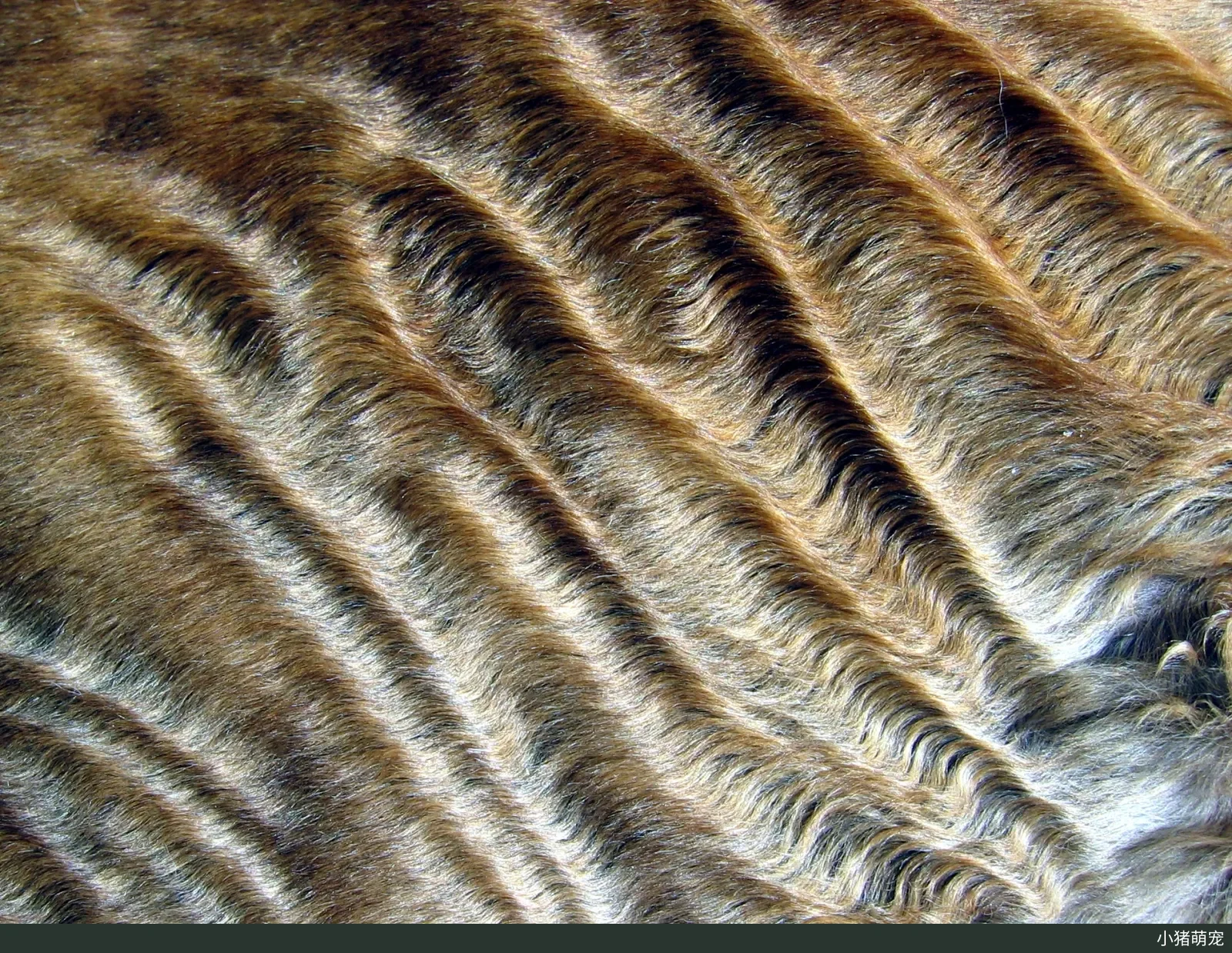
Close-up of the wavy coat along a Devon Rex tom’s flank. Photo: Sonja Pauen (Stanhopea), 2 May 2008, source: Wikimedia Commons, license: CC BY 2.0 DE.

On temperament, several associations agree closely: smart, active, mischievous, and very affectionate. CFA says they can learn to answer to their names, follow people around the house, and often burrow under the covers to sleep; TICA and GCCF note strong leaping ability, a love of high perches such as door tops, and a habit of riding on shoulders to “supervise” cooking. They are not especially loud and mostly “talk” in soft chirps. Association materials generally say they get along with children and other pets, but that is a breed-level summary—individual personality and socialization still matter.
Common health issues
TICA and GCCF both consider the Devon Rex a relatively healthy breed overall, but its gene pool started small and early breeding involved heavy inbreeding. GCCF’s breeding policy states plainly that patellar luxation, clotting problems, and hereditary myopathy have troubled the breed from the start. The points below deserve special attention.
Hereditary myopathy (congenital myasthenic syndrome). Once called “spasticity,” a 2015 PLOS ONE study confirmed it is caused by a recessive mutation in COLQ; Sphynx cats can carry it too. Per Universities Federation for Animal Welfare (UFAW) materials, affected cats usually show generalized muscle weakness, inability to hold up the head, and easy fatigue between 3 and 23 weeks of age, tending to stabilize after about 9 months; the greatest danger is dysphagia leading to choking or even sudden death. There is no cure, but DNA testing can identify clear, carrier, and affected cats; when two carriers are bred, about one in four kittens will be affected. UFAW also notes that reliable population prevalence data are not yet available.
High type B blood frequency. CFA notes that type B blood is relatively common in the breed’s gene pool: if a type A tom is bred to a type B queen, kittens may die after birth unless hand-reared from the start. GCCF breeding policy explains that type B cats have strong anti-A antibodies, which can cause neonatal isoerythrolysis (often called “fading kitten syndrome”) and transfusion reactions, so blood typing is advised for all cats and especially breeding cats.
Patellar luxation and heart screening. GCCF notes that patellar (kneecap) luxation is fairly common in the breed; TICA recommends available genetic testing for all Devon Rex cats and hypertrophic cardiomyopathy (HCM) echocardiographic screening of breeding parents.
On “breed controversy.” The Devon Rex does not involve folded-ear cartilage problems and is not a short-legged or flat-faced breed; CFA’s standard even lists an overly short muzzle as a deduction. What needs facing squarely are two points: the curl itself is a hair-structure mutation that brings fragile hair, bald patches, and poorer insulation; early inbreeding left the hereditary risks above. Responsible breeders should offer the relevant test records without being asked.
Care basics
- Groom the coat gently: hair is brittle and breaks easily; GCCF advises gentle combing, and often a hand stroke is enough. Shedding is not heavy, but CFA, TICA, and GCCF all stress that Devons are not hypoallergenic; TICA advises people with allergies to meet Devon Rex cats several times and watch for at least 24 hours after each exposure before deciding.
- Watch warmth: poor coat insulation means they love sun and heat sources (TICA, GCCF); in cold weather mind room temperature and provide a warm bed.
- Ears, nails, and teeth: large ears collect grease—clean when they look dirty; TICA suggests weekly nail trims, regular brushing with vet-approved pet toothpaste, and taller scratching posts.
- Manage appetite: many Devon Rex cats are greedy and need strict portion control. TICA suggests feeding three times a day before 6 months of age and twice daily afterward; keep the water bowl at least about 1 meter (3 feet) from food, or use a filtered fountain.
- Companionship: they dislike long stretches alone and may wreck things when bored (CFA, TICA, GCCF). Puzzle toys, interactive toys, and climbable heights help; GCCF thinks they do best living with other cats (preferably the same breed).
- Buy with records: ask breeders for congenital myasthenic syndrome (CMS) genetic tests, blood type, and parental echocardiogram records. On lifespan, GCCF writes 12–16 years; TICA writes 14–17 years or more.
References
-
The Cat Fanciers' Association. Devon Rex (accessed 2026-10-17)
-
The International Cat Association. Devon Rex (accessed 2026-10-17)
-
The Governing Council of the Cat Fancy. Devon Rex (accessed 2026-10-17)
-
The Governing Council of the Cat Fancy. Devon Rex Breeding Policy (PDF, accessed 2026-10-17)
-
Fédération Internationale Féline. FIFe Standards: Category 4, version 2026 (version dated 2026-01-01)
-
Science for Animal Welfare (UFAW). Hereditary Myopathy – Devon rex (updated 2026-05-06)
-
Abitbol M, et al. (2015). A COLQ Missense Mutation in Sphynx and Devon Rex Cats with Congenital Myasthenic Syndrome. PLOS ONE 10: e0137019.
-
Gandolfi B, et al. (2010). The naked truth: Sphynx and Devon Rex cat breed mutations in KRT71. Mammalian Genome 21(9-10): 509–515.