The Hokkaido is also known as the Ainu-ken. In the mountains and harsh winters of Hokkaido, the Ainu hunted bear and deer with these dogs. They valued a dog that could keep working over difficult ground and had the courage to face large game. Japan designated the Hokkaido a Natural Monument in 1937. In the United States, the American Kennel Club (AKC) has listed the breed in its Foundation Stock Service (FSS) since January 2016. [1][2]
Look at a standing Hokkaido from the side and follow the line from the shoulders to the base of the tail. The back is straight, the chest is deep, and the thick tail is set high. The breed standard from the Fédération Cynologique Internationale (FCI) gives the ratio of shoulder height to body length as 10 to 11. In profile, the dog is just a little longer than it is tall. The AKC describes a sturdily built, medium-sized dog, about 46–51 cm at the shoulder and roughly 20–30 kg. In the photograph on the grass, the curl of the tail stands out. Below it, you can see where the belly tucks up toward the hind legs. [1][2]
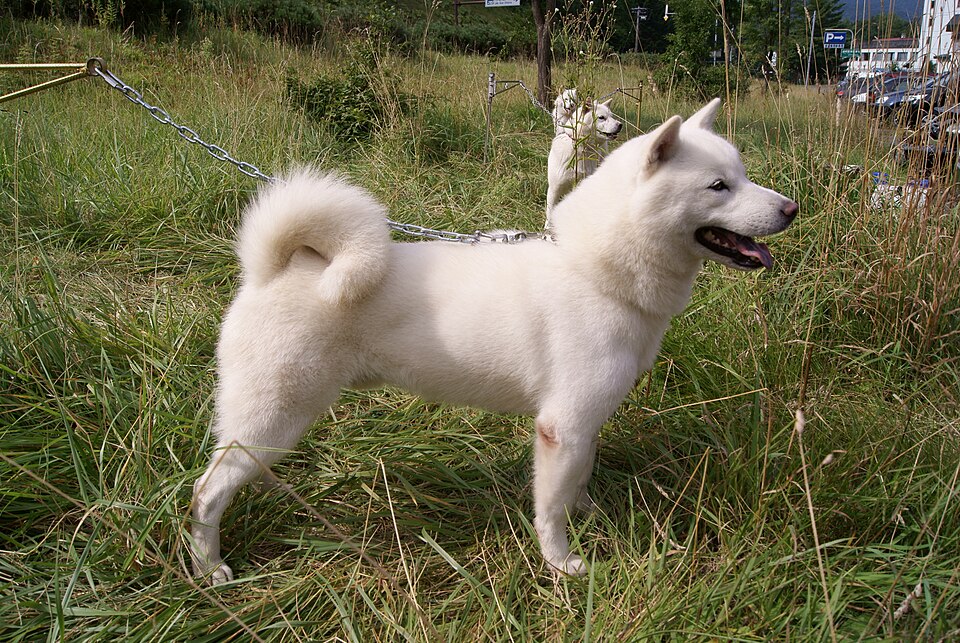
A Hokkaido stands in profile. Midori, Wikimedia Commons[4]

From the front, look for small, upright triangular ears, a broad forehead and well-developed cheeks. The muzzle narrows from the cheeks toward the nose, and the ears tilt slightly forward. Those lines are easy to trace in the close-up of the white dog. Compare it with the photograph of Rin, an Ainu-ken photographed by 三上 勝生. Rin has a reddish-brown forehead and ear backs, with paler fur along the sides of the muzzle. Beneath the different coloring, the outline is much the same. Other Hokkaido coat colors include black, brindle and sesame. [1][2]
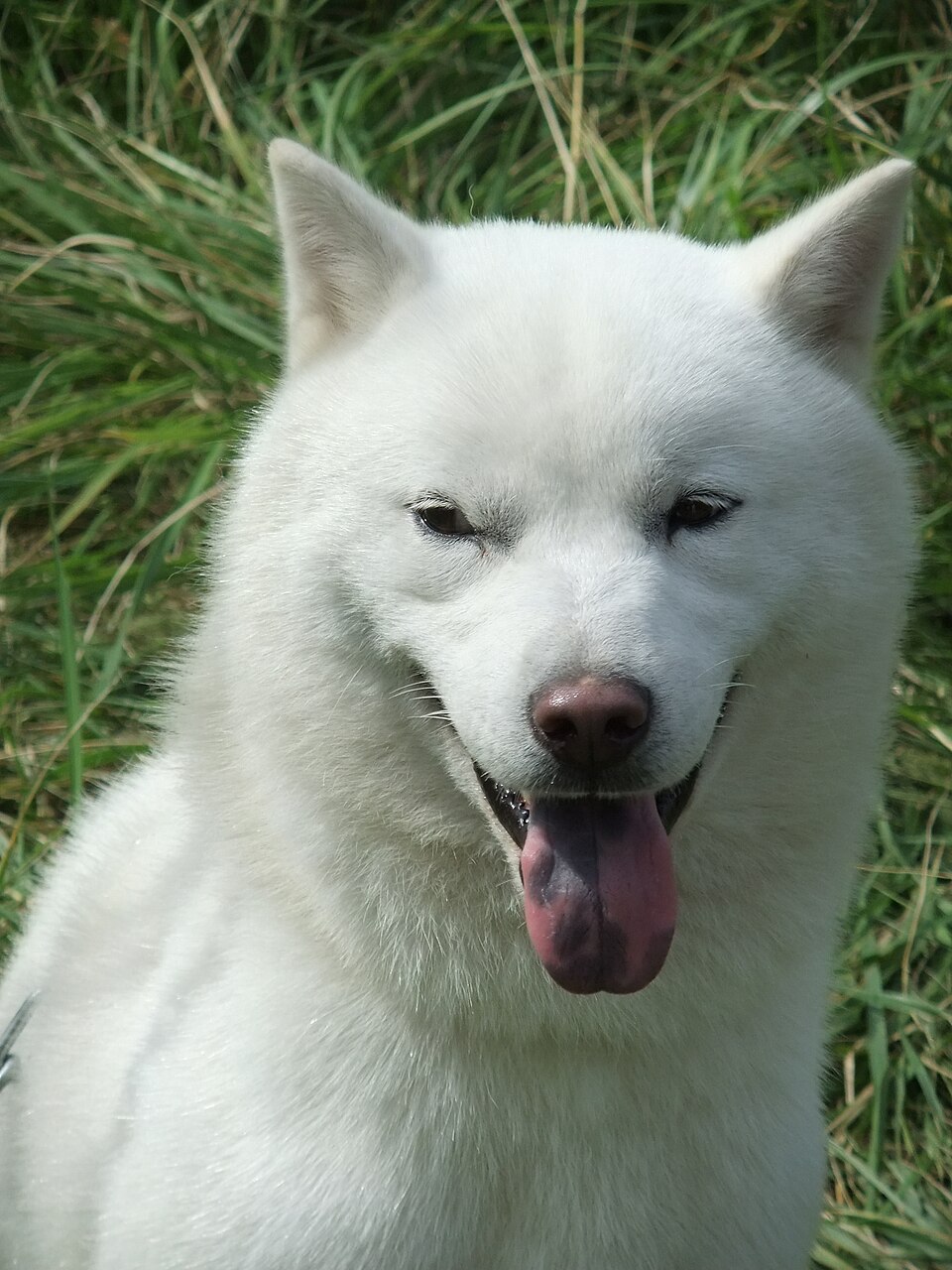
A Hokkaido faces the camera. Midori, Wikimedia Commons[5]

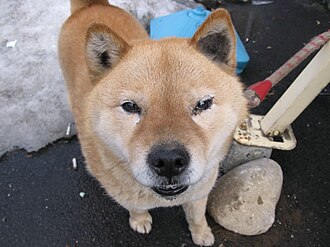
Rin has a reddish-brown brow. 三上 勝生, Wikimedia Commons[6]

Practice a turn together on a walk
Hokkaido are active dogs that enjoy figuring things out. The AKC suggests hiking as an activity to share with the family. It also mentions agility and rally, sports in which the dog pays attention to the handler while moving. You can borrow that part for an ordinary walk. Give the dog a chance to look back at you, pick up a cue and work out which way to go. For a dog that likes to take toys apart, this is a particularly handy game. You can give the dog a puzzle with just a leash in your hand. [1]
Choose a tree with plenty of space around it on a familiar route. Walk toward it together. When the dog glances back at you, give a clear hand signal for the turn. Walk around the same side of the trunk and reward the dog when you reach the other side. Lead the way the first few times. Once the dog knows the route, slow your steps a little and see whether it follows your hand. Change one thing at a time. Keep the same tree while practicing direction. When you try a new spot, start with a turn the dog already knows. Then carry on with the walk and give the dog time to sniff.
To see how this might fit your household, picture an ordinary workday. Who has time in the morning to fasten a well-fitting harness, clip on a sturdy leash and go for a walk? Who can give the dog a few minutes of attention for practice in the evening? A yard brings another consideration. Hokkaido can jump well, and the AKC recommends a six-foot fence, about 1.8 metres high, for a backyard where the dog will run free. Before unclipping the leash, walk the boundary, check that the gate latches and look for raised surfaces the dog could use as a step. [1]
Hokkaido tend to form close bonds with familiar people and may be wary of strangers. Make room for early socialization in the routine. If you meet a neighbor on a walk, you can use the same hand signal. Pause far enough away for the dog to look back at you calmly, wait for it to respond to the cue, then walk on together. If visitors often come to the house, leave a clear path from the entryway to a place where the dog can rest. The distance this dog needs and the time it takes to relax tell you more about its progress than a count of how many people it met that day. [1]
Retire a toy as soon as it tears
The AKC specifically mentions pica, the eating of nonfood items, in its health information for the Hokkaido and advises owners to inspect toys frequently. A toy may be too large to swallow whole, yet a corner chewed off it can be small enough to gulp down. When you take a toy out, run your fingers along its seams and any parts that stick out. During play, watch what the dog does with it. Is it chasing or carrying the toy, or working away at one spot? As soon as an edge tears open, end the game and discard the damaged toy. For the next round, you can switch to following a hand signal around a tree. [1][3]
In a home with children, clearing the play area might mean looking under the sofa for small building blocks and picking up socks or gift ribbon. Cornell University's College of Veterinary Medicine explains that swallowed objects such as toy fragments can lodge in the stomach or intestines. String-like objects can also injure the intestinal wall. If you see your dog swallow a piece, or a piece is missing and you suspect the dog swallowed it, call a veterinarian immediately. Describe what is missing, roughly how big it is and when you noticed. If the dog later vomits, loses its appetite or shows signs of abdominal pain, report those changes as well. [3]
Allow more time for brushing during shedding season
The full coat around the neck and tail has two distinct layers. Coarse outer guard hairs cover a fine, dense undercoat. For much of the year, regular brushing removes loose hair, and the coat keeps its shape without trimming or shaving. The bigger job comes roughly twice a year, when much of the undercoat comes loose at once. Plan for a bath and more frequent brushing to lift out the loose fur. Short, relaxed grooming sessions during the rest of the year help the dog grow comfortable with handling. Regular nail trims and toothbrushing can become part of that routine. [1]
When preparing to bring a Hokkaido home, ask about its health records as well as its favorite games. The AKC lists collie eye anomaly, hip dysplasia and luxating patellas among the breed's health concerns. Ask the breeder what eye or joint examinations the parents have had. Bring the identity of each dog examined, the date and the result to your veterinarian. At the first visit, you can then discuss this dog's family history alongside its age and usual activity, including how gradually to lengthen hikes and which changes should prompt another visit. [1]
References
-
[1] American Kennel Club. Hokkaido.
-
[2] Fédération Cynologique Internationale. FCI-Standard N° 261: HOKKAIDO. English edition, February 9, 2017.
-
[3] Cornell University College of Veterinary Medicine. Gastrointestinal foreign body obstruction in dogs. Updated December 2024.
-
[4] Midori. File:Hokkaido Inu 3.JPG. Wikimedia Commons.
-
[5] Midori. File:Hokkaido Inu 1.JPG. Wikimedia Commons.
-
[6] 三上 勝生. File:Ainuken 01.jpg. Wikimedia Commons.