The Korat comes in only one color: silver-tipped blue. Each hair is lighter near the root, deepens to blue toward the tip, then finishes silver, so the whole cat looks wrapped in a silver sheen. On short-haired areas such as the bridge of the nose and the backs of the ears, the silver is brighter.[1] The Cat Fanciers’ Association (CFA) breed standard disqualifies any color other than silver-tipped blue, and any white spotting or white locket.[1]
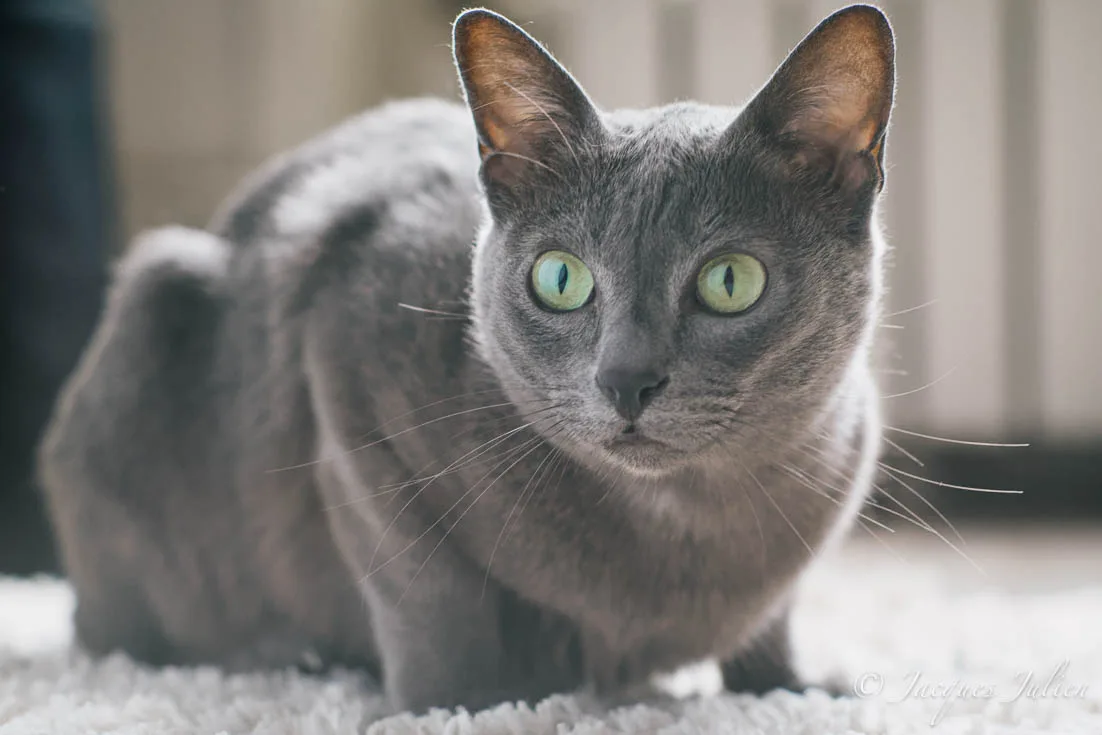
Figure: A Korat. Source: Jacques Julien, Wikimedia Commons. License: CC BY-SA 4.0. Changes: converted to WebP and width-limited only; original credit retained.
A breed that stepped out of a Thai poem book
CFA notes that the Korat was first found around Thailand’s Korat province. The earliest known record appears in the Ayutthaya-period (1350–1767) Smud Khoi of Cats, which illustrated 17 Thai “good-luck cats”; the Korat was the best known. In Thailand it was traditionally given as a bridal gift, a symbol of luck and happiness.[1]
In 1959 Jean Johnson brought the first two Korats to the United States. A decade later Daphne Negus brought nine more from Thailand to broaden the U.S. bloodlines and became a key figure in the breed’s development.[1] CFA’s standard also notes that even in its homeland Thailand the Korat remains uncommon.[1]
How to recognize a Korat
The face is the easiest cue. From the front, the brow ridge forms the upper edge of a heart; the cheeks taper down to the chin, completing a heart-shaped face; large ears with rounded tips and outward-set bases further frame that outline.[1]
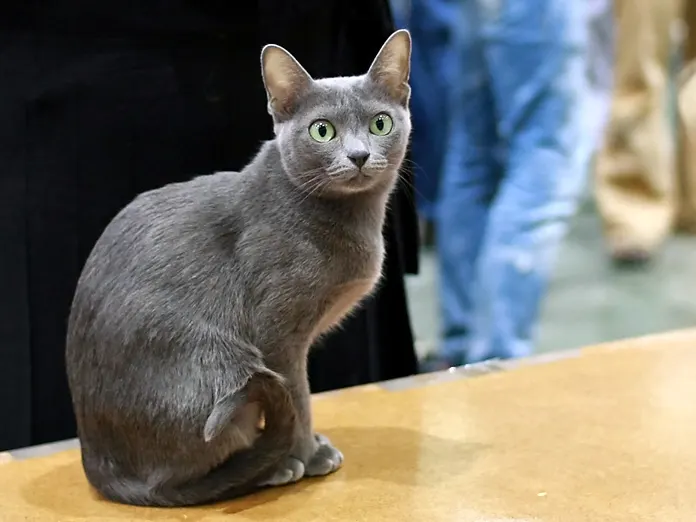
Figure: A Korat sitting at a cat show; green eyes and silver-blue short coat are both visible. Source: heikkisiltala, Wikimedia Commons. License: CC BY-SA 3.0. Changes: converted to WebP and width-limited only.

The eyes are large and luminous; the standard calls them “oversized” relative to the face. In adults, luminous green is preferred; amber is acceptable. Kittens and young cats often have yellow or amber-green eyes that usually settle to the final green only at maturity, around 2 to 4 years.[1] So a yellow-eyed Korat kitten does not mean it is “impure.”
The body is medium, muscled, and heavier than it looks. Adult males at or above 10 pounds (about 4.5 kg) are not rare; females are usually smaller. The coat is a single layer of short hair, close-lying and glossy; the hair along the spine naturally parts as the cat moves.[1]
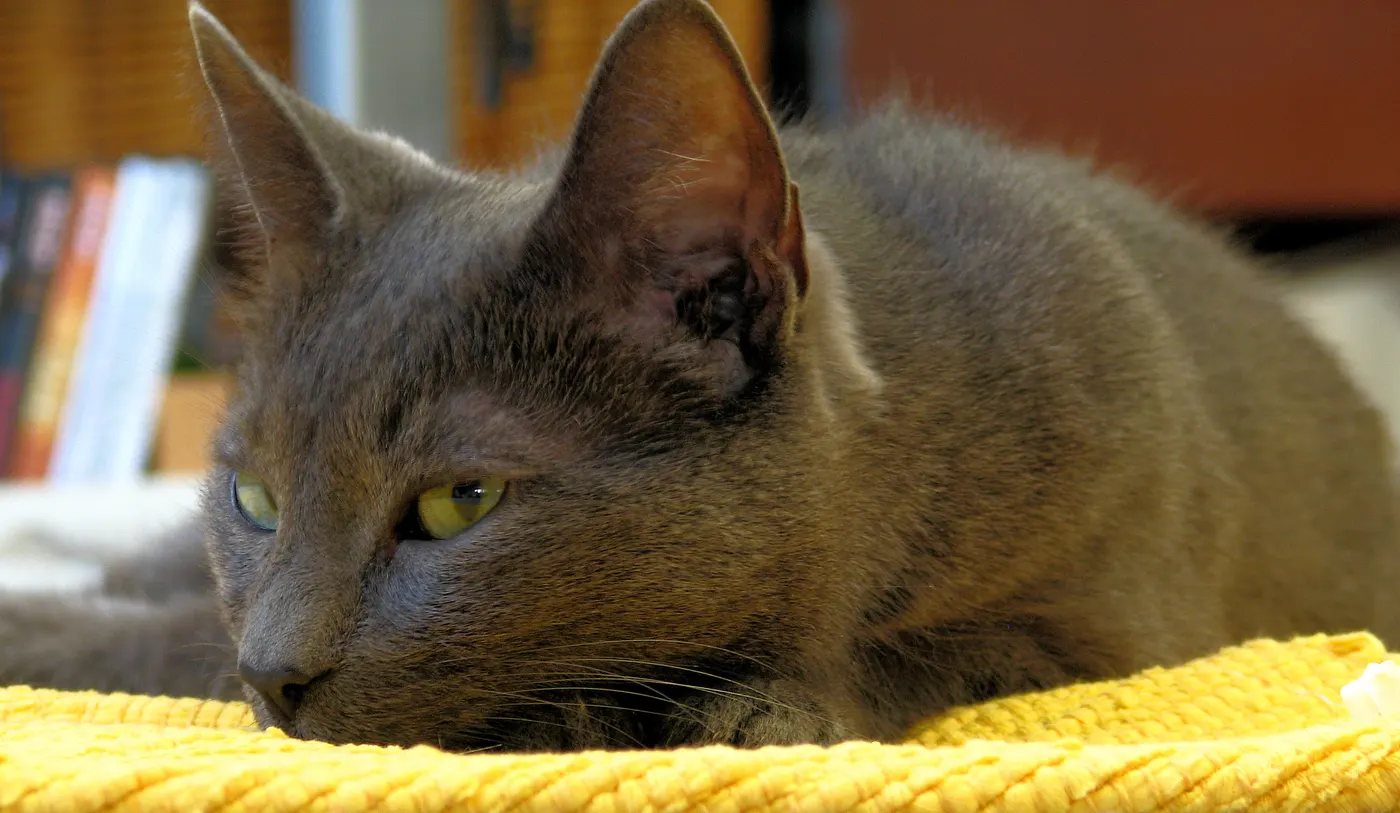
Figure: A Korat lying on its side; the close-lying short coat and large ears show clearly, eyes leaning yellow-green. Source: Goele, Wikimedia Commons. License: CC BY-SA 3.0. Changes: converted to WebP and width-limited only.

Temperament: smart, and they want company
CFA describes the Korat as very intelligent and able to learn small tricks—if it chooses to. It wants stimulation; interactive toys, puzzle feeders, and treats keep it engaged. It bonds tightly with its people, likes to join in everything at home, and uses a range of vocalizations to make demands.[1]
It is energetic without being over-the-top and usually gets along with other pets. CFA especially notes: when a new pet arrives, keep giving the Korat enough attention so its “head of household” status is not challenged and jealousy does not set in.[1]
Everyday care
Korats need little grooming. The single coat sheds little; a weekly brush is enough and also builds the bond. Nail trims, tooth brushing, and ear cleaning should be done on the same schedule as for other cats.[1]
CFA notes that Korat hair does not float easily when stroked, so occasional guests who are cat-allergic may meet somewhat less airborne allergen—but that does not make the Korat a hypoallergenic breed.[1] If someone in the household is allergic to cats, test real contact several times before deciding.
Genetic diseases to ask about when choosing a cat
CFA considers the Korat, as a natural breed, generally quite healthy and advises asking breeders for vaccine and other health records before purchase.[1] Veterinary literature, meanwhile, records two fatal inherited neuropathies in Korats:
- GM2 gangliosidosis: In 1994, researchers at Oregon Health Sciences University identified a single-base deletion in the HEXB gene in Korats that causes premature termination, and detected the difference molecularly in affected and normal cats.[2]
- GM1 gangliosidosis: In 1998 an Italian report described a Korat with onset at 7 months, slowly progressive neurologic signs, very low β-galactosidase activity, and euthanasia at the owner’s request at 21 months.[3] Later work found the same GLB1 mutation (c.1448G>C) in Korats and Siamese in Europe and North America, and homozygous genotypes in two local kittens with neurologic signs in Bangladesh, suggesting the mutation arose in local cats of the Siamese region and spread with breeds such as Korat and Siamese.[4]
Both diseases are lysosomal storage disorders in which metabolites accumulate in nerve cells.[3][4] For cat owners, the practical step when choosing a cat is to ask the breeder directly whether the parents were tested for both diseases and what the results were.
References
- The Cat Fanciers' Association. Korat. Accessed 2026-11-13.
- Muldoon LL, Neuwelt EA, Pagel MA, Weiss DL. Characterization of the molecular defect in a feline model for type II GM2-gangliosidosis (Sandhoff disease). American Journal of Pathology. 1994;144(5):1109-1118.
- De Maria R, Divari S, Bo S, et al. Beta-galactosidase deficiency in a Korat cat: a new form of feline GM1-gangliosidosis. Acta Neuropathologica. 1998;96(3):307-314.
- Uddin MM, Hossain MA, Rahman MM, et al. Identification of Bangladeshi domestic cats with GM1 gangliosidosis caused by the c.1448G>C mutation of the feline GLB1 gene: case study. Journal of Veterinary Medical Science. 2013;75(3):395-397.