When you bring home a European Burmese, two records are worth keeping together. The first is the cat’s registration paperwork. Read the breed name alongside the name of the registry to understand which branch of the Burmese family it describes. The second is the genetic test report for Burmese hypokalemia. Before you read the result, check whose name is on the report: the kitten’s, its sire’s or its dam’s. A sturdy cat with a lively step can carry one copy of the variant.[1][5]
The Burmese line developed in Britain
“European” refers to a later chapter in the breed’s history. Both the European and American lines trace their ancestry to Wong Mau, a female cat Joseph Thompson brought to the United States in 1930. Dark brown cats among her descendants became the foundation of the American Burmese breeding program. Beginning in 1949, Burmese bred in the United States were brought to Britain, where brown was the first color to gain recognition. A blue kitten was born in a British litter in 1955, and blue gained recognition in 1960. The color range gradually expanded to include red, cream and tortoiseshell.[1][2]
That history helps explain why registration papers can look different. In the United States, the Cat Fanciers’ Association (CFA) lists Burmese and European Burmese as separate breeds. The CFA recognizes four show colors for the Burmese and ten for the European Burmese. It accepted the European Burmese for registration in 1993 and granted it championship status in 2002. In Britain, the Governing Council of the Cat Fancy (GCCF) lists ten colors under the breed name Burmese. A cream cat registered with the GCCF can therefore have papers that simply say “Burmese.”[1][2]
The World Cat Federation’s 2019 standard uses the name European Burmese and the code BUR. Its color table also includes silver and smoke. When comparing records, keep the registry, full breed name and coat color together. Our guide to Burmese origins, features and care describes the American-developed Burmese with its rounded head and eyes. To see what distinguishes the European standard, follow the outline of the cheeks toward the muzzle.[1][3][6]
How the cheeks form a short wedge
In Elsa’s portrait, trace the line from each cheekbone toward her nose. Her face is widest across the cheeks and tapers gradually, leaving some width at the muzzle. That outline gives the head the shape of a short, blunt wedge. Now look at the eyes. They are set well apart, with upper lids that slope toward the nose and lower lids that form a rounder curve. The spacing and the two different curves give the expression described in the breed standard much of its character.[1][3]
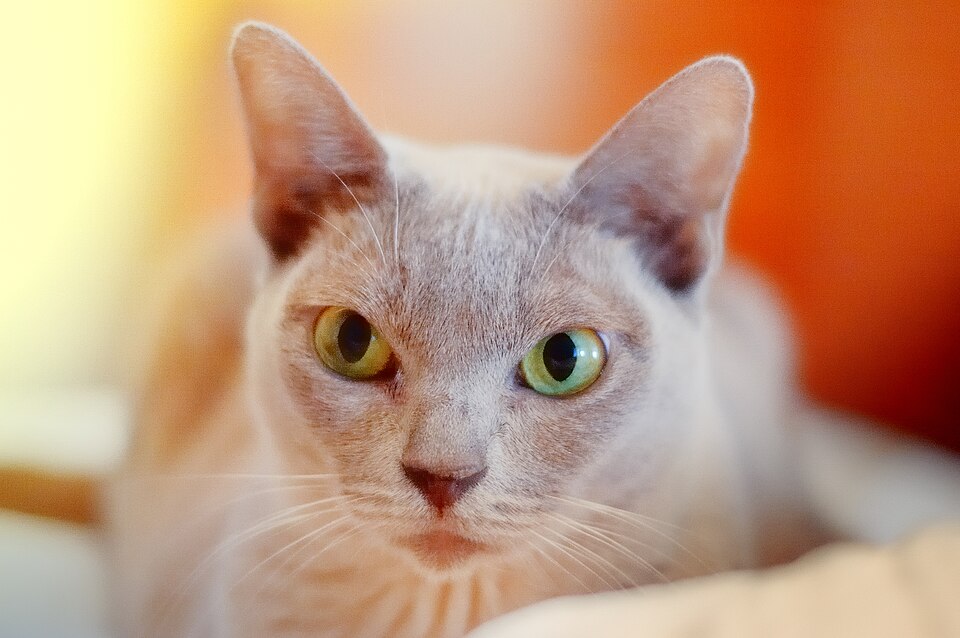
Elsa’s face forms a short wedge. Mikael Moiner, Wikimedia Commons

The photographer identifies Elsa’s coat as lilac. In the breed standard, lilac is a pale dove gray with a pinkish cast. On the cat sitting in the sink, notice how the face, ears and paws are darker than the chest. The CFA standard allows some variation in shading at the extremities, and the underside can be lighter than the back. Kittens may have paler bodies and faint tabby markings. To keep a record of a kitten’s color, take a photograph in natural light that shows the face, back and legs together. A close-up of one ear misses those differences in shade.[1][2]
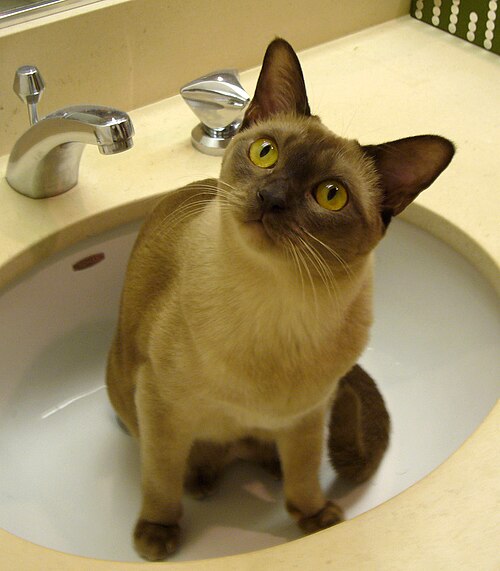
The face is darker than the chest. asi02, Wikimedia Commons[8]

The European Burmese is medium in size and body length, with slender legs and small, oval paws beneath a well-muscled body. The coat is very short and fine, lies close to the skin and has little undercoat. As Felicia lies on her side, the outline of her shoulders and back is easy to see through the fur. An occasional gentle pass with a rubber brush in the direction the coat grows will lift loose hairs. A family pet generally has no need for routine baths.[1][3]
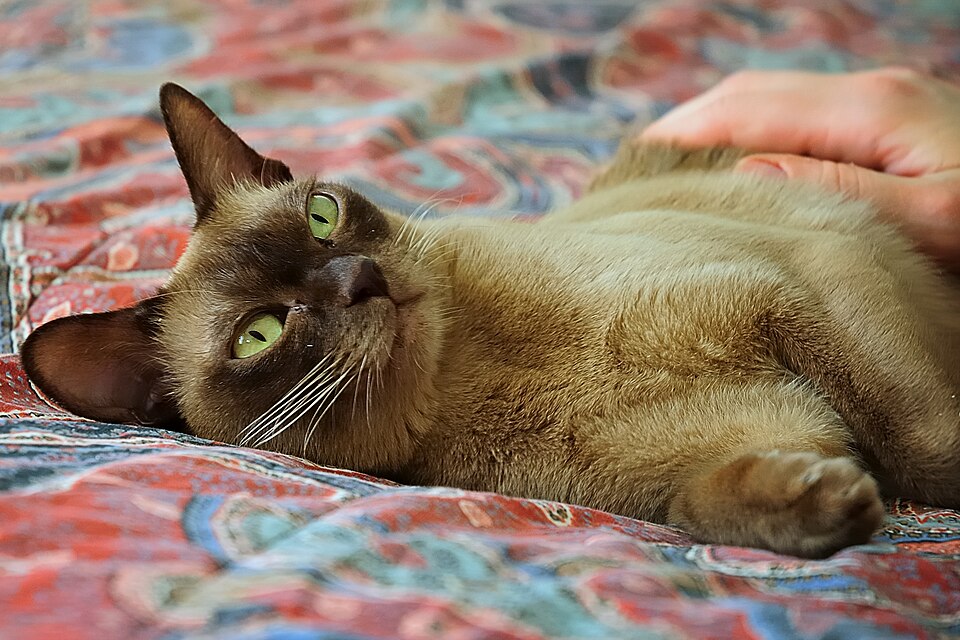
Felicia’s short coat lies close to her body. Mikael Moiner, Wikimedia Commons

Let the cat decide when to join in
The CFA describes European Burmese as playful cats that often follow people around and seek out their company. Set aside a fairly regular time when someone in the household is free to play. Draw a wand toy along the floor past a cardboard box the cat can watch from behind. Pause to give the cat time to crouch, chase and catch it. When the cat looks toward the toy again, set it moving. If the cat comes over and settles beside you, quiet company can be how the session ends.[1][4]
Start at the cat’s favorite resting place and walk the routes to water, food and the litter box. In a home with several cats, two full bowls side by side may still leave both cats squeezing through the same doorway at every meal. Spread feeding places, water sources and litter boxes around the home, and give each cat a safe place to spend time alone. When a cat goes back to a familiar resting spot, let it settle. That gives each cat room to seek company, chase a toy or rest undisturbed.[4]
The three results on a Burmese hypokalemia report
The Veterinary Genetics Laboratory at the University of California, Davis, offers a Burmese Hypokalemia test for European Burmese. It looks for a variant in the WNK4 gene. Once you have identified the cat tested, read the laboratory’s result. N/N means the test found no copies of this variant. N/BHK means the cat carries one copy and can pass it to offspring. A carrier does not develop this recessive disorder from that single copy. BHK/BHK means the cat has two copies, the affected genotype. If you have the parents’ reports, read both. When both parents are carriers, each kitten can inherit two copies. The parents’ results alone cannot tell you which kittens have inherited them.[5]
At home, get to know how your cat usually holds its head and walks. This inherited disorder can cause episodes of muscle weakness, often most noticeable in the neck, though sometimes the limbs are chiefly affected. If your cat is awake and suddenly struggles to lift its head to its usual position or seems weak when walking, contact a veterinarian promptly. Describe when the change began and how long it lasted, and bring the genetic report if you have it. The report tells the veterinarian which copies of the variant the cat inherited. A blood test measures the cat’s potassium level at the time of the episode and helps the veterinarian decide whether potassium supplementation is needed and how to give it.[5]
References
-
[1] The Cat Fanciers’ Association. European Burmese.
-
[2] The Governing Council of the Cat Fancy. Burmese.
-
[3] World Cat Federation. European Burmese (BUR). July 1, 2019.
-
[4] Feline Veterinary Medical Association. New Feline Veterinary Medical Association Position Statement Reimagines Life for Indoor Cats. August 28, 2025.
-
[5] University of California, Davis, Veterinary Genetics Laboratory. Burmese Hypokalemia.
-
[6] 小猪萌宠. 每日一猫. October 28, 2026 entry, “缅甸猫:起源、特征与饲养要点.”

