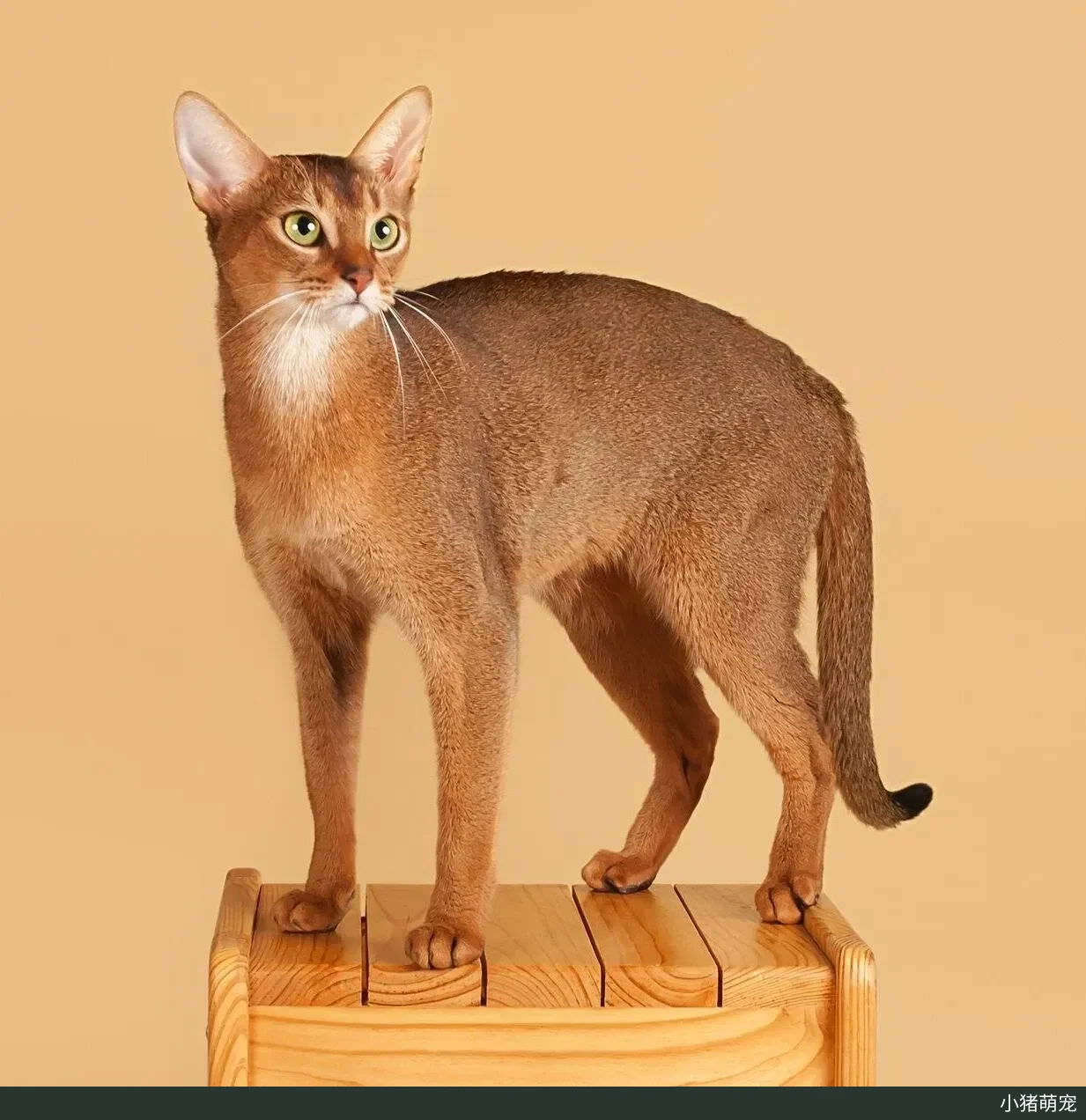
Ruddy is the most common Abyssinian coat color; the tip of the tail is black. Figure: Oleg Royko, source Wikimedia Commons, license CC BY-SA 4.0 (Commons cropped version).
The Abyssinian (often shortened to “Aby”) is best known for its “ticked” coat: each hair shows alternating bands of light and dark, so the whole cat looks warm and luminous. The name points to the former name of Ethiopia, yet genetic research suggests its ancestors more likely came from Asian and European cats. Abys are curious, active, and drawn to high places; they are affectionate but rarely sit long on a lap. Health concerns to watch include pyruvate kinase deficiency, progressive retinal atrophy, and renal amyloidosis.
Name and documented history
“Abyssinia” is the former name of Ethiopia, but CFA (the Cat Fanciers’ Association) stresses that the name only means the earliest Abys shown in Britain were said to have been brought back from Ethiopia—it does not mean the breed originated in Africa. Because they resemble cats in ancient Egyptian murals and sculptures, folk tales have long cast them as “cats from the Blue Nile” or descendants of Egyptian sacred cats; TICA (The International Cat Association) calls such stories romantic legends and notes that the breed’s true ancestors can no longer be traced.
The early individual most often named is Zula. TICA notes a claim that a British soldier brought this cat to Britain at the end of the Abyssinian War in 1868; CFA records Zula as the first Aby shown at a cat show, in 1871 at the Crystal Palace in Britain. TICA also cautions that no documents yet link Zula to today’s Abyssinians. Zula is better seen as an early documented show cat than as a proven breed founder.
Genetic research offers another thread. A 2008 study in Genomics analyzed multiple breeds and random-bred cats worldwide and found that both Abyssinians and Japanese Bobtails carry markers common in Southeast Asian and Western breeds, showing that Asian and European cats were used in developing both; in the study’s correspondence analysis, Abyssinians sat with Sri Lankan cats between European and Asian clusters. CFA summarizes such work as an origin along the Indian Ocean coast and Southeast Asia; TICA’s wording is that cats from the Bay of Bengal region may be ancestors. The phrasing differs, but both point to Asia—not Ethiopia or ancient Egypt.
What is clearer is that the breed was fixed in Britain. Per TICA, Abys reached the United States in the early twentieth century, first shown there in 1909, with systematic breeding from the 1930s; CFA records the breed among the earliest registered with CFA in 1906. There is also a scientific footnote: the first draft of the domestic cat genome, published in 2007 (about 1.9× coverage), was sequenced from an inbred Abyssinian female named Cinnamon who lived at the University of Missouri.
Ticked coat, colors, and type
The Aby’s “ticked” coat is genetically a form of agouti: each hair from root to tip is made of alternating dark and light bands. TICA describes 4–6 bands per hair, somewhat like rabbit fur. CFA’s breed standard requires coat long enough for two or three dark bands, with the darkest color at the tip and a clear undercoat next to the skin. The coat feels soft yet springy; TICA notes that after stroking against the grain, the coat springs back into place.
The often-mentioned “warm body color” matches CFA’s demand for a coat that is warm and glowing. Cold or gray tones are penalized; blue and fawn cats with a white undercoat are also penalized; barring on the legs, rings on the tail, and broken dark “necklace” markings are likewise undesirable. White is allowed only on the nostrils, chin, and upper throat; white elsewhere means disqualification. The face calls for “eyeliner”: a fine dark line around the eyes, with a lighter band outside it.
Color recognition differs between the associations. CFA accepts only four: the most common ruddy (burnt-sienna brown with black ticking), cinnamon (warm red with chocolate ticking; CFA past award records also write Red), blue (warm beige with slate-blue ticking), and fawn (rose-beige with light cocoa ticking), with gold or green eyes. TICA divides traditional and silver groups: traditional includes ruddy, cinnamon, chocolate, blue, fawn, and lilac; silver is the silver version of each of those six.
In type, Abys are medium-sized: they look slender, yet feel heavier than expected when held. TICA’s reference weights are about 6–9 lb (about 2.7–4.1 kg) for adult females and about 7–12 lb (about 3.2–5.4 kg) for adult males. Limbs are long, paws small and oval; CFA’s standard describes them as standing as if on tiptoe.
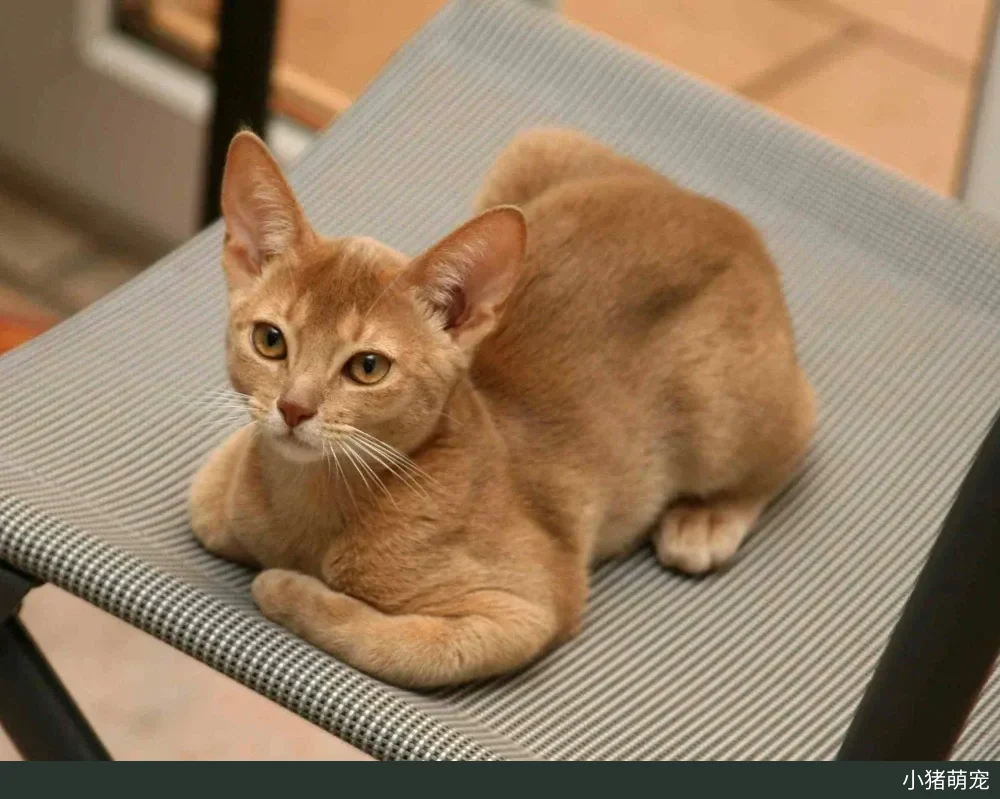
A fawn Aby kitten; fawn is one of the four colors CFA recognizes. Figure: Joachim Berger-Uelsberg, Gabriele Uelsberg, source Wikimedia Commons, license CC BY-SA 3.0.
Temperament and activity needs
CFA describes Abys as busy, active, self-directed yet people-oriented. They are curious about everything in their environment and, aside from sleep, almost always in motion; if toys run short, they “invent” their own. TICA rates their activity as extremely high and half-jokingly warns: if a cat perched on a ceiling fan would drive you crazy, this breed may not be for you.
Abys are affectionate but are not really “lap cats”: they seek attention, may tap you gently with a paw if ignored, then trot off to patrol elsewhere. They are not very vocal and prefer to express needs through action. CFA notes they dislike long stretches alone; in a quiet home, keeping two can help. TICA adds that in multi-cat homes where attention must be shared, Abys are not always happy.
Day to day, three things help. First, give vertical space: both associations say Abys favor height—cat trees, wall shelves, or safe cabinet tops all work. Second, give them something to watch: TICA suggests a view of a bird feeder or other moving targets through a window. Third, schedule daily interactive “hunt” play, such as chasing a wand toy. CFA also notes that well-socialized Abys can handle change, and some even enjoy leash walks; if you try that, let them adapt slowly to a harness at home first.
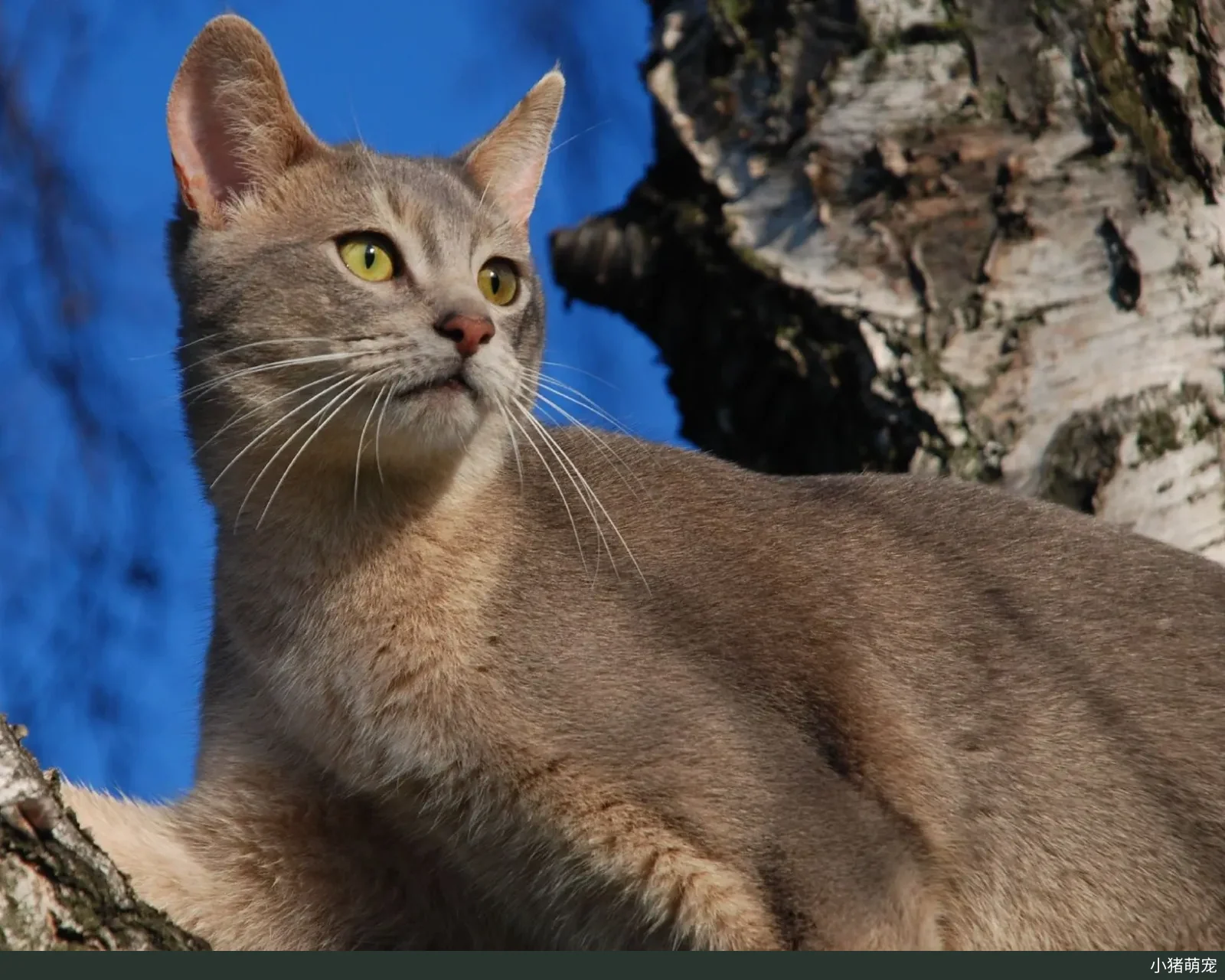
A blue Aby looking out from a tree. Figure: polandeze (Flickr), source Wikimedia Commons, license CC BY 2.0.
Daily care and inherited disease
Abys are shorthaired, shed modestly, and are easy to groom. CFA suggests several brushings a month to manage shedding, and wiping with a chamois can add shine; baths are usually unnecessary unless showing. TICA suggests trimming nails about every two weeks and brushing teeth from an early age with vet-approved pet toothpaste; CFA also notes that some breeders teach new owners to brush teeth to help prevent gingivitis and other oral problems.
On health, the first condition to know is erythrocyte pyruvate kinase (PK) deficiency. Per the UC Davis Veterinary Genetics Laboratory (VGL), this is an autosomal recessive hemolytic anemia: low activity of this key enzyme makes red cells unstable and easily lost. Anemia is intermittent; age of onset and signs vary and may include severe lethargy, weakness, weight loss, jaundice, and a swollen abdomen. Test results fall into three classes: N/N is clear and does not pass the mutation; N/K is a carrier that does not itself become ill; K/K is affected, but severity cannot be predicted. For example, two healthy-looking carriers mated average one affected kitten in four—exactly why testing before breeding matters. CFA also notes that with genetic testing, breeders can now remove carriers of this once anemia-causing trait from breeding programs.
Second is progressive retinal atrophy (PRA); two forms are known in Abys. The more often mentioned rdAc type involves a CEP290 mutation and is likewise recessive: affected cats are born with normal vision, degeneration can be detected by electroretinogram around 7 months of age, vision then declines slowly, and most are blind by 3–5 years; there is no treatment. The Rdy type involves a CRX mutation and is dominant—one mutant copy is enough—and blindness appears by about 7 weeks; VGL notes this mutation is rare and so far known only in Abyssinians and Somalis.
Third is familial renal amyloidosis. A 1984 pathology report found amyloid A protein deposited in the renal medulla and glomeruli, with papillary necrosis and other lesions, in eight related adult Abys from two catteries, progressing to chronic kidney disease. The difficulty is that there is no genetic test, and ante-mortem diagnosis is hard; confirmation is often only at necropsy. A 2015 follow-up of 23 Abys found that serum amyloid A and the urine protein/creatinine ratio helped with earlier detection; elevated urinary amyloid A may appear before clinical signs, but the sample was small and this is not yet a routine screen. Researchers hold that the only prevention so far is not breeding cats with a family history.
TICA also lists patellar luxation (the kneecap slipping out of place) as higher risk in Abys. Practical advice for new owners: before adopting or buying, ask the breeder for proof of PK-deficiency and PRA genetic testing—TICA states this clearly as well. If a cat seems dull, skin or sclera turn yellow, drinking and urination rise markedly, appetite and weight fall, or vision seems worse, see a veterinarian promptly. This article is for general information only; diagnosis and treatment should follow veterinary advice.
References
-
The Cat Fanciers' Association (CFA). Abyssinian (breed profile and standard). Accessed 2026-10-23.
-
The International Cat Association (TICA). Abyssinian (breed profile). Accessed 2026-10-23.
-
Lipinski MJ, et al. (2008). The ascent of cat breeds: Genetic evaluations of breeds and worldwide random-bred populations. Genomics, 91(1), 12–21.
-
Pontius JU, et al. (2007). Initial sequence and comparative analysis of the cat genome. Genome Research, 17(11), 1675–1689.
-
UC Davis Veterinary Genetics Laboratory. Erythrocyte Pyruvate Kinase Deficiency (PK Deficiency). Accessed 2026-10-23.
-
UC Davis Veterinary Genetics Laboratory. Progressive Retinal Atrophy (PRA rdAc) (Abyssinian). Accessed 2026-10-23.
-
UC Davis Veterinary Genetics Laboratory. Progressive Retinal Atrophy (PRA Rdy) (Abyssinian). Accessed 2026-10-23.
-
Boyce JT, DiBartola SP, Chew DJ, Gasper PW. (1984). Familial renal amyloidosis in Abyssinian cats. Veterinary Pathology, 21, 33–38.
-
Paltrinieri S, et al. (2015). Changes in Serum and Urine SAA Concentrations and Qualitative and Quantitative Proteinuria in Abyssinian Cats with Familial Amyloidosis: A Five-year Longitudinal Study (2009–2014). Journal of Veterinary Internal Medicine.
-
Science for Animal Welfare. Abyssinian: Amyloidosis. Accessed 2026-10-23.
-
小猪萌宠 · Welcome to my pet planet