An Australian Terrier once earned its keep by noticing a rustle in the grass before anyone else did. In the nineteenth century, British settlers brought several kinds of working terrier to Australia. From them, people bred a small dog that could catch small mammals and tackle snakes. These terriers worked alongside people and kept them company at isolated homesteads. Both parts of that history show up on an ordinary day with one today. The dog may be eager for you to join a game, yet the moment a cat runs past on a walk, it may forget all about you.[1]
In the full-length photograph, follow the level line of the back from shoulder to rump. An Australian Terrier stands about 10 to 11 inches (25 to 28 cm) at the shoulder. Its body is slightly longer than it is tall, and it stands firmly on its feet. Below the red collar, a ruff falls along the neck and onto the chest. Above it are small, upright ears and a soft, silky topknot. The outer coat on the body feels much harsher. Look for that same outline and topknot across the breed’s colors, which include blue and tan, solid sandy, and solid red.[1]
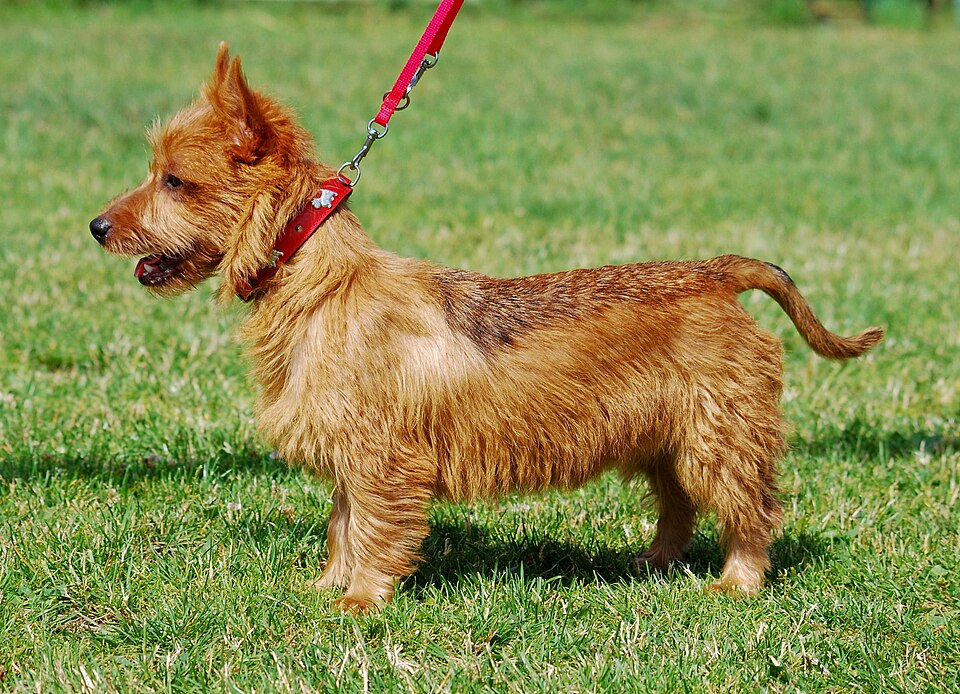
The side view shows the Australian Terrier’s outline. Lilly M, Wikimedia Commons[3]

Where can an Australian Terrier play chase?
Start by picking out the routes where you’ll walk on leash and the places where the dog can run free. An Australian Terrier can be after a moving animal in an instant and well into unfamiliar territory before it gives up the chase. Keep hold of the leash on neighborhood streets and country trails alike. At a park, look beyond the stretch of grass you can see. Where does that path at the far edge lead? It may take only a turn for the dog to disappear from view. Save off-leash running for a securely fenced space with the gate closed.[1]
In a fenced yard, roll a toy along the ground for the terrier to chase. When the dog turns back toward you with it, start another round. The dog gets a short run and a reason to keep track of where you are. A household without a yard can clear a short stretch of floor for the same game indoors and still head outside for the usual leashed walk. The American Kennel Club (AKC) recommends daily play. The real question when you pick up a toy is who will have time to play with it on an ordinary workday.[1]
Try planning for your busiest weekday. Who can take the dog out in the morning? Who has time for a game in the evening? Where could you play on a rainy day? Naming a person and a place for each activity tells you more than a promise of a long walk on the weekend. Let this particular dog’s age, stride, and enthusiasm guide the length of an outing. Notice how far it walks with an easy step and when it starts to pause between rounds of a game. Use that to plan the next outing. Australian Terriers enjoy company. Even with a yard, someone needs to step outside and play.[1]
Make turning back to you part of the game
Australian Terriers learn quickly and can tire just as quickly of repeating an exercise. Start at a quiet moment indoors with one simple response. Say the dog’s name once. As soon as it turns to look at you, praise it or offer the toy in your hand. Stop after a few turns. Next time, try it in the fenced yard while you’re still holding the toy. Changing one thing at a time makes it easier to tell whether the dog is still learning what its name means in this game or is already intent on where the toy will roll.[1]
If several people walk the dog, agree on the word you’ll use and the response you’ll reward. One person may offer the toy and another a word of praise. What matters is that both respond promptly when the dog turns. If you use food, set aside a small share of the day’s allowance for training before you leave. That makes it easier to keep track when different people take turns. Once the dog knows the game indoors, practice on walks with the leash still in hand. A small animal darting across the path is much harder to look away from than a familiar toy.[1]
If you already have animals, think through which doors will be open and where each pet will spend time. Small pets need a separate space with a door that closes securely, well away from the terrier’s route after a toy. If you have another dog, make room for each to rest separately and for someone to be present when they meet. If you’re considering an adult Australian Terrier, ask its caregiver specific questions. What does this dog do when it sees a cat on a leashed walk? How does it behave around other dogs? Those observations help you work out what your household will need to arrange.[1]
Check the hair around the eyes at each weekly brushing
In the seated dog’s profile, the dark outer coat lies over the back, while longer hair hangs below the neck and over the chest. The Australian Terrier has a double coat. Its harsh outer layer helps keep mud out and sheds dirt readily. A weekly brushing is usually enough. After a walk, see where the mud has stuck and clean that patch if you can. Give the dog a full bath when it needs one. Frequent shampooing can soften the outer coat and leave the skin dry and flaky. Brushing is the job worth giving a regular place on the calendar.[1]
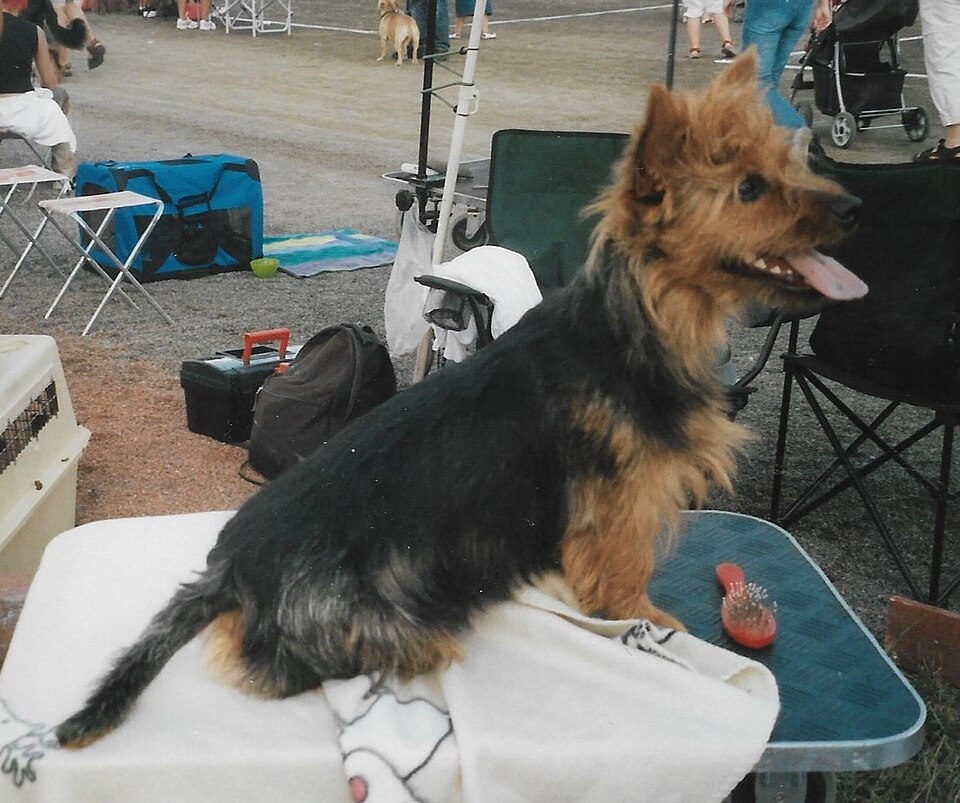
The Australian Terrier’s ruff extends onto the chest. Canarian, Wikimedia Commons[4]

After brushing the back, get down to the dog’s level and look at its face. In the photograph, Melly faces the camera. The pale hair between her ears parts to either side, and you can see the finer strands in front of her eyes. Pay attention to that small patch in front of and between the eyes. If strands grow long enough to touch an eye, a groomer familiar with the breed can tidy them. Brushing time is also a chance to part the coat for a look at the skin and check the ears and nails. Keep up with flea prevention and regular toothbrushing. If the dog keeps scratching the same spot, have a veterinarian examine it.[1]
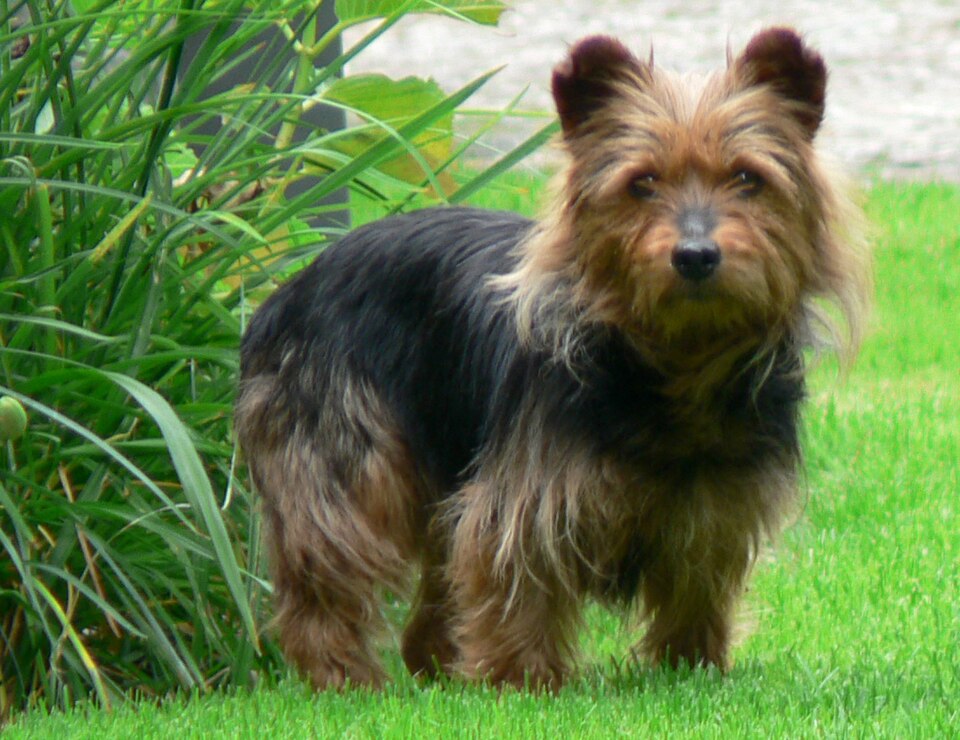
Melly’s topknot parts above the eyes. Ketterechts, Wikimedia Commons[5]

The person who rolls the toy is also well placed to notice a change in the dog’s stride. Health concerns in Australian Terriers include patellar luxation, in which the kneecap slips out of place, and Legg-Calvé-Perthes disease, a condition of the hip that can cause pain and lameness in young dogs. If the dog repeatedly lifts a hind leg, skips a few steps, and puts it down again, or if a limp persists, put the toy away. Note which leg was affected and when it happened, and contact a veterinarian for an examination. Before bringing home a puppy, ask the breeder about the parents’ patella, eye, and thyroid evaluations. For a dog limping during a game today, its own stride and the veterinarian’s findings should guide its return to play.[1][2]
References
-
[1] American Kennel Club. Australian Terrier Dog Breed Information.
-
[2] American College of Veterinary Surgeons. Patellar Luxation.