On an Irish farm, an Irish Terrier might catch rats, guard livestock and go out hunting. The work called for a dog that could cover ground and make its own decisions when something stirred. By the 1870s, the breed had begun to take on its familiar shape, and the American Kennel Club (AKC) recognized it in 1885. You can still see that working heritage in the dog’s easy, long-legged stride and the wiry coat that lies close along its back in cold, wet weather.[1]
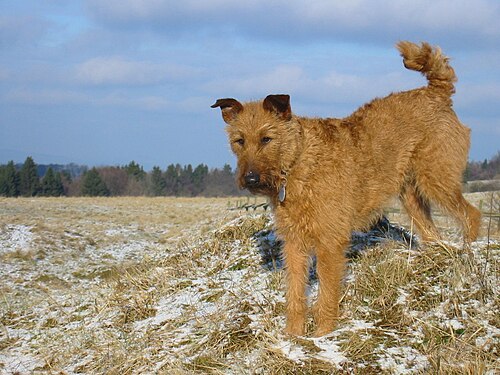
An Irish Terrier stands on a grassy slope. Achim Stelter (Batman1000), Wikimedia Commons[5]

Look first at the legs of the dog on the slope. A typical Irish Terrier stands about 18 inches (46 cm) at the shoulder, with a deep chest and a body slightly longer than it is tall. The forelegs drop straight from the shoulders. A firm back and those long legs give the dog its light, athletic outline. The head is long and narrow, with small ears that fold forward and a wiry beard on either side of the muzzle. Those proportions are a good guide to recognizing the breed, whose coat can range from red to wheaten.[1][2]
Give your Irish Terrier a job on walks
Irish Terriers enjoy running and chasing. In a securely fenced yard, a game with a thrown toy gives the dog room to stretch out. Beyond the fence, keep the leash on, especially where birds or small animals are close to the path. For households without a yard, the AKC suggests several leashed walks spread through the day. Picture an ordinary workday in your household. Who has time for a morning walk? Who can take the dog out again during the day? Who will still want to play after dinner?[1][2]
Each outing can offer something different. On the morning walk, leave time to sniff along the verge. In the evening, choose a quiet stretch of pavement to practise changing direction together. Say the dog’s name while you still have its attention. As soon as it looks back, offer a small treat and set off together in a new direction. With practice, the dog has a familiar response to draw on when something more interesting appears. If it is already staring ahead with the leash pulled tight, move farther from the distraction and try again where it can respond. Leave time to walk at a good pace, too.[1][2]
Irish Terriers learn quickly and have minds of their own. Start with a small routine on the first day home, while everyone has time to teach it. At the front door, for instance, clip on the leash and wait for all four paws to reach the floor before opening it. The next person who takes the dog out follows the same rule. Once a cue is familiar, the reward can be something the dog already wants, such as permission to go sniff a tree. If you enjoy learning together, obedience or rally training offers more to try. In rally, you follow signs around a course, turning and stopping together as the dog learns to match its pace to yours.[1][2]
If a cat or another dog already lives with you, think about where each animal will spend its time. An Irish Terrier can be affectionate with family, quick to chase a running animal and selective about unfamiliar dogs. Before bringing an adult terrier home, ask which animals it has lived with and what it usually does when it meets a dog on a walk. Can your cat reach a resting place the terrier cannot enter? Is there a walking route where the dog can get exercise without passing through a crowd of other dogs? The answers tell you more about everyday life together than the distance to the nearest dog park.[2]
What keeps the coat wiry?
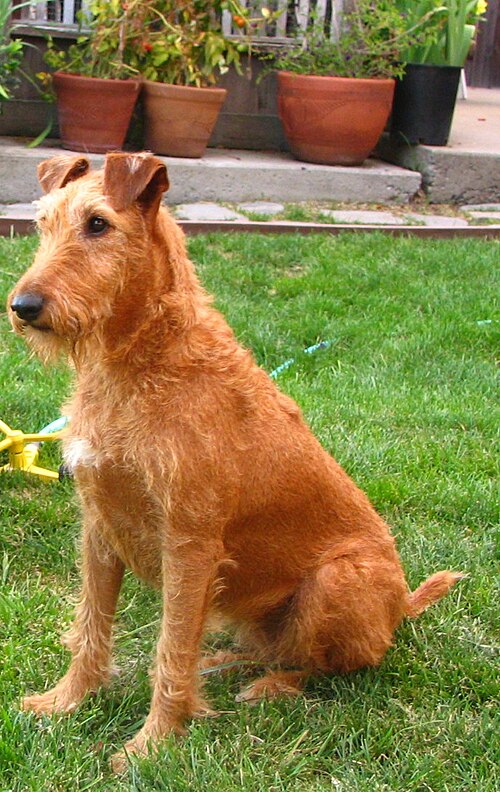
The coat lies close along the flanks. Dan Carmell, Wikimedia Commons[6]

On the terrier sitting on the lawn, the hair follows the shape of the flanks but stands out a little on the chest and legs. Part a typical Irish Terrier’s coat with your fingers and you can feel its two layers. The dense, wiry outer hairs feel harsh to the touch and help shed water. Underneath lies a finer, softer coat that helps keep the dog warm in damp, cold weather. If you like taking a dog across wet grass, that harsh outer layer along the back serves a practical purpose.[1][3]
After a run through the grass, check the beard and leg hair for bits of vegetation and gently tease apart any tangles. Once a week, set aside time to brush from head to tail to lift out loose hair and dirt. With a young puppy, start with a few strokes during a break in play. Gently handle an ear or a paw, then finish while the pup is relaxed. The same familiar touch will serve you later when you brush the coat, dry wet feet or take a closer look at a pad.[1][3]
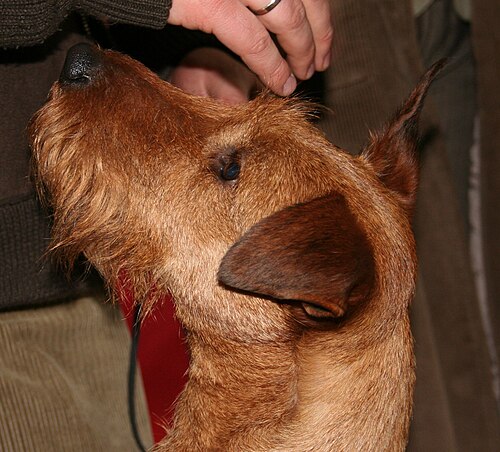
Wiry hair frames the Irish Terrier’s muzzle. Pleple2000, Wikimedia Commons[7]

A comb deals with debris from a walk. Older outer hairs need different attention once they loosen. To keep the wiry texture, ask a groomer experienced with terriers to demonstrate hand-stripping. The groomer selects loose, mature hairs and draws out a few at a time in their direction of growth, leaving the growing wiry hairs in place. Clippers cut the outer hairs short, giving a tidy outline that can feel softer. When booking, describe the texture you want to keep. Ask what the groomer will do at this visit and how to brush the coat between appointments.[1][2][3]
For a family companion, the North of England Irish Terrier Club gives spring and autumn as a possible schedule for hand-stripping. At the first appointment, ask the groomer to part the coat over the shoulders and back and show you which hairs are ready to come out and which should stay. How your dog’s coat grows will help you plan the next visit. Before taking on an Irish Terrier, include that time and skilled work in the household budget. A glance at the short coat gives little hint of either.[3]
Check the pads as you dry the paws
As you lift each paw to wipe away mud, look for pads that keep thickening or hardening, or cracks that repeatedly open. Irish Terriers can inherit a condition called footpad hyperkeratosis, which can cause thick calluses and painful splits. If the dog avoids putting weight on one foot or a crack is painful to the touch, set running and jumping aside and have a veterinarian examine the paw. Tell the vet when you first noticed the change and which feet are affected.[1][4]
When considering a puppy, ask the breeder for both parents’ genetic test records for footpad hyperkeratosis. Ask, too, about any family history of urinary stones associated with cystinuria. At home, someone will need to trim overgrown nails, check the ears and brush the dog’s teeth with canine toothpaste. A good way to picture whether an Irish Terrier fits your family is to imagine the whole walk, right through to its end. Who would enjoy running and practising turns with this dog, then sitting down at home to take a grass-flecked paw in hand?[1][4]
References
-
[1] American Kennel Club. Irish Terrier.
-
[2] LifeLearn. Irish Terrier. VCA Animal Hospitals, 2014.
-
[3] The North of England Irish Terrier Club. Grooming your Irish Terrier.
-
[4] Ian MacDonald. Health Statement for the Irish Terrier Club of America (ITCA). July 5, 2017.