The World Cat Federation (WCF) lists the Savannah under the breed code SAV. Descended from crosses between domestic cats and the African serval, the Savannah is smaller than the serval but shares its tall silhouette. Seen from the side, the cat described in the standard has a long torso, a deep rib cage and prominent shoulder blades. Its hind legs are slightly longer than its front legs. From the front, the head looks small for the body. Two large ears stand high and upright, broad at the base and rounded at the tips. Follow the brow line and the jaw down to the muzzle and the face forms a triangle.[1]

Figure: The Savannah’s upright ears. Maxinjo, Wikimedia Commons[5]

Trace the markings from the back of the head. Nearly parallel stripes fan out a little over the shoulders, then solid dark brown to black spots follow their direction along the flanks. The spots can be round, oval or elongated. Smaller ones appear on the face and legs, and the belly is spotted too. The standard also lists black and black smoke coats. On a black cat, the spots may be only faintly visible. The coat is short and lies close, with slightly coarse guard hairs over a softer undercoat. To groom it, start where the cat accepts touch, brush gently with the coat and pause when the cat moves away.[1][4]
The Savannah’s ancestry matters when considering a home for one. WCF has a breed standard but excludes the F1 through F3 generations from its shows. The UK’s Governing Council of the Cat Fancy does not recognize the breed because of its wild-species ancestry and raises concerns about whether an average UK home can meet its needs.[1][2] Before taking in a Savannah, establish its generation from documented parentage. The darkness of the spots cannot tell you how far back the serval ancestor was. The cat’s pedigree and the rules where it will live, including after a move, matter when determining whether ownership is permitted or requires a licence.
At home, pick a perch the cat might use and follow the route up from the floor. If a low cabinet leads to a window, give the cabinet a push to check that it is steady. Look at how much of the top is available once a plant pot and other objects are in place. Picture a long-legged, deep-chested cat reaching the edge with its front paws. Where can its hind feet land? Once all four paws are up, can it turn around? Now trace the way down. A door that swings into the takeoff spot could leave the cat with nowhere clear to land.[1][3][4]
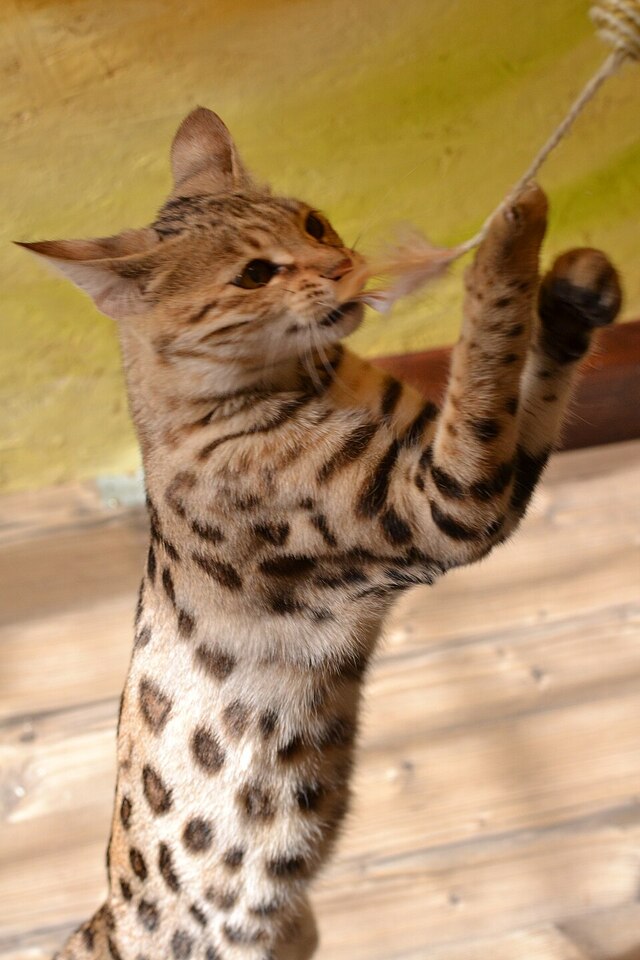
Figure: A Savannah’s outstretched forelegs. Savannah Clark, Wikimedia Commons[6]

Check the window in the position you normally leave it in for fresh air. From sill height, could a paw push the screen out of its frame? Does the open window leave a gap that narrows toward the bottom? A shelf beside it may also put an open balcony within reach. A perch at a fixed pane preserves the view. Where a window needs to open, an interior door can keep the cat clear while the room airs. The same idea works at the entrance. Choose a room the cat can settle in and close its door before opening the front door for a delivery.[3]
A cat on a high shelf may have gone there for peace. The Feline Veterinary Medical Association identifies safe resting places and access to resources in separate locations as basic needs for indoor cats.[3][4] Look out from a proposed bed. If someone stands in the passage, can the cat leave another way? This matters especially when cats share a home. Two cats may greet each other nose to nose and still need separate places to eat, drink and use a litter box. With two bowls beside one doorway, a single cat can block access to both. Separate the feeding spots and check the route to each from the cats’ beds.
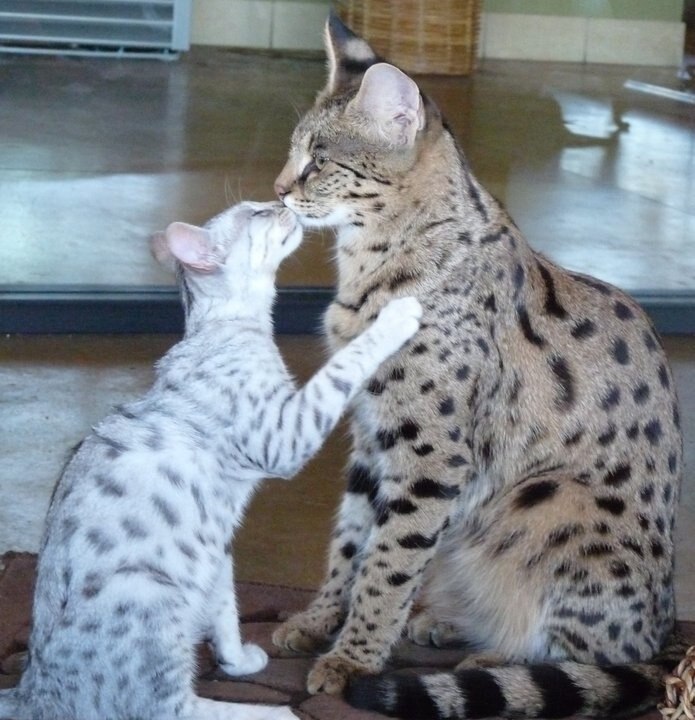
Figure: Spots along the Savannah’s flanks. Leekimbud, Wikimedia Commons[7]

A cardboard box on the floor can give a game a satisfying shape. Draw a wand toy along the ground until it disappears behind a corner of the box, then pause. The cat can circle round, crouch or pounce, and when it catches up, let it pin the toy with its paws. A cat that likes to stalk close to the floor can play the whole game there. Choose a stretch of clear floor away from glass, narrow ledges and another cat’s bed, so the chase has room to finish and a sleeping companion can stay asleep.[3][4]
Give the cat a choice about company, too. If it rubs a cheek against your hand, offer a brief stroke and pause to see whether it leans in again. Some days it may choose to watch from across the room. When people in the household respond consistently, the cat can anticipate what a reaching hand will do. Before bringing it home, ask its previous caregiver what it likes to chase, where it settles and how it signals that it has had enough petting. Keep a familiar blanket and a quiet retreat available, then adjust the room as you see which places the cat uses.[3][4]
That route to the window can also help you notice a change in health. A cat that used to jump onto the cabinet may now stop at its foot, hesitate on the way down or start sleeping on the floor. Note when the change began, which movements look different and whether eating or litter box habits have changed as well. Contact your veterinarian promptly with those details. While waiting for an assessment, put bedding, water and a litter box within easy reach on the floor. Describing exactly where the cat now stops gives the veterinarian a starting point for questions and an examination.[4]
References
-
[1] World Cat Federation. Savannah (SAV). November 22, 2020.
-
[2] The Governing Council of the Cat Fancy. Unrecognised Breeds.
-
[3] Feline Veterinary Medical Association. New Feline Veterinary Medical Association Position Statement Reimagines Life for Indoor Cats. August 28, 2025.
-
[4] Feline Veterinary Medical Association. Client Education. See “Knowing What is Normal for Your Cat” (July 2025) and “What Your Cat Needs to Feel Secure” (September 2025).