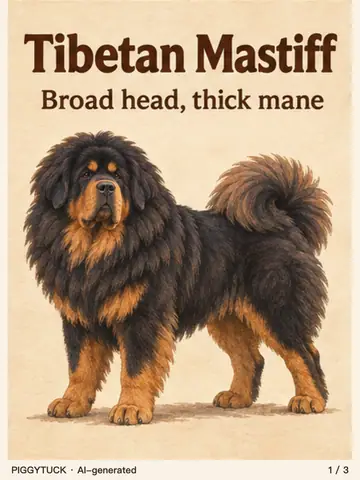
Tibetan Mastiffs have guarded Himalayan flocks and settlements for centuries. Their precise origins are uncertain. Early travellers sometimes received the dogs as gifts, and the breed is often linked to later Middle Eastern and European mastiff lines.[1] A Tibetan Mastiff can stand about 26 inches at the shoulder and weigh well over 100 pounds, yet move quickly when it senses trouble.[1] At home, leashed walks and safe places to patrol usually suit this Working Group guardian better than repetitive obedience drills.[1]
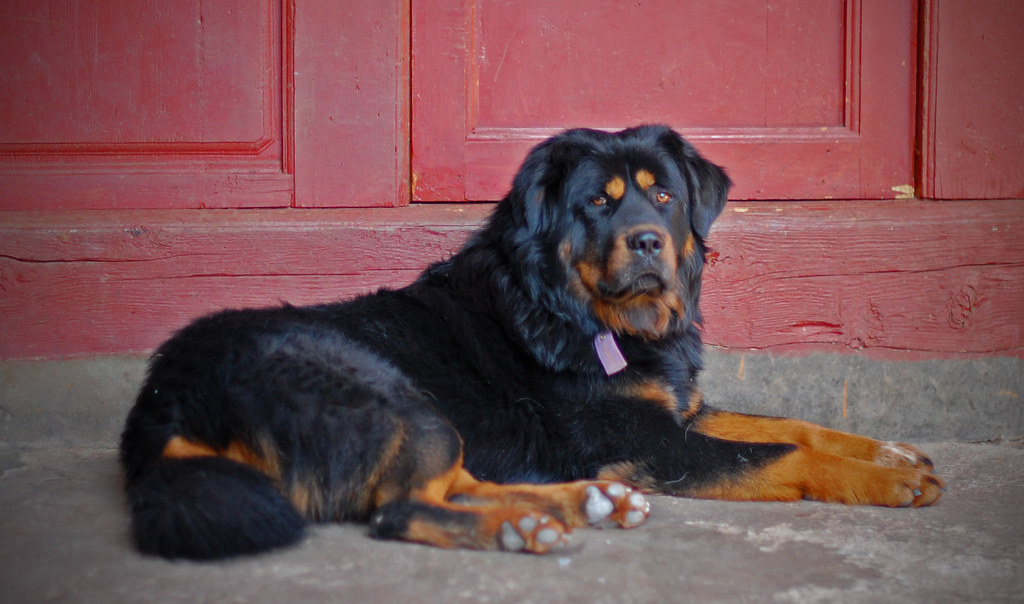
Figure: Black-and-tan Tibetan Mastiff lying on concrete before a red door, whole body and legs visible. timquijano, Flickr[2]
Broad head, mane, and curled tail: how to recognise it
Look first for the broad, heavy head and curled tail: a strong brow; deep-set almond eyes in brown shades, noble and aloof; medium V-shaped ears set high, hanging forward, lifting toward the skull top when alert; a well-feathered tail curled once over the back to balance the head, with feathered britches.[1] The body is a touch longer than tall, topline firm and level, chest developed, ribs moderately sprung, tuck-up clear but not extreme; a muscled, arched neck wears a thick mane in mature dogs; feet are large, compact “cat” feet, sometimes feathered between the toes.[1] Heavy wrinkling is heavily faulted; one mature fold from above the eyes to the mouth corner is allowed.[1] Dogs usually carry more coat than bitches; quality beats length—coarse stand-off guard hair, never silky or wavy, with a dense woolly undercoat in cold weather that thins in warm months.[1] A lying dog hides the curl of the tail, so check carriage standing; a full reclining frame still shows legs, feet, and coat lay.
Patrol-style exercise and training that refuses repetition
Tibetan Mastiffs need moderate daily exercise. They often prefer walking the perimeter of familiar territory to chasing a ball or disc. They are more active in cool weather, with short bursts of speed and limited endurance.[1] Provide a securely fenced area and regular leash walks, and choose cooler hours when the weather is hot.
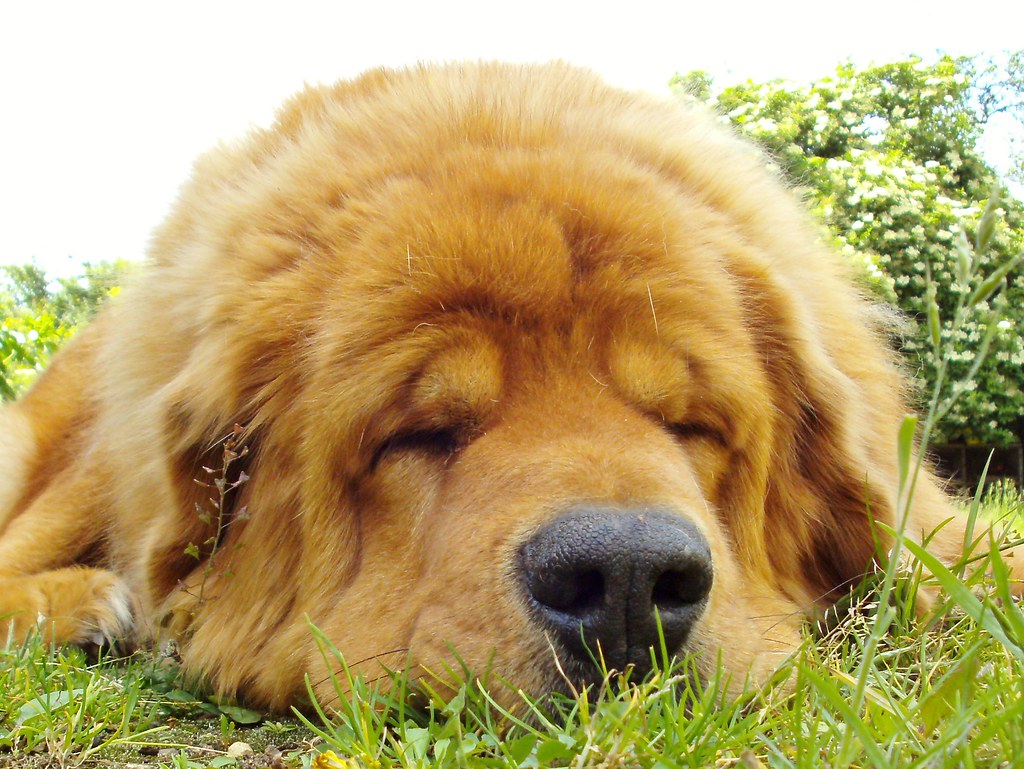
Figure: Golden Tibetan Mastiff resting its head on grass with eyes closed, thick mane and dark nose visible. lgrvv, Flickr[3]
Training expectations matter just as much: traditional drill-heavy obedience fits poorly; they learn fast, dislike repeating known cues, and follow owners they respect—yet default to instinct when unsure.[1] Food rewards are often weak; class perfection with home amnesia is a known pattern; recall is not reliable, so keep them on leash.[1] Appetite is often smaller than the frame suggests, and they may eat only when hungry; how much and how often should follow age, body-condition scoring, and veterinary advice—not a fixed cup count or a home rule to wait out skipped meals. Marked changes from the dog’s own baseline belong with a veterinarian.[1]
Weekly brushing and the yearly coat blow
Coat care is the lighter half of ownership. For most of the year a double coat of woolly undercoat and coarse guard hair needs little more than a weekly slicker or long-pin brush plus a wide-tooth comb through mane, tail, and britches.[1] The heavy lift is the once-yearly undercoat blow in late spring or summer, when a rake or de-shedding tool earns its keep.[1] The breed is shown natural—trim only to tidy feet and hocks—and the undercoat thins on its own in warmer months.[1] Block time before shed season rather than fighting loose hair after it fills the house.
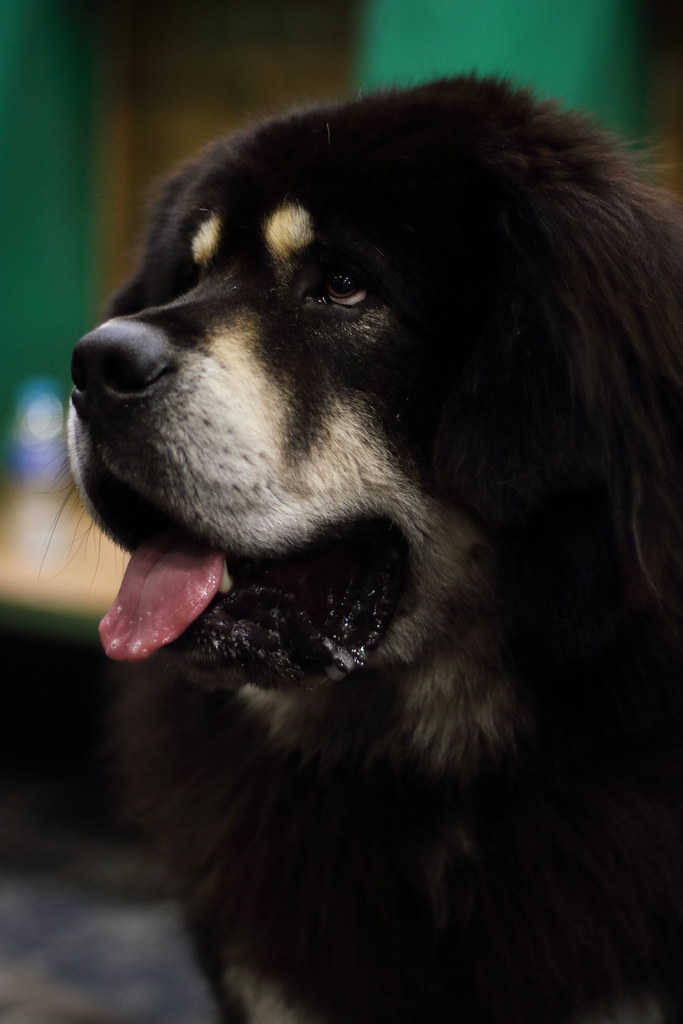
Figure: Black-and-tan Tibetan Mastiff facing left with mouth open and tongue showing, tan brows and cheeks visible. adam w, Flickr[4]
Elbows, hips, thyroid, and eyelids
Ask breeders about elbow and hip dysplasia, hypothyroidism, and eyelid problems such as entropion and ectropion. Seizures have been reported but do not appear common.[1] Mature dogs should have eyelid rims that fit closely against the eye. Changes in eyelids, gait, appetite, or energy call for a veterinary examination.[1]
Recognise a Tibetan Mastiff by the broad head, deep almond eyes, tail curled over the back, and neck mane, then match on moderate daily patrol exercise, training without endless cue drills, weekly brushing plus the yearly coat blow, and screening talks on elbows, hips, thyroid, and eyelids.[1] Identity rests on the dog and its registration.[1]
References
-
American Kennel Club. Tibetan Mastiff.
-
timquijano. The Tibetan Mastiff at our Hostel.
-
lgrvv. almak aour tibetan mastiff.