
Show-bred adult male Golden Retriever Sammy standing indoors. Photo: Pharaoh Hound (2006-01-12), CC BY-SA 3.0 / CC BY 2.5, source: Wikimedia Commons.

With a gentle, friendly temperament, a bright golden coat, and strong working and companion qualities, the Golden Retriever is one of the world’s most popular medium-sized breeds. First developed as a gundog in the nineteenth-century Scottish Highlands, they combine ample athletic stamina with a reputation for being eager to please and relatively easy to train. This article outlines breeding history, U.S. and U.K. type standards, everyday exercise and care, and key hereditary health screening for household keepers.
Breeding roots in the Scottish Highlands and formal recognition
Golden Retriever history begins in the mid-nineteenth-century Scottish Highlands. Dudley Marjoribanks, 1st Baron Tweedmouth, systematically bred gundogs at Guisachan. AKC historical material phonetically notes the estate as “yoush-a-gan,” while the AKC breed page labels it “Gooeesicun.” In 1865, while walking in Brighton, England, Marjoribanks met a yellow wavy-coated retriever named Nous belonging to a cobbler; both of Nous’s parents were solid black retrievers. In 1868 Nous was bred to Belle, a Tweed Water Spaniel (now extinct), producing the foundation litter—Cowslip, Crocus, and Primrose. An early folk tale that the breed descended from Russian circus dogs was overturned by Marjoribanks’s detailed stud books, now held by The Kennel Club.
After decades of refining type and performance, yellow retrievers moved from estate gun dogs into public showing and registration. Per Canadian Kennel Club (CKC) history, The Kennel Club granted independent breed status in 1913; the American Kennel Club (AKC) followed with recognition in 1925. Since then Goldens have excelled in field work and as family companions; AKC breed materials also note guide and search-and-rescue roles.
Balanced build and key differences between U.S. and U.K. standards
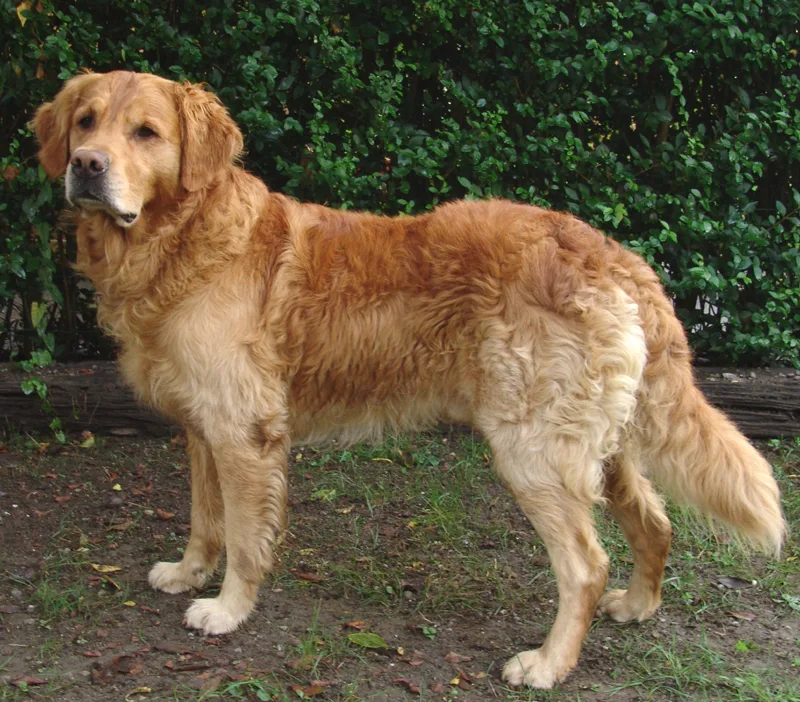
Golden Retriever standing before an outdoor hedge. Photo: Andreas Dobler (Umaluagr, 2004-09-12), CC BY-SA 3.0 / GFDL, source: Wikimedia Commons.

Goldens are sturdy, well-proportioned medium dogs with symmetrical structure and a smooth, powerful gait. The current AKC official standard published by the Golden Retriever Club of America (GRCA; effective September 1990) sets clear size bounds: adult males 23–24 in (about 58.4–61.0 cm) at the withers and 65–75 lb (about 29.5–34.0 kg); adult females 21.5–22.5 in (about 54.6–57.2 cm) and 55–65 lb (about 24.9–29.5 kg). Height is strictly judged: any dog more than 1 in outside the range is a disqualification. The double coat has a dense, water-resistant undercoat and a resilient outer coat that is flat or slightly wavy, with abundant feathering on the rear of the legs, front of the chest, and underside of the tail.
U.S. and U.K. authorities differ notably on height and color. The Kennel Club standard (updated 2025-04-01) allows males 56–61 cm (22–24 in) and females 51–56 cm (20–22 in). The British lower limits are thus below AKC’s (22 in males / 20 in females vs. AKC 23 in / 21.5 in). On color, The Kennel Club allows “any shade of gold or cream, but neither red nor mahogany”; AKC requires a “rich, lustrous golden of various shades,” noting that “extremely pale or extremely dark is undesirable” as the main body color. Knowing both orientations helps families see the normal range of Golden coat shades.
Friendly, trustworthy temperament and daily exercise and training
Under the AKC standard, core temperament is “friendly, reliable, and trustworthy.” Unprovoked aggression or hostility toward dogs or people, or unwarranted timidity or nervousness, is foreign to the breed. AKC introductions also call Goldens outgoing, trustworthy, and eager to please. They need ample company and activity; long isolation or little interaction can make steady routines and behavior harder to maintain.
Bred as gundogs, they have substantial stamina and drive and need enough physical and mental work. Outdoor time is central: they naturally run and retrieve, and swimming and fetch games match retrieving and water instincts. Plan activity around fitness, season, and footing, and avoid extreme hard work in hot sun. Training is relatively straightforward and often described as eager-to-please; games plus basic obedience help burn energy and build stable habits.
Pre-breeding medical screening and lifelong health care
Responsible breeding rests on parental health screening. GRCA (accessed 2026-11-11) lists four core pre-breeding checks for parents of a litter: (1) hip dysplasia screening via Orthopedic Foundation for Animals (OFA) or PennHIP imaging—OFA official ratings require dogs to be at least 24 months old; (2) elbow dysplasia screening, also by OFA radiographs after 24 months—GRCA notes about 10% of U.S. Goldens are affected to some degree; (3) annual eye exams by a boarded veterinary ophthalmologist, focusing on hereditary/juvenile cataracts and pigmentary uveitis, with commercial DNA tests available for progressive retinal atrophy (PRA) in some lines; (4) cardiac exam after 12 months by a boarded veterinary cardiologist for issues such as subaortic stenosis (SAS). GRCA notes SAS is uncommon in the breed but can be serious when present; murmurs may prompt further workup.
Across the lifespan, owners should also watch for early signs of other problems and keep up routine care. GRCA mentions hypothyroidism, epilepsy, skin disease, and cancer, noting these usually lack the routine pre-breeding phenotypic screens used for hips, elbows, eyes, and heart. Consult a licensed veterinarian rather than self-medicating. Because Goldens have pendulous ears and love water, AKC advises weekly ear checks for infection signs and drying around the canals after baths or swimming. Sensible calorie control and a lean body condition ease joint load.