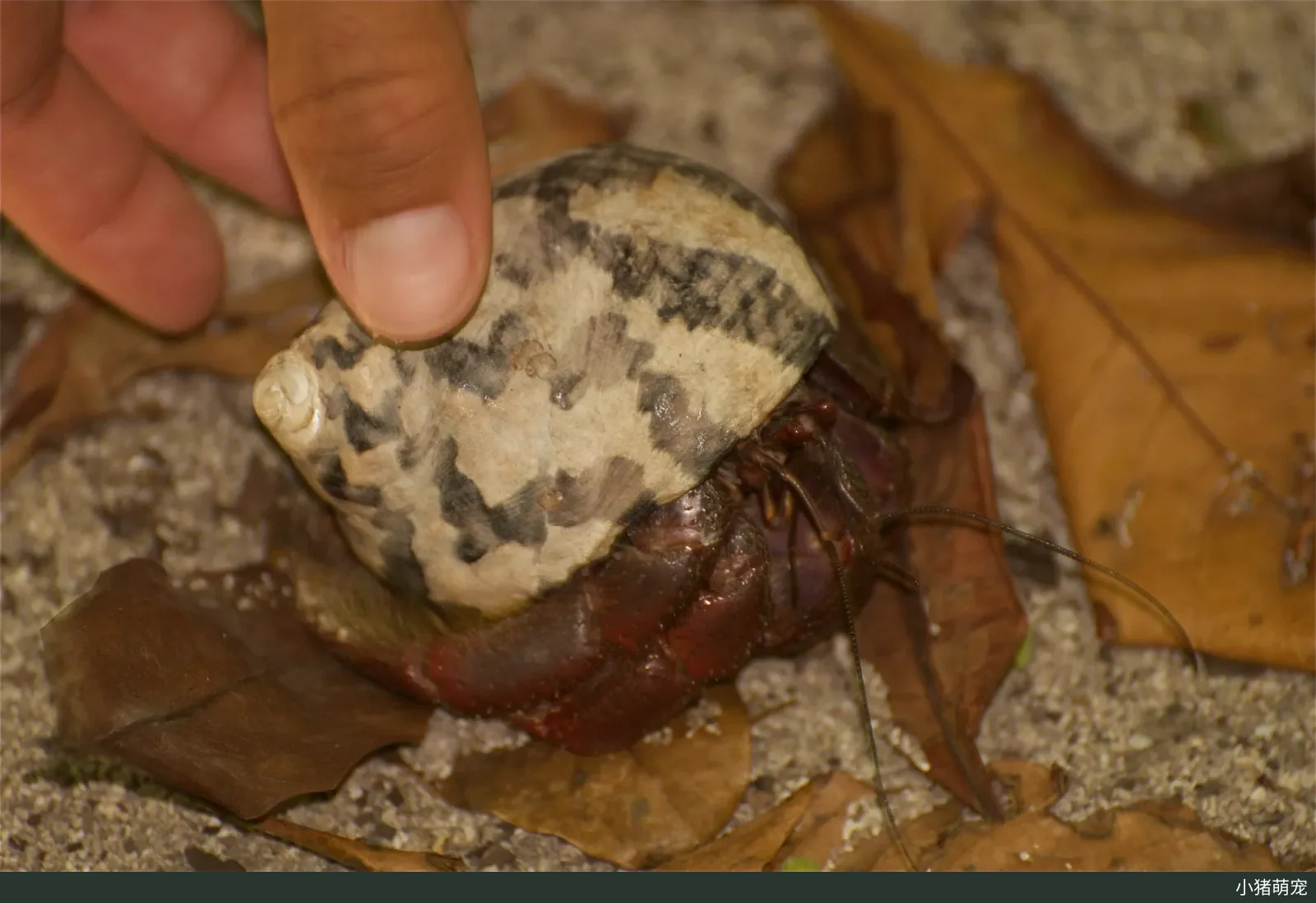
A Caribbean hermit crab (Coenobita clypeatus) living in an empty shell of the large marine snail Cittarium pica, photographed at Half Moon Caye, Belize, on 21 April 2008. Photo: Jerry Kirkhart; source: Wikimedia Commons; license: CC BY 2.0.

Land hermit crabs live on coastal land as adults but return to the sea to breed; individuals sold in pet shops almost all come from the wild. Keeping them well means 70%–80% humidity, moist substrate deep enough to dig, both freshwater and saltwater sources, and suitable natural snail shells. Neither the CITES Appendices nor China’s key protection lists currently include the land hermit crab genus, but Japan has designated them a Natural Monument, and capture inside protected areas is also restricted by law.
Natural habits
What we usually call land hermit crabs are members of the genus Coenobita in the family Coenobitidae. Common pet-trade species include the Caribbean hermit crab (C. clypeatus), the Ecuadorian hermit crab (C. compressus), and the strawberry hermit crab (C. perlatus). The coconut crab (Birgus latro), in the same family, is the world’s largest terrestrial arthropod, can weigh more than 4 kg, and is not a routine pet. Land hermit crabs inhabit tropical coasts of the Indo–Pacific, western Atlantic, and Caribbean, and are mostly nocturnal: by day they hide in coastal woodland, grass, or under rocks; after dark they forage on beaches and at the water’s edge, eating a little of almost anything.
The front half of a hermit crab has a hard exoskeleton, but the abdomen is soft and can only be protected by an empty snail shell. Each growth step means a new shell. Smithsonian’s National Zoo has described the shell-selection sequence: sizing up the shape, testing whether it can be moved, feeling the surface and form, probing the aperture, climbing in to confirm it can withdraw instantly, then flipping the shell over to check that it can right itself again. Their gills have reduced; they exchange gas through a moist gill chamber, so they must regularly wet the gills and shell interior at seawater pools or in rock crevices.
Adult land hermit crabs live on land, but breeding still depends on the sea. Taking the Caribbean hermit crab as an example, the female carries eggs inside the shell for about 30 days, then releases them into seawater at the shore; larvae spend 3–7 weeks in the sea through as many as five zoeal stages, become megalopae, seek snail shells, crawl ashore, and bury in sand to metamorphose into juvenile crabs. Because the life history is so complex, Smithsonian’s National Zoo notes that land hermit crabs do not breed in captivity, and every individual sold in pet shops comes from the wild.
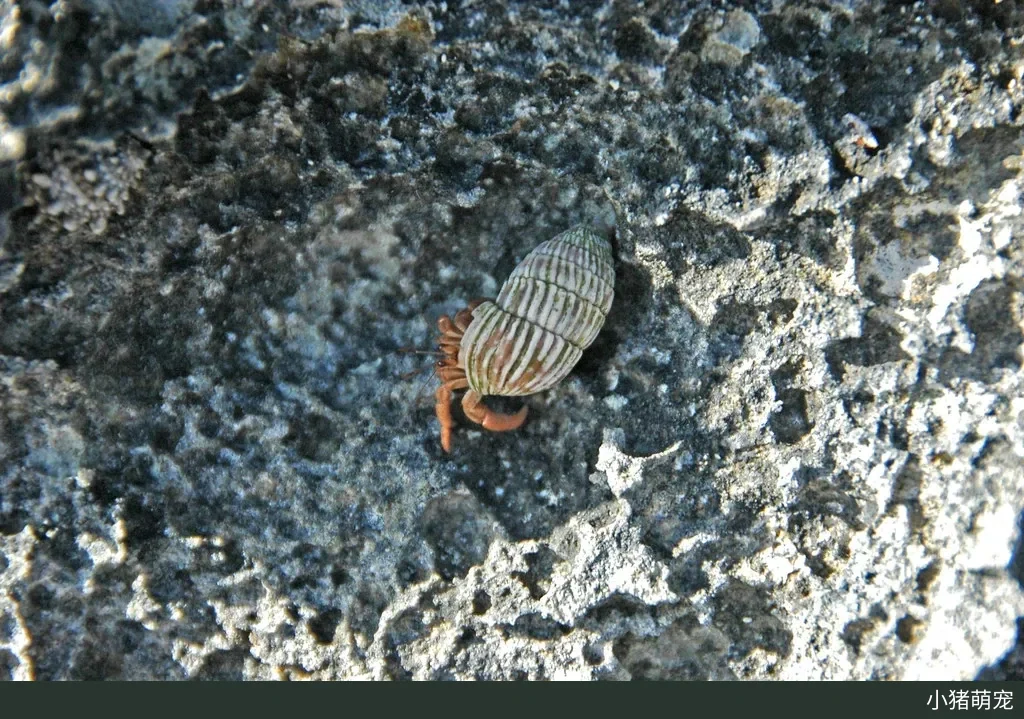
A juvenile Caribbean hermit crab carrying an empty shell of the Bahamian land snail Cerion watlingense, photographed in the supra-tidal zone of a rocky shore on San Salvador Island, Bahamas. Photo: James St. John; source: Flickr; license: CC BY 2.0.
Housing and diet
For hermit crabs, temperature and humidity come first. Tree of Life Exotic Pet Medical Center, a U.S. exotic-pet specialty hospital, recommends keeping temperature at 24–29°C with a warm–cool gradient, and humidity at 70%–80%; PetMD gives a humidity range of 70%–90% and warns that humidity that is too low can suffocate hermit crabs. Check daily with digital thermometers and hygrometers; heat with side-mounted heat pads or ceramic lamps, and avoid direct heat lamps that dry the air.
The same hospital suggests: at least about 10 gallons (about 38 L) for two small individuals; 20–40 gallons (about 76–151 L) for adults or groups, with an escape-proof mesh lid. Use play sand mixed with coconut fiber for substrate, moist enough to pack into a “sandcastle” that holds shape, at least 15 cm deep—deeper for larger animals, because they bury to molt. Place two water dishes in the tank: one with dechlorinated freshwater, one with seawater mixed from marine salt (not table salt); depth should let the crab partly immerse, with a ramp or shells for easy exit. Provide several empty natural snail shells of different sizes and shapes, plus hides and climbable branches. Hermit crabs are social; solitary housing causes stress—keep at least two, and avoid mixing individuals of very different sizes.
Land hermit crabs are omnivorous scavengers. Veterinary sources recommend a copper-sulfate–free hermit-crab pellet as the base, plus produce such as mango, apple, banana, spinach, carrot, and zucchini, with occasional unsalted nuts, cooked egg, fish, or shrimp; offer cuttlebone, crushed oyster shell, or coral fragments for calcium. Remove leftover fresh food daily so it does not mold. Freshly molted crabs often eat their own shed exoskeleton—likely recycling calcium and other minerals—so there is no rush to clean it away.
Common health problems
Molting is when “do not disturb” matters most. Before a molt, hermit crabs often eat and drink more, then grow inactive, start digging, and show a duller exoskeleton before burying into the substrate. PetMD notes that hermit crabs typically molt once or twice a year, needing days to weeks depending on size; Smithsonian materials mention that for some species the whole molting period can last 45–120 days. Never move or dig up a molting individual—doing so can cause serious injury or death. If it molts on the surface or is attacked by tankmates, isolate it for protection.
Most common problems listed in veterinary sources are environment-related: dehydration leaves crabs lethargic, grayish, and unable to withdraw fully into the shell; poor hygiene or ventilation invites mites and mold; too few empty shells triggers shell fights; low humidity, stress, or substrate that is too shallow favors failed molts. Industry outlet Veterinary Practice News also notes that trauma (for example being dropped by a child), dehydration, and improper husbandry are the most common issues. When picking up a hermit crab, hold it over a soft surface and let it climb onto the hand—never pull it out of the shell by force.
Contact an exotic veterinarian promptly for: ongoing lethargy outside a molt, leaving the shell and refusing to return, a stuck molt, or not eating. PetMD also recommends a yearly checkup; bring photos of the enclosure and a list of items used so the veterinarian can assess the environment.
Legality, conservation status, and ethical notes
Internationally, the current CITES Appendices (version valid from 5 March 2026) list no species in Coenobitidae, including the coconut crab. The IUCN Red List, however, raised the coconut crab from Data Deficient to Vulnerable in July 2020, and researchers have suggested considering CITES Appendix III listing.
Domestically, the List of Wild Animals under Special State Protection published and effective in February 2021 includes only the ornate spiny lobster among Malacostraca Decapoda (wild populations only)—no land hermit crab or coconut crab. Whether the June 2023 “three-haves” list (terrestrial wildlife of important ecological, scientific, or social value) includes land hermit crabs could not be verified from the original annex for this article; before buying or collecting, check with local forestry or fisheries authorities. Even off the lists, you cannot freely catch animals in protected areas: the revised Regulations on Nature Reserves effective 15 March 2026 prohibit human activity in core zones except for statutory exceptions, and general control zones allow only activities listed in the regulations.
Nearby regions are stricter. Japan designated land hermit crabs (オカヤドカリ) a National Natural Monument on 12 November 1970, in part because individuals from the Ogasawara Islands had been heavily collected for sale. Inside Taiwan’s Kenting National Park, capturing animals and collecting shells are banned; per a Central News Agency report of 26 September 2020, police caught a man taking about 30 hermit crabs in the Zhongzhou Lagoon protected demonstration zone and fined him NT$3,000 under the National Park Act.
Ethically, remember this first: every hermit crab in a shop comes from the wild. Before deciding to keep one, consider that under good conditions it can live 10–20 years or more, while poorly housed individuals often die within a year. Do not take hermit crabs from the beach, and do not bring empty shells home from the shore—the CNA report notes that after tourists remove shells, Kenting’s hermit crabs end up in snail shells, bottle caps, and other debris. Avoid painted shells when choosing replacements; paint may contain toxic substances. Once you keep them, see it through; Smithsonian’s National Zoo also urges never releasing pets into the wild.
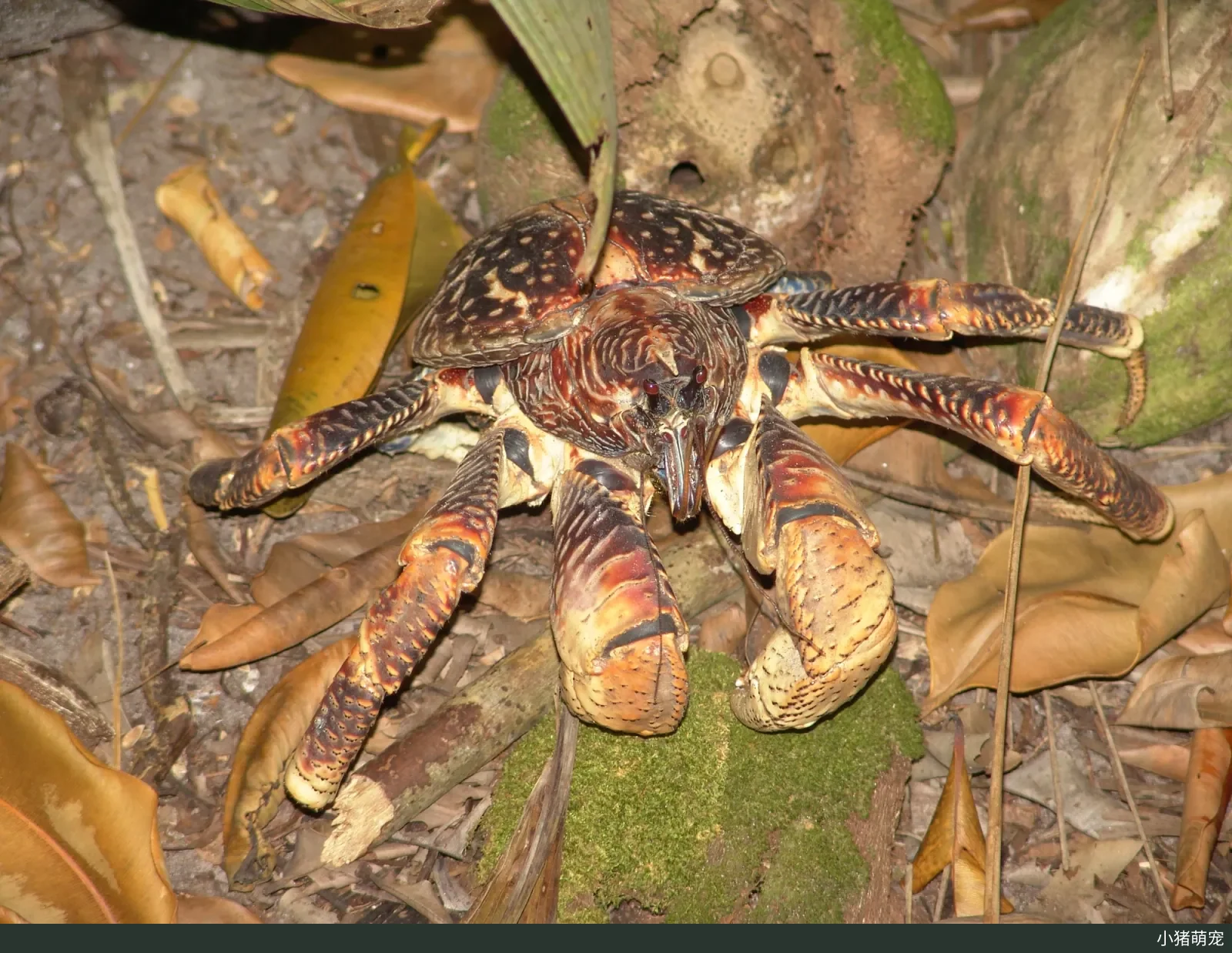
The coconut crab (Birgus latro) is the largest member of Coenobitidae and was listed as Vulnerable on the IUCN Red List in 2020. Photographed on Diego Garcia, Chagos Archipelago, on 21 June 2009. Photo: Drew Avery; source: Wikimedia Commons; license: CC BY 2.0.

References
-
Smithsonian's National Zoo and Conservation Biology Institute. Land hermit crab (page undated; accessed 2026-10-17)
-
Tree of Life Exotic Pet Medical Center. Hermit Crab Care (undated; accessed 2026-10-17)
-
PetMD. Hermit Crab Care Sheet (accessed 2026-10-17)
-
Veterinary Practice News. Got spiders? An overview of potential invertebrate patients (accessed 2026-10-17)
-
Greenaway, P. (2003). Terrestrial adaptations in the Anomura (Crustacea: Decapoda). Memoirs of Museum Victoria, 60(1).
-
鹿児島県教育委員会. オカヤドカリ (updated 2022-02-13)
-
Cumberlidge, N. et al. (2022). Troubled giants: The updated conservation status of the coconut crab (Birgus latro). Raffles Bulletin of Zoology.
-
国家林业和草原局、农业农村部. 公告2021年第3号(国家重点保护野生动物名录) (2021-02-05)
-
npadata.cn 物种库. 国家重点保护野生动物名录-2021(转录本)
-
国家林业和草原局. 公告2023年第17号(有重要生态、科学、社会价值的陆生野生动物名录) (2023-06-30)
-
中国政府网. 中华人民共和国自然保护区条例(2026年修订) (published 2026-02-03; effective 2026-03-15)
-
文化庁 文化遺産オンライン. オカヤドカリ (designated 1970-11-12)
-
墾丁國家公園管理處. 國家公園法裁罰及相關禁止事項
-
中央社. 墾丁國家公園抓寄居蟹 保七當場查獲只能罰3000 (2020-09-26)