
At home, an owner pours kibble for a golden retriever beside a newly opened pet-supplies delivery box. AI-generated illustration.
On 13 October 2026, GlobalPETS reported a U.S. consumer survey by retail analytics firm First Insight: people who buy pet supplies once a month were the largest group, at 35%; Millennials had the highest weekly-purchase share; Baby Boomers were most willing to spend more on pet supplies, and Gen Z least willing. The study had already been released in March 2026, however, and pet-category breakdowns currently appear only in media summaries.
Purchase frequency, channels, and subscriptions
Per GlobalPETS’s retelling, among 2,151 surveyed U.S. consumers, 35% buy pet supplies once a month—the most common rhythm—with Gen X highest in that group (38%). Nearly three in ten buy at least once a week; Millennials lead that group at 39%. The two lower-frequency groups are both dominated by Gen Z: buying every few months accounts for 11% (Gen Z 13%), and rarely buying or only once or twice a year for 5% (Gen Z 8%).
On channels, online retailers are the most-used pet-supplies channel for Gen Z (36%), Millennials (37%), and Boomers (37%); Gen X leans more toward large general merchandise stores (39%).
On subscriptions, 27% of Gen Z currently subscribe to pet food or supplies services, Millennials 24%, and Gen X and Boomers only 16% each. Asked whether they would be willing to subscribe to pet supplies, 31% overall said yes—Millennials highest (35%), Gen X and Boomers 33% each, Gen Z lowest (27%). In other words, the two older cohorts subscribe less today but state fairly strong willingness.
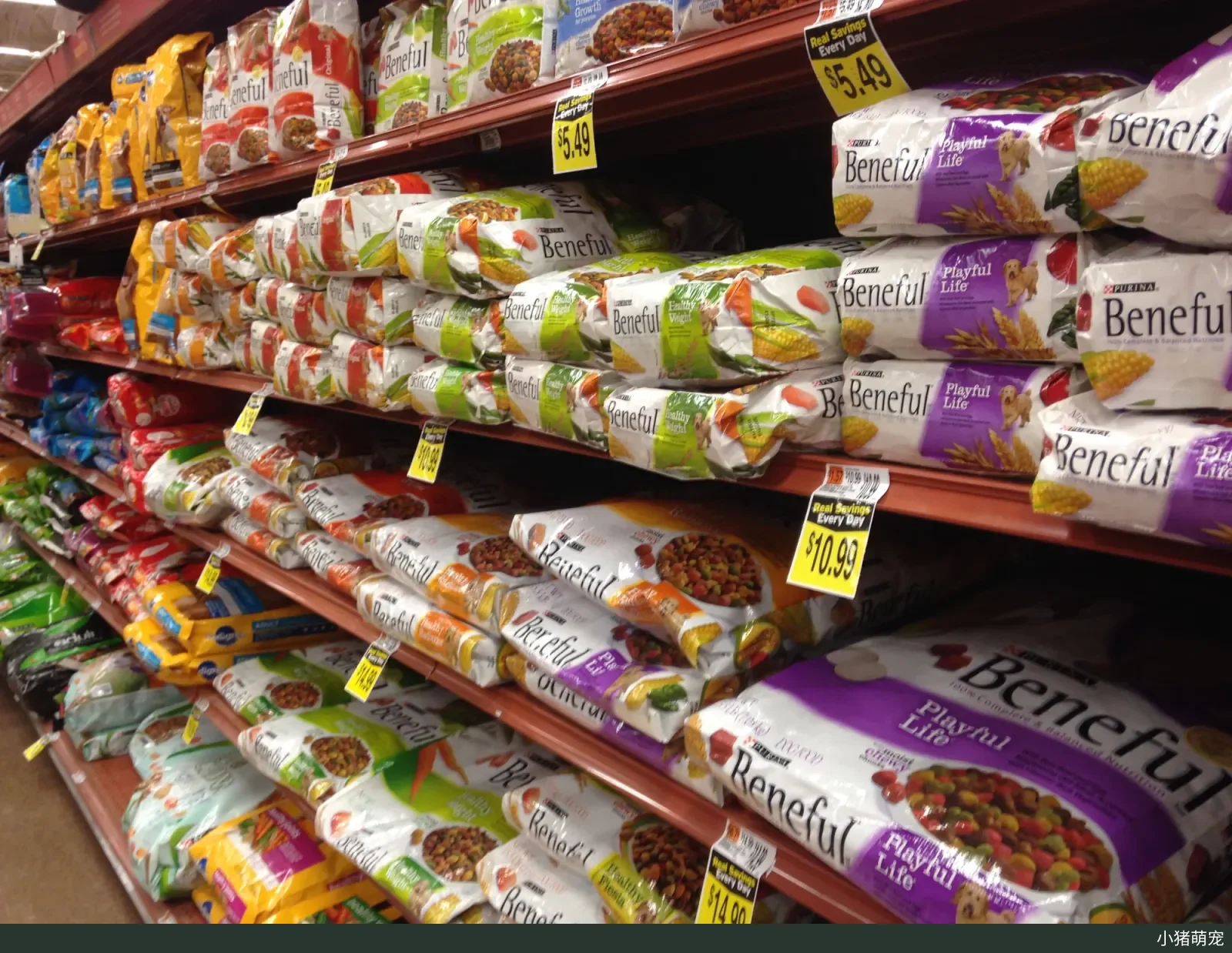
Dog-food aisle in a supermarket pet-supplies section in New Hampshire, USA, January 2014. Photo: MarkBuckawicki; source: Wikimedia Commons; license: CC0 1.0
Premium willingness and brand preference
Willingness to spend more on pets shows clearer generational gaps. Twenty-nine percent of Boomers list pet supplies among categories they would pay a premium for, slightly above their 28% for skincare and beauty; Gen X and Millennials are both at 21%, and both prefer to spend more on skincare and beauty (26% and 23%). Gen Z is lowest at 20%; their top premium category is health and wellness (25%).
Private label (the retailer’s own brand, like supermarket house brands) is not popular in pet: only 13% overall lean toward private-label pet supplies, while 22% lean toward value products. Gen Z is more willing to choose private label in food and beverage (31%), household goods (24%), and health and wellness (16%), with pet supplies last (14%). GlobalPETS summarizing First Insight’s data says Gen Z saves on substitutable everyday items and spends on categories tied to health, identity, and self-expression; First Insight’s press release calls pet food “the last category where brand inertia still holds.”
On reasons for choosing, “quality” is the top factor across generations, but the weight differs sharply: Gen Z 24%, Boomers 46%.
On specific brands, GlobalPETS’s overall ranking is: Purina ONE 39% (Boomers 53%), Pure Balance 26% (Millennials 32%), Ollie 18% (Gen Z 24%), Stella & Chewy’s 17% (Gen Z and Millennials both 18%). First Insight used shelf tests mixing national brands, private label, premium brands, and direct-to-consumer (DTC) brands for respondents to pick; Pure Balance is Walmart’s exclusive private label; the report does not say which bucket the other three brands fell into, or the exact question wording. Pure Balance’s 26% looks at odds with “only 13% lean toward private label”—possibly because one question looked at specific products and another at general preference—but the reporting does not clarify the definitions, so the figures should not be compared directly.
Data source and release timing
The GlobalPETS piece, by Diana Dominguez and published 13 October 2026, calls this a “new survey.” Tracing the sample size leads to a First Insight press release from Pittsburgh on 24 March 2026: the study is titled Is Gen Z Still Choosing Your Brand? Here's What's Quietly Changing Across CPG, based on answers from 2,151 respondents aged 18 to 80+, on how Gen Z is changing brand choice in consumer packaged goods (CPG). Pet is only one category; others include food and beverage, household goods, skincare and beauty, and health and wellness.
The press release’s generation bands are: Millennials 29–44, Gen X 45–60, Boomers 61+, with Gen Z’s age band not stated. Most figures released are cross-category—for example, only 25% of Gen Z and 28% of Millennials have no product subscription at all, versus 55% of Gen X and 69% of Boomers; the pet-category breakdowns above are not in the press release. The full report requires a form on First Insight’s site; this article could not access it, so these pet figures can currently be verified only as far as GlobalPETS’s summary.
First Insight is a commercial firm providing consumer feedback and pricing analysis to brands and retailers, claiming to serve more than 600 brands and retailers. The report is aimed mainly at CPG brands; the press release’s takeaway is that companies should survey consumers directly.
Meaning and limits for pet owners
For ordinary pet owners, this survey is more a “mirror of shopping habits” than a food-selection guide. It reflects how U.S. consumers buy and where they are willing to spend more; it does not address pet-food nutrition, safety, or health outcomes. A brand being more popular in one generation only means more people chose it—not that it is better for your dog or cat. Changing food or picking supplements should still follow the animal’s age, health, and veterinary advice.
If pet-food subscription services are tempting you, one cross-category figure from the press release is useful: 44% of respondents think a subscription is worth more than in-store buying when there is a discount or savings, 34% value exclusive products not available in stores, and 33% value convenience. Compare subscription price with your usual one-off cost, delivery frequency, and cancellation rules before deciding.
When reading these numbers, also note several limits:
- The sample is U.S. consumers. GlobalPETS writes “U.S. pet owners,” but public materials only say 2,151 consumers, without stating whether everyone who answered pet questions keeps a pet, or giving sample sizes by generation.
- Public materials do not disclose fieldwork dates, sampling method, weighting, or margins of error. Gaps of one or two points—like 29% vs 28% or 20% vs 21%—may not reflect real differences.
- “Willing to subscribe” and “willing to pay a premium” are self-reported attitudes, not actual spending.
- The study was released in March 2026, not brand-new data in October; findings cover the U.S. market and should not be applied directly to pet owners elsewhere.
- Some metrics in the reporting (such as “average channel engagement”) are not defined.
References
-
Diana Dominguez. Gen Z to Boomers: How each generation is reshaping pet spending habits. GlobalPETS, 2026-10-13.
-
First Insight. 59% of Gen Z Consumers Trade Down on Household Staples to Splurge on Health, Wellness and Beauty. Press release, 2026-03-24.
-
First Insight. Is Gen Z Still Choosing Your Brand? Report page (form required; this article could not read the full text).
-
Walmart. Walmart is Helping Pets Live Better, Too. 2021-05-03.