The Thai Ridgeback (listed by the FCI as the Thai Ridgeback Dog) is an ancient primitive breed recorded in Thai archaeological manuscripts roughly 360 years ago.[1][2] Shaped in eastern Thailand, where historically limited transportation kept crossbreeding rare, it preserved its original type as a versatile hunting dog, cart escort, watchdog, and defender capable of keeping cobras at bay.[1][2] Internationally, the Fédération Cynologique Internationale (FCI) granted provisional acceptance on March 6, 1993, and definitive recognition on May 26, 2003, as Standard No. 338 in Group 5 (Primitive Type–Hunting Dogs), while the United Kennel Club (UKC) recognized the breed in 1996.[2][3][4] In the American Kennel Club (AKC), the Thai Ridgeback currently remains recorded in the Foundation Stock Service (FSS) rather than a fully recognized group, and it is still uncommon outside Thailand.[1]
Physically, the Thai Ridgeback is a streamlined, muscular medium-sized athlete noted for exceptional jumping and climbing ability.[1][4] Under FCI Standard No. 338 and the UKC standard, its body is slightly longer than tall (11:10 ratio) with chest depth half the shoulder height, well-sprung ribs that are never barrel-shaped, and a well-tucked belly; ideal shoulder height is 56 to 61 cm (22 to 24 inches) for males and 51 to 56 cm (20 to 22 inches) for females with a 2.5 cm tolerance, and the AKC lists adult weights from 35 to 75 pounds.[1][2][4] Viewed from above or in profile the head forms a clean wedge, while from the front the UKC standard describes an elongated octagonal outline; the forehead wrinkles when the dog is attentive, almond-shaped eyes are dark brown (amber permitted in blue dogs), medium triangular ears incline forward and stand firmly erect without cropping, and spotted or solid black/blue tongues are prized.[1][2][4] The short, hard, smooth coat lacks an undercoat and appears in four solid colors—red (often with a black mask), black, blue, and very light fawn (isabella)—paired with a thick-based tapered tail carried upright in a gentle curve.[1][2][4]

A red Thai Ridgeback standing in profile showing its athletic build. Canarian, Wikimedia Commons[7]

How Official Standards Evaluate Dorsal Ridge Patterns
The dorsal ridge of reverse-growing hair is shared by only three purebred dog breeds worldwide—and unlike the single symmetrical blade silhouette expected on a Rhodesian Ridgeback, the Thai Ridgeback exhibits broader natural variation in ridge outline.[1][4] The AKC notes that the breed displays up to eight different ridge patterns.[1] Rather than prescribing one rigid contour, both FCI Standard No. 338 and the UKC standard set structural criteria that govern all acceptable shapes: the ridge begins at the withers and runs down the spine toward the top of the pelvis bones, remains clearly demarcated from surrounding smooth hair, and stays within the width of the back.[2][4] Narrower or wider shapes and varying lengths are all permitted as long as the ridge is symmetrical on either side of the backbone, and crowns or whirls at the head of the ridge are explicitly accepted.[2][4]
At the same time, official standards draw firm lines around deviations. FCI Standard No. 338 penalizes an unbalanced or asymmetrical ridge as a fault and lists both ridgeless dogs and long hair as disqualifying faults—a rule echoed in the UKC standard.[2][4] Because the ridge is inherited as a dominant trait, litters can naturally include ridgeless or plush-coated puppies; the AKC notes that while such dogs make fine companions, they are considered pet-quality and should be spayed or neutered rather than bred.[1]
Elevated view of a dark Thai Ridgeback showing its dorsal ridge. Pleple2000, Wikimedia Commons[8]

Independent Temperament, Dermoid Sinus Screening, and Owner Fit
Far more than its striking back pattern, the Thai Ridgeback’s primitive temperament determines whether a home can live happily with one. Centuries of hunting independently, escorting carts, and guarding homesteads produced a dog with strong survival instincts, high prey drive, and keen intelligence.[1] Deeply loyal to its family and typically quiet unless alerting, it is naturally protective and reserved or suspicious toward strangers, and tends to prefer steady daily routines over constant upheaval.[1] The AKC states plainly that the breed requires a patient, consistent, experienced owner with a solid grasp of canine behavior and is not suited to first-time dog owners.[1] Thorough early socialization, steady training, daily walks, active outdoor outlets such as hiking, swimming, or retrieving, structured dog sports like agility, obedience, or rally, and securely high-fenced exercise spaces that respect its jumping and climbing agility are essential.[1][4]

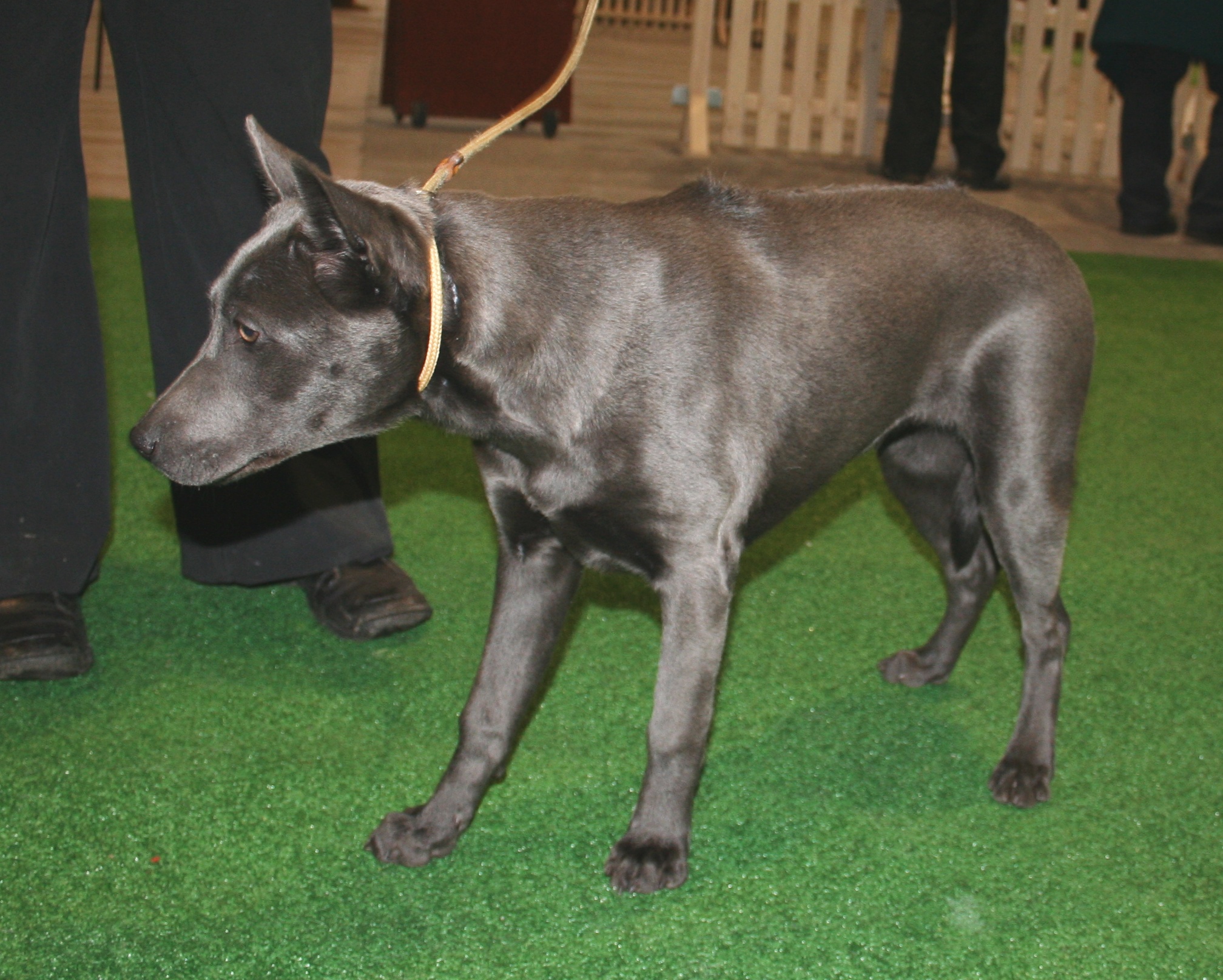
A solid blue Thai Ridgeback showing its sleek coat and stance. Canarian, Wikimedia Commons[9]

Grooming is simple: occasional brushing—stepped up during once- or twice-yearly shedding—paired with regular trimming of strong, fast-growing nails, ear checks, and toothbrushing keeps the undercoat-free coat tidy.[1] Thai Ridgebacks commonly live 14 to 15 years and are broadly hardy, yet one congenital condition tied directly to the ridge deserves close screening.[1] A landmark 2007 Nature Genetics study demonstrated that the dorsal hair ridge in both Rhodesian and Thai Ridgeback dogs stems from the same dominant 133-kb genomic duplication involving FGF3, FGF4, FGF19, and ORAOV1, which also predisposes ridged dogs to dermoid sinus.[5] As veterinary literature explains, a dermoid sinus is a congenital tubular skin indentation extending to variable depth into underlying tissues along the dorsal midline, including areas cranial or caudal to the ridge.[6] The AKC lists Dermoid Sinus Cyst as the breed’s most notable health concern (with hip dysplasia occurring more rarely): responsible breeders and veterinarians palpate carefully along the neck, dorsal midline, and tail base starting in puppyhood, and any suspected cord, nodule, or draining tract warrants prompt veterinary examination.[1][6] Overall, the Thai Ridgeback belongs with experienced handlers who value aloof, self-reliant primitive dogs and can provide secure containment and structured socialization—not households hoping for an easygoing, stranger-friendly first dog.[1][4]
References
- American Kennel Club. Thai Ridgeback Dog Breed Information.
- Fédération Cynologique Internationale. FCI-Standard N° 338: Thai Ridgeback Dog.
- Fédération Cynologique Internationale. FCI Breeds Nomenclature: Thai Ridgeback Dog (338).
- United Kennel Club. Official UKC Breed Standard: Thai Ridgeback.
- Salmon Hillbertz NHC, Isaksson M, Karlsson EK, et al. Duplication of FGF3, FGF4, FGF19 and ORAOV1 causes hair ridge and predisposition to dermoid sinus in Ridgeback dogs. Nature Genetics, 2007.
- PubMed. Prevalence and segregation analysis of dermoid sinus in Rhodesian Ridgebacks. 2022.
- Canarian. File:Red Thai Ridgeback 2.jpg, Wikimedia Commons.
- Pleple2000. File:Thai ridgeback 2009 pl.jpg, Wikimedia Commons.
- Canarian. File:Blue Thai Ridgeback 3.jpg, Wikimedia Commons.