The Rhodesian Ridgeback took shape in southern Africa from crosses between European breeds brought by Dutch settlers—such as Greyhounds and terriers—and the native ridged dogs kept by the Khoikhoi people.[1][2] In the late nineteenth century, big-game hunter Cornelius van Rooyen in Rhodesia (today’s Zimbabwe and Zambia) bred two ridged females into his pack, producing hardy, all-purpose hounds capable of trotting beside horses all day and guarding homesteads.[1] Although popularly nicknamed the “African Lion Hound,” both the American Kennel Club (AKC) and The Royal Kennel Club clarify the breed’s actual job: Ridgebacks tracked and held lions at bay with agility and courage until hunters arrived, never killing lions themselves.[1][2] The first breed standard was drawn up in 1922 using the Dalmatian standard as a template; the AKC recognized the breed in 1955 in the Hound Group, while the Fédération Cynologique Internationale (FCI) places it in Group 6 (Scent hounds, Standard No. 146).[1][3]
Beneath its signature ridge is a powerful, muscular large hound built for endurance and speed. Under the AKC standard, mature males stand 25 to 27 inches at the shoulder and weigh around 85 pounds, while females stand 24 to 26 inches and weigh about 70 pounds.[1] The skull is flat, fairly broad between the ears, and wrinkle-free at rest, framed by medium-sized drop ears set fairly high and carried close to the head; a very deep, capacious chest and straight, heavy-boned forelegs anchor a balanced silhouette.[1] The short, dense, glossy coat appears exclusively in shades of wheaten—from pale flaxen to rich red wheaten—paired with either a black or less common brown nose.[1][2]
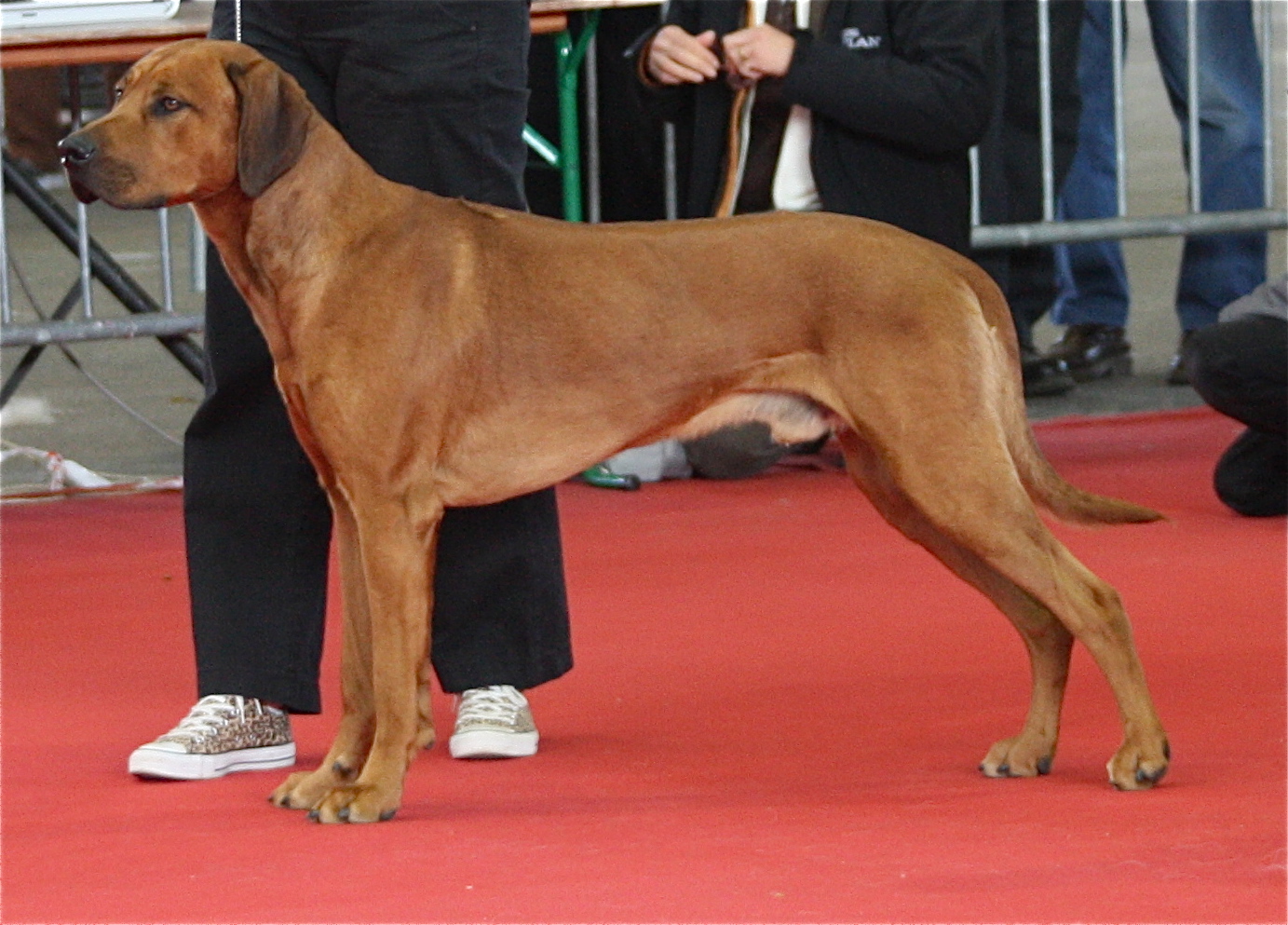
A muscular wheaten Rhodesian Ridgeback standing in side profile. Vulkano12, Wikimedia Commons[7]

The Genetics Behind the Ridge and Dermoid Sinus Screening
So what creates the stripe running down the breed’s spine? According to the AKC standard, the ridge is a clearly defined, symmetrical tapering band of hair growing in the opposite direction to the rest of the coat, beginning immediately behind the shoulders with two identical opposite crowns (whorls) and tapering to a point between the hip prominences.[1] Regional folklore once viewed a clear ridge as a mark of courage, and the feature became the breed’s defining hallmark.[1][2] A landmark 2007 study in Nature Genetics identified the molecular cause: the dorsal hair ridge in Rhodesian (and Thai) Ridgebacks stems from a dominant 133-kilobase duplication encompassing three fibroblast growth factor genes (FGF3, FGF4, and FGF19) plus ORAOV1, genes that play crucial roles during embryonic development.[4]
Because that developmental duplication acts during embryogenesis, ridged dogs also carry a predisposition to a congenital skin defect called dermoid sinus.[4] Present from birth, a dermoid sinus is a tube-like indentation of skin extending to variable depth along the dorsal midline, either within or cranial/caudal to the ridge.[1][5] A 2022 study in The Veterinary Journal analyzing 12,700 Rhodesian Ridgeback puppies across 1,622 litters born in Germany between 2001 and 2019 found an overall dermoid sinus prevalence of 2.53% (2.81% in all-ridged litters), noting a complex genetic architecture beyond the ridge locus alone alongside a gradual decline over time.[5] For puppy buyers, the practical focus is screening: as the AKC explains, experienced breeders palpate puppies along the dorsal midline from neck to tail base to feel for any cord-like tubular tract under the skin, and new owners should have their veterinarian recheck the midline during initial exams rather than attempting to manipulate any suspected defect themselves.[1]

Close-up of the two symmetrical crowns and backward-growing hair ridge. M3 SHERPA, Wikimedia Commons[8]

Daily Exercise and Guiding an Independent Large Hound
Beyond the ridge, day-to-day life centers on managing a strong, athletic 70-to-85-pound hound. The AKC characterizes the breed’s exercise needs as moderate yet consistent—daily long walks, running play sessions, or canine sports like tracking and agility that engage both mind and body—while The Royal Kennel Club lists over two hours of daily activity as a benchmark; once well exercised, a Ridgeback adapts calmly indoors and needs to live inside with its human family.[1][2] Because its prey drive is very strong, off-leash time belongs strictly inside securely enclosed areas.[1] In temperament, Ridgebacks are dignified, deeply devoted to family, and reserved with strangers, yet they can also be independent, strong-willed, and occasionally domineering—making the AKC caution that a Ridgeback can be too much dog for a novice owner.[1] Firm, fair, patient positive-reinforcement training and early socialization classes from puppyhood are essential, as is kitchen discipline, since Ridgebacks are notorious “counter surfers” around unattended human food and need measured portions to avoid excess weight.[1]

Head portrait showing the flat skull, dark nose, and close-fitting drop ears. Vulkano12, Wikimedia Commons[9]

Grooming, Recommended Health Tests, and Household Fit
Coat care is minimal: weekly brushing removes loose hair and keeps the short coat glossy, paired with occasional baths and frequent nail maintenance—noting that many Ridgebacks dislike clippers and respond better to a nail grinder, while overgrown nails cause discomfort during walking and running.[1] With an average life expectancy of 10 to 12 years, the breed is generally robust.[1] The AKC highlights Hip Evaluation and Elbow Evaluation as core recommended tests, and alongside the Rhodesian Ridgeback Club of the United States (RRCUS) emphasizes screening breeding stock for hip dysplasia (OFA after age two or PennHIP from 16 weeks), elbow dysplasia (OFA), hereditary eye anomalies such as juvenile cataracts, and thyroid function, in addition to newborn and puppy palpation for dermoid sinus.[1][6] Overall, a Rhodesian Ridgeback fits experienced, active households that provide daily structured exercise, secure fencing, indoor family living, and consistent positive leadership—while first-time owners expecting an automatically biddable dog may find its independence demanding.[1][2]
References
- American Kennel Club. Rhodesian Ridgeback Dog Breed Information.
- The Royal Kennel Club. Rhodesian Ridgeback Breed Information.
- Fédération Cynologique Internationale. Rhodesian Ridgeback (FCI Standard No. 146).
- Salmon Hillbertz NHC, Isaksson M, Karlsson EK, et al. Duplication of FGF3, FGF4, FGF19 and ORAOV1 causes hair ridge and predisposition to dermoid sinus in Ridgeback dogs, Nature Genetics 2007;39(11):1318-1320.
- Kehl A, Kuehn C, Distl O, et al. Prevalence and segregation analysis of dermoid sinus in Rhodesian Ridgebacks, The Veterinary Journal 2022;280:105788.
- The Rhodesian Ridgeback Club of the United States. Health Screenings.
- Vulkano12. File:Akani Stehbild.JPG, Wikimedia Commons.
- M3 SHERPA. File:CrestadoRodesia.jpg, Wikimedia Commons.
- Vulkano12. File:Akani Kopf.jpeg, Wikimedia Commons.