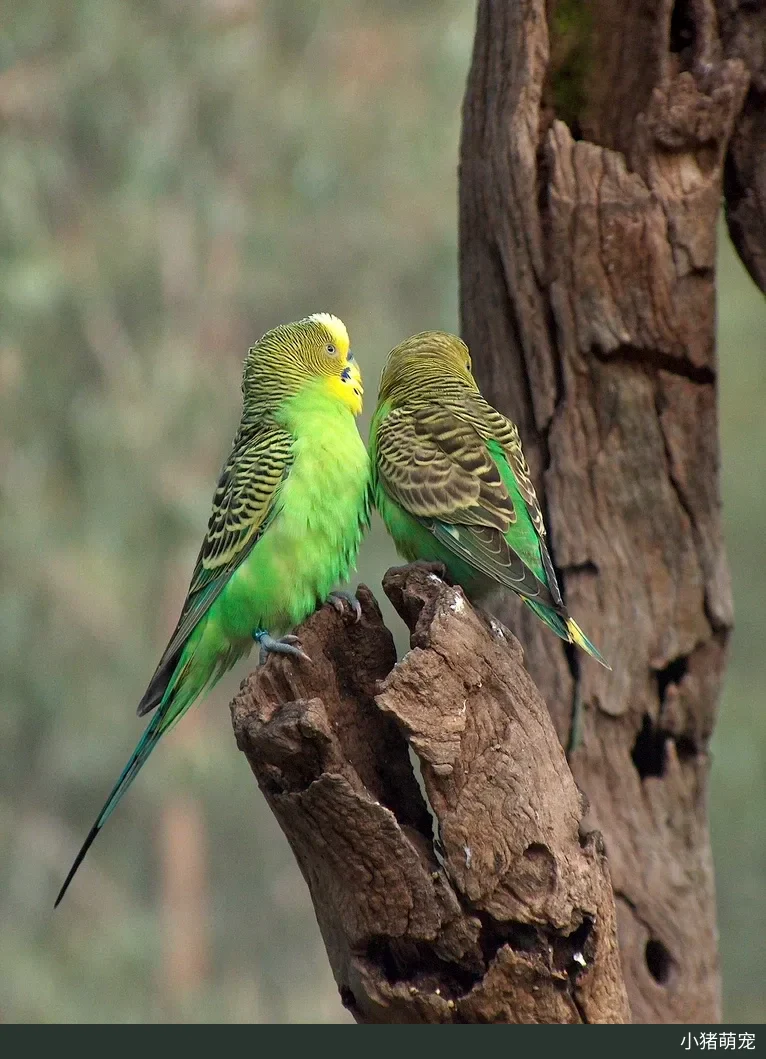
Two wild-type budgerigars perched on a dead stump in the Australian wild, photographed 10 August 2005. Author: Guillaume PILLET; source: Wikimedia Commons; license: CC BY 2.0

Budgerigars are native to inland Australia. In the wild they roam in flocks and live on grass seeds; today they may be the world’s most popular pet bird. Small as they are, they still need companions, daily flight space, and a balanced diet based on pellets; a long-term seed-only diet invites obesity, goiter, and lipomas. Legally, they are not listed on the CITES Appendices, and in China they are not managed as nationally key-protected wildlife.
Natural range and habits
The budgerigar (Melopsittacus undulatus) is about 17–18 cm long and native across much of mainland Australia, but not the far southwest, the northern Northern Territory, Tasmania, or most of the east coast. Wild birds are green and yellow with black barring on the back and a small blue cheek patch; today’s blues, whites, yellows, greys, purples, and other colors are captive-bred color morphs. Adults can be sexed by the cere (the skin around the nostrils at the base of the upper beak): males are deep blue; females are brown in breeding condition and light blue at other times. Juveniles are duller, with dark brown eyes; adults have white or yellow irises.
They are classic nomads: they have no fixed migration route, but follow rain and food across open habitats, rarely far from water. Flocks usually range from a few birds to a hundred or more; in wet, food-rich seasons they may gather in tens of thousands, flying in a distinctive undulating wave. Wild budgies eat almost only seeds of local herbs and grasses, mostly foraging on the ground, with drinking and feeding concentrated in the morning. Breeding also follows rainfall; when conditions suit, they may nest year-round, laying in hollows in trunks or branches, six to eight eggs per clutch. Flocking, daily flight, and ground foraging—these three wild traits are exactly what home care must respect.
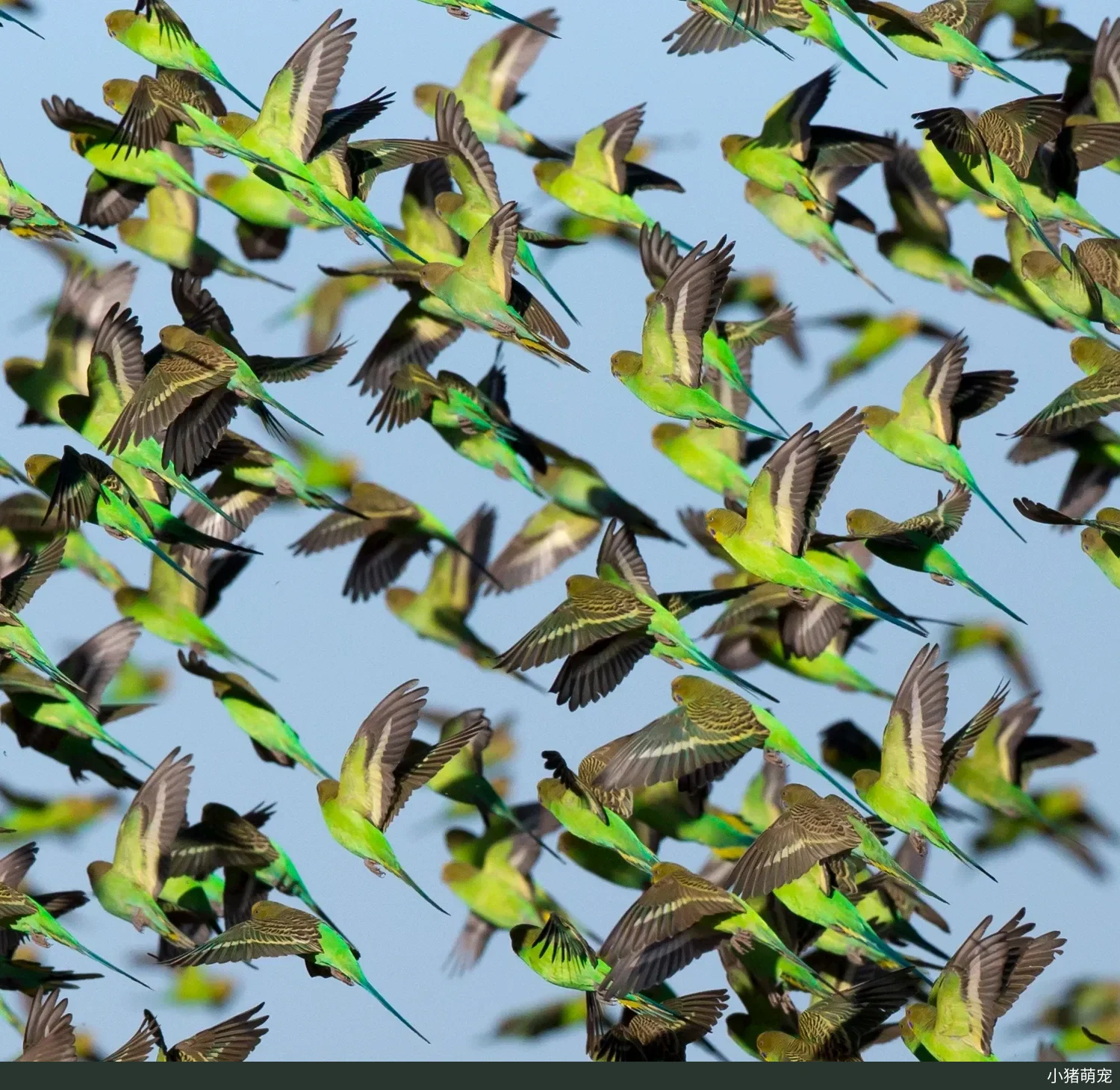
A flock of wild budgerigars near Karratha in Western Australia’s Pilbara region, photographed early morning on 29 July 2012. Author: Jim Bendon; source: Wikimedia Commons; license: CC BY-SA 2.0

Housing and diet
Budgerigars are flocking birds. RSPCA Australia recommends keeping pet birds as compatible pairs or small groups to meet social needs; the UK RSPCA also notes that species that breed in flocks in the wild, such as budgies, are among the few suited to group housing in one cage. Cages should be as large as conditions allow, and “long” rather than “tall,” because birds mainly fly horizontally. RSPCA Australia’s minimum guidance: for a pair, cage width at least three times the combined wingspan of both birds; space between two perches enough for at least two wingbeats; cage height at least three times the longest bird from head to tip of tail. Even a large cage does not replace flight—ideally provide a flight aviary, or schedule safe indoor free-flight daily; the UK RSPCA suggests at least six hours of out-of-cage free flight each day when there is no aviary. Before free-flight, close doors and windows, switch off ceiling fans, and cover large glass and mirrors.
For cage setup, prefer natural non-toxic branches of varied thickness and shape as perches to exercise feet—do not wrap them in sandpaper; keep food and water dishes out from directly under perches so droppings do not foul them. Newspaper or kitchen paper on the floor is enough; sand, wood shavings, and corn cob can be ingested and may grow mold and bacteria. Cotton-fiber toys and poor plastic or metal bits can be chewed and swallowed; galvanized ware can pose zinc and lead risks—avoid them. Place the cage in a room corner, away from main traffic, on a stand about chest height for an adult. Change water and food daily; clean the cage and accessories at least weekly, preferably every 1–2 days.
Diet is central to budgie health. VCA Animal Hospitals veterinarians note that commercial seed mixes are high in fat and carbohydrate, low in protein, and short on essential vitamins and minerals—and budgies often pick only millet or one or two favorite seeds. Veterinarians therefore recommend a small-bird pellet as the staple, about 60–80% of the daily diet; fresh produce at most 20–25%, washed, chopped small, served in a separate dish, and removed after a few hours before it spoils; seed only as a small treat—a millet spray once or twice a month is enough, and most avian veterinarians do not recommend honey sticks. Avocado can be toxic and must never be fed; chocolate, coffee, tea, soda, alcohol, and very salty snacks such as chips should also be avoided. Budgies hull seeds before eating, so grit is not needed; some birds overeat grit and risk life-threatening digestive obstruction. Switching from seed to pellets may take days to months—go gradually; when pellets are 75–80% of the diet, extra vitamins are usually unnecessary, and any supplement should be under avian veterinary guidance. Clean drinking water must always be available; wash the water dish daily.
Common health problems
Many of the most common budgie problems tie to a seed-only diet. Birds on high-fat seed for long periods readily become obese and may develop hepatic lipidosis (fatty liver), which can be fatal; they also readily develop lipomas, often soft, movable subcutaneous lumps on the sternum and abdomen. Seed is low in iodine; long-term poor seed diets can cause goiter: affected birds are often overweight, with a higher, thinner voice; an enlarged thyroid can compress the esophagus and cause regurgitation when eating. Hens may lay even when housed alone; a seed diet short of calcium and vitamin D readily leads to egg binding (dystocia).
Several other conditions deserve attention. Kidney and gonadal tumors are common in budgies; a tumor may compress the sciatic nerve and present as lameness in one leg, which owners often mistake for a simple injury. Scaly-face mites (Knemidocoptes pilae) form rough crusts on the beak and feet and, in severe cases, deform and overgrow the beak. Avian gastric yeast (Macrorhabdus ornithogaster) infection causes weight loss, with undigested seed visible in the droppings. Psittacosis (chlamydiosis) is more common in crowded pet-shop settings; birds may carry the organism without signs, or show sneezing, labored breathing, a bobbing tail with each breath, diarrhea, and more. VCA veterinarians advise an exam by an avian-experienced veterinarian soon after a new bird arrives home, then checkups every six months; seek care promptly for any of the signs above.
Psittacosis can also infect people. The U.S. Centers for Disease Control and Prevention (CDC) explains that Chlamydia psittaci spreads mainly by inhaling dust with dried droppings or respiratory secretions; bites or beak-to-mouth contact are less common. Human illness is usually a milder respiratory disease—fever, chills, dry cough, headache, and muscle aches—but severe pneumonia and other complications can occur. If you fall ill after buying or handling birds, seek care promptly and tell the doctor about the exposure. When cleaning cages, minimize dust and wash hands carefully afterward—basic protection.
Legality, conservation status, and ethical notes
Internationally, the Convention on International Trade in Endangered Species of Wild Fauna and Flora (CITES) lists the order Psittaciformes on Appendix II as a whole (except species already on Appendix I), but expressly excludes four species from all Appendices: peach-faced lovebird, budgerigar, cockatiel, and rose-ringed parakeet; the Appendices valid from 5 March 2026 still do so. On conservation status, BirdLife International’s species factsheet shows the IUCN Red List rates the budgerigar Least Concern (LC), last assessed in 2018, with wild population trend inferred as increasing.
In China, the National Forestry and Grassland Administration’s letter of 2 April 2021 on properly resolving issues related to captive-bred parrots (Lin Hu Fa [2021] No. 29) states clearly: except for peach-faced lovebirds, budgerigars, and cockatiels, CITES-listed parrots introduced from abroad are managed as nationally key-protected wildlife. A public reply from the Yunnan Forestry and Grassland Bureau on 25 February 2026 likewise states that these three parrots are not on protection lists, are not managed as nationally key-protected wildlife, and do not require captive-breeding or commercial-use permits. Note that the same letter says management of captive breeding of parrots not under key protection follows provincial local regulations, and sales must still meet epidemic-prevention and quarantine rules. If you plan to breed, sell, or transport over long distances, confirm first with local forestry and grassland authorities.
Legal does not mean casually kept. First, never release birds, and prevent escape: VCA materials note that escaped budgies have formed feral populations in Florida, USA, and BirdLife also records introduced populations in the United States and Puerto Rico, and introduced breeding pairs in Japan and Korea. Second, they are flock animals by nature; long-term solitary housing in a small cage is unkind; RSPCA Australia notes that birds never let out of the cage may develop obesity, arthritis, softening bones, and boredom-related behaviors such as feather-plucking, screaming, and aggression. Third, obtain birds from reputable breeders or rescue—do not buy on impulse; RSPCA Australia’s position is that wildlife should never be taken from the wild for pets. Fourth, count twice-yearly avian veterinary exams, patient diet conversion, and daily free-flight companionship into the long-term commitment of keeping one.
References
-
CITES Secretariat. Appendices I, II and III (valid from 5 March 2026)
-
National Forestry and Grassland Administration. Letter on properly resolving issues related to captive-bred parrots (Lin Hu Fa [2021] No. 29), 2 April 2021
-
Yunnan Forestry and Grassland Bureau. Whether pet parrots may be kept legally (public consultation reply), 25 February 2026
-
BirdLife International. Budgerigar Melopsittacus undulatus Species Factsheet (IUCN Red List assessment year: 2018)
-
Australian Museum. Budgerigar
-
Rich G, Hess L, Axelson R. Budgies – General. VCA Animal Hospitals.
-
Rich G, Hess L, Axelson R. Budgies – Feeding. VCA Animal Hospitals.
-
Rich G, Hess L, Axelson R. Common Conditions of Pet Birds. VCA Animal Hospitals.
-
RSPCA Australia Knowledgebase. What kind of enclosure does my bird need? (updated 17 July 2023)
-
RSPCA (UK). Environment: Giving your bird a good place to live
-
U.S. Centers for Disease Control and Prevention. About Psittacosis (18 September 2025)