In the early 1800s, as Australian cattle ranching spread from coastal settlements to the inland grasslands, stockmen needed dogs that could help move herds to distant markets. The Smithfield dogs brought from Britain struggled with the heat, rough ground and sheer length of the journey. Over generations, stockmen bred working dogs from several lines, including Dingoes and Collies. The Australian Cattle Dog’s old job helps explain what a family takes on today. A dog driving cattle needed the stamina to travel with the herd and the attention to notice where the animals were going and respond to the stockman along the way. [1]
Seen in profile, the Australian Cattle Dog has a compact, muscular body. The American Kennel Club (AKC) gives its height as 17 to 20 inches, or about 43 to 51 centimetres, measured from the ground to the top of the shoulders. It stands solidly and moves with a supple stride. The dog on the grass below has turned its head, leaving the outline of its body and the blue mottling along its side easy to see. Red is the other adult colour, and either coat can be mottled or speckled. Puppies are born predominantly white and develop their blue-grey or red colouring as they grow. [1]
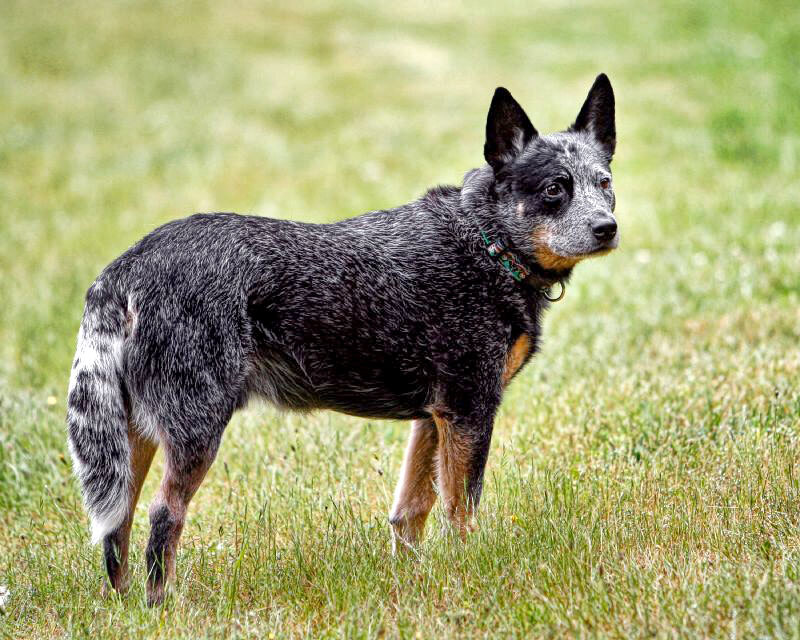
Figure: A blue-mottled cattle dog in profile. Zingpix, Wikimedia Commons[2]

For a household without cattle, a good place to start is an outing the family already enjoys. The AKC describes an alert, energetic dog whose exercise needs extend beyond a quick walk and some time in the yard. A dog suited to running can accompany a family member on a run. A walker might choose a quiet spot along a familiar route to practise a recall, look for an object or change direction together. Mileage tells you how far you went. To judge what occupied the dog’s mind along the way, think about what it had to notice and how you responded. [1]
One job you can teach at home is finding a familiar toy. Choose one your dog readily approaches and put it where the dog can see and reach it. Give your search cue. When the dog goes over and touches the toy, reward it right then so it can connect the reward with the find. Once it understands which object to seek, place it a little off to one side. After the find, step back, call the dog to you with a familiar cue and reward the return. A dog that has yet to learn to fetch can do the whole job.
The return gives you a chance to practise ending the game. If you throw the toy every time the dog comes back, it has good reason to expect another chase. Pick an easy find for the last turn. When the dog comes back, put the toy away, use the same words to signal that you’re finished and walk together to its usual resting place. Watch when its attention shifts away from the toy and whether it can settle there without another instruction. If turning away is difficult, try the next recall closer to the toy, somewhere with fewer people passing.
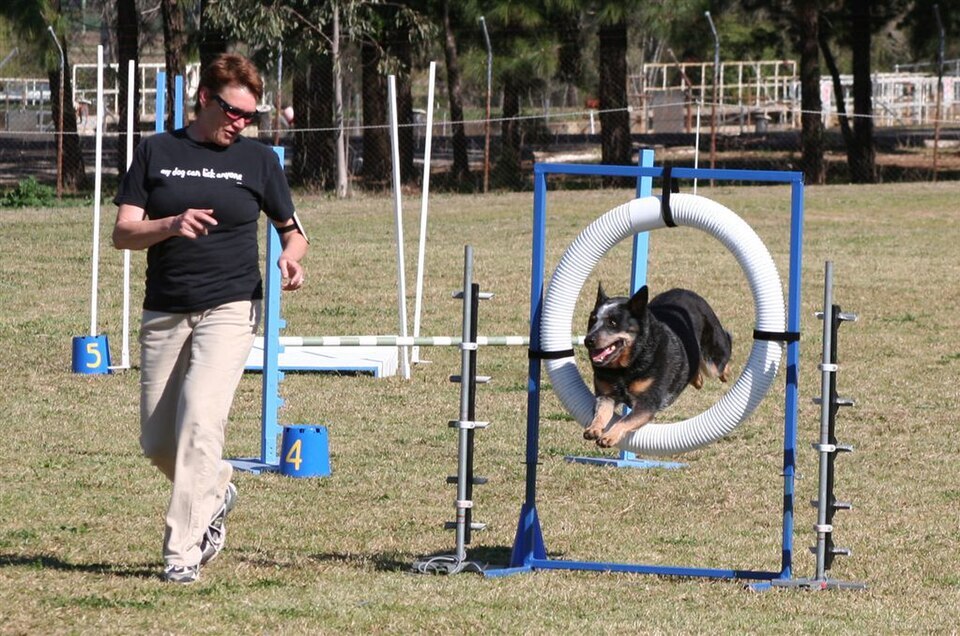
Figure: The hoop jump in agility. Mdk572, Wikimedia Commons[3]

For families who enjoy organised activities, obedience and agility both offer ways to work together. The hoop jump in the photograph lasts a moment. The skill you can also use on an ordinary walk is keeping in touch with each other while moving. The AKC recommends early socialisation and obedience training, with shared activities continuing into adulthood. Choose something you would enjoy learning yourself. You might like practising turns together in an open space or figuring out where to stand to guide a dog through an obstacle. Think about which parts you could keep up on a working weekday. [1]
At home, look at the busiest stretch of floor between the front door and the living room. A dog resting in the middle of that route has someone squeezing past every time the door opens. Set its mat to one side and practise going to it while the hallway is quiet. Then have one family member walk past and reward the dog for staying on the mat. When visitors arrive, you have a familiar place to guide it. Australian Cattle Dogs can be reserved with strangers, and this arrangement lets the dog watch from a comfortable distance as guests come in. [1]
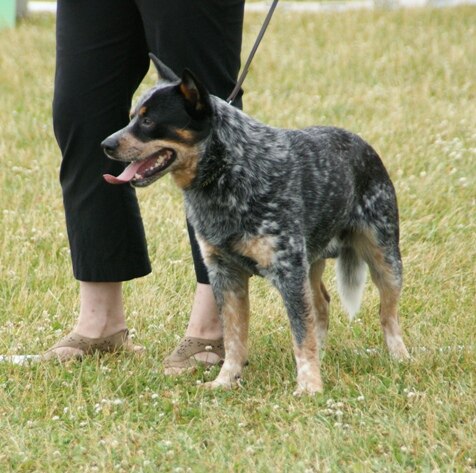
Figure: Coat markings on the body and legs. Canarian, Wikimedia Commons[4]

To judge whether the breed fits your household, take a recent ordinary weekday. Who could have taken the dog out that morning? Who had time to put things down in the evening and practise with it? Could the adults use a consistent cue when children or guests came through? A yard can make a game convenient, but someone still needs to be there to play it. When you meet a particular dog, notice what it enjoys doing, how close a distraction can come before it loses focus and how it rests once the activity ends. Those details can help you plan for that individual. [1]
Beneath the smooth outer coat is the undercoat that helped protect this outdoor worker. A quick weekly brushing and an occasional bath usually suffice. Twice a year, when the undercoat sheds, set aside time every few days for a thorough brushing. Work through the coat with a short-bristled brush and use a comb if needed to lift out loose undercoat. The colourful surface is what catches the eye in a photograph. At grooming time, how much hair is coming loose underneath tells you how much work you have that day. Routine care also includes nail trims, checking the ears for debris or wax buildup, and regular toothbrushing. [1]
If you’re speaking with a breeder, ask what hearing, eye and hip checks each parent has had and which dog each record belongs to. The AKC identifies deafness, progressive retinal atrophy, which causes vision loss, and hip dysplasia as concerns when screening breeding dogs. The records tell you which risks the breeder considered. With your own dog, pay attention to changes in familiar surroundings. If it repeatedly fails to respond to sounds or starts bumping into objects, note when and where this happens and describe it to your veterinarian. That context matters when a missed recall first looks like a training problem. [1]
References
-
[1] American Kennel Club. Australian Cattle Dog.
-
[2] Zingpix. File:ACD-blue-spud.jpg. Wikimedia Commons.
-
[3] Mdk572. File:Agility.jpg. Wikimedia Commons.
-
[4] Canarian. File:Australian Cattle Dog blue.JPG. Wikimedia Commons.