In early 19th-century Brussels, coachmen kept small, rough-coated dogs to catch rats in their stables. By the 1870s, the dogs had found favor with Belgian royalty and were making their way into more homes. Today the Brussels Griffon belongs to the American Kennel Club’s Toy Group. It is still a lively little dog, especially when someone joins in the game. If you’re thinking of bringing one home, start with your daily schedule. Who would be free to take the dog out when it’s cool enough for a walk? [1]
In the side view below, follow the line from the shoulders to the base of the tail. The back is short and level, and the deep chest gives this compact dog a sturdy outline. The AKC lists a height of 7 to 10 inches (about 18 to 25 cm) at the shoulder and a weight of 8 to 10 pounds (about 3.6 to 4.5 kg). In profile, the forehead curves above a very short nose. The lower jaw and, on this rough-coated dog, the beard project forward. That sturdy little body is made for getting about on foot. The short muzzle is a reason to leave room for rests along the way. [1][2]

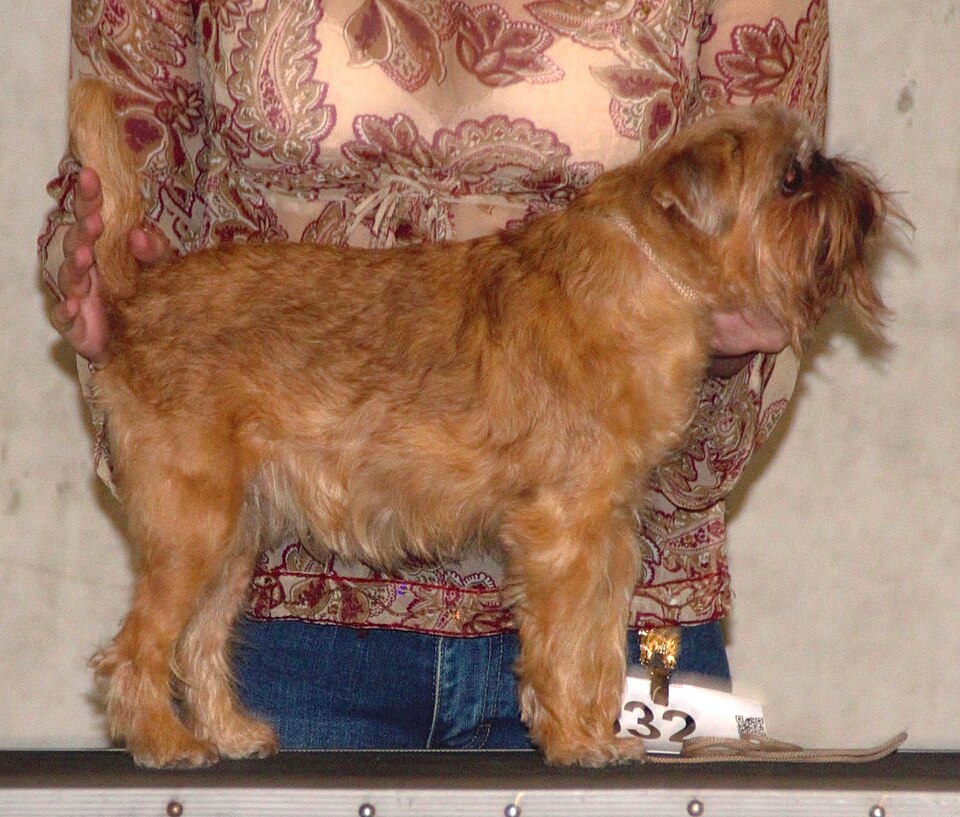
A Brussels Griffon shows its compact build. Canarian, Wikimedia Commons[2]
Walk during the cooler parts of the day
The AKC recommends at least half an hour of moderate exercise a day for the breed. You might take a short walk around the neighborhood in the morning and another in the evening, with time to stop and sniff. A dog that likes chasing a ball might enjoy a few rounds of fetch somewhere cool. Choose a route where it’s easy to turn back. You can carry on together while your dog is moving comfortably and finish the outing if it starts to struggle. Use the half hour to plan your day, and let the dog in front of you set the length of each outing. [1][3]
Brooklyn, the smooth-coated puppy below, has no long beard to hide the shape of the face. You can see how the nose sits between the eyes and how little the muzzle projects. That shape matters on a walk. Dogs cool themselves by panting, and air passing through the nose helps carry heat away. If a short-faced dog’s upper airway is obstructed, it can have trouble shedding heat as its temperature rises during exercise. Strong sun, heat, and humidity can all make breathing harder for a Brussels Griffon. On a muggy day, save the walk for a cooler hour. Indoors, you can hide a toy for your dog to find or practice a few familiar cues in a cool room. [1][3][4][5]

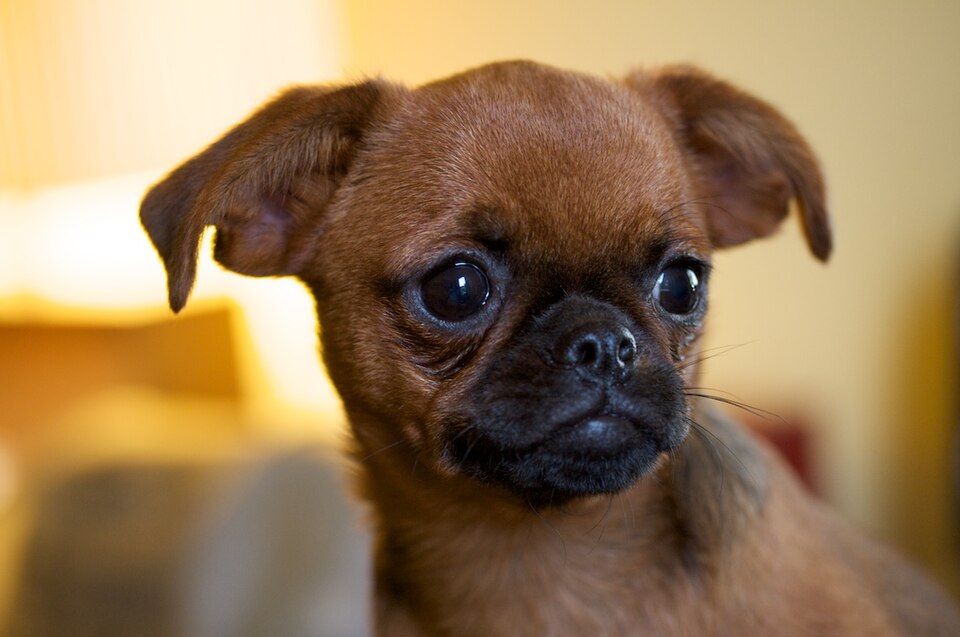
Brooklyn’s smooth coat reveals the short muzzle. Bellevuegeek, Wikimedia Commons[5]
When your dog brings the ball back, listen to its breathing before you throw again. If even gentle activity repeatedly brings on a loud snoring sound, or your dog has to work to draw breath, stop the game, move somewhere cool, and have a veterinarian assess it. Tell the vet when you hear the sound. Does it happen at rest, when your dog gets excited, or after a short walk? That detail is more useful than simply saying your dog snores. If the tongue or gums turn blue or purple, or your dog collapses, contact an emergency veterinarian immediately. [4]
Play the whole family can join
For a family with children, a ball rolled gently along the floor is a good place to start. Have the child sit down and roll the ball into an open space. The puppy can choose whether to chase it. If it brings the ball back and lets go, the child can roll it again. The puppy has room to run, and the child has a part to play. A small, sensitive Brussels Griffon can find boisterous chasing and tight hugs overwhelming. An adult should be ready to step in before the children start chasing the dog, and the dog needs a resting place where children know to leave it in peace. [1]
Many Griffons will happily follow someone from room to room. You can build on that closeness in training. In a quiet room, call your dog, praise it as soon as it reaches you, then let it go back to playing. From puppyhood, introduce new people, sounds, and places gradually, in situations you can manage. Housetraining often takes longer than learning a game. Agree on one toilet spot, take your puppy there as soon as it wakes and after meals, and reward it right there when it goes. After an accident, try taking the puppy out a little earlier next time. A raised voice can frighten a sensitive dog. [1]
Think through an ordinary workday. Can the person on the early shift manage the first walk? Who can come home during the day for a toilet break and a little company? If someone has to work late, who takes the evening walk? Brussels Griffons form close attachments to their families and can develop troublesome behaviors when regularly left alone for long stretches. An apartment can accommodate a Griffon’s daily routine. If everyone is out until late, the harder question is who can spend time with the dog during those long daytime hours. [1]
Grooming a rough or smooth coat
Brussels Griffons come in rough and smooth coats. The rough coat is dense and wiry, with longer hair around the eyes, cheeks, and chin. In the photo below, you can see the outline of the body clearly, while a thick beard hangs around the muzzle. Many owners of rough-coated pets keep the body hair trimmed short and leave the beard. If you like that look, allow time for brushing and trimming. Smooth-coated Griffons like Brooklyn have short, straight hair that lies close to the body. A weekly brushing is usually enough. During the spring and fall shedding seasons, brush daily to lift out loose hair. Bathe the dog when it gets dirty. [1][5][6]

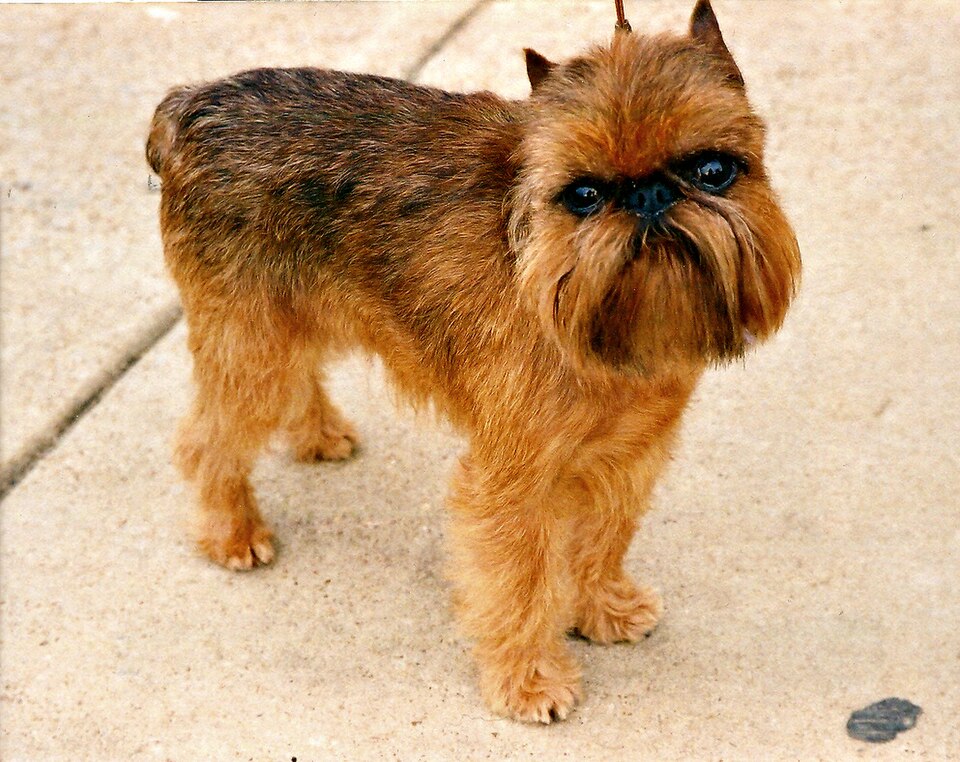
A full beard frames the rough-coated Griffon’s face. Dan9186, Wikimedia Commons[6]
Both coat types need regular nail trims. Take a look at the paws after a walk. When nails grow long enough to interfere with how a paw meets the ground, walking and running can hurt. Ear checks and brushing with dog toothpaste can also become part of the time you spend together. Introduce each in small steps your dog is comfortable with. Count training treats toward the day’s food allowance. With a dog this small, it’s easy to lose track of how much those little rewards add up to. [1]
When you talk to a breeder, ask what the puppy likes to play and whether you can see the parents’ health screening records. The AKC breed page lists kneecap and hip evaluations and an examination by a veterinary ophthalmologist. It also calls attention to heart problems. The records show which checks the parents have had. Once your own Griffon is home, daily walks give you a chance to learn how it breathes at an easy pace and how comfortably it moves on all four feet. A walk you both enjoy, followed by a quiet few minutes of grooming at home, gives that half hour a natural place in family life. [1][4]
References
-
[1] American Kennel Club. Brussels Griffon Dog Breed Information.
-
[2] Canarian. File:Brusselsgriffonbruxellois2.jpg. Wikimedia Commons.
-
[3] University of Cambridge, Department of Veterinary Medicine. Management & Treatment.
-
[4] University of Cambridge, Department of Veterinary Medicine. Recognition & Diagnosis.
-
[5] Bellevuegeek. File:BrooklynTheDog.jpg. Wikimedia Commons.
-
[6] Dan9186. File:Brussels Griffon Rembrant (jpg format).jpg. Wikimedia Commons.
