In some of France’s closely cultivated river valleys, the pasture a Briard tended was a strip of grass between two crops. Each morning, the dog helped the shepherd bring the sheep out to graze. It patrolled the edges as the flock ate its way along the strip. A sheep only had to stray a few steps for the crop to come within reach. In the evening, the Briard accompanied the flock back to the farm and kept watch for anything that might threaten it. The work called for a dog that could follow the shepherd’s directions and use its own judgment when there was no time to wait for one. [1][2]
To recognize a Briard, start with the whole dog. Adults stand about 56 to 69 cm at the shoulder. They have a deep chest, sturdy bones and strong muscles, with a long, slightly wavy coat that falls over the flanks and legs. In profile, a Briard looks solidly built. In motion, it has the agility a herding dog needs to change direction quickly. The dog below is tawny. Briards can also be black or gray. Look more closely at the head and you can see where the hair parts naturally over the forehead. That parting, the heavy eyebrows and the long beard give you more to go on than color alone. [1][4][5]


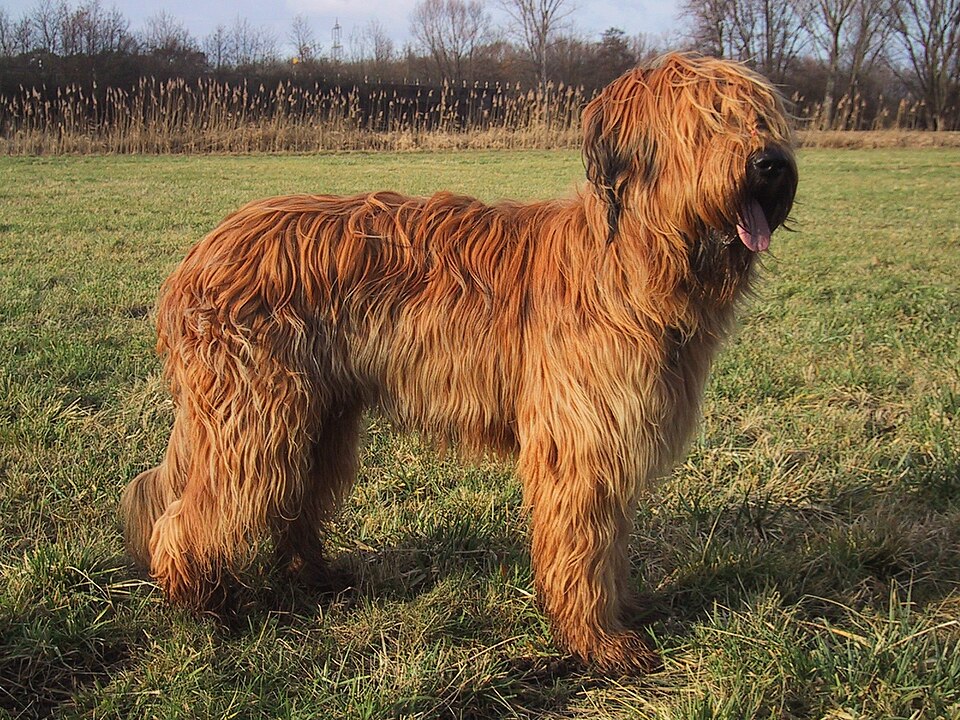
A tawny Briard stands in profile. Birgit Balzer, Wikimedia Commons[4]
Practice coming back during play
If you’re thinking about a Briard, picture an ordinary workday. Who will take the dog out in the morning and evening? Is there a securely fenced space nearby with room for the dog to stretch out and run? Once you get there, who will join in? The American Kennel Club (AKC) suggests hiking together or throwing a ball for the dog to chase. Part of the appeal of a ball game is that the person gets to play, too. Even if you have a large yard, someone still needs to make time to step outside, pick up the ball and play with the dog. [1]
A ball game gives you a chance to teach something you’ll use at home. Start in a quiet, fenced space with the dog close by. Call it back to you. Encourage it as soon as it turns your way, then wait until it reaches you before throwing the ball again. Coming back makes the game continue. Once the dog understands, try the same cue once or twice on leash during a walk where there’s a little more to catch its attention. Briards learn quickly and have ideas of their own. Giving the dog a clear connection between returning and the next throw is more useful than calling its name over and over once it’s far away. [1][2]
Give your Briard a familiar spot when guests arrive
Briards tend to stay close to their families and take time to size up a stranger. The Briard Club of America encourages owners to introduce puppies to people outside the household from an early age. If you often have visitors, practice the moment after the dog notices someone new. Can it turn away from the doorway and come to you? You can see when it takes that step. The dog has room to watch from a comfortable distance, and your guest has room to come inside. [1][3]
Teach the greeting in two stages. First, have one family member step outside and come back in. Another stays with the dog a few steps from the door, clear of the path into the house. As the door begins to move, use the cue from the ball game and reward the dog when it comes to your side. Opening the door a crack is enough at first. Once the routine is familiar, ask a friend to visit. Give your friend time to come in and sit down while the dog watches from the side. If the moving door and the sound of conversation together make it hard for the dog to respond, stand farther back next time and practice just the door opening. [1][3]
How your family shares the work matters here. When a child brings a classmate home, can an adult take the leash so the children have room to take off their shoes? If the person who usually walks the dog is out, does everyone else know which cue to use and where the dog should go? Before choosing a Briard, walk through an arrival in your own entryway. Find a spot out of the foot traffic and decide who can be there with the dog when the door opens. Everyday walks also give the dog chances to meet different people, a habit you can keep up into adulthood. [1][3]
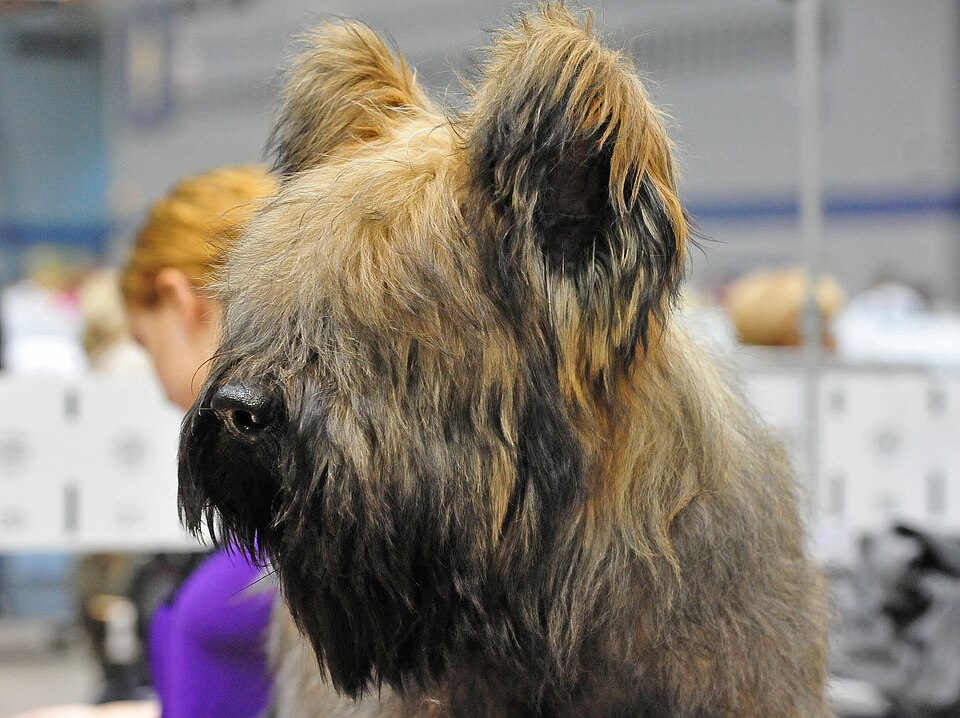
Heavy brows and a beard frame the Briard’s face. State Farm, Wikimedia Commons[5]
Brush the long coat to the roots, one layer at a time
The eyebrows and beard stand out in a photograph. When you sit down to groom a Briard, most of the work is in the coat over the rest of the body. A few strokes along the back can leave the surface looking tidy even when the pins have passed through only the outer layer. The AKC recommends brushing several times a week with a pin brush, working all the way to the skin. Part a small section on the dog’s flank so you can see the roots. Brush gently through that layer, then let down the next one. An undercoat rake can help work loose hair out of the coat. How often the dog needs a bath depends on what it’s been doing and how dirty it gets. Brushing has its own regular place in the week. [1]
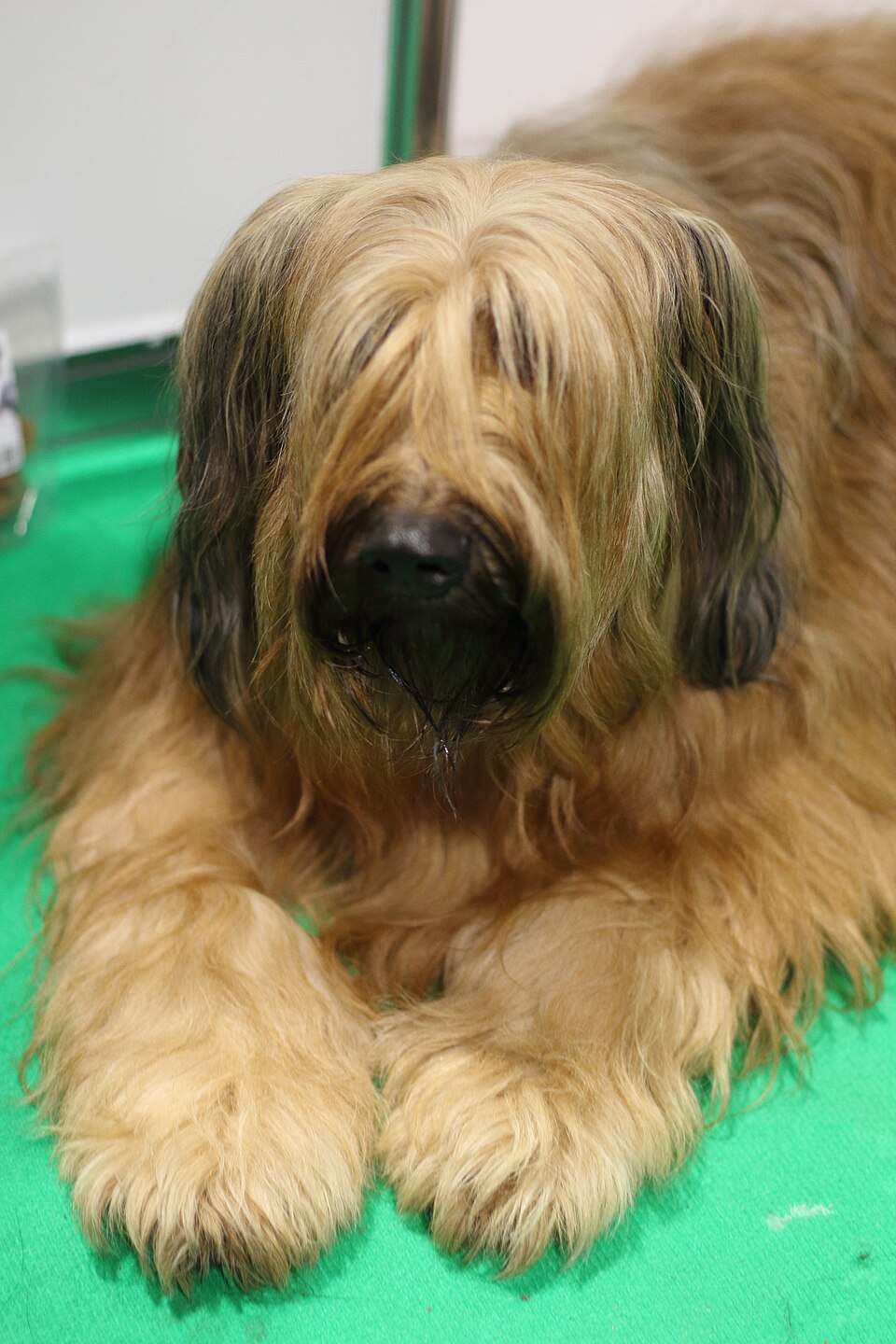
Long hair parts over the forehead and covers the paws. adam w, Wikimedia Commons[6]

You can introduce brushing while the dog is still a puppy and grooming sessions can be brief. Choose a moment when the puppy is happy to settle. Let it feel your fingers part the coat and the brush pass gently through a small section, then give it a reward. As the puppy grows comfortable staying with you, gradually spend longer at it. By the time the dog is grown, someone in the family will already know how to brush through the coat on its flanks and legs. Set aside time for those sessions when you plan your week. In particular, think about who will still have time to sit down with the brush after an outing. [1]
When you ask about a puppy’s health background, ask the breeder to show you three screening records for each parent and talk you through the results. The AKC lists a hip evaluation, an examination by a veterinary ophthalmologist and a DNA test for congenital stationary night blindness. The eye report records what the specialist could see at the examination. The DNA report answers a question about a particular inherited variant. Keep the parents’ results separate from the puppy’s own veterinary records. If you later notice a change in how your dog moves or sees, your vet can consider its history alongside what you’re seeing now. [1]
Picture all of this on the same evening. The dog has just come back from a run, your child’s friend is at the door, and one of the week’s brushing sessions is still ahead. Who can call the dog to their side as the door opens? Who will pick up the pin brush after the guest goes home? The watchfulness and the long coat may be what drew you to a Briard in the first place. An ordinary evening tells you where each would fit in your family’s life.
References
-
[1] American Kennel Club. Briard Dog Breed Information
-
[2] Briard Club of America. A Useful Dog
-
[3] Briard Club of America. A Best Friend
-
[4] Birgit Balzer. File:Briard fauve.JPG
-
[5] State Farm. File:A Briard.jpg
-
[6] adam w. File:Crufts 2019- NEC, Birmingham- 08-March 2019 - 47331266701.jpg