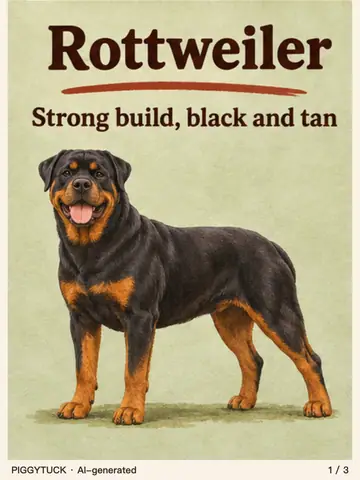
The Rottweiler is a medium-large, muscular dog with a short black coat and clearly defined rust markings. Males typically stand about 24–27 inches and weigh about 95–135 pounds; females are somewhat smaller. Life expectancy is about 9–10 years.[1] The breed has a compact, solid build and an easy, powerful trot.[2] Many Rottweilers are playful with family and more reserved around strangers. Daily exercise, early socialisation, and consistent training belong in the household routine.[1]
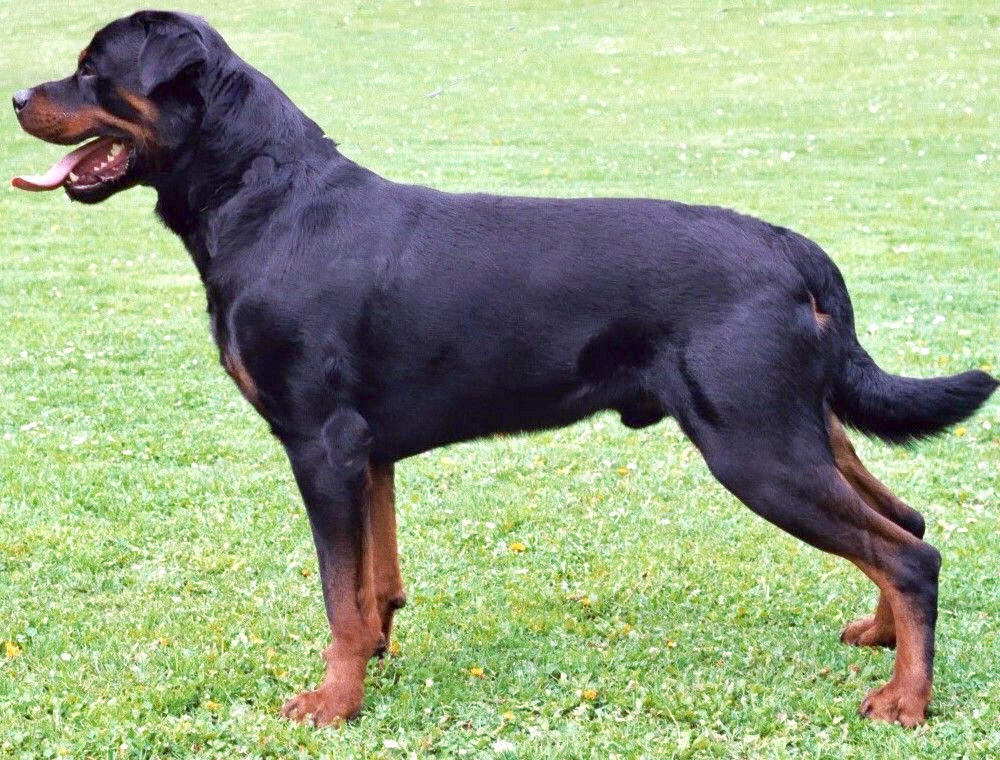
Figure: Adult Rottweiler standing on grass. Dr. Manfred Herrmann / ADRK, Wikimedia Commons[3]

Droving–guarding background and identifiable form
The breed’s distant ancestors are thought to include droving dogs that moved and guarded herds for Roman legions, with some Asian mastiff ancestry; dogs brought to the Empire’s northern borders became foundation stock for many German breeds.[1] After Rome’s collapse, those drovers worked the cattle town of Rottweil—moving herds from pasture to market and deterring thieves—earning the name Rottweiler Metzgerhund, the butcher’s dog of Rottweil.[1] When railroad cattle cars rose in the 1800s, livestock work waned; the breed shifted to police work, personal protection, and heavy-duty tasks, served among early guide dogs, and later as search-and-rescue workers at disaster sites.[1] A German standard fixed the breed type around 1901.[1]
Identification starts with a medium-large, robust frame, black coat with clear rust markings, and a noble, self-assured expression; eyes medium and almond-shaped, preferably uniform dark brown; ears pendant and triangular; nose and lips black.[2] Body length is slightly greater than height, ideally about 9 to 10; chest depth reaches roughly the elbow.[2] Tail set matters more than length: correctly set, it extends the topline and may rise slightly above horizontal when moving; docked or natural tails depend on registry and law.[2] Household dogs that are leaner or less marked still need size, head type, and gait for recognition—not “big and black” alone. Standards describe ideals; individuals vary.
Activity, training, and the household
Rottweilers need daily exercise. Walks, trotting, or swimming with people suit many, with intensity adjusted to age and condition. Carting, herding, tracking, and obedience can give a dog a task to focus on. Regular movement also helps manage weight.[1] A daily routine of walks and short training or scent games is easier to sustain than the occasional exhausting outing.
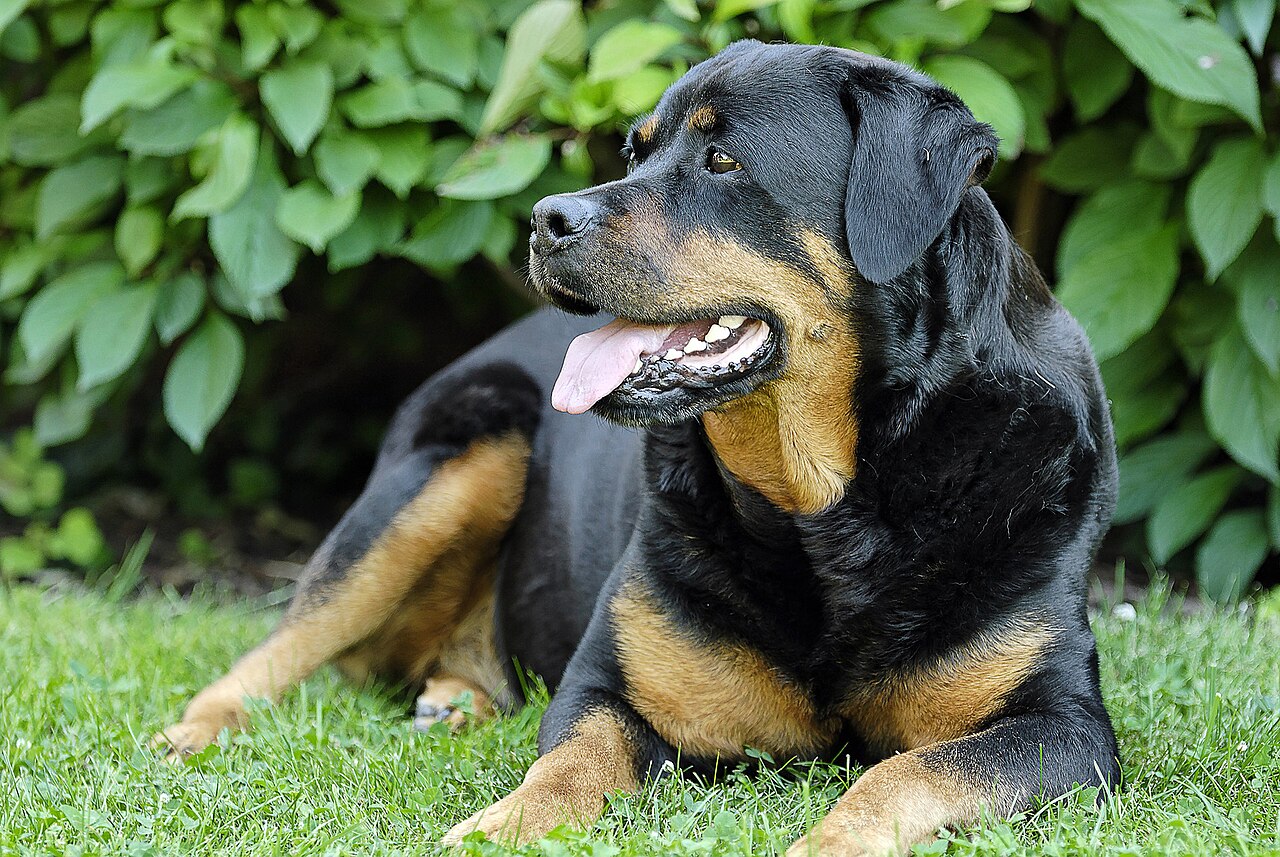
Figure: Rottweiler lying on grass. mar_qs, Wikimedia Commons

Training must start early: leadership, puppy socialization, basic classes, and living in the owner’s home are keys to a well-mannered Rottweiler.[1] They are “people dogs” that do poorly when isolated from humans and life experience; every breed must meet strange animals and people.[1] The breed is intelligent, trainable, and willing, though some individuals are stubborn; discipline should be consistent, fair, and firm without roughness—roughhousing may encourage aggression and should be avoided.[1] Early socialization can channel territorial instincts positively.[1] Structured, reward-based training and gradual socialisation can help an individual dog handle unfamiliar situations calmly.
Coat care and health topics
The coat is straight, coarse, and medium-length on the outside, lying flat, with undercoat on neck and thighs; weekly brushing and regular baths usually suffice.[1] Shedding is only moderate most of the year, heavier in spring and fall; brush teeth and trim nails weekly—a grinding tool helps with nails.[1] “Moderate shedding” must not be rewritten as “will not cause allergies”—triggers are complex, and household reactions need real exposure and medical advice.[1]
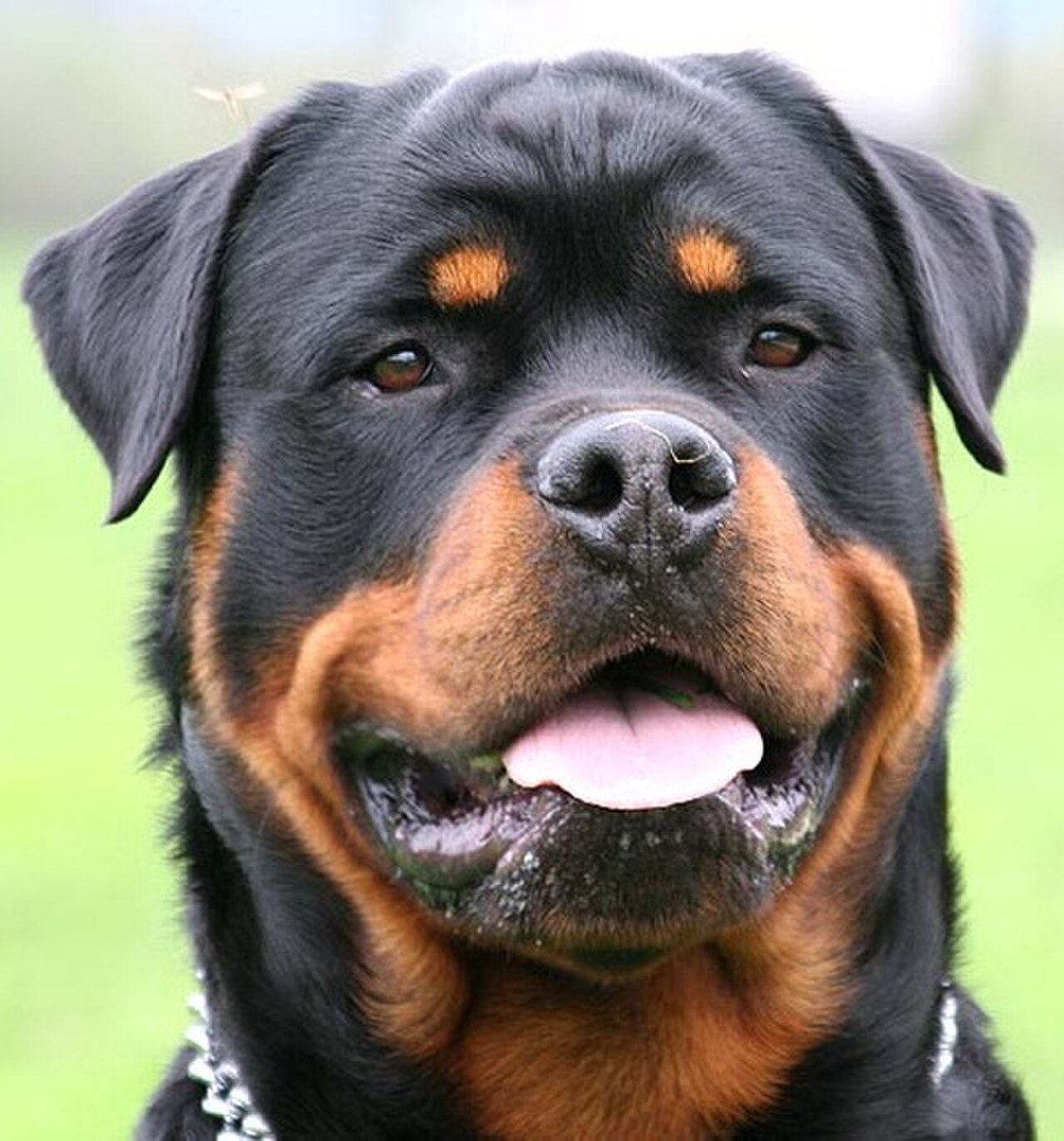
Figure: Rottweiler head portrait. Rains27, Wikimedia Commons

Responsible breeders test potential sires and dams for problems such as hip dysplasia (visible on X-ray), eye disease, and heart conditions; cancer can occur as in dogs generally.[1] Research funded by the Rottweiler Health Foundation has linked cancer and longevity discussions to vaccination regimens and keeping males and females intact until at least six years of age—stated as research and club concerns, not a bedside diagnosis or health guarantee for any dog.[1] Households can ask for screening records, follow veterinary exams and imaging, and not treat a powerful look as a free pass.
Droving and guarding history explain the Rottweiler’s mass and work appetite: daily exercise, early socialization, and consistent non-rough rules matter more than “it can watch the yard.” The short coat is easy to keep; hip, eye, and heart screening and weight management still need questions. Fit depends on whether a household can supply activity, training, and companionship time; individual temperament and health still rest on living with the dog and veterinary judgment. Guarding-type companions often need more time than “a big enough yard”: walks with a person and rules that keep up are what keep size from becoming a burden.
References
-
American Kennel Club. Rottweiler Dog Breed Information. https://www.akc.org/dog-breeds/rottweiler/
-
American Kennel Club. Official Standard of the Rottweiler. https://images.akc.org/pdf/breeds/standards/Rottweiler.pdf
-
Wikimedia Commons. File:Rottweiler standing facing left.jpg. https://commons.wikimedia.org/wiki/File:Rottweiler_standing_facing_left.jpg