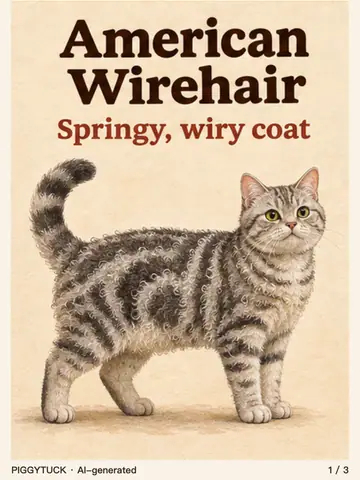
The American Wirehair has a short, dense coat that stands away from its body. Individual hairs curl, hook, or bend, giving the coat a rough, springy texture.[1] Coat quality is the breed’s highest-scoring feature in Cat Fanciers’ Association judging, with 45 points. The registry can show wirehaired and straight-coated cats in separate classes.[2]
How associations describe type and origin
The American Wirehair arose from a spontaneous mutation recorded in a litter of barn cats in upstate New York in 1966.[2] Only one of the four original wirehaired kittens survived—a red tabby and white male later known as Council Rock Farms Adam of Hi-Fi. Breeder Joan O'Shea used him to establish the breed and found the wiry coat dominant but incompletely penetrant: roughly half the kittens from a wire-to-straight breeding may be wired, while two wired parents raise that share.[2] CFA accepted registrations in 1967 and granted championship status in 1978.[2] The only allowed outcross is the American Shorthair, so structure stays close to that relative, with more prominent cheekbones framing large, round eyes.[2] These are registration and conformation facts, not promises about any one cat's temperament.
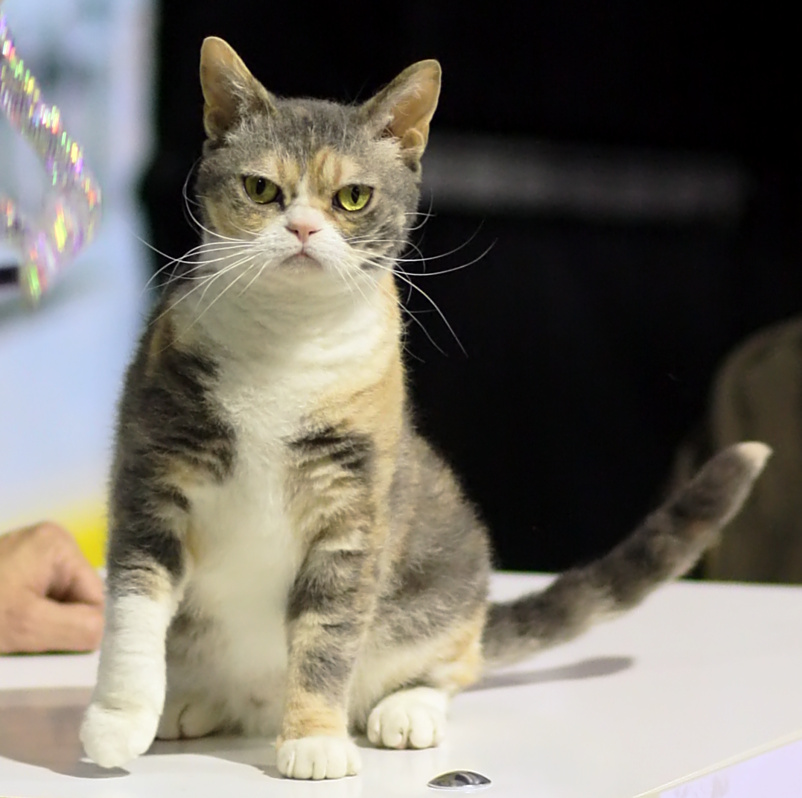
Figure: Blue tortie-white American Wirehair sitting on a show table. Heikki Siltala, Wikimedia Commons[5]

The American Wirehair is a medium to large, muscular cat with a round, well-developed rib cage; medium-length solid legs ending in firm round paws; and a medium tail with a broad base tapering to a rounded tip. The broad head is slightly longer than wide, with a medium broad nose, a modified stop, and a massive, angular muzzle; ears are medium with slightly rounded tips; eyes are round, open, and slightly slanted, with color matching the coat—green only in silvers, golden only in brown tabbies.[1] Beyond coat texture, WCF does not recognize chocolate or cinnamon (or their dilutes) in any combination, nor the pointed pattern; other colors and patterns are allowed, including any amount of white.[1] CFA's wired-coat wording is more granular: medium length, dense, springy, resilient, and coarse to the touch; hair inside the ears and the whiskers should also be crimped or bent; density favors ringlets over waves. Straight-coated cats need dense, thick, medium-length straight hair, with slight crimping allowed at the tail base and inside the ears, and curly whiskers still desirable.[2] Penalties include a deep nose break and a close-lying coat; disqualifiers include incorrect coat, kinked or abnormal tail, long or fluffy fur, wrong toe count, and evidence of hybridization into chocolate, lavender, Himalayan pattern, or those with white.[2] Standards describe a show ideal; household cats vary in curl, hardness, and density.
Coat care and household interaction
Use a gentle brush suited to the individual cat: some Wirehairs have a soft, dense coat, and others have stiffer, sparser hair. An occasional bath can remove loose fur. Towel the cat dry and let the coat finish drying in a warm room.[2] Short handling sessions in kittenhood can help a cat get used to brushing, ear checks, and nail care.
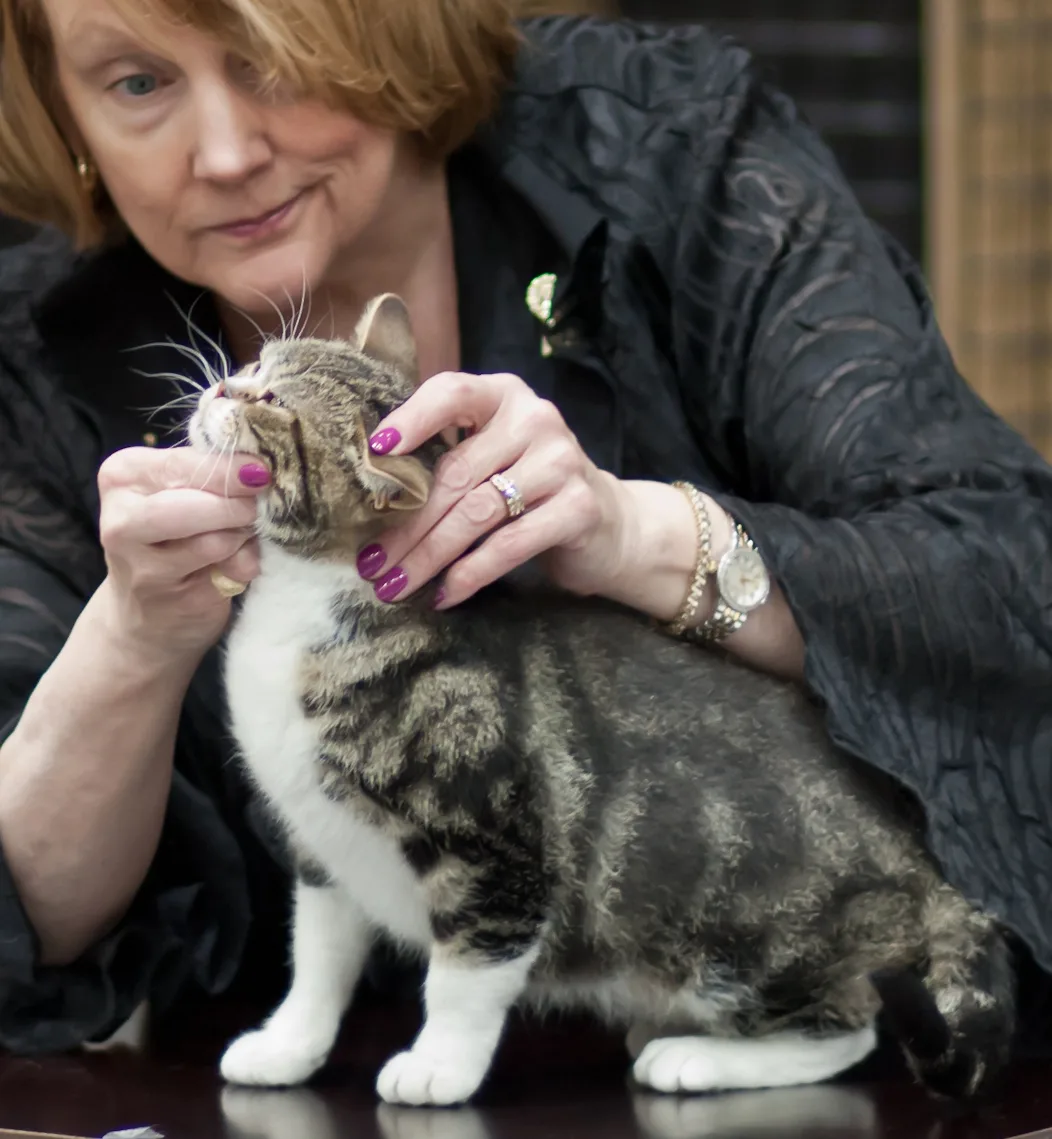
Figure: Brown tabby-white American Wirehair standing on show table; judge lifts chin. Heikki Siltala, catza.net
Many Wirehairs like to watch household activity and seek out familiar people. Some announce playtime with a purr or learn to open cupboards, especially where food is kept.[2] Offer chances to chase and pounce on toys. Around children and other pets, let the cat approach at its own pace and have somewhere to retreat.
Indoor environment and health questions
Indoor cats need a safe retreat, separate places to eat, drink and use litter, opportunities to stalk and play, predictable social contact, and a manageable sensory environment. A sturdy tree, a window perch, and rotating wand toys give an American Wirehair places to watch and play. Multiple cats benefit from resources spaced around the home.[3]
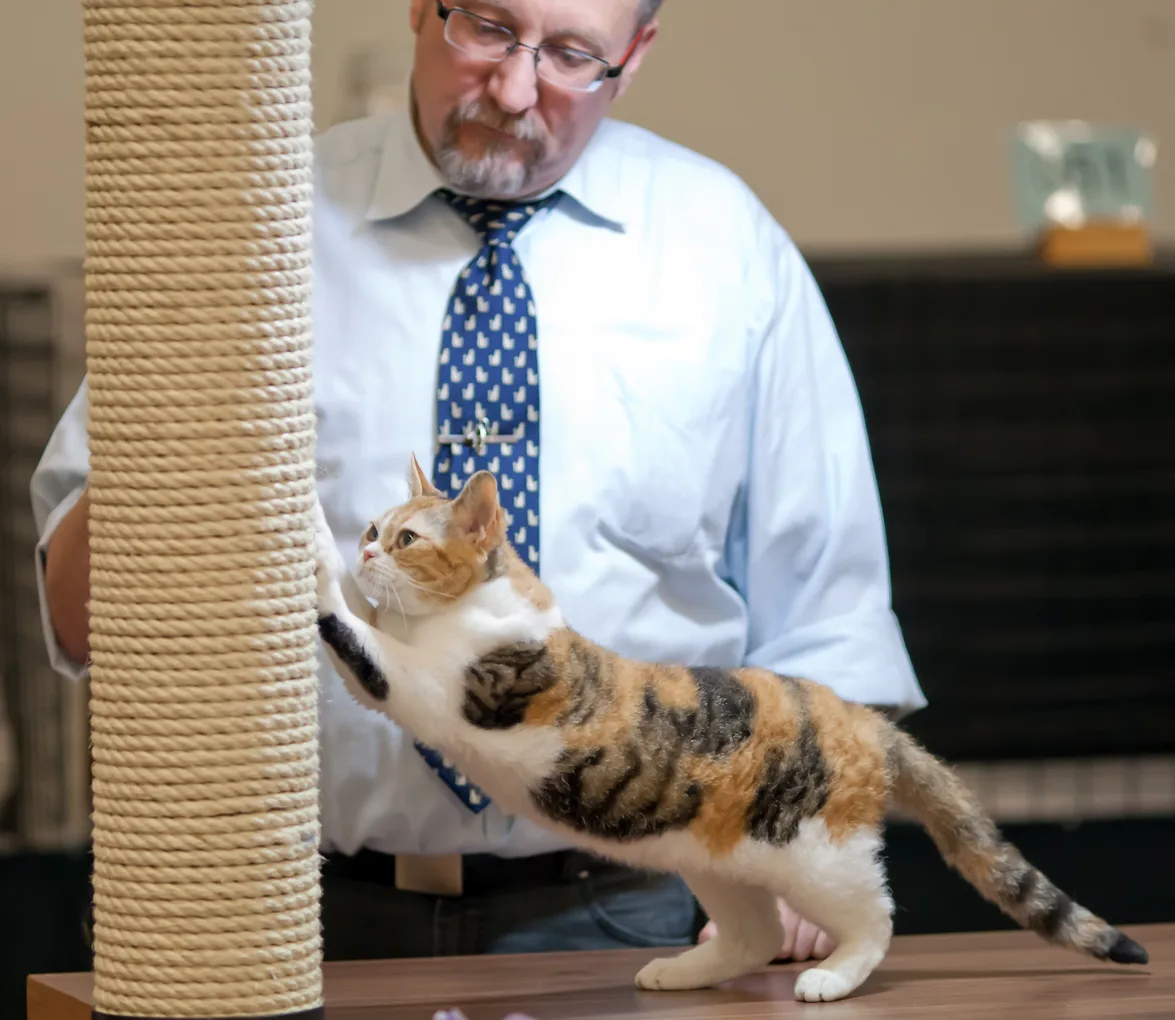
Figure: Orange-black tabby-white American Wirehair, hind on table, paws on sisal post. Heikki Siltala, catza.net
Ask about the individual cat’s family health history and any genetic tests or echocardiograms done on the parents.[2] Cats with hypertrophic cardiomyopathy (HCM) may appear normal early on. The disease thickens the wall of the left ventricle, and a veterinarian can assess it with echocardiography after considering other causes such as high blood pressure or hyperthyroidism. Laboured breathing or sudden hind-leg pain or weakness needs prompt veterinary attention.[4] Plan routine checkups and any follow-up imaging with your veterinarian.[2][4]
To recognize an American Wirehair, look first for the springy wired coat, medium-to-large solid body, and prominent cheekbones. To share a home, plan light grooming, an indoor setup that covers the five pillars, and heart-health questions tied to the American Shorthair outcross. Standards help identify type and coat weighting; temperament and health still rest on the individual cat and veterinary judgment, not on one show-bench photograph.
References
-
World Cat Federation. American Wirehair (AWH) breed standard (2010-01-01). https://wcf.de/pdf-en/breed/AWH_en_2010-01-01.pdf
-
Cat Fanciers' Association. American Wirehair. https://cfa.org/breed/american-wirehair/
-
Feline Veterinary Medical Association. Meeting the Physical and Emotional Needs of Indoor Cats (position statement news, 2025-08-28). https://catvets.com/news/2025-indoor-cats-position-statement/
-
Cornell Feline Health Center. Hypertrophic Cardiomyopathy. https://www.vet.cornell.edu/departments-centers-and-institutes/cornell-feline-health-center/health-information/feline-health-topics/hypertrophic-cardiomyopathy
-
Wikimedia Commons. File:American Wirehair - CFF cat show Heinola 2008-05-04 IMG 8721.JPG. https://commons.wikimedia.org/wiki/File:American_Wirehair_-_CFF_cat_show_Heinola_2008-05-04_IMG_8721.JPG