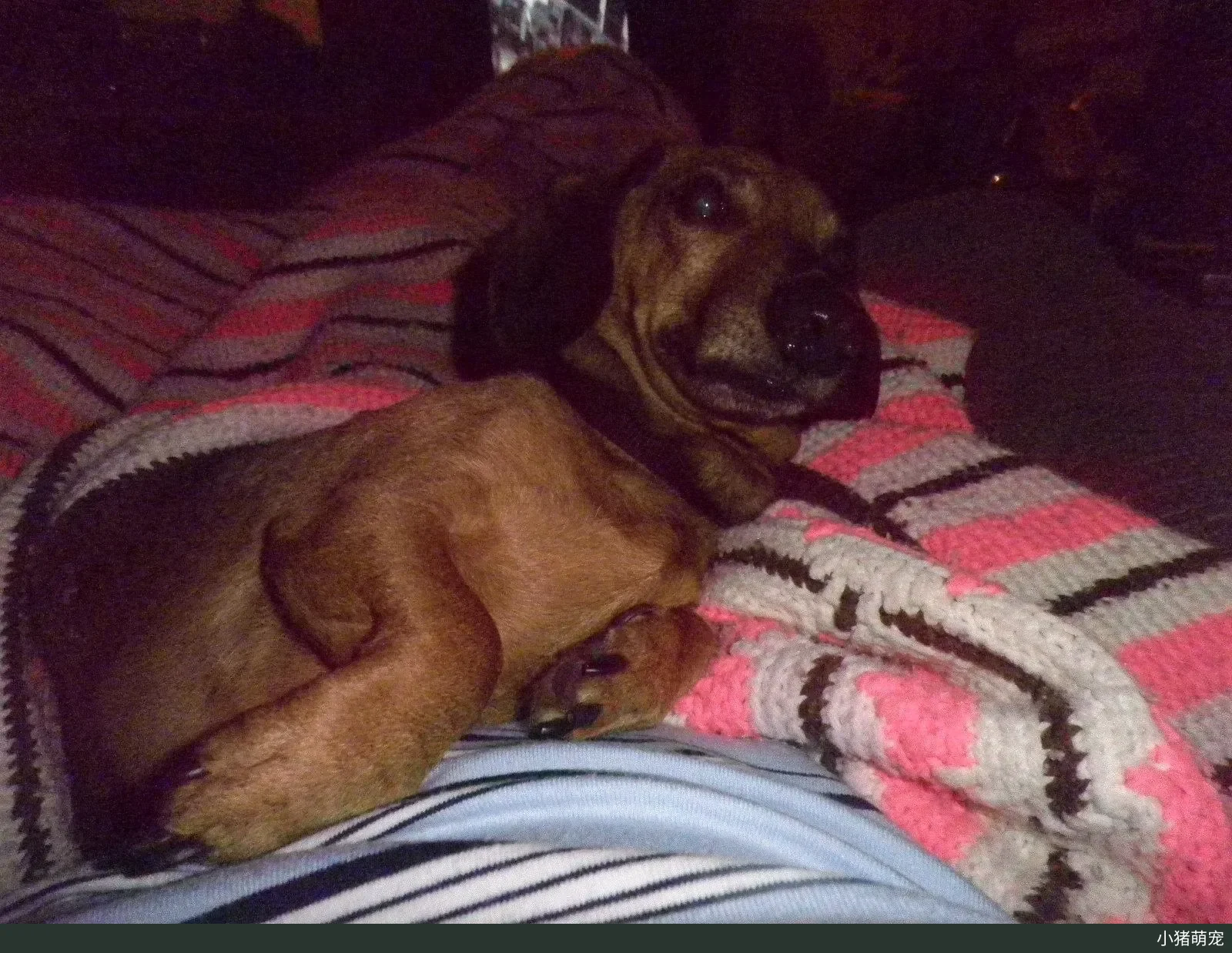
A chocolate smooth miniature Dachshund (photographed June 2013). Image: Lord Laitinen, from Wikimedia Commons, license CC0 1.0.
The Dachshund has a long body and short legs and is often called a “sausage dog,” yet its German name means “badger dog.” This German hunting breed was developed to go to ground after badgers; under the FCI standard it comes in three sizes and three coat types. Smart, brave, and opinionated, it needs extra patience in training; the long back and short legs also make intervertebral disc disease especially common—protecting the back is lesson one of life with a Dachshund.
Origin and history
Dachshund means “badger dog” in German. Europeans have used dogs to hunt badgers at least since the Middle Ages. The FCI standard says people selected short-legged dogs suited to underground work from German scent hounds (Bracken), and the Dachshund followed; an AKC breed-history article says the type gradually took shape in the late seventeenth century, and by the eighteenth century German foresters and hunters were breeding it steadily. France and other places also had their own badger dogs, so the Dachshund Club of America (DCA) notes that the earliest ancestral origin remains uncertain, while credit for fixing the type belongs to Germany.
In 1888 Germany founded its earliest Dachshund specialty club (the FCI standard records Deutsche Teckelklub e.V.). Per AKC records cited by DCA, AKC recognized the breed in 1885. During World War I anti-German feeling ran high; American owners renamed it “Badger Dog” or “liberty hound” to avoid hostility, and only in 1923 formally restored the name Dachshund.
Today it is more than a sofa companion. FCI still classifies the Dachshund as a hunting dog that “works above and below ground,” alone in Group 4, and requires working tests; the UK Kennel Club also notes that in its native Germany it is still used to track wounded deer and to go to ground after badgers and rabbits.
Appearance and size
The FCI standard describes the Dachshund as low to the ground and short-legged, with a long yet compact, muscular body, a proudly carried head, and an alert expression. Height at the withers is about one-third of body length; body length to height is about 1.7–1.8:1. The AKC standard likewise stresses that the Dachshund should not look crippled, clumsy, or restricted in movement, but free, agile, and enduring. This build was designed for work: per the AKC history article, short legs help enter badger dens, compact feet dig earth back, and a deep, long chest gives heart and lungs room for long underground effort.
There are three coats: smooth, wirehaired, and longhaired. AKC articles say smooth is considered the original type; longhair came from selecting longer-coated smooths; wirehair appeared in the nineteenth century after crossing with coarse-coated terriers. FCI-accepted colors include solid red, black or brown with tan markings, and dapple (merle) and brindle; wirehairs also have “wild boar” color.
The three Dachshund coat types, left to right: smooth Jimmy Dean, longhaired Link, and wirehaired Frank (photographed August 2010). Image: Tony Alter (Tobyotter), from Flickr, license CC BY 2.0.
Size divisions differ by kennel organization:
- FCI: three types by chest circumference, measured after 15 months of age. Standard: males above 37 cm up to 47 cm, females above 35 cm up to 45 cm; miniature: males above 32 cm up to 37 cm, females above 30 cm up to 35 cm; rabbit (Kaninchen): males 27–32 cm, females 25–30 cm.
- AKC: only standard and miniature. Miniatures compete in the class for dogs 12 months and older weighing 11 lb (about 5 kg) or less; standards usually weigh 16–32 lb (about 7–14.5 kg).
- UK Kennel Club: also standard and miniature, each in three coats—six breed classifications sharing one standard.
Temperament, exercise, and training
The two major standards emphasize different sides of temperament. FCI writes “friendly by nature, neither shy nor aggressive, even-tempered,” while also an eager, persistent, fast hunting dog with an excellent nose; the AKC standard says “clever, lively, and courageous to the point of rashness,” with any shyness a serious fault. In a narrow tunnel the Dachshund must face a badger alone and decide for itself; the AKC history article sees this as why it will not “blindly obey.”
That independence shows in daily training. The UK veterinary charity PDSA advises positive, reward-based methods from puppyhood, clear consistent rules, and readiness to be “very, very patient”: once a more interesting scent appears, interest in training may vanish. PDSA also notes that Dachshunds bark with a surprisingly deep voice—practice reducing needless barking early; they bond closely with people and may show separation anxiety if left alone long. Prey drive is strong; cohabiting with small pets is not advised, and even cats raised together should be supervised.
For exercise, Dachshunds have more energy than they look. The UK Kennel Club’s reference for miniature smooths is up to 1 hour a day; PDSA’s minimums are 1 hour for standards and 30 minutes for miniatures, ideally split into two walks, one with plenty of sniffing time, plus free running in a safe enclosed space. Short daily training, scent games, and puzzle toys also engage the mind. Puppy skeletons are still developing—increase exercise gradually and avoid overdoing it.
Common health issues
The condition Dachshund owners must watch most is intervertebral disc disease (IVDD). The UC Davis Veterinary Genetics Laboratory (VGL) explains that an FGF4 retrogene insertion on dog chromosome 12 (called CDDY) both shortens the legs and causes discs to calcify and degenerate early in youth. Degenerated discs can herniate and compress the spinal cord, causing severe pain or neurologic dysfunction. Among Dachshunds tested at that lab, the CDDY allele frequency is about 0.92 (data updated September 2024)—nearly all Dachshunds carry it.
Several studies put lifetime or prevalence figures roughly around “one in five or six”: the UK 2015 DachsLife questionnaire of 2,031 Dachshunds found a vet-diagnosed IVDD prevalence of 15.7%, highest in standard smooths (24.4%) and lowest in standard wirehairs (7.1%); a Danish study found overall disc herniation incidence of 18% in Dachshunds; a 2025 U.S. study of 43,517 companion dogs found a Dachshund lifetime prevalence of 15.3%, highest among purebreds. These figures all rely on owner questionnaires, with different populations and diagnostic definitions.
DachsLife also found that dogs exercised more than 1 hour a day and rated moderately to highly active by owners had lower IVDD odds; those exercised under 30 minutes had higher odds. This is a cross-sectional survey—association, not proof that more exercise prevents IVDD. Dogs “not allowed to jump on and off furniture” had higher odds; the authors suggest reverse causation—dogs that had already been ill were barred from jumping. PDSA’s daily advice remains to avoid jumping and keep the dog lean with a balanced diet. If a dog shows clear pain or abnormal gait, see a veterinarian promptly.
Beyond the back, PDSA lists common Dachshund issues including heart disease (miniatures), progressive retinal atrophy (PRA—gradual vision loss over months to years; DNA testing before breeding miniatures is advised), and dry eye. When welcoming a Dachshund puppy, ask what health screens the parents have had.
References
-
FCI. FCI-Standard N° 148 DACHSHUND. Official valid standard published 2021-05-25; English translation 2022-03-14.
-
FCI. DACHSHUND (148). Breed nomenclature page.
-
American Kennel Club. Official Standard of the Dachshund.
-
Flaim D. Dachshund History: The Badger Dog's Fascinating Past. American Kennel Club, updated 2024-01-25.
-
Dachshund Club of America. Dachshund History.
-
Dachshund Club of America. The Dachshund Illustrated Standard.
-
The Kennel Club. Dachshund (Miniature Smooth Haired).
-
PDSA. Dachshund.
-
UC Davis Veterinary Genetics Laboratory. Chondrodystrophy (CDDY and IVDD) and Chondrodysplasia (CDPA). Frequency table updated 2024-09-16.
-
Packer RMA, Seath IJ, O'Neill DG, De Decker S, Volk HA. DachsLife 2015: an investigation of lifestyle associations with the risk of intervertebral disc disease in Dachshunds. Canine Genetics and Epidemiology, 2016.
-
Bruun CS, Bruun C, Marx T, Proschowsky HF, Fredholm M. Breeding schemes for intervertebral disc disease in dachshunds: Is disc calcification score preferable to genotyping of the FGF4 retrogene insertion on CFA12?. Canine Medicine and Genetics, 2020.
-
Wee C, Nin DZ. Demographic and lifestyle characteristics impact lifetime prevalence of owner-reported intervertebral disc disease: 43,517 companion dogs in the United States. JAVMA, 2025;263(5).