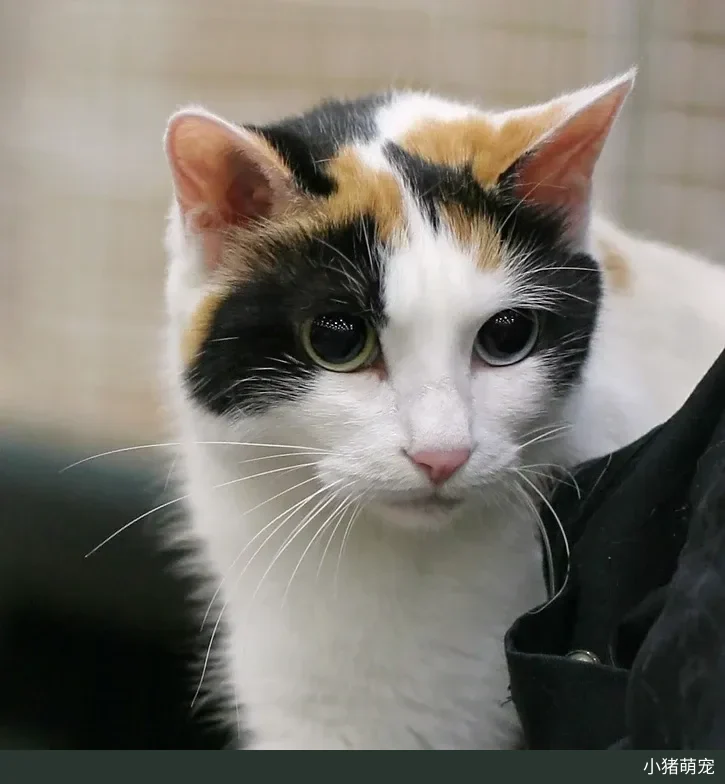
A female shorthair Japanese Bobtail with a mi-ke coat and odd eyes, photographed in October 2006 at the URK cat show in Vantaa, Finland. Photo: Heikki Siltala; source: Wikimedia Commons; license: CC BY 3.0.

The Japanese Bobtail’s most striking mark is the fluffy “pom-pom” at the base of the tail: the vertebrae inside are bent and kinked, and breed associations say no two are exactly alike. This natural breed from Japan was first brought to the United States in 1968; both CFA and TICA recognize longhair and shorthair types. This article covers origins, the cause of the short tail, temperament, and care.
Origins, history, and maneki-neko lore
Short-tailed cats have lived in Japan for a long time, but accounts of where they first came from do not agree. CFA’s breed history says short-tailed cats appear in Japanese scrolls, prints, and carvings from the Middle Ages onward, and suggests they may have arrived from the Korean peninsula as early as the sixth century; a 2016 genetic study in Scientific Reports cites the view that domestic cats reached Japan from China in the early sixth century. TICA also notes a fifteenth-century painting in the Freer Gallery of Art at the Smithsonian that shows two longhaired short-tailed cats. These claims come from association or secondary sources; this article did not locate matching primary historical documents or collection records.
How did they go from “court pets” to “street cats”? Per CFA, short-tailed cats were at first kept only by court members; in 1602, to fight rodents threatening the silk industry, an edict ordered cats turned out into the streets. Short-tailed cats spread nationwide, mixed with street cats, and short tails became a common trait among many Japanese cats. TICA also records a seventeenth-century story of releasing cats to protect the silk industry, but explicitly labels it “according to folklore.” The start of modern breeding is much clearer: in 1968, breeder Judy Crawford sent the first cats from Japan to Elizabeth Freret in the United States. CFA granted championship status to the shorthair in 1976 and to the longhair in 1993; TICA accepted the shorthair for competition in June 1979 and the longhair in March 1991.
The link to maneki-neko needs careful separation. TICA calls the Japanese Bobtail “Japan’s lucky cat” and writes that a mi-ke cat with a raised beckoning paw and a short tail is a symbol of good fortune in Japan. Origins of maneki-neko itself have several legends. The official site of Gotokuji Temple in Setagaya, Tokyo, tells how Ii Naotaka of the Hikone domain, returning from falconry, was beckoned into the temple by a cat at the gate and thus escaped a thunderstorm; he later funded the temple’s 1633 rebuilding, and the temple later built a hall of good fortune dedicated to that cat. In a 2023 article, Tets Kimura of Flinders University notes that maneki-neko-style cat figurines can be traced roughly to the Edo period (1603–1868) or a little earlier, possibly first appearing at Gotokuji, Saihoji, or Jishoin in Edo, with different stories at each temple. None of these sources identify the breed of the legendary cat. A safer statement is that breed associations often link the Japanese Bobtail with the maneki-neko image, but available evidence does not prove maneki-neko was modeled on this breed.

Maneki-neko ceramic figures at Gotokuji Temple in Setagaya, Tokyo, photographed in July 2023. Photo: LeLaisserPasserA38; source: Wikimedia Commons; license: CC0 1.0.

Breed standard and short-tail genetics
Per CFA’s standard, the Japanese Bobtail is a medium-sized, elongated cat—muscular but not bulky. The head is roughly an equilateral triangle, with high cheekbones and a long, straight nose; large oval eyes slant distinctly in profile; ears are large and upright. Hind legs are clearly longer than the front; when standing relaxed the hind legs bend so the back stays essentially level—TICA says that is why they jump high and easily. On weight, TICA’s reference is females 5–7 lb (about 2.3–3.2 kg) and males 8–10 lb (about 3.6–4.5 kg). Coat comes in shorthair and longhair, soft and silky to the touch, without a pronounced undercoat. CFA’s standard prefers no particular color or pattern; blue eyes and odd eyes are both allowed. Traditionally the most beloved is still the black-red-white tri-color “mi-ke.”
The tail is the soul of the breed. CFA requires a clearly visible tail formed of one or more bends, angles, or kinks; the farthest extension of the caudal vertebrae from the body must not exceed 3 inches (about 7.6 cm); the tail may be rigid or flexible. Hair on the tail is longer than on the body and flares into a rabbit-tail pom-pom that hides the bone structure beneath. Under CFA show standards, complete absence of caudal vertebrae, vertebrae longer than 3 inches, lack of pom-pom effect, or a “delayed bob” with an inch or two of ordinary tail before the pom-pom all bring disqualification. CFA also notes that this short tail comes from a dominant gene—it is not a docked tail.
Researchers have found genetic clues behind the short tail. A University of California, Davis study by Pollard and colleagues (published online 2014) confirmed through breeding analysis that the short tail is autosomal dominant, that length and kink position vary by cat, and that it is unrelated to the T-box gene linked to Manx taillessness. In 2016, Lyons and colleagues (BMC Genomics) and Xu and colleagues (Scientific Reports) independently reported that the Japanese Bobtail short tail is associated with a missense variant (p.V2A) in the HES7 gene. All 12 Japanese Bobtails tested by Xu et al. carried two copies of the variant; the same variant also appears in some curly-tailed street cats in southern China. Cats with two copies show the strongest kink; those with one copy show a milder kink. In a rough analogy, HES7 is like a metronome that paces vertebral segmentation in the embryo—a slight timing error can shorten, fuse, or bend the caudal vertebrae.
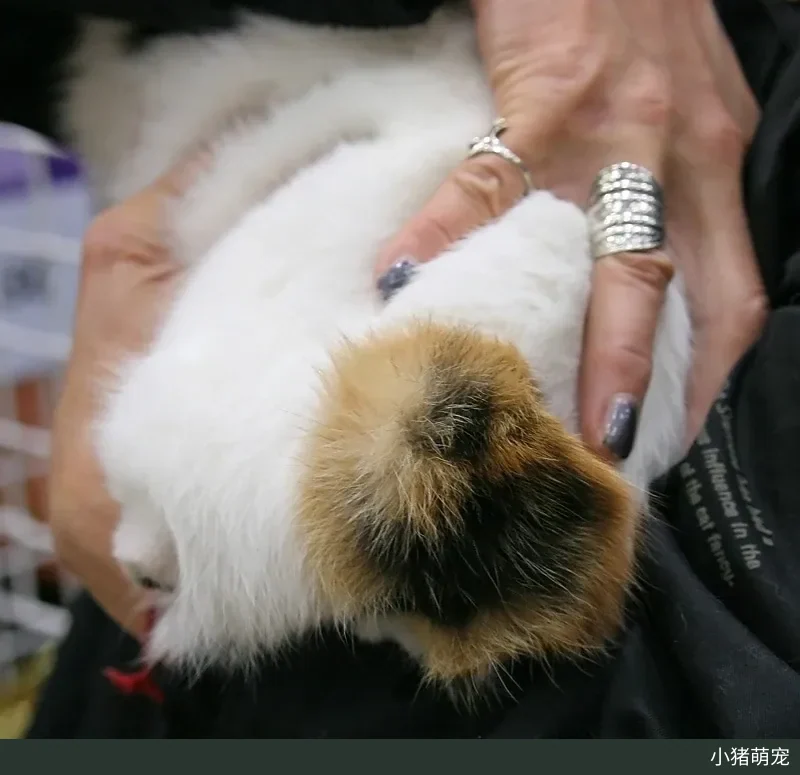
Close-up of a Japanese Bobtail’s pom-pom short tail; the tail belongs to a female shorthair Japanese Bobtail photographed in October 2006 at the URK cat show in Vantaa, Finland. Photo: Heikki Siltala; source: Wikimedia Commons; license: CC BY 3.0.

Temperament and life at home
CFA and TICA describe temperament in highly consistent terms: lively, intelligent, and people-oriented. They will nap briefly on your lap, then soon head off to explore the next corner—so TICA says outright that this is “not a lap cat.” They like to “chat” with people in soft chirps and meows; CFA calls the voice interesting rather than noisy. TICA also notes that they love to dab at water, play fetch, and often perch on a family member’s shoulder; CFA says they excel in feline agility.
At home, both associations say they get along well with children and dogs; CFA adds that resident cats may need extra time to adjust to a newcomer who “looks tailless.” They need a fair amount of attention and interaction, and will seek it out if they do not get it. TICA suggests teaching a few tricks and offering puzzle toys that reward treats; if the house is often empty during the day, provide climbing and high lookout spots and schedule fixed daily play sessions. These are breed-level generalizations; individual personality still depends on upbringing and socialization.
Day-to-day care and health notes
Daily grooming is not demanding. Without a pronounced undercoat they shed little, and longhairs are less prone to mats. CFA suggests brushing a shorthair a few times a month with a flea comb and brushing a longhair more often with a fine-toothed comb, with occasional baths; TICA suggests twice-weekly brushing, more often in spring and autumn shedding seasons. As with all cats, trim nails regularly, clean ears, brush teeth with vet-approved pet toothpaste, and provide a tall enough scratching post. There are no special dietary needs—quality cat food plus fresh clean water daily; TICA cites cat-behavior specialists in recommending that the water bowl sit at least 3 feet (about 0.9 m) from food, or that a filtered fountain be used to encourage drinking.
The tail needs the most care. CFA warns that whether rigid or flexible, these tails are sensitive and should always be handled gently; TICA notes that the vertebrae are often fused, or flexible at only one or two points, so touch must be very light. If there are young children at home, explain clearly: no pulling or pinching the tail. If the cat shows clear pain when the tail is touched, or an abnormal gait, see a veterinarian promptly.
On health, CFA says there are currently no known abnormalities linked to this unusual tail; overall it is a sturdy natural breed without specific health problems. TICA also considers it generally healthy, recommends timely vaccines and parasite control, and gives an expected lifespan of 9–13 years or more. In research, Pollard et al.’s radiographs found that all 17 curly-tailed cats with full-spine films had vertebral counts that departed from the norm—most missing one thoracic vertebra, nearly half with caudal hemivertebrae—but these changes did not correspond to disease or death; Lyons et al. also reported no extra abnormalities in cats carrying two copies of the variant. Those studies covered only a few dozen cats, however, and there are still no large-scale lifespan or disease-incidence data. CFA also notes that the breed is relatively rare, so breeders need to maintain genetic diversity; CFA breeders in the United States have long been able to bring in Japanese street cats and use genetic testing to reduce problematic pairings. If you plan to welcome one, ask the breeder about parental health records.
References
-
The Cat Fanciers' Association (CFA). Japanese Bobtail (breed profile and show standard; page undated; accessed 2026-10-18)
-
The International Cat Association (TICA). Japanese Bobtail (page undated; accessed 2026-10-18)
-
Pollard RE, Koehne AL, Peterson CB, Lyons LA. Japanese Bobtail: vertebral morphology and genetic characterization of an established cat breed. Journal of Feline Medicine and Surgery, 2015, 17(8): 719–726 (published online 2014-12-08)
-
Lyons LA, Creighton EK, et al. Whole genome sequencing in cats, identifies new models for blindness in AIPL1 and somite segmentation in HES7. BMC Genomics, 2016 (published 2016-03-30)
-
Xu X, Sun X, et al. Whole Genome Sequencing Identifies a Missense Mutation in HES7 Associated with Short Tails in Asian Domestic Cats. Scientific Reports, 2016, 6: 31583 (published 2016-08-25)
-
Gotokuji Temple. Gotokuji and Manekineko (accessed 2026-10-18)
-
Kimura T. What is the story of maneki-neko, the Japanese beckoning cat?. The Conversation, 2023-07-03