The name Kinkalow refers to a cross between the Munchkin and the American Curl. The Japan Cat Club lists these two parents under Kinkalow in its registration table. The familiar short legs come from the Munchkin, and the ear tips that curve backward come from the American Curl. When you read about an individual cat, each part of its record answers a different question. A photograph shows which way its ears curl, a pedigree documents its ancestry, and a registration tells you which registry’s rules apply.[1][2]
The Rare and Exotic Feline Registry (REFR) accepts Kinkalow for registration under the code KKL. The International Cat Association (TICA) has a different history with the name. Its spring 2015 board meeting materials listed the Kinkalow and the longhaired Kinkalow separately as experimental breeds. In August 2025, the TICA board voted unanimously to end experimental status for a group of breeds under Registration Rule 33.1.2.3, effective immediately. Both Kinkalow entries were on that list. A Kinkalow can therefore be eligible for REFR registration, while its experimental listing with TICA belongs to the historical record.[2–4]
Watch a route your cat takes every day
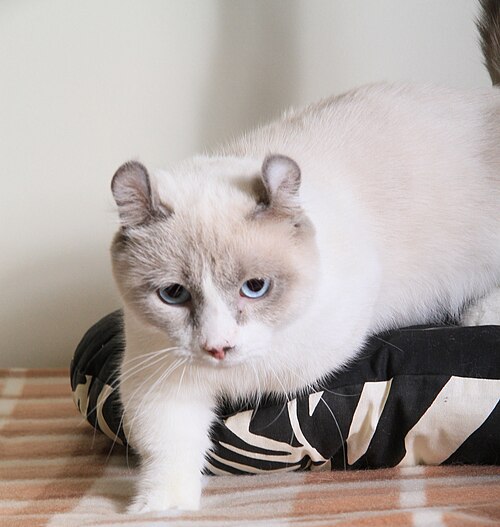
One forepaw clears the edge of the bed. Kirimiti, Wikimedia Commons[11]

In the photograph, the cat has one forepaw on the blanket while its body is still on the cushion. A home is full of small changes in height like this one. There is the rim of a cat bed, the lip of a litter box and the last step down from the sofa. To see how a short-legged cat manages them, pick a route your cat takes willingly each day and watch the whole round trip. Where does it push off on the way up to the sofa? On the way down, does it land on the floor or step onto a low stool first? Knowing your cat’s usual route will help you recognize a change later.[5][6]
If your cat likes a window seat, put a sturdy, nonslip step on the way to it. Give the cat a few days to choose whether to use it, then adjust its position to suit the route the cat takes. The same idea works for the litter box. Look for a low entrance with enough room inside for the cat to turn around. Pay particular attention to the return trip from a perch. A cat may climb up readily and then spend a long time at the edge before coming down. Putting a secure landing on the side it usually approaches gives it the freedom to come and go without waiting to be lifted.[5][6]
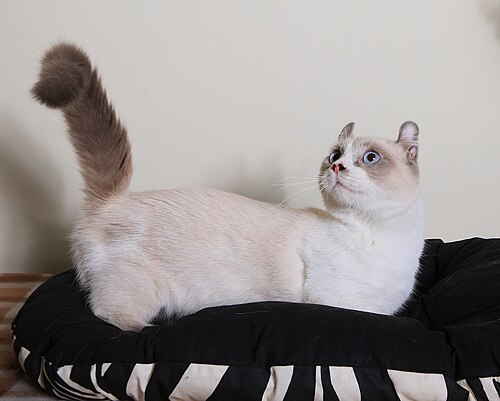
A Kinkalow stands in profile. Kirimiti, Wikimedia Commons[13]

Short-legged cats still need opportunities to chase, hide and watch what goes on around them. During play, draw a wand toy along the floor and pause it at the edge of a cardboard box so the cat can watch, stalk and pounce. A cat that enjoys a view can have a lookout it can reach. One that wants quiet needs a hiding place it can enter and leave on its own. In a household with several cats, offer water, food, litter boxes and resting places in separate locations. Even a bowl at floor level can be hard to reach if another cat guards the only way to it.[5]
If your cat skips a jump once, consider what was happening at the time. Pay closer attention when a familiar movement changes repeatedly. A cat that used to jump straight onto the sofa may now wait to be lifted every time. It may start toward a window it used to visit daily, then turn back halfway. Take a short video while the cat is moving of its own accord. Try to include how it starts off, turns and lands, and note when you first noticed the change. If your cat keeps avoiding a movement it used to manage easily, or if it is limping, arrange a veterinary assessment. Earlier and recent videos give the veterinarian something to compare without having to coax the cat through another jump.[6]
Check curled ears from the outside
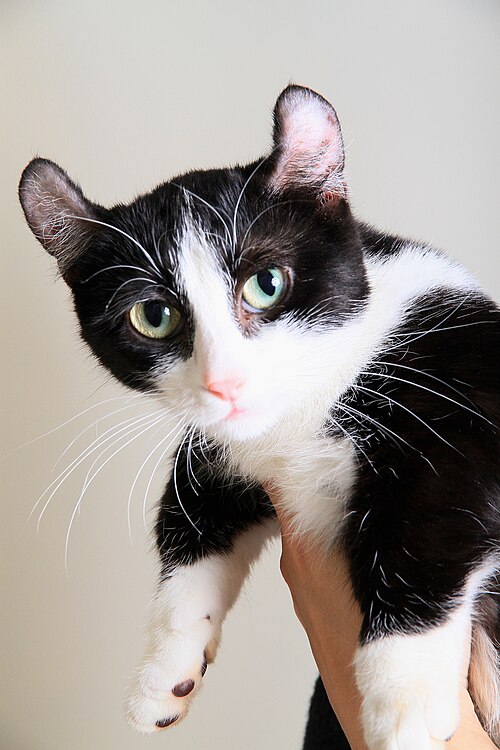
The ear tips curl backward. Kirimiti, Wikimedia Commons[12]

The front view of the black-and-white cat shows the curve of both ear tips. When your cat is relaxed and comes close, look at the skin you can see on each ear. You can get to know its usual color and outline without straightening the tips. Watch for a change such as swelling on one side, discoloration, discharge at the ear opening or repeated scratching at the same ear with a hind paw. The Cornell Feline Health Center advises having persistent ear scratching checked promptly by a veterinarian. Keep cotton swabs and other objects out of the ear canal.[7]
Why short legs raise welfare concerns
Short legs can affect more than the height of a jump. An imaging study examined five cats with an inherited form of dwarfism in which the limbs are disproportionately short. The researchers found changes in the alignment of long bones in the front and hind limbs. One example was an outward twist of the radius, one of the bones in the foreleg. Those findings give owners a reason to pay attention to how a short-legged cat walks. Whether a particular cat feels pain as it walks requires a clinical assessment. The study did not follow a group of Kinkalows over time, so it cannot tell us how often they develop joint disease or how a particular kitten will walk years from now.[8]
The UK’s Governing Council of the Cat Fancy cites reported health problems in listing the Munchkin, the Minuet and other dwarf breeds as ineligible for recognition. It lists the Scottish Fold separately because of osteochondrodysplasia, a disorder of bone and cartilage. The Kinkalow’s backward curl comes from the American Curl. The shape of its ear tips alone gives no basis for attributing the Scottish Fold disorder to it. The Feline Veterinary Medical Association’s position on breeding puts a cat’s lifelong comfort, behavior and health needs ahead of selection for appearance. A breeding decision therefore calls for weighing the potential cost of an inherited body shape. For a cat already at home, that concern comes down to a familiar question. Can it still make its usual trip to the window in comfort?[1][8–10]
References
-
[1] Japan Cat Club. レジストレーションオンリー猫種一覧.
-
[2] Rare and Exotic Feline Registry. Breed Recognition (scroll down for list of breeds).
-
[3] The International Cat Association. 2015 Spring Board Meeting. May 2015, PDF p. 49.
-
[4] The International Cat Association. Minutes of TICA Board of Directors - 2025 Annual Meeting. August 2025, p. 2, item 8.
-
[5] Feline Veterinary Medical Association. New Feline Veterinary Medical Association Position Statement Reimagines Life for Indoor Cats. August 28, 2025.
-
[6] Cat Friendly Homes. Providing Care for a Senior Cat.
-
[7] Cornell Feline Health Center. Feline Ear Disorders.
-
[9] The Governing Council of the Cat Fancy. Unrecognised Breeds.
-
[10] Feline Veterinary Medical Association. 2024 Responsible Breeding in Feline Medicine.