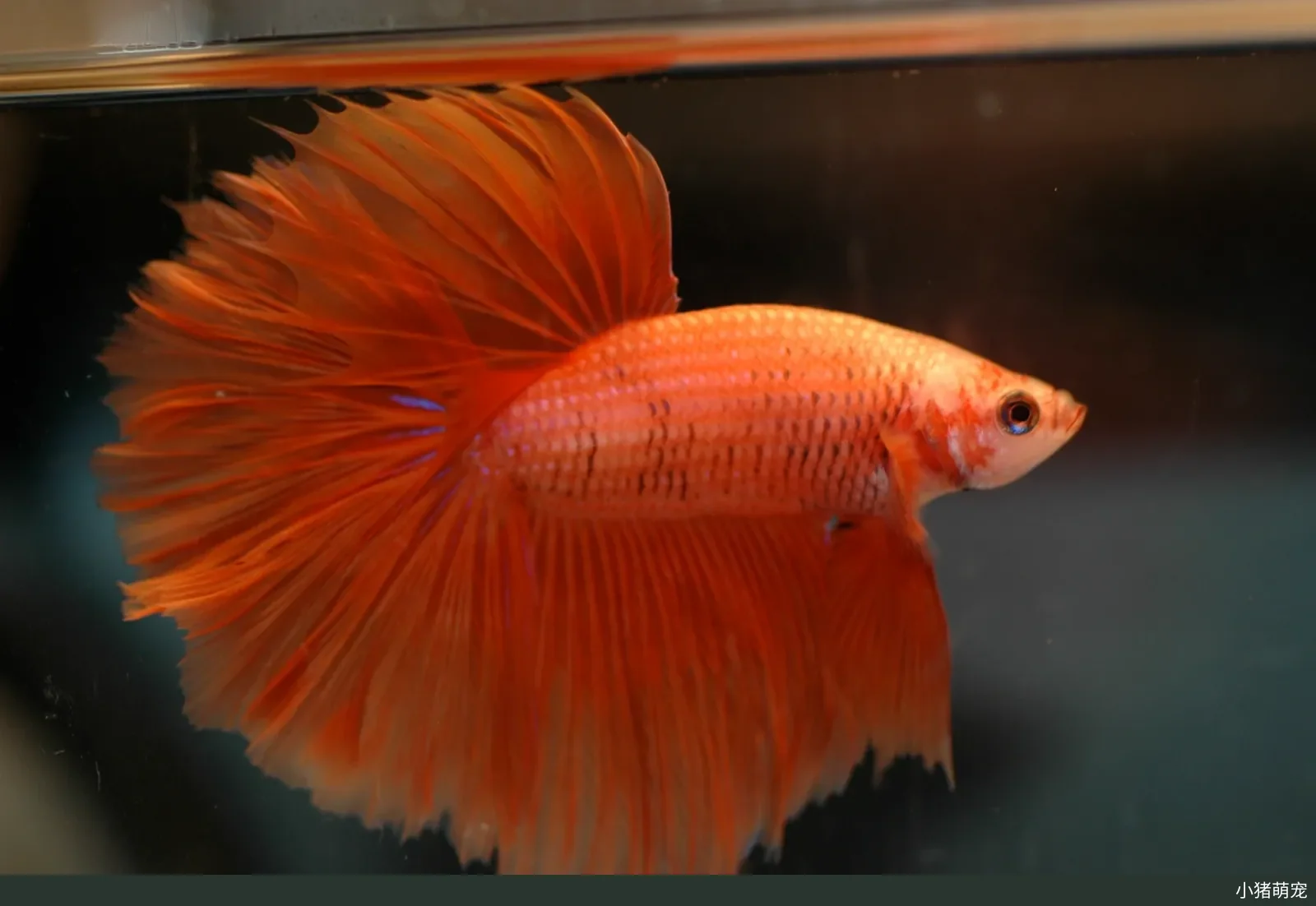
An orange halfmoon-strain male Siamese fighting fish; the broad long fins are the product of selective breeding. Figure: Daniella Vereeken / Wikimedia Commons (originally Flickr), CC BY 2.0.
The Siamese fighting fish (Betta splendens) is native to shallow waters such as rice paddies and marshes in and around Thailand; with a labyrinth organ it can breathe air directly. Wild fish are brownish-green with short fins; the vivid long-finned bettas in pet shops are the result of nearly a century of selection. It is not listed on CITES Appendices and is not on China’s list of key protected wild animals, but wild populations are assessed as Vulnerable by the IUCN. Keeping it well turns on stable water temperature, clean water, and housing males alone.
Natural history
The Siamese fighting fish is a small freshwater fish in the family Osphronemidae (also called the gourami or fighting-fish family). Sources disagree somewhat on native range: the IUCN assessment treats it as endemic to Thailand, in the Mae Khlong to Chao Phraya basins, the eastern slopes of the Cardamom Mountains, and the Isthmus of Kra; FishBase writes the Mekong basin; some veterinary sources also include Cambodia, Laos, and Vietnam. They live in still waters—floodplain pools, ditches, rice fields, and shallow ponds—where dense vegetation helps them hide from herons, kingfishers, and other predators. University of Florida IFAS materials cite a 2001 Thai field survey: in the breeding season (April–May), nest sites averaged about 29.9°C, pH about 5.5, depth only about 5 cm on average, and dissolved oxygen about 3.8 mg/L on average, sometimes near zero. Wild bettas are dull brown or green with short fins, about 5–5.5 cm long—almost a different fish from the long-finned shop stock.
Surviving hot, oxygen-poor water depends on a pair of accessory breathing organs above the gills—the labyrinth organ: layered bony structure lined with respiratory epithelium that can use air at the surface. So a betta periodically rising to “take a gulp” is normal. For breeding, the male builds a bubble nest at the surface, mouths fertilized eggs into it one by one, and guards eggs and newly hatched fry; a spawn is about 300 eggs, usually hatching in about a day. Males are highly territorial; meeting another male they flare fins and opercula, then bite. Thailand has long selectively bred aggressive males for fighting and gambling; a 2022 whole-genome study in Science Advances notes records as early as the fourteenth century. In the early twentieth century, people began selecting color and fin shape for display. That study also found today’s ornamental bettas mainly descend from Betta splendens, with some ancestry from related B. imbellis and B. mahachaiensis.
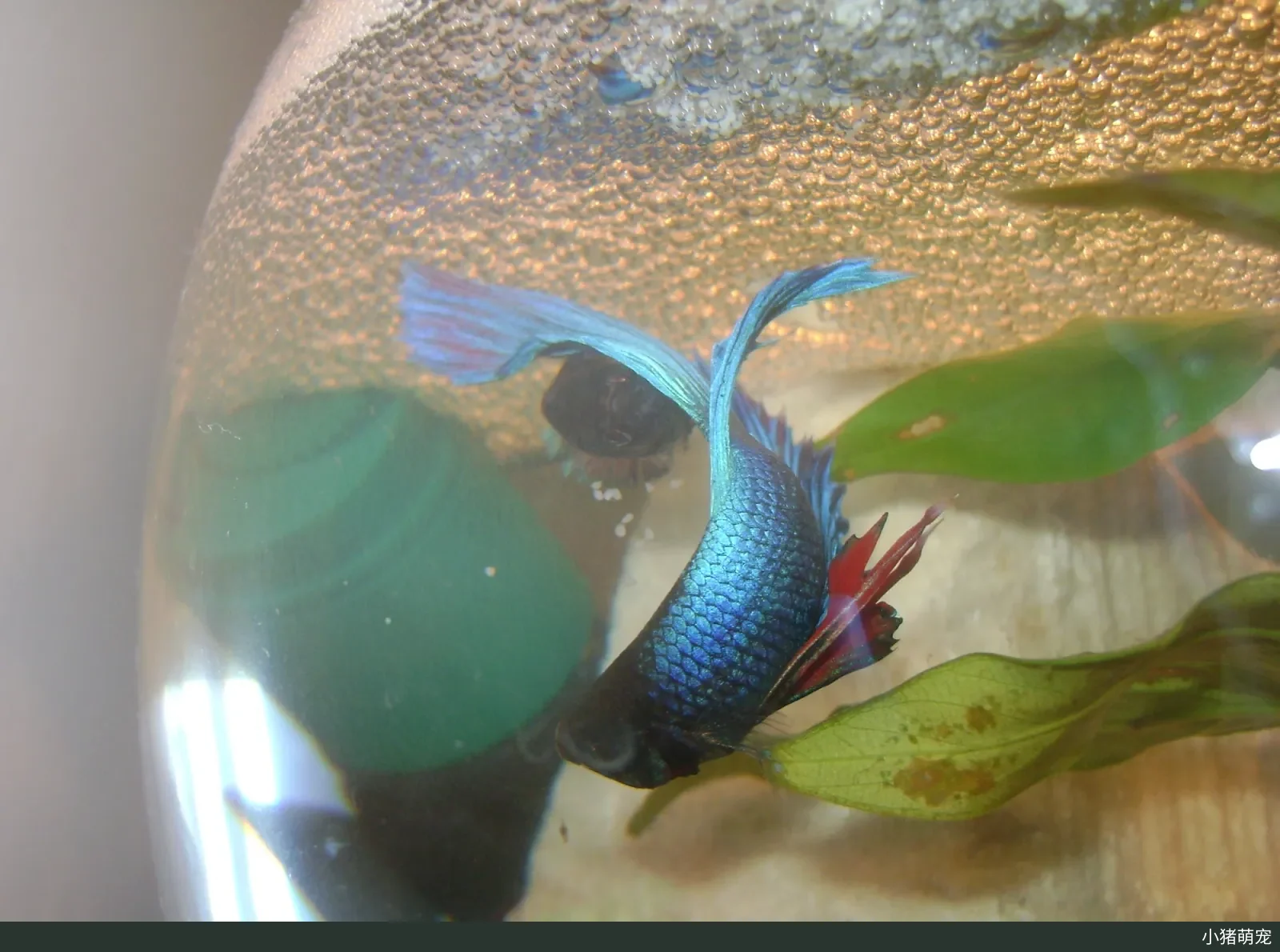
A pair of Siamese fighting fish spawning in a tank: the brightly colored male below collects sinking eggs, then will spit them into the surface bubble nest and guard alone until the fry’s yolk sacs are absorbed. Figure: Rodrigo / Wikimedia Commons, CC BY-SA 3.0.
Housing and diet
Bettas are often sold in tiny cups, which invites the idea that “a small bowl of water is enough.” Institutions disagree. The U.K. Ornamental Aquatic Trade Association (OATA) recommends at least 20 liters for a single male and at least 60 liters for a female group, stressing that shop cups are temporary and should not be copied at home; MEAMS’s care sheet also says sales cups and bowls are too small and suggests at least 5 gallons (about 19 liters). University of Florida IFAS extension material from 2019 argues that with good water quality and nutrition, males can do well in small containers—quality depends on management, not container size; FishBase explicitly discourages keeping males in very small containers. Our advice: beginners should choose a larger tank. More water means temperature and chemistry swing less, and there is more margin for error.
- Temperature: Bettas are tropical. MEAMS suggests 76–81°F (about 24.5–27°C); OATA’s range is 20–28°C. Most homes fall short of room-temperature alone, so use a thermostat heater plus a separate thermometer—also Merck Veterinary Manual advice. IFAS notes that without heating, room temperature should stay above 22°C.
- Water quality: Ammonia and nitrite should be 0; nitrate no more than 20 mg/L above tap baseline; pH 6.0–8.0 (OATA). Cycle a new tank before adding fish to avoid “new tank syndrome.” Test at least weekly.
- Water changes: Change 25%–30% weekly; treat tap water with dechlorinator first; do not change everything at once or the nitrogen cycle must restart (MEAMS). The Merck Veterinary Manual notes that small tanks without filtration or heat need more frequent, larger changes—up to 50% weekly.
- Flow and layout: A filter is essential, but flow should be gentle; IFAS-cited research shows current stresses bettas. Add live plants or smooth hides; avoid sharp décor that can tear long fins (OATA).
- Lid: Bettas jump; use a cover, but leave a gap between lid and surface so they can breathe (MEAMS, OATA).
- Placement: Away from direct sun, heaters, and drafts; avoid noise and vibration (OATA).
- Tankmates: Two males must never share a tank—they will fight until one is badly hurt or dead. Males often have fins nipped by other fish; best kept alone or only with very peaceful species; females are calmer and can be kept in groups of four or more (OATA).
Wild Siamese fighting fish eat mainly zooplankton, mosquito larvae, and other insect larvae (FishBase). At home, OATA suggests quality flakes or betta pellets as the staple, with occasional live or frozen daphnia, bloodworms, and similar; feed once daily, only what is eaten in a few minutes. IFAS also warns against overfeeding and insists live foods come from clean sources. Leftover food rotting on the bottom releases toxic waste—often the start of poor water and illness.
Common health problems
The Merck Veterinary Manual notes that poor water quality is the most common cause of environment-related fish disease. Specialty veterinary clinicians at the University of Illinois College of Veterinary Medicine add that water that is too hot or cold, or too dirty, weakens immunity; infection is among the most common reasons fish are presented, with parasites, bacteria, or fungi often arriving with new fish. Among common pet-fish diseases listed by the American Veterinary Medical Association (AVMA), those most relevant to bettas include: ich (white spot disease from Ichthyophthirius, white spots on fins and body), fin rot (bacterial or fungal rotting of fin edges), velvet (a parasitic disease that makes scales look dusty and feel slimy), trauma, and ammonia or chlorine poisoning from bad water. The Merck Veterinary Manual also lists bettas among common hosts of intestinal flagellates (Spironucleus), which can cause progressive weight loss.
Day-to-day warning signs (OATA): lingering at the surface or lying on the bottom, abnormal swimming; color darkening or paling; more hiding than usual; faster or slower opercular movement; white spots or cottony growths, missing fins or scales; clear weight change; reduced appetite. Illinois clinicians add that marked abdominal swelling, inability to reach the surface, or skin lesions warrant a veterinarian. When something looks wrong, test water first; quarantine new fish. IFAS cautions that many drugs and chemicals do more harm when misused—identify whether the problem is water, nutrition, or infection before treating; in China, start by asking an exotic-pet veterinarian who sees aquatic animals. Lifespan figures vary: FishBase records a maximum age of 2 years; OATA says “many years” with good water; an Illinois case report describes a 3-year-old male. Wash hands before and after tank work, and do not mouth-siphon—tank water can carry bacteria harmful to people (OATA).
Conservation status and keeping ethics
Internationally, the Siamese fighting fish is not listed on CITES Appendices: in the CITES Species+ database, the genus Betta shows as “not listed” (NC). On the IUCN Red List it is Vulnerable (VU), criterion A2ace, assessed by C. Vidthayanon on 25 February 2011. Under IUCN rules, that implies observed population decline, reduced range or habitat quality, and effects of alien species, hybridization, pollution, and similar factors. The assessment is more than a decade old; a 2026 study by a Kasetsart University team also notes that the status of many original Thai type localities for wild bettas is largely unknown and urgently needs full reassessment. In China, the February 2021 National Key Protected Wild Animals List issued by the National Forestry and Grassland Administration and the Ministry of Agriculture and Rural Affairs lists only a few perciforms such as the Chinese bahaba and the humphead wrasse—not fighting fishes—so the Siamese fighting fish is not a national key protected wild animal. OATA notes that most bettas on the market are captive-bred. Local rules and specific transport or trade requirements can be confirmed with local authorities.
Beyond legality, ethics and ecology matter more. First, do not make them “fight”: two males together will injure or kill one another; staging fights for entertainment is causing animal harm. Second, do not treat them as ornaments: IFAS materials describe more than 100,000 male bettas air-shipped mainly from Thailand each week worldwide; OATA reminds buyers to confirm they can provide a suitable tank and care for the fish’s whole life. Third, never release them. The Siamese fighting fish is not native to China; the Biosecurity Law forbids unauthorized release or abandonment of alien species, with orders to recapture and fines of 10,000–50,000 yuan; the Wildlife Protection Law also requires that releases use only native species suited to local wild conditions. Abroad there are precedents: a 2019 U.S. Fish and Wildlife Service ecological risk summary records large populations of Siamese fighting fish in the Adelaide River floodplain near Darwin, Australia. Even in the native range, the 2022 genomic study detected ornamental-betta ancestry in some wild B. splendens and B. mahachaiensis; escape of captive-bred fish may disrupt wild genetics. If you can no longer keep one, rehome to a reliable aquarist or ask a shop whether they will take it.
References
-
Vidthayanon C. Betta splendens. The IUCN Red List of Threatened Species 2011: e.T180889A7653828(assessment date 2011-02-25)
-
CITES Secretariat & UNEP-WCMC. Species+: Betta(accessed 2026-10-17)
-
National Forestry and Grassland Administration & Ministry of Agriculture and Rural Affairs. Announcement (No. 3 of 2021) (National Key Protected Wild Animals List)(published 2021-02-05)
-
Standing Committee of the National People’s Congress. Biosecurity Law of the People’s Republic of China(adopted 2020-10-17; Articles 60 and 81)
-
Standing Committee of the National People’s Congress. Wildlife Protection Law of the People’s Republic of China(revised 2022-12-30, effective 2023-05-01; Articles 40 and 41)
-
Froese R, Pauly D (eds). Betta splendens Regan, 1910. FishBase(accessed 2026-10-17)
-
Watson C, DiMaggio MA, Hill JE, Tuckett Q, Yanong R. Evolution, Culture, and Care for Betta splendens (FA212). University of Florida IFAS Extension, 2019.
-
Ornamental Aquatic Trade Association. How to look after Siamese fighting fish (Bettas)(accessed 2026-10-17)
-
Merck Veterinary Manual. Providing a Home for Fish(accessed 2026-10-17)
-
MSD Veterinary Manual. Parasitic Diseases of Fish(accessed 2026-10-17)
-
American Veterinary Medical Association. Got a sick fish?(accessed 2026-10-17)
-
Mueller B. Francisco the Fish Visits the Vet. University of Illinois College of Veterinary Medicine, 2019-07-24.
-
U.S. Fish and Wildlife Service. Siamese Fighting Fish (Betta splendens) Ecological Risk Screening Summary, 2019.
-
Kwon YM, et al. Genomic consequences of domestication of the Siamese fighting fish. Science Advances, 2022.
-
Prukudom S, et al. Development of Cells Repository of Betta Species: A Tool for Genetic Conservation and Biotechnological Advancement. Animals, 2026, 16: 408.