Look for the chin in a full-length photograph of a Keeshond. From there, long hair falls over the shoulders and chest, almost hiding the neck. This lion-like ruff gives a good idea of what it takes to care for the coat. Run a hand over it and the surface may feel smooth. Part the long hairs and you can still find loose tufts of soft undercoat caught beneath them. Brushing a Keeshond starts with knowing where the coat grows thickest and how deep the brush needs to reach. [1][2][3]
The Keeshond is a medium-sized Dutch spitz. When boatmen carried freight along the canals of the Low Countries, these dogs kept watch on the barges and their owners company. In the eighteenth century, the breed became a symbol of the Dutch Patriots. Beneath the abundant coat is a compact, sturdy dog with a short back. The ideal adult height at the shoulder is 18 inches (about 46 cm) for a male and 17 inches (about 43 cm) for a female. To get a sense of Majic’s build in the photograph, start at the paws and follow the legs up to where they meet the body. The coat extends well beyond that outline. [1][2]
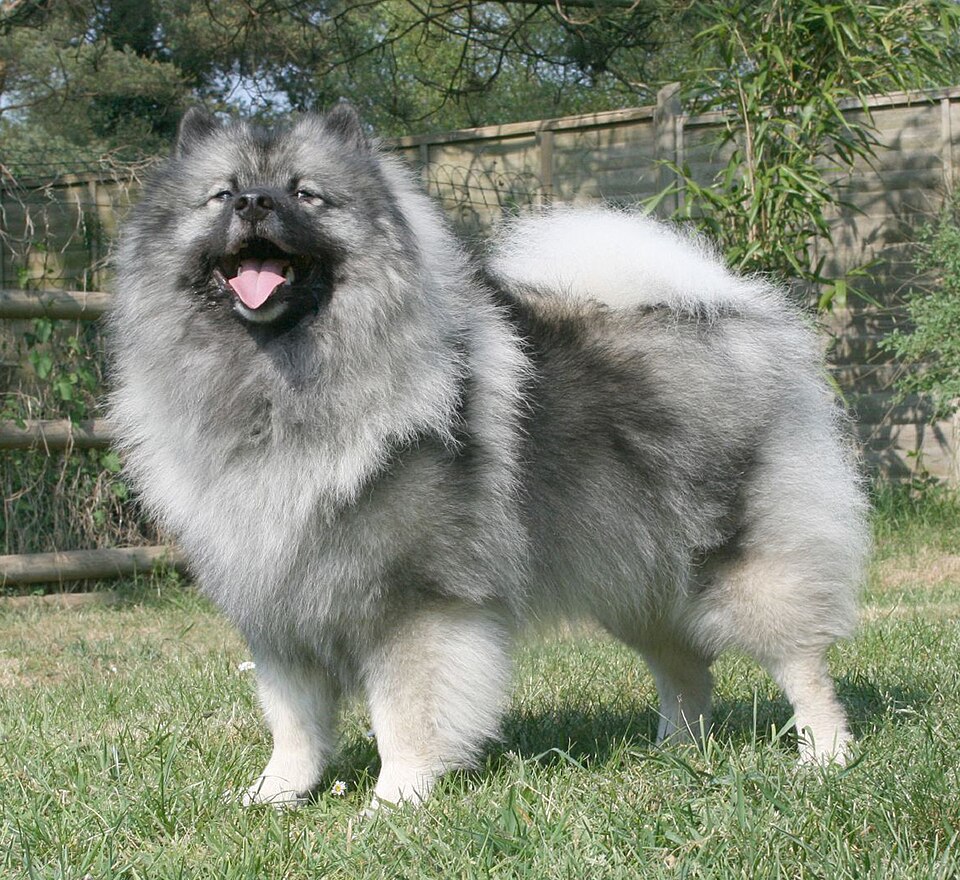
Majic stands in full view. dancing with wolves, Wikimedia Commons[5]

Now look at the face. Small, pointed ears stand upright, the muzzle tapers, and pale cheeks set off the dark muzzle. One of the easiest markings to pick out begins at the outer corner of each eye. A fine dark line runs diagonally toward the lower corner of the ear. Together with the shading around the eyes and the markings over the brows, these lines form what the breed standard calls “spectacles.” In the portrait below, the dog faces the camera, making the two lines as easy to follow as the arms of a pair of glasses. [2]
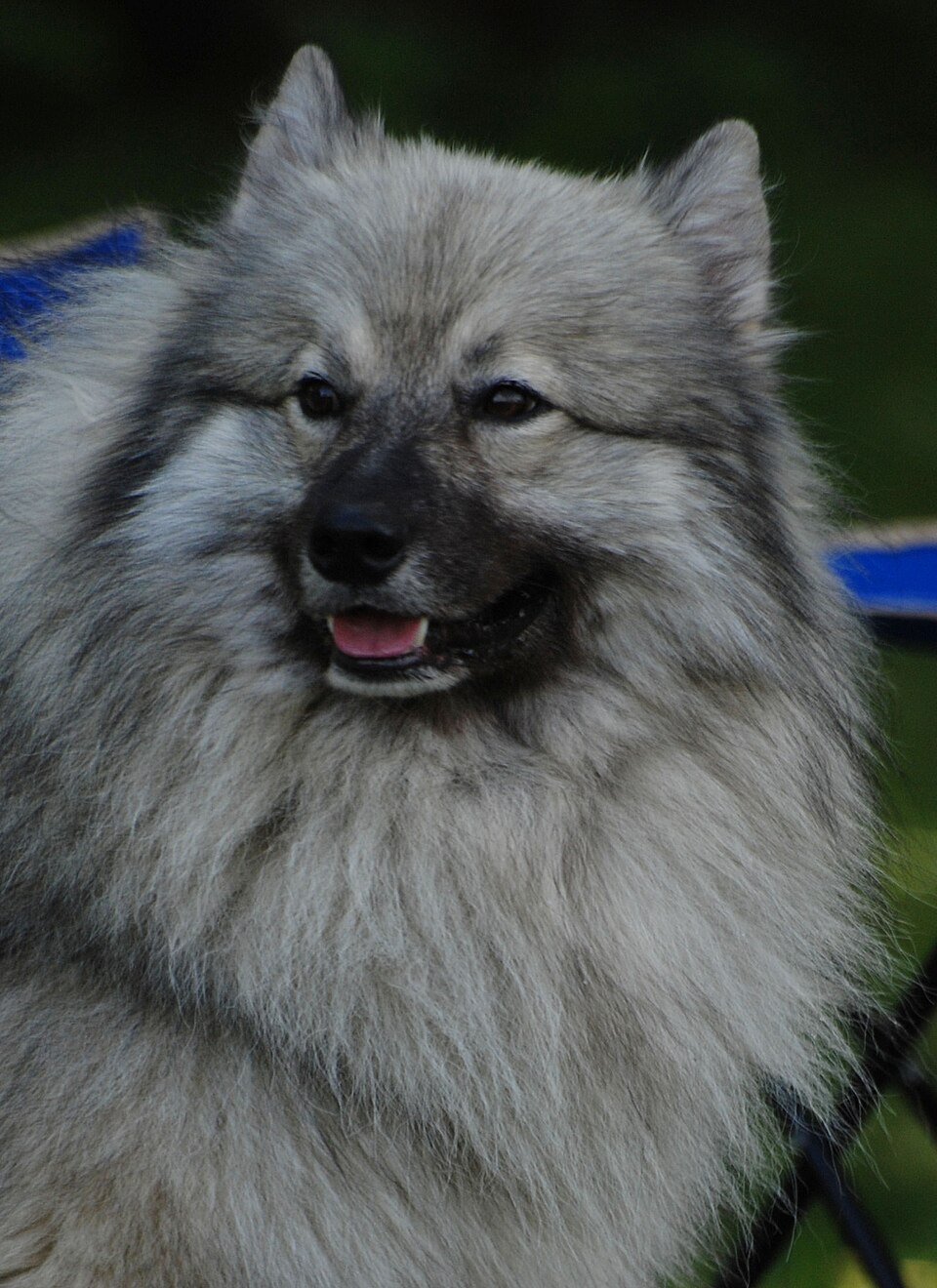
The Keeshond’s spectacles frame its eyes. Lilly M, Wikimedia Commons[6]

Where does a walk fit into an ordinary workday?
Keeshonden once lived on narrow barge decks as well as on farms with room to run. For a family today, the first question is how you would spend a day together. The American Kennel Club (AKC) recommends a daily walk or a chance to run freely. If you live in an apartment, think of a route from your front door that you could walk every day. If you have a fenced yard, you can go out and exercise together there. These dogs enjoy their family’s company, too. Leave room in the day for the part after the walk, when the dog comes home and settles down beside you. [1]
Take an ordinary workday as your starting point. Who can take the dog out in the morning? Who has time for a walk in the evening, and who can step in if someone works late? Those answers tell you more about everyday life with a dog than an occasional long weekend outing can. It helps to have a short route and a longer one. You can then choose according to the dog’s age, stamina and energy that day, while keeping the walk a regular part of family life. [1]
Getting ready for a walk is a good time to teach a useful skill. Keeshonden tend to learn quickly and can lose interest in repeated drills. To teach a dog to stand still while you clip on the leash, start in a quiet room. Reward the dog when all four paws are still, then try it by the door once the action is familiar. When the dog stands for the clip, go for your walk. The next outing will give you another chance to practice. The AKC recommends socialization and basic training in puppyhood. For a dog whose coat you’ll brush every week, standing quietly and getting used to brief touches are worth practicing early, too. [1]
Part the outer coat to reach the undercoat
From the side, you can see where the long hair grows. The ruff falls forward from the neck and shoulders over the chest. Along the body, a dense, soft undercoat holds the straighter, coarser outer hairs away from the skin. On the backs of the hind legs, long feathering hangs like a pair of trousers almost to the hocks. Farther down, the hair on the feet is much shorter. Above it all, the long plume of the tail curls over the back. When you brush, use these changes in length as landmarks. Follow the lower edge of the ruff and work down the backs of both hind legs as carefully as you cover the easy stretch along the back. [2][3]
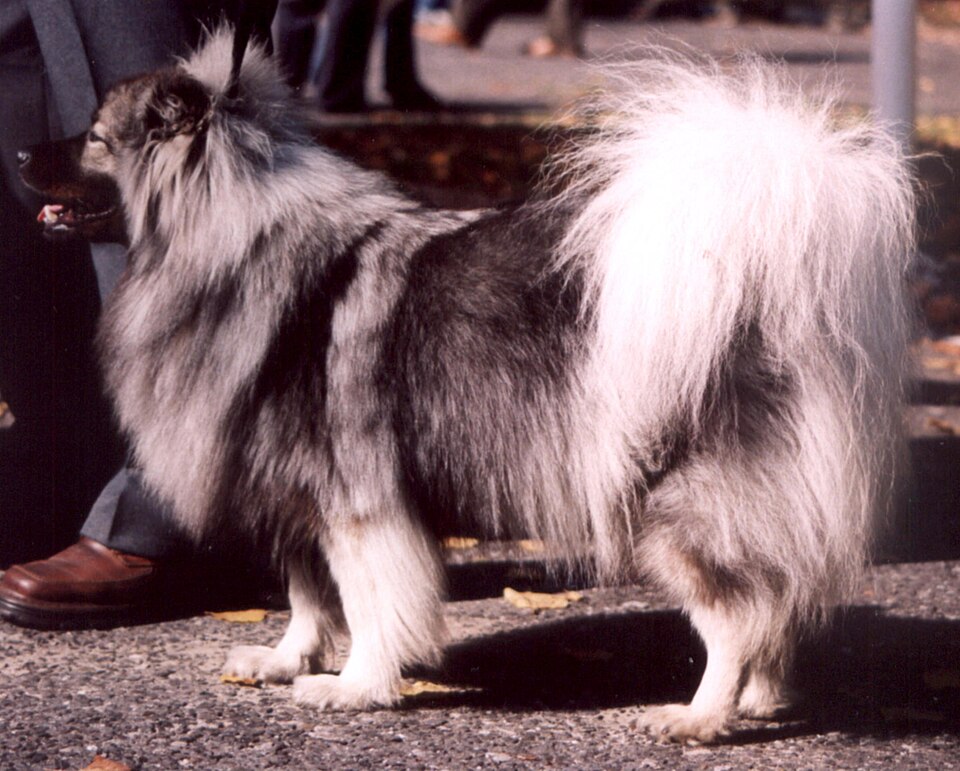
A side view shows the hind-leg feathering. Pleple2000, Wikimedia Commons[7]

Start with a weekly, whole-body brushing using a pin brush. At the ruff, lift a thin layer of long hair with one hand until you can see the soft coat underneath. With the other hand, gently brush out the loose hair. Let the layer fall, move a little to one side and repeat, working from beneath the chin toward the front of the shoulder. Take only as much hair as the brush can pass through easily. If it catches, divide that section again so you can work without tugging on the whole lock. Use the same method along the sides and down the hind legs. Once you’ve finished, part the coat again in a few places. You’ll be able to see whether any tufts of loose undercoat remain. [1][3]
How much time should you set aside? The Keeshond Club of America gives families a rough estimate of half an hour a week for brushing. Start by putting that time on the calendar, then adjust it to suit your dog’s coat. When the undercoat starts coming out in handfuls, a few shorter sessions will save you from having to work through all the loose hair at the next bath. Allow separate time for bathing and drying. The AKC describes a bath and blow-dry every four to six weeks, either at home or with a groomer. At an appointment, ask the groomer to part the coat at the shoulder and show you how far the pin brush should reach. The feet, pads and hocks are the main areas that need a little tidying with scissors. The ruff can keep its natural length. [1][3][4]
Ask for both parents’ screening results
A puppy’s stance and coat tell you little about some inherited health risks. Ask the breeder to show you the results for the sire and dam separately, and match each report to the dog it names. The AKC breed profile lists X-rays to assess the hips and elbows for dysplasia, an examination for kneecaps that slip out of place, an eye examination and genetic screening for primary hyperparathyroidism. If the breeder says both parents have had a checkup, ask which tests each dog had and what the results showed. The records tell you which risks the breeder considered when planning the litter. Your veterinarian can assess the puppy’s own health as it grows. [1]
If you can meet an adult Keeshond before bringing one home, stay long enough to watch the owner brush one side of the ruff. Notice how much hair they lift to expose the undercoat, how they steady the dog and when they give it a break. Then picture that same job in your own week, alongside the daily walks. It’s easier to decide whether you’d enjoy living with a Keeshond once you’ve seen what goes into that handsome coat.
References
-
[1] American Kennel Club. Keeshond Dog Breed Information.
-
[2] American Kennel Club. Official Standard of the Keeshond.
-
[3] Beth Blankenship. Grooming a Keeshond. Keeshond Club of America.
-
[4] Keeshond Club of America. General Keeshond Information.