Known affectionately among feline enthusiasts as the "parlor panther" and the "patent leather kid with new-penny eyes," the Bombay cat presents one of the most striking visual silhouettes in the domestic cat fancy [1]. Despite displaying the sleek, muscular mystique of a wild Indian black leopard in miniature, this breed possesses an exceptionally gentle, gregarious, and affectionate temperament, frequently described by devoted owners as harboring an interactive, dog-like soul [1]. In the Cat Fanciers' Association (CFA) 2026 breed landscape, alongside widely popular companions like the Maine Coon, Ragdoll, and American Shorthair, the Bombay continues to occupy a distinctive, tightly curated lineage prized for purebred consistency and dramatic aesthetics [2]. Developing a scientific understanding of the breed's hybrid origin, anatomical conformation standards, companion needs, and routine husbandry is essential for providing this domestic panther with a high-quality home environment.
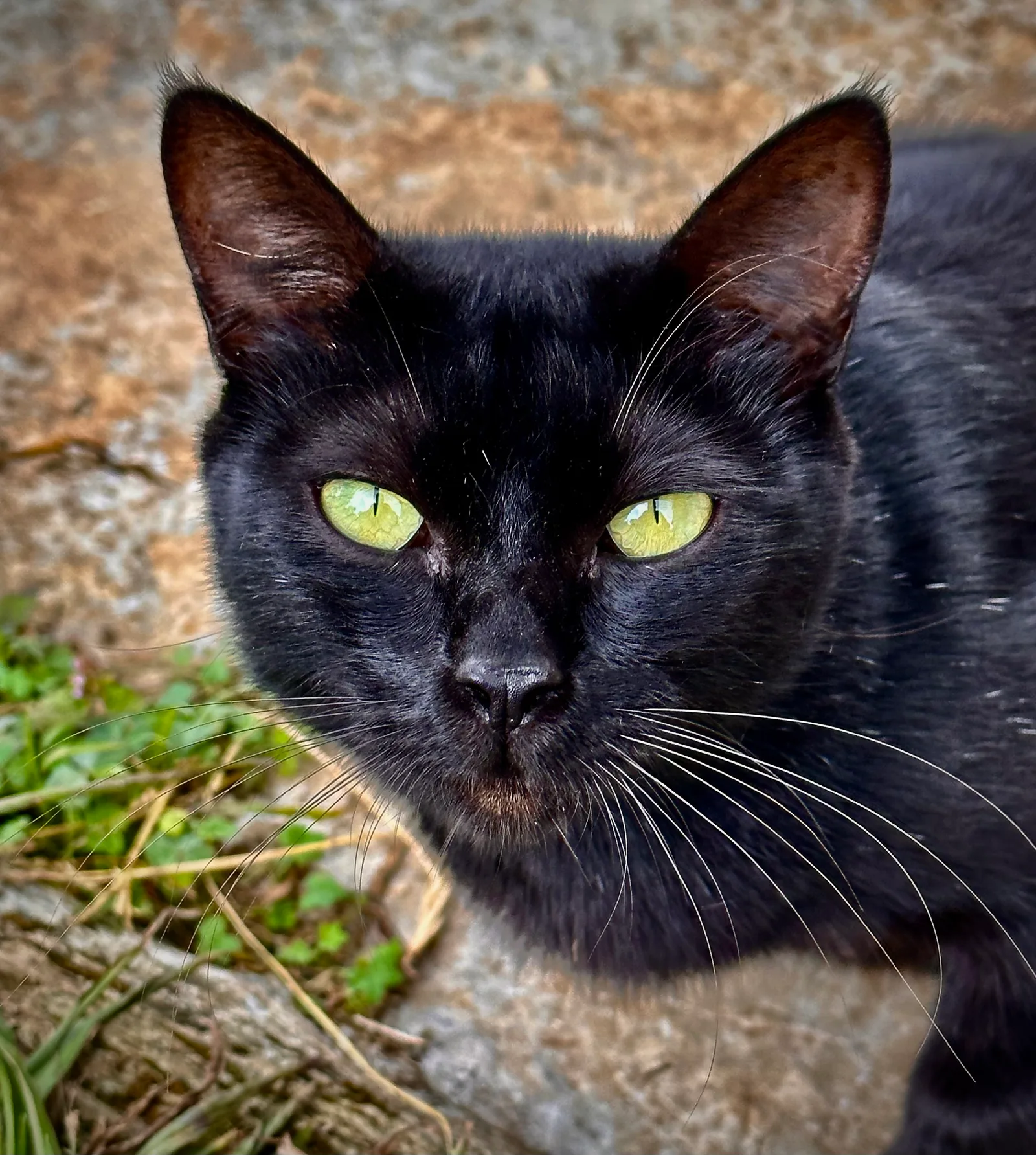
An adult Bombay cat displaying its signature patent-leather jet-black coat and vivid, round copper eyes. Photograph: Alrio htp; Source: Wikimedia Commons[4]; License: CC0 1.0.

Breed Origins: Nikki Horner and the Creation of the "Parlor Panther"
Far from being a wild hybrid or a tamed melanistic predator, the Bombay is entirely a domestic purebred cat developed through meticulous planning and selective hybridization [1]. In the late 1950s, Nikki Horner, an accomplished breeder from Louisville, Kentucky operating under the Shawnee cattery prefix, conceived a unique vision: to create a domestic cat with the compact size and sweet disposition of a pet, but cloaked in the jet-black satin coat and glowing copper eyes of an Indian black leopard [1]. To unite the visual intensity of an apex predator with the gentle nature of a companion animal, Horner embarked on a deliberate interbreed crossing program.
Horner crossed carefully chosen solid black American Shorthairs with champion sable Burmese cats [1]. In combining these genetic lines, the black American Shorthair contributed robust bone structure, dense black pigmentation, and richer eye color depth, while the Burmese contributed a tight, satin-textured single coat, rounded contours, and an intensely human-oriented temperament [1]. Following more than two decades of selective backcrossing and line purification, the Bombay breed type stabilized, earning formal Championship recognition from the Cat Fanciers' Association (CFA) in 1976 [1]. The breed was named after the historic Indian metropolis of Bombay (now Mumbai) in homage to the black leopards of South Asia that inspired its creation.
Conformation Standards and Anatomical Profile
Under official CFA breed standards, the paramount defining feature of the Bombay is its immaculate, solid black coat: pigmented to the roots with no white lockets, tabby ghost markings, or pale underfur permitted [1]. The coat is exceptionally short and close-lying, with a fine, lustrous texture that reflects ambient light like high-gloss patent leather [1]. In strict adherence to this monochromatic standard, both the nose leather and all paw pads must be pure jet black, creating an entirely uninterrupted ebony appearance [1].
In head and facial structure, the Bombay exhibits a pleasingly rounded skull without flat planes, a short, well-developed muzzle, and a visible moderate nasal stop (nose break), supported by a firm, well-aligned chin [1]. The eyes are notably large, round, and set wide apart, exhibiting vivid coloration ranging from bright amber-gold to deep copper, with newly minted penny-copper tones considered the show ideal [1]. Medium-sized ears are set broad and wide on the head, slightly rounded at the tips and tipped gently forward, imparting an alert, inquisitive expression.
Physically, the Bombay conformation is classified as semi-cobby: medium in body length with a broad, rounded chest, level back, and sturdy musculature [1]. While presenting an agile, compact visual outline, the breed possesses remarkable bone density and muscular weight, leading show judges and breeders to describe the Bombay as "a brick wrapped in silk" [1]. Adult males typically weigh between 3.6 and 5.4 kg (8 to 12 lbs), while adult females generally range from 2.7 to 4.1 kg (6 to 9 lbs).
Temperament and Behavioral Characteristics
Directly contrasting with their imposing panther-like appearance, Bombays are celebrated for an exceptionally outgoing, gentle, and affectionate personality, frequently earning comparisons to dogs for their interactive loyalty [1]. They eagerly participate in household routines, shadowing family members from room to room and warmly greeting returning guardians at the door [1]. Possessing high intelligence and curiosity, many Bombays naturally learn interactive games like fetch without extensive training and readily accept walking on a harness and leash.
Vocalizations in the Bombay are generally soft, melodious, and restrained; they rarely produce loud caterwauls, preferring delicate chirps and rhythmic purring to communicate [1]. Given proper early socialization, Bombays integrate smoothly with cat-friendly dogs, other cats, and considerate children [1]. However, their strong social attachment also makes them susceptible to loneliness and separation anxiety if left isolated for long stretches. Additionally, Bombays are notorious "heat-seekers," instinctively burrowing beneath duvets, resting in warm sun patches, or curling up in their owners' laps for hours.
Coat Maintenance and Husbandry Essentials
Thanks to the absence of a dense, heavy undercoat, grooming demands for the Bombay are minimal, and seasonal shedding is significantly lower than in double-coated or longhaired breeds [1]. Routine coat care does not require harsh wire combs; a gentle weekly brushing with a soft rubber curry brush or silicone grooming glove easily removes loose dead hair. To enhance the breed's signature patent-leather sheen, owners can gently polish the coat in the direction of hair growth using a slightly damp microfiber towel or a genuine chamois cloth, which evenly distributes natural cutaneous sebum across every hair shaft [1].
Because their close-lying single coat does not trap dirt easily and offers limited defense against cold drafts, frequent immersion baths are unnecessary; routine bathing every few months with a mild feline shampoo suffices unless the coat encounters heavy soiling, as over-washing can strip protective skin lipids. Alongside coat grooming, biweekly claw trims and regular home dental hygiene are indispensable. Indoor living environments should incorporate sturdy multi-tiered cat trees and warm, draft-free bedding to accommodate their instincts for vertical vantage points and heat conservation.
Regarding nutrition and metabolic management, Bombays inherit hearty appetites from their American Shorthair and Burmese lineage and, if under-exercised indoors, are prone to accumulating excess adipose tissue around the abdomen [1]. Caregivers should avoid ad libitum free-feeding, opting instead for portion-controlled meals served two to three times daily adjusted for age and activity level [1]. A diet rich in digestible animal protein with controlled carbohydrates, paired with 20 to 30 minutes of daily interactive hunting play using wands or puzzle toys, helps sustain their lean, dense muscle mass.
Health Considerations and Breeding Screening
The Bombay is a robust, resilient domestic breed with an average indoor life expectancy of 15 to 20 years under dedicated preventive veterinary care [1]. Nonetheless, because foundational stock is closely tied to Burmese genetics, two specific medical considerations require careful attention: Burmese Head Defect (BHD) and Hypertrophic Cardiomyopathy (HCM) [1,3].
Burmese Head Defect is a severe craniofacial malformation caused by an autosomal recessive mutation in the ALX1 gene that originated in contemporary short-muzzled Burmese lines and historically entered the Bombay gene pool [3]. Heterozygous carriers harboring a single mutant allele display mild facial flattening and live normal, healthy lives; however, carrier-to-carrier matings carry a 25% statistical risk of producing homozygous offspring with fatal, non-viable craniofacial deformities [3]. Modern veterinary genetics has established commercial DNA cheek swab screening (such as the panel offered by the UC Davis Veterinary Genetics Laboratory), enabling ethical breeders to genotype all prospective breeding stock and completely prevent carrier crosses, eliminating this fatal condition at the source [3].
Hypertrophic Cardiomyopathy (HCM), the most common acquired and hereditary feline cardiac disorder, involves abnormal thickening of the left ventricular myocardium, impairing diastolic filling and potentially leading to congestive heart failure or arterial thromboembolism [1]. Although a breed-specific causative mutation has not been isolated in Bombays, regular veterinary cardiac auscultation and periodic echocardiography represent the clinical gold standard for monitoring heart health [1]. In addition, because the Bombay possesses a moderately shortened muzzle and pronounced nasal break, occasional mild epiphora (clear tear tearing) may occur from narrowed nasolacrimal ducts; gentle daily hygiene around the eyes using a warm, damp cotton pad prevents crusting and secondary periocular irritation [1].