A Black Russian Terrier’s long beard makes an already broad face look square. To comb the hair beneath the chin, someone has to come close and reach toward the dog’s mouth. For a large dog bred to guard borders and inclined to keep strangers at a distance, that everyday gesture is worth getting used to early. If you are thinking of bringing a puppy home, picture the adult a few years from now. Who will usually comb that beard? How familiar will the routine feel when someone else takes over? [1][2]
The breed’s working history goes back to the Red Star Kennel near Moscow. The Soviet military needed dogs that could patrol and stand guard in cold regions. Its breeding program drew on the Giant Schnauzer, Rottweiler and Airedale Terrier, among other breeds. The dogs it produced were heavy-boned, muscular and thick-coated, yet agile on their feet. They served at border checkpoints and military installations. By the 1950s, some puppies were going to civilian homes, and some veterans took their working partners home with them. Today the American Kennel Club (AKC) classifies the Black Russian Terrier in its Working Group. [1][2]
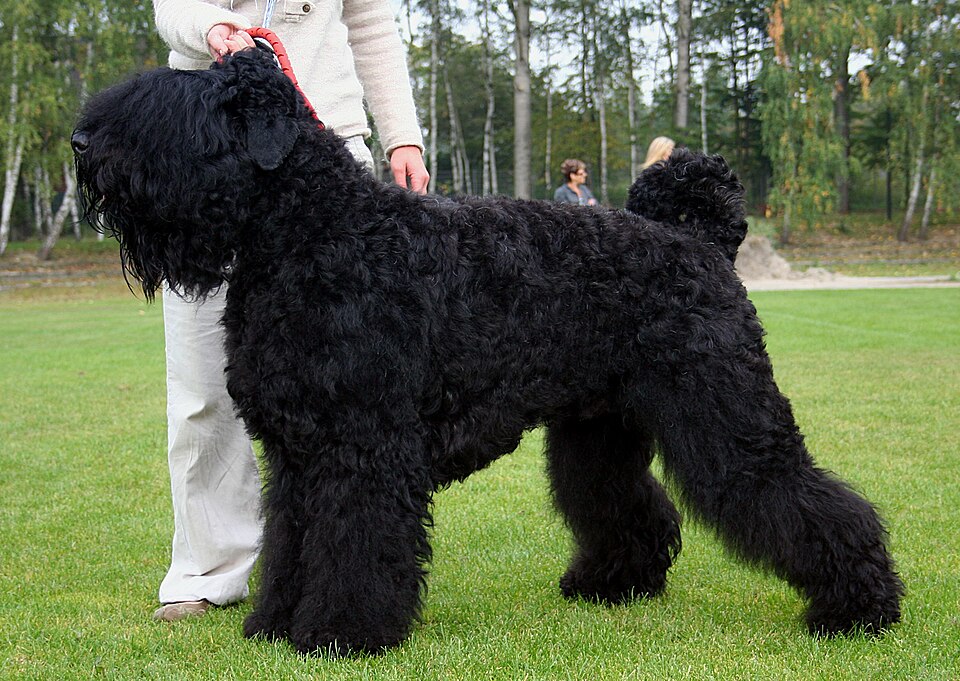
A Black Russian Terrier stands in profile. Pleple2000, Wikimedia Commons[4]

In the photograph on the grass, follow the line of the neck down over the shoulder. The chest reaches nearly to the elbow, and the forelegs drop straight to the ground. The hind legs extend back, revealing the outline of a sturdy body beneath the coat. The muzzle is broad, with long hair at the lips and under the chin. The AKC gives an adult weight range of 80 to 130 pounds (about 36 to 59 kilograms). Males stand 27 to 30 inches at the shoulder and females 26 to 29 inches (about 69 to 76 and 66 to 74 centimeters, respectively). That measurement ends where the shoulders meet the back. When the dog lifts its head for you to comb its beard, its face will be higher still. [1]
Practicing a check-in on walks
Black Russian Terriers used to patrol fence lines. Today, even a dog with a yard needs someone to exercise with every day. The AKC gives at least 30 to 40 minutes a day as a starting point. A brisk walk, a hike, a swim or a game of ball with a family member can all provide activity. For an ordinary workday, start with a route someone has time to walk each day. The dog’s age, stamina and condition at the end of the walk can help you decide when to go farther. A yard earns its keep when someone goes out with the dog to play or practice coming when called. [1][2]
A walk is also a chance to learn what holds your dog’s attention. Suppose someone is approaching. Pause far enough away that your dog notices the person and can still respond to its name. As soon as it turns to look at you, reward it and walk on together. If it keeps staring at the passerby, give it a little more space. Next time, begin at a distance where turning back to you comes easily. The dog gets a familiar thing to do when it sees a stranger, and you learn how much room it needs to respond. Quietly passing someone is a good place to begin. [1][2]
Include everyone who will regularly hold the leash. Agree on a cue, practice it somewhere quiet and have each person reward the dog promptly when it responds. Try changing handlers and walking a different route. Once the dog can turn with either person, move on to a busier place. Black Russian Terriers mature slowly. The Canadian Kennel Club puts maturity at around three years, and the AKC recommends socialization from puppyhood throughout the dog’s life. Before bringing a puppy home, think about who can handle the adult dog and recognize its reactions when the usual walker works late or travels. [1][2]
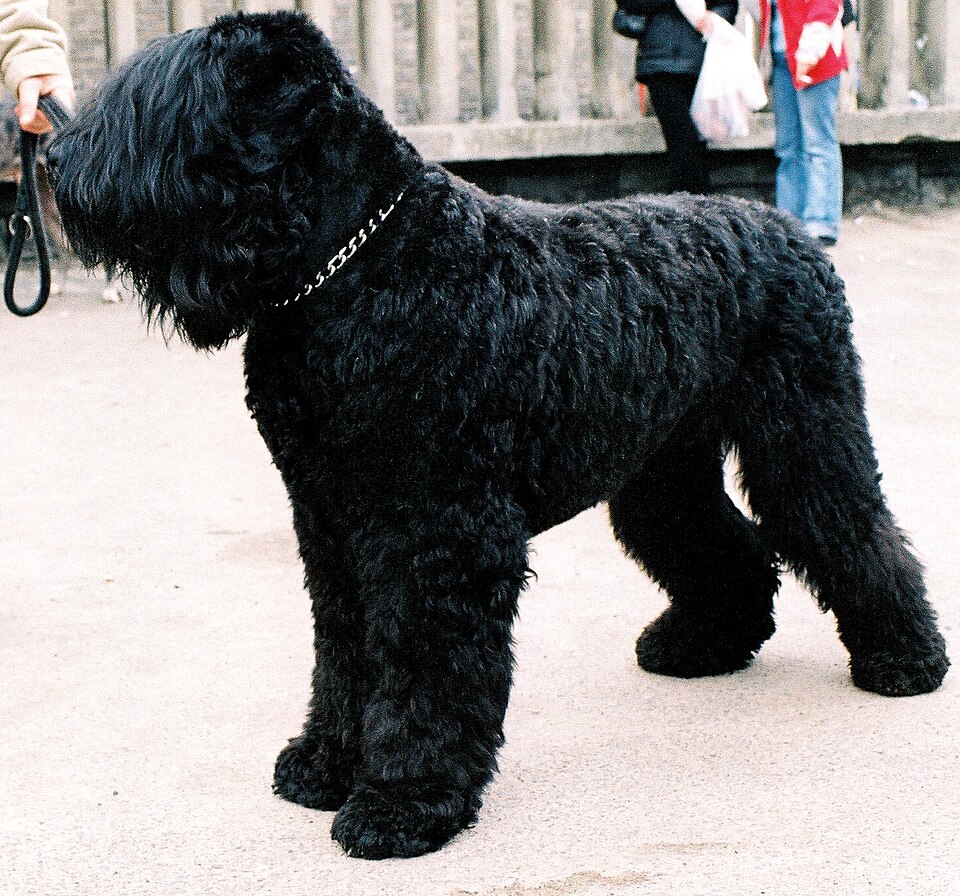
This view shows the chest and forelegs. Pleple2000, Wikimedia Commons[5]

Introducing the beard comb one stroke at a time
Begin with someone the puppy knows, at a time when it is awake and settled. Let it see the comb and give it a small reward for standing comfortably beside you. Next time, touch the side of its shoulder briefly and take your hand away. If it stays relaxed, work gradually toward the cheek and the underside of the chin. Once the puppy is comfortable with your hand there, gently draw the comb through a small, tangle-free lock of beard. If it turns its head away, stop. Next time, return to a touch it was happy to accept. Early on, one easy stroke is enough to end a session. [1]
Once the dog knows the routine, have another family member start with the easiest step. If a professional groomer will eventually trim its face, a brief first visit gives the dog time to meet the person and get to know the surroundings. Tell the groomer which cheek the dog offers readily, where the comb tends to make it turn away, and which cue helps it stand again. Those details give the next person a clearer place to start than a general assurance that the dog is well behaved. [1][2]
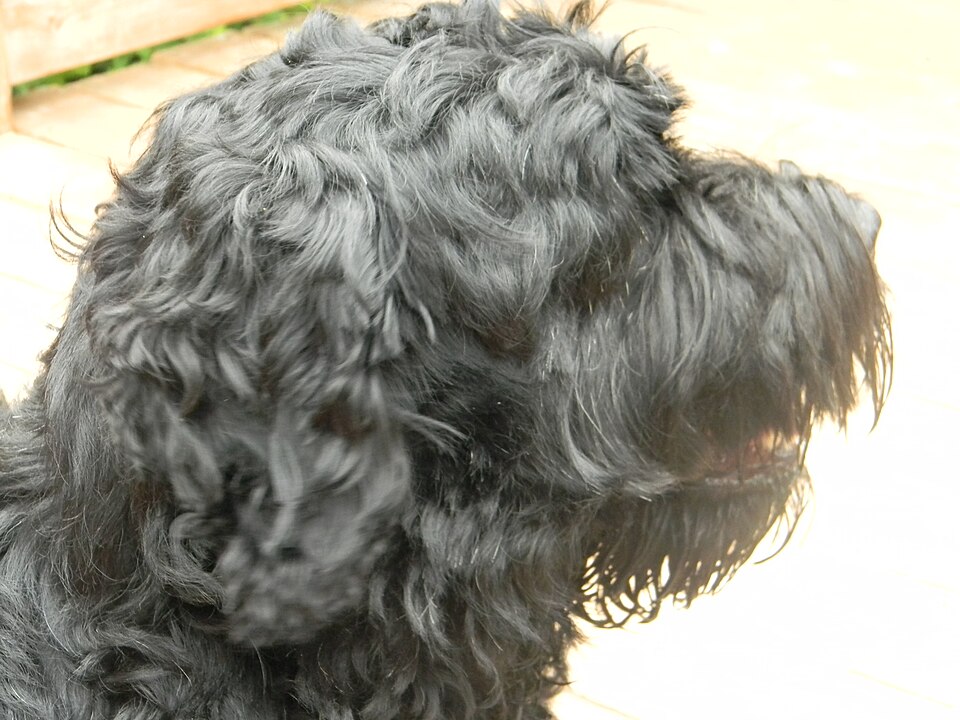
Long hair frames the muzzle. Laslovarga, Wikimedia Commons[6]

The beard is only a small part of the grooming job. The photographs show long hair on the legs and waves along the body. Beneath the coarse outer coat lies a soft, dense undercoat. The AKC recommends a thorough grooming once or twice a week to work through hair that tangles. Take one area at a time, starting with the shoulders and chest, then moving along the body and down the legs. Part the hair and brush through one layer at a time. Gently pass a comb through the section you have just brushed. A sweep along the back can leave the surface looking tidy while a tangle remains underneath. [1][2]
The Canadian Kennel Club estimates that a thorough weekly grooming takes half an hour to an hour, depending on the size of the dog and how much coat it carries. Set aside that time in addition to the daily walk. A groomer can trim the face, but someone at home still needs to comb the coat between appointments. Once the dog is comfortable with someone working around its head, take the opportunity to check its ears. Introduce toothbrushing in separate practice sessions, and make room for regular nail trims as part of caring for its feet. [1][2]
Before you bring a puppy home, ask the breeder to go through both parents’ health records with you. The Black Russian Terrier Club of America identifies hip and elbow dysplasia as major concerns in the breed. Ask to see each parent’s hip and elbow evaluations. Look together at the cardiac and eye examination results and the DNA test records for juvenile laryngeal paralysis and polyneuropathy (JLPP). Even if both parents have Canine Health Information Center (CHIC) certification, read each result. Certification means the required tests were completed and the results made public. A certified dog can have an abnormal result. [1][3]
Before deciding, try fitting an adult dog’s week into your household calendar. Who can take the daily walk? When can someone sit down and comb through the whole coat? Who else can spare a few quiet minutes to let the puppy get used to a different hand under its chin? If those jobs fit into an ordinary working week, then by the time the puppy grows its full beard, the people at home will already know how to care for it.
References
-
[1] American Kennel Club. Black Russian Terrier Dog Breed Information.
-
[2] Canadian Kennel Club. Black Russian Terrier.
-
[3] Black Russian Terrier Club of America. Breed health statement. Approved August 12, 2025.
-
[4] Pleple2000. File:Wystawa Rybnik 02.10.2011 czarny terier rosyjski 2pl.jpg. Wikimedia Commons.
-
[5] Pleple2000. File:Czarny terier rosyjski 64.jpg. Wikimedia Commons.
-
[6] Laslovarga. File:4Tchiorny Terrier.JPG. Wikimedia Commons.