Measuring up to 18 to 20 centimeters long with glossy black armor and crab-like front pincers, the emperor scorpion (Pandinus imperator) looks like the textbook image of a lethal arachnid. Yet in the scorpion world, massive size often runs opposite to venom potency. This West African rainforest heavyweight subdues prey mainly by brute mechanical crushing rather than with its stinger. For most healthy adults, its venom is mild—comparable to a bee sting—but mild venom does not mean risk-free: pincer pinches hurt, allergic reactions can be serious, and international wildlife trade rules apply.
Burrowing Forests and Family Groups in West Africa
Wild emperor scorpions inhabit hot, humid tropical forests across West Africa, including Ghana, Togo, Nigeria, Sierra Leone, Benin, Guinea, and Côte d'Ivoire. Ranking among the world's heaviest scorpions, adults reach roughly 15 to 20 centimeters and gravid females commonly exceed 28 grams. Far from being desert dwellers, they are obligate forest-floor burrowers that shelter under leaf litter, decaying logs, stream banks, and termite mounds by day, emerging after dark to hunt termites, insects, other arthropods, and the occasional small vertebrate.
Despite carrying multiple eyes, emperor scorpions have weak vision geared mainly toward light and movement. They navigate by vibration-sensing hairs and paired comb-like ventral organs called pectines—typically larger in males—that sweep the ground for substrate textures and pheromones. Unlike most solitary scorpions, P. imperator can form loose communal groups of up to fifteen individuals in the wild. Mating involves an elaborate pincer-gripping courtship dance before spermatophore transfer; after roughly nine months of gestation, the female gives live birth to 10 to 12 pale, soft-bodied young that ride on her back until their first molt. Juveniles mature in about four years, and captive adults typically live five to eight years.

Figure: Wild Pandinus imperator resting on damp leaf litter and soil in Ghana. Evgeniy Meyke, Wikimedia Commons

Huge Claws, Mild Venom, and Allergic Risk
Are giant emperor scorpions dangerously venomous? Although every scorpion species possesses venom glands, San Diego Zoo Wildlife Alliance notes that only about 25 of roughly 1,500 known species pose a life-threatening hazard to humans. Almost all medically severe species belong to the slender-clawed family Buthidae—such as Leiurus, Androctonus, Centruroides, Tityus, and Hottentotta profiled in the Merck Veterinary Manual—whose neurotoxic peptides disrupt sodium and potassium ion channels. Pandinus imperator belongs to Scorpionidae, where evolution favored massive, heavily granulated pedipalps over potent toxin. Adults routinely crush prey mechanically and rarely sting except when cornered, whereas smaller juveniles rely more on their stinger until their claws grow strong.
Producing venom is metabolically costly, so adult emperor scorpions are generally timid, prefer to flee, and may deliver dry defensive stings without injecting venom. According to Animal Diversity Web, CITES, and exotic veterinary guidance, a typical sting causes localized bee-sting-like pain, redness, and swelling in healthy adults, while a pinch from the broad claws often hurts worse. Its venom still contains bioactive peptides—including scorpine, studied for antimalarial and antibacterial effects—and any scorpion venom can trigger severe allergic reactions or anaphylaxis in sensitized people. Children, older adults, or anyone developing hives, airway tightness, dizziness, rapid pulse, or systemic distress after a sting should seek prompt evaluation from a medical facility rather than relying on home care.
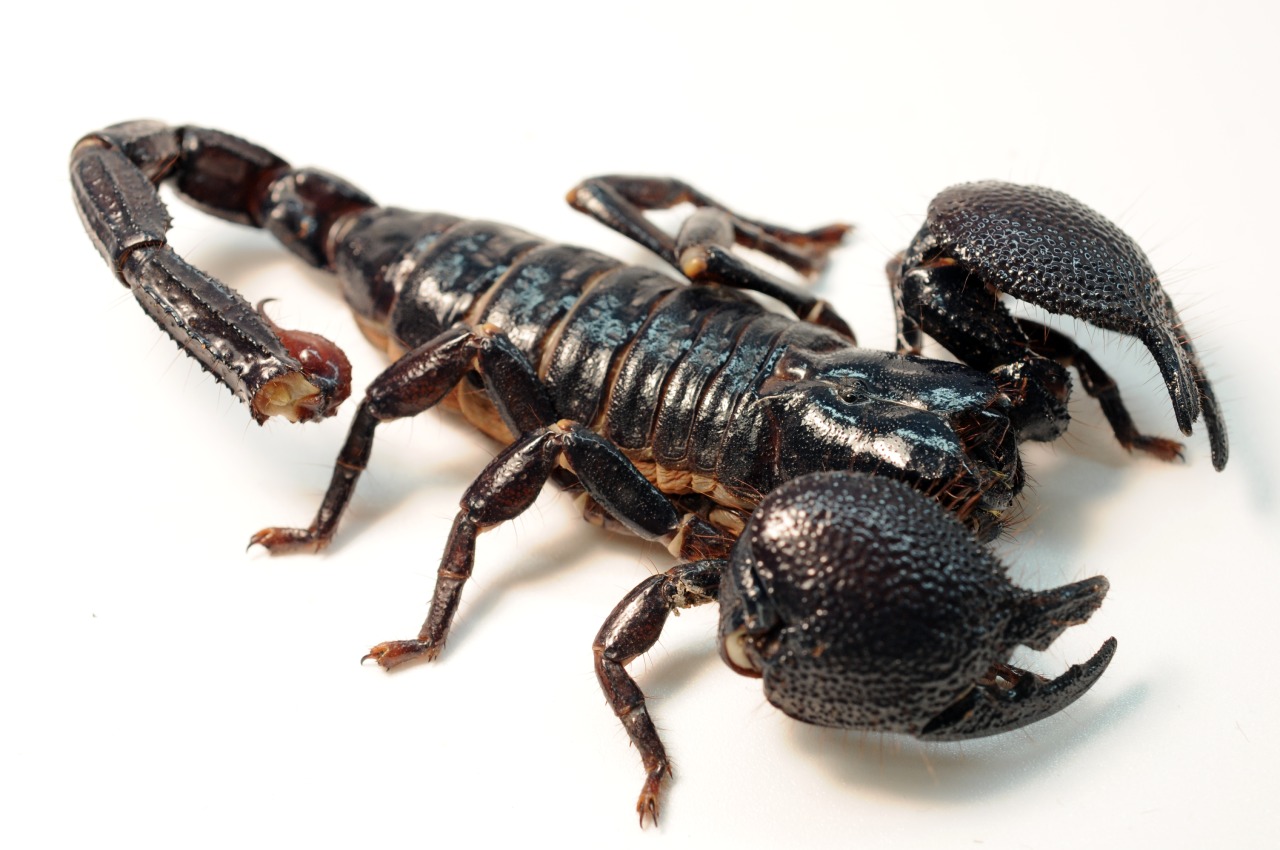
Figure: Adult female emperor scorpion displaying heavily granulated pedipalps and reddish telson. Rosa Pineda, Wikimedia Commons

Why Emperor Scorpions Glow Under Ultraviolet Light
Under a long-wave ultraviolet lamp, a glossy black emperor scorpion lights up in vivid cyan-blue. As American Museum of Natural History arachnologist Lorenzo Prendini notes, all scorpions fluoresce because two compounds—beta-carboline and 7-hydroxy-4-methylcoumarin—sit inside the clear hyaline layer of the hardened exocuticle. The glow switches off immediately without UV light and develops only as the exoskeleton hardens: freshly molted soft scorpions do not fluoresce, while shed hardened skins still do. Researchers continue debating its evolutionary function, with leading hypotheses suggesting the cuticle acts as a whole-body photon collector that helps nocturnal scorpions detect UV in moonlight and judge whether they are fully concealed. Keepers who use UV light for observation should keep exposure brief to avoid stressing photophobic animals.

Figure: Hardened cuticle of Pandinus imperator fluorescing bright cyan-blue under UV light. Rosa Pineda, Wikimedia Commons

Humid Husbandry, Trade Rules, and Keeping Boundaries
Maintaining West African forest conditions indoors requires steady attention to depth, humidity, and airflow. Exotic veterinary care guidelines recommend at least a 10- to 20-gallon escape-proof enclosure for one adult with 10 to 20 centimeters of damp—never waterlogged—coconut coir, pesticide-free topsoil, or peat mix for burrowing. Maintain 75 to 80 percent relative humidity alongside adequate ventilation to curb mold, keep daytime temperatures around 24 to 29 °C with a gentle night dip near 21 °C using a side-mounted heater rather than drying lamps or hot rocks, and furnish tight hides such as cork bark or flat stones plus a daily refreshed shallow water dish. Feed gut-loaded crickets, roaches, or locusts once or twice weekly, pulling uneaten prey within 24 hours so insects cannot injure a resting or molting scorpion. Dehydration, mite outbreaks, trauma from falls, or incomplete juvenile molts are signals to consult an exotic-animal veterinarian.
Legal provenance matters just as much as enclosure setup. Heavy wild collection from West Africa placed Pandinus imperator on CITES Appendix II on February 16, 1995, a listing retained in the CITES Appendices valid from March 2026; Benin, Togo, and Ghana have also faced CITES Review of Significant Trade export suspensions. Although the IUCN Red List currently lists the species as Not Evaluated, wild harvesting remains a serious conservation concern. Buyers should also beware of smoother-clawed Asian forest scorpions (Heterometrus) mislabeled as emperor scorpions. Before considering one, verify regional exotic-keeping laws, insist on documented captive-bred stock, and never release captive scorpions outdoors.

Figure: Pale juvenile emperor scorpions resting on moist coconut coir burrowing substrate. DigitalLem0n, Wikimedia Commons

Emperor scorpions suit calm adult observers who enjoy nocturnal naturalistic enclosures and treat venomous arachnids strictly as hands-off display animals. Frequent handling causes stress, invites painful pinches or defensive stings, and risks fatal falls, while group housing always carries cannibalism risks if space or food runs short. Households with young children, residents with known arthropod venom allergies, or anyone unable to maintain warm humid microclimates and legal captive-bred provenance with exotic veterinary backup should skip keeping this species at home.
References
- Animal Diversity Web: Pandinus imperator
- Merck Veterinary Manual: Spider and Scorpion Bites and Stings to Animals
- CITES Appendices I, II and III (valid from 5 March 2026)
- CITES Species Gallery: Emperor Scorpion (Pandinus imperator)
- AMNH (Lorenzo Prendini): Scorpiones in Grzimek's Animal Life
- San Diego Zoo Wildlife Alliance: Scorpion
- Tree of Life Exotic Pet Medical Center: Emperor Scorpion Care