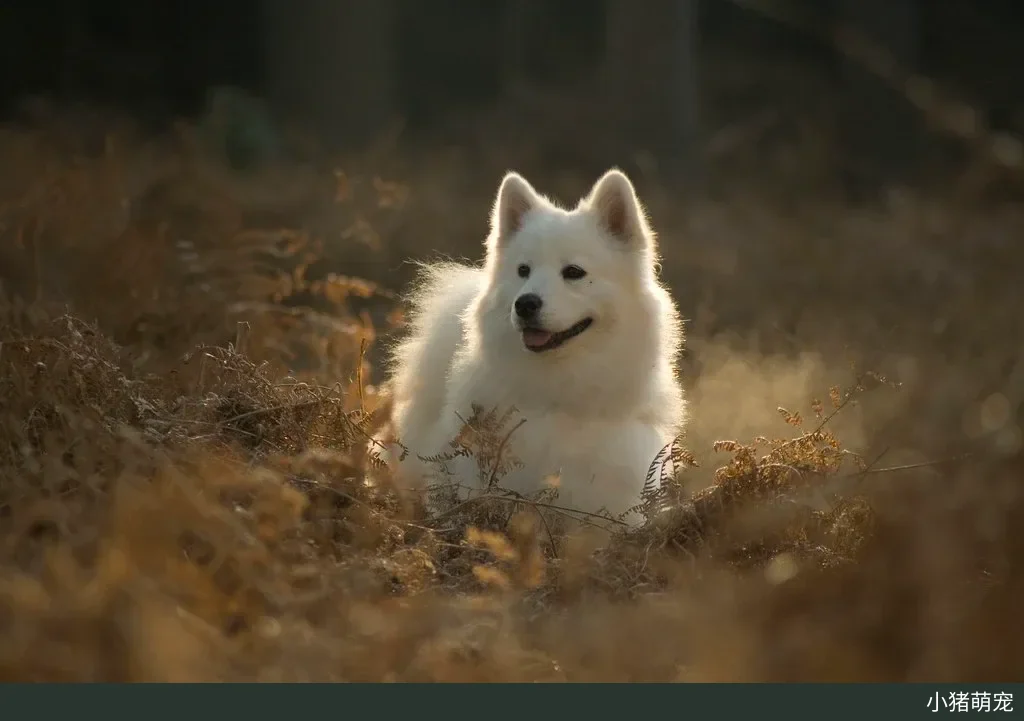
A Samoyed lying among backlit dry yellow ferns, grinning in a “smile.” Photo: Caninest; source: Flickr; license: CC BY 2.0.
The Samoyed comes from northern Russia and Siberia—a snow-white northern spitz whose upturned mouth corners, the “Samoyed smile,” make it especially appealing. It once pulled sleds and herded reindeer for local people; today it is also a family companion: affectionate and lively, almost useless as a guard dog, but a heavy shedder with high exercise needs that dislikes long stretches alone. Drawing on kennel-club and health-organization sources, this article covers origins, appearance, temperament, exercise and training, and health essentials.
Origins and history
The name “Samoyed” comes from the Samoyed peoples of northern Russia and Siberia. The FCI breed standard’s brief history notes that in the southern parts of that land, people used white, black, and brown mixed dogs to herd reindeer; northern dogs were pure white and gentle, used for hunting and sled work. These dogs lived close to their people—even sleeping in tents as living “heaters.” AKC also notes that Samoyed peoples huddled with their dogs through harsh Arctic nights, and that closeness made the breed especially people-oriented.
The breed’s path west is tied to British zoologist Ernest Kilburn Scott. Per the FCI standard, he spent three months among Samoyed peoples in 1889 and returned with a brown male puppy named Sabarka; he later imported a cream bitch, Whitey Petchora, from west of the Urals and a snow-white dog, Musti, from Siberia. Those dogs, plus animals brought by explorers, formed the Western Samoyed foundation; the first breed standard was written in Britain in 1909.
Kennel organizations classify it differently: FCI places it in Group 5 (Spitz and primitive types) among Nordic sled dogs, with final recognition on 26 June 1959 and the current standard published 4 September 2019; AKC puts it in the Working Group and says it recognized the breed in 1906, with the Samoyed Club of America as parent club since 1923; The Kennel Club (UK) places it in the Pastoral Group.
Appearance and coat
The FCI standard describes the Samoyed as a medium-sized, elegant white Arctic spitz that as a whole conveys power, endurance, charm, flexibility, dignity, and self-confidence; body length is about 5% more than height at the withers, and muzzle and skull lengths are roughly equal. The trademark “Samoyed smile” comes from eye shape and placement plus slightly upturned mouth corners. The smile also has a practical use: AKC explains that the upturned corners help keep drool from freezing into icy hangings on the face in extreme cold.
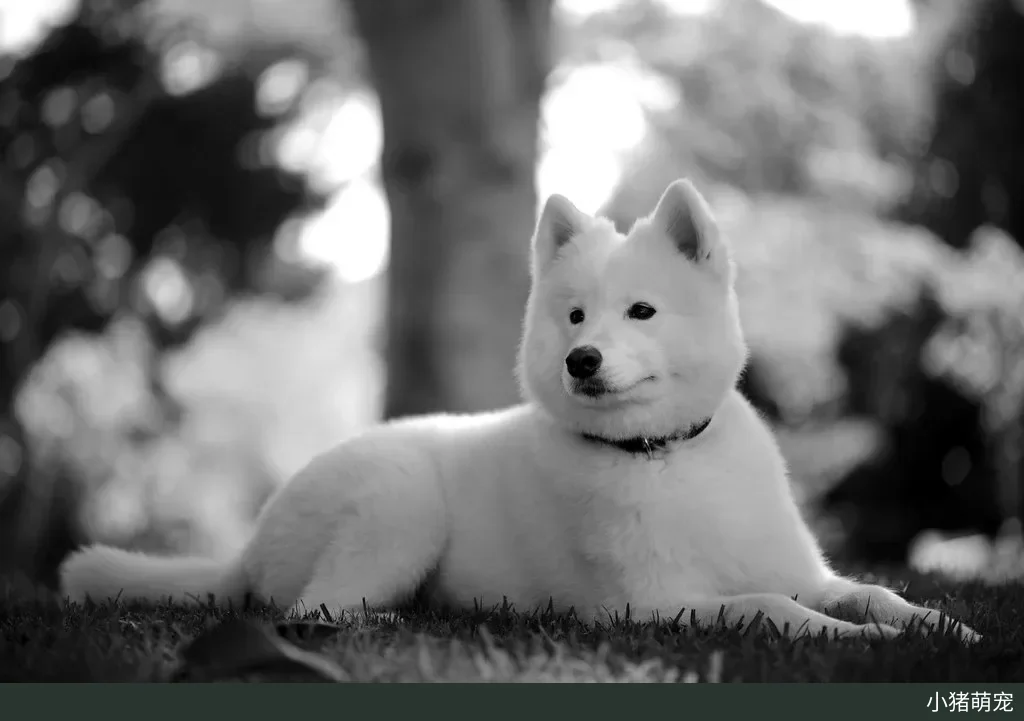
A Samoyed lying in profile on grass, with a wedge-shaped head, erect triangular ears, and a thick coat (original photo in black and white). Photo: jikatu; source: Flickr; license: CC BY-SA 2.0.
On size, the FCI standard’s ideal height at the withers is 57 cm for dogs and 53 cm for bitches, each allowed ±3 cm; the AKC standard (approved 1993) sets dogs at 21–23.5 inches (about 53–60 cm) and bitches at 19–21 inches (about 48–53 cm). The AKC breed page lists average weight as 45–65 lb (about 20–30 kg) for dogs and 35–50 lb (about 16–23 kg) for bitches, with expected lifespan 12–14 years; The Kennel Club (UK) marks lifespan as “10 years or more.”
That “cotton-candy” coat is double: a longer, rather harsh outer coat and a soft, dense, wool-like undercoat. Colors accepted by the AKC standard are pure white, white with biscuit, cream, and all biscuit. The cost of the look is shedding: AKC notes Samoyeds shed a fair amount year-round and more during one or two seasonal coat blows; it recommends daily brushing with a pin brush or metal comb to open mats, and nail trims about every 3–4 weeks; The Kennel Club (UK) likewise lists grooming frequency as “daily.”
Temperament, exercise, and training
The FCI standard calls the Samoyed friendly, open, alert, and lively, with a very weak hunting instinct, neither shy nor aggressive, and—because it is so social—“not usable as a guard dog.” AKC describes it as intelligent, social, and a bit mischievous, needing lots of affection and attention; a Samoyed left alone “in solitary” in the yard will be miserable and may destroy things. Think of it more as an enthusiastic roommate who wants to join every conversation than as a door guard.
Do not let the “smile” fool you—the Samoyed is a working dog that needs plenty of activity. The Kennel Club (UK) recommends more than 2 hours of exercise a day and considers it better suited to a rural home with a large house and garden. AKC suggests play in a securely fenced yard or long leashed walks, and warns that Samoyeds have a strong urge to run and roam—once off leash they may go far and put themselves at risk. Outings are best on leash, and yard fences should be checked for soundness.
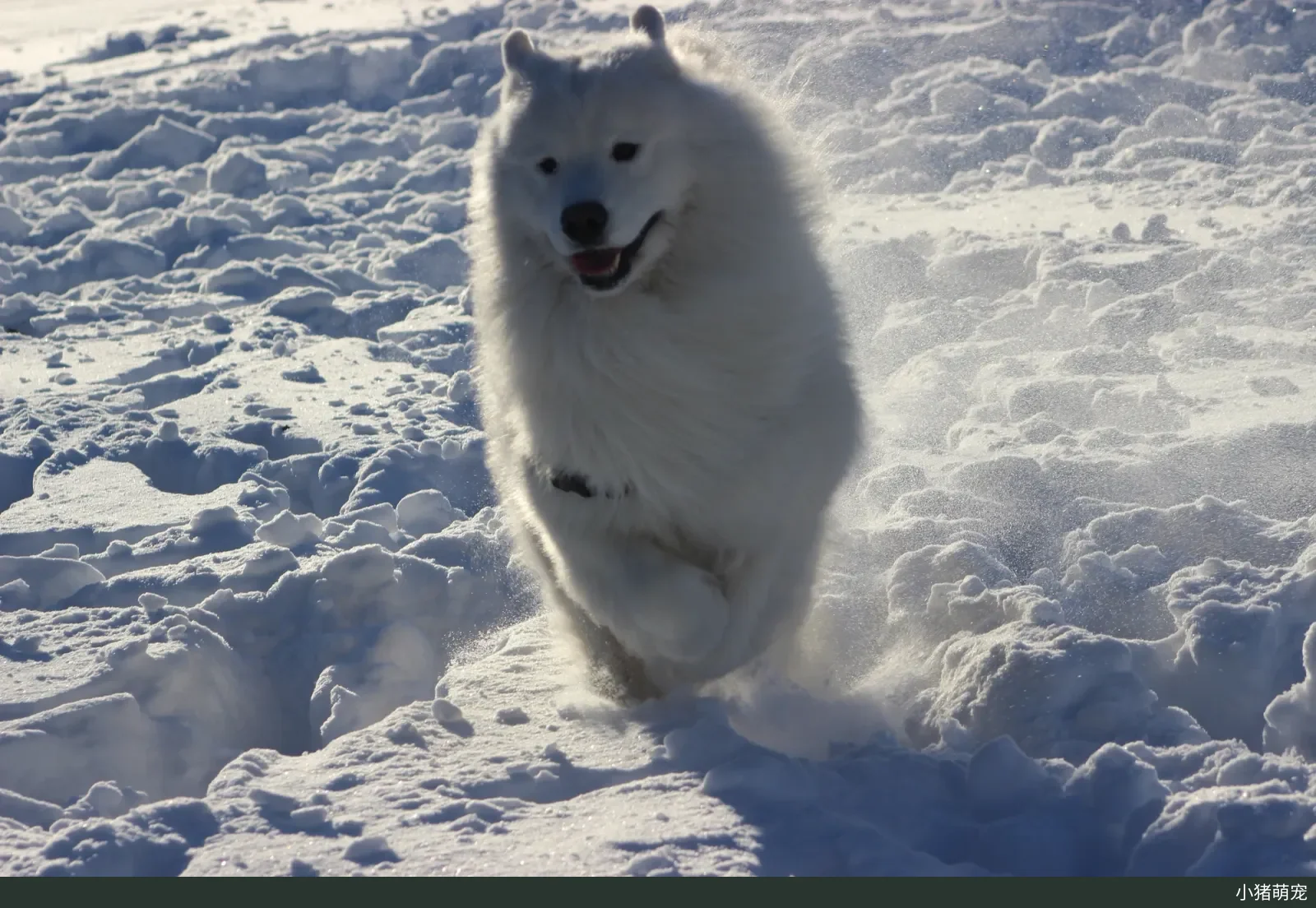
A Samoyed running through snow in Central Park, New York (author notes 24 January 2016). Photo: Johnjptraynor; source: Wikimedia Commons; license: CC BY-SA 4.0.

On training, AKC advises clear rules for a Samoyed: make expectations plain early and practice often, firmly but gently. AKC also notes some Samoyeds pack on weight easily—count training treats toward daily calories. For them, walks, brushing, and short training sessions are not only chores but time with family.
Common health issues
AKC considers the Samoyed generally healthy; responsible breeders screen breeding stock for hip dysplasia and eye and heart disease. In a 29 October 2014 statement, the Samoyed Club of America listed CHIC health-registry requirements: eye exam by a veterinary ophthalmologist at 1 year or older, hip evaluation (OFA, OVC, or PennHIP), X-linked progressive retinal atrophy (XLPRA) DNA testing, cardiac exam by a cardiologist, and retinal dysplasia / oculoskeletal dysplasia (RD/OSD) DNA testing. When choosing a puppy, ask the breeder for these results on the parents.
Hip dysplasia is the skeletal issue most watched. The Samoyed Club of America explains it as abnormal hip development—the femoral head and the pelvic acetabulum misalign, and long wear leads to painful arthritis; the most common sign is lameness. Multiple genes are involved, as are overweight and trauma; treatment ranges from anti-inflammatories to surgery, and keeping ideal weight eases load on the hips. Citing OFA data, the club says hip dysplasia among X-ray-screened Samoyeds fell from 13.21% in the 1980s to 7.22% in 2005–2010; elbow dysplasia was 2.2% among dogs screened through 2014. These are statistics for dogs voluntarily submitted for screening—not incidence across all Samoyeds.
On eyes, X-linked progressive retinal atrophy (as the name says, the retina gradually degenerates) and RD/OSD2 both have DNA tests and are required for the club’s health registry. The Samoyed Health Foundation (page information through 6 October 2020) lists other testable genetic disorders including degenerative myelopathy, familial enamel hypoplasia, and X-linked hereditary nephritis. The foundation also notes that commercial DNA panels do not cover all of these diseases.
“Samoyed hereditary glomerulopathy” is named for the breed but is not common in Samoyeds. The veterinary genetics lab at the Université de Montréal explains that the disease was first described in a Samoyed family in 1977 and is caused by a COL4A5 mutation on the X chromosome: affected dogs show proteinuria at 2–3 months, progress to kidney failure at 7–15 months, and die before 18 months. The lab notes that affected males can be recognized clinically and carrier females via offspring, so the condition is relatively easy to control within the breed and is “mainly of academic interest,” not a widespread breeding worry. Day to day, regular checkups, parasite control, and brushing with dog toothpaste remain AKC basics; seek care promptly for lameness, vision changes, or abnormal drinking and urination.
References
-
FCI-Standard N° 212 SAMOIEDSKAÏA SABAKA (Samoyed) (FCI, current standard published 2019-09-04)
-
CHIC requirements statement (Samoyed Club of America, 2014-10-29)
-
Genetic Disorders (Samoyed Health Foundation, information through 2020-10-06)
-
Nephritis, X-linked (Alport syndrome) (Laboratoire de génétique vétérinaire, Université de Montréal)