The Dandie Dinmont Terrier takes its name from a novel, but its history as a hunting dog goes back more than a century before the book appeared. Records place these working terriers in the Cheviot Hills on the border between England and Scotland around 1700. In his 1815 novel Guy Mannering, Walter Scott wrote about a farmer named Dandie Dinmont who kept pepper and mustard terriers. The farmer gave the breed its name. The instinct that hunters valued still matters on an ordinary walk across a field. If a small animal breaks cover, a Dandie may be off after it in an instant. [1]
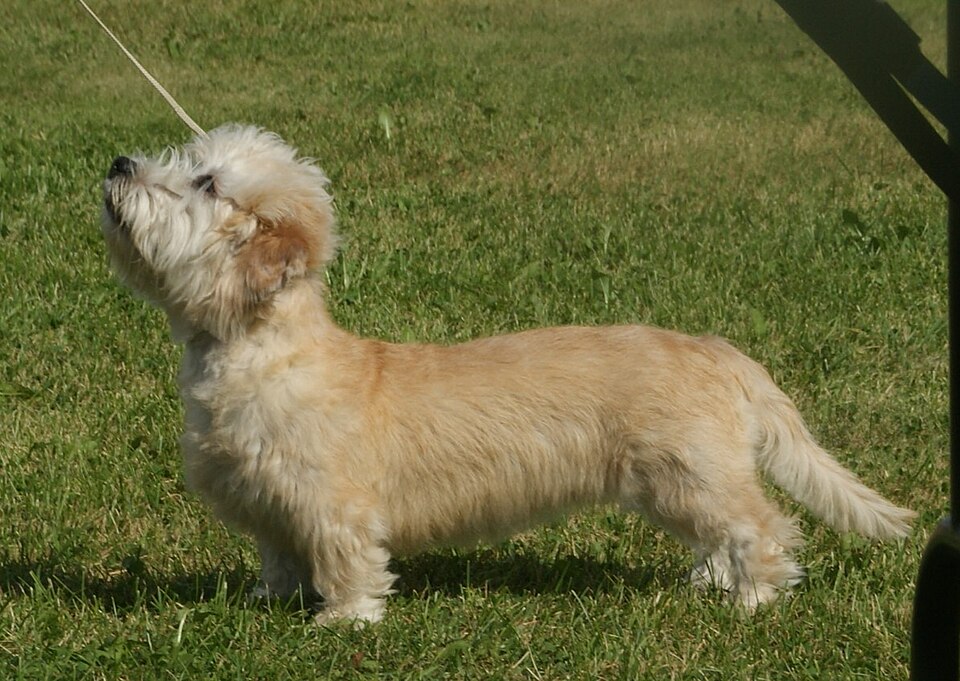
The Dandie Dinmont Terrier in profile. Canarian, Wikimedia Commons[2]

To recognize a Dandie from the side, follow the line of its back. It starts low at the shoulders, arches gently over the loin, then slopes down toward the base of the tail. Four short, sturdy legs carry the long body, and the chest drops between the front legs. The head is large, with a pale, silky topknot, round, dark eyes set well apart, and low-set ears that hang close to the cheeks. The pale dog on the grass has noticeably darker ears. A mustard coat can range from reddish brown to pale fawn. Pepper, the breed’s other color, runs from bluish black to silvery gray. The distinctive outline is the same in either color. [1][2]
Save ball games for fenced ground
When planning a Dandie’s day, the American Kennel Club (AKC) suggests two exercise sessions of about half an hour each. A brisk walk on a leash or a game of ball in a fenced yard can fill that time. You might take the morning walk before work and save the ball for an evening when you have somewhere enclosed to play. Choose a walking route that leaves your dog enough energy for the trip home, and set your turnaround point according to its age and stamina. A Dandie may sprint eagerly after a ball, but keeping pace with a jogger over a long distance asks something quite different of those short legs and long back. Moderate exercise suits the breed. Distance running and keeping up with a bicycle do not. [1]
Before you throw a ball, look at where it could roll. A fence on every side and a gate that latches give a Dandie room for a short chase off leash. If one side opens onto a driveway or the grass runs straight to a sidewalk, keep the leash on and take a walk. A broad lawn may look more inviting than a small yard, yet a dog can be off it in a few strides. Agree on one habit with everyone who uses the yard. When someone needs to open the gate, put the dog on its leash first and resume the game once the gate is shut. Count on the terrier to spot a small animal at the edge of the grass before you do. [1]
A household without a yard can still make this routine work. Look for a route from your front door where you can walk for a good stretch on leash. A visit to a safely enclosed space can give your dog a chance to run freely when one is available. If you’re considering the breed, work out who could take the morning and evening walks on a typical weekday. A family hoping to exercise the dog on a bike commute would need to set aside separate walking time. If you already enjoy a walk after dinner, one of those outings may fit naturally into your day. [1]
Reward the moment your Dandie turns to you
Dandies are alert, independent-minded dogs that form close bonds with their families. Start training with a response you can see. In a quiet room, say your dog’s name. The moment it turns to look at you, offer praise or a small treat. Once everyone in the family can draw its attention with the same cue, practice in the yard with the gate shut or on a quiet stretch of a leashed walk. Then try turning and taking a few steps so the dog follows. By the time you need to change direction at a street corner, you and your dog will have practiced the move together. [1]
Even when practice goes smoothly at home, clip on the leash for walks. The AKC points out that a well-trained Dandie may still bolt when something catches its eye. If a child wants to play, an adult can latch the gate before the child rolls the ball. Along the street, the person holding the leash needs to be able to keep a firm grip. A Dandie’s alert bark can be deeper and louder than its size suggests. If your front door opens onto a shared hallway, decide who will call the dog’s attention away from footsteps, lead it back from the door, and reward it for following. [1]
Grooming the Dandie’s mixed-texture coat
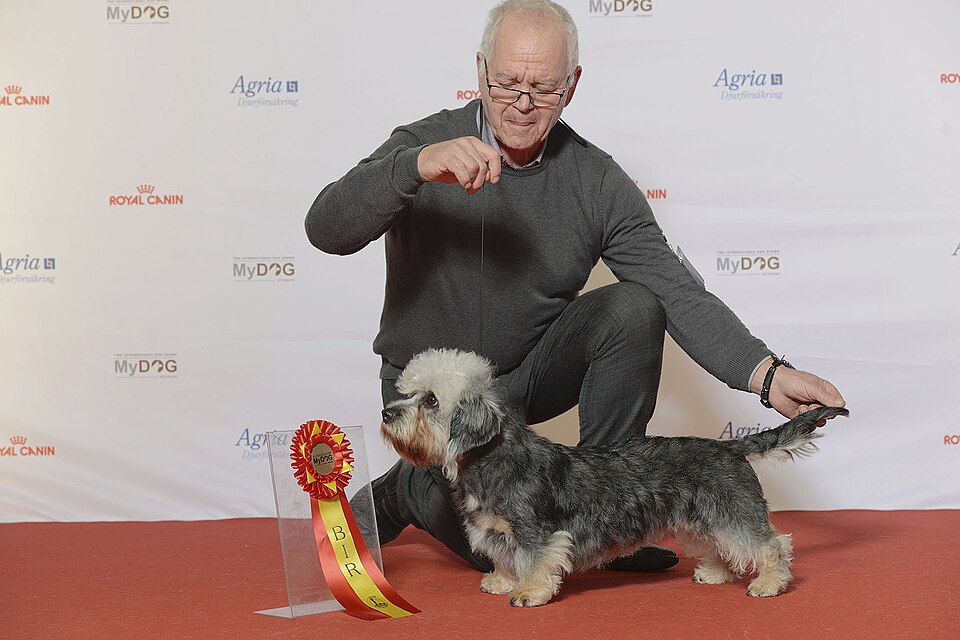
Ulaika’s pale topknot stands out against her dark coat. Svenska Mässan, Wikimedia Commons[3]

In the show photograph of Ulaika, the pale hair rises in a tuft above the head, while the dark coat follows the curve of the back. The textures differ under the hand, too. The topknot feels silky. On the body, harder and softer hairs mingle in a double coat that feels fairly crisp. Dandies shed little, so loosened dead hair needs regular attention. Make brushing a daily habit. When your dog is standing quietly, start along one side and work through the longer hair on the chest and legs before moving to the other side. The aim is to keep the strands separate before tangles tighten into mats. [1][3]
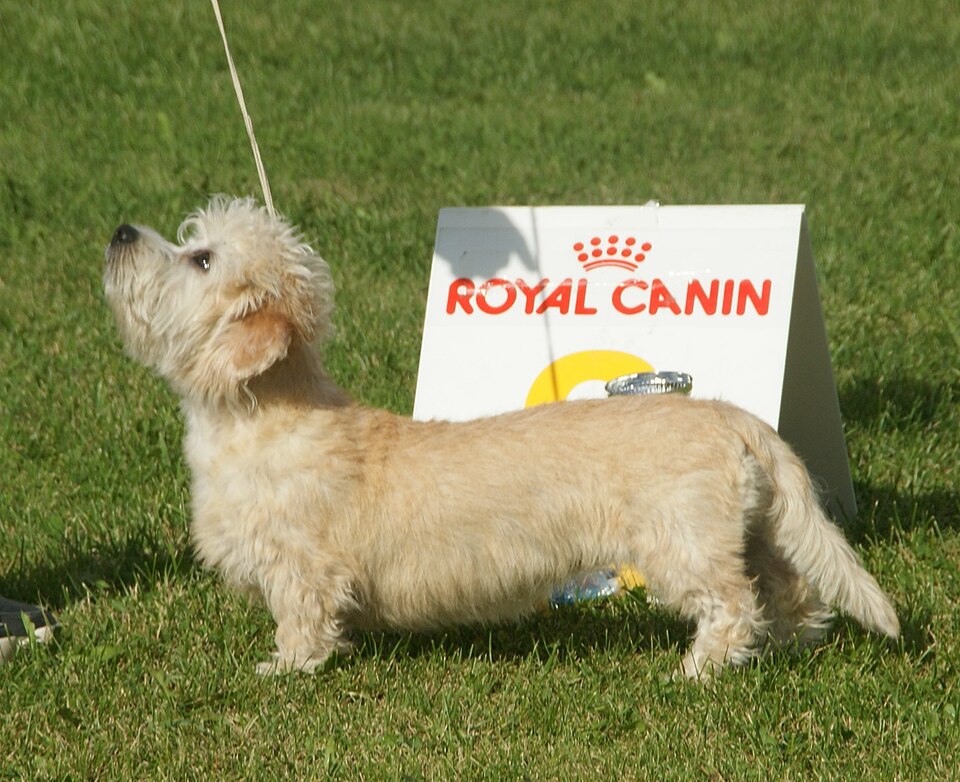
Longer hair fringes this mustard Dandie’s chest and belly. Canarian, Wikimedia Commons[4]

Brushing out tangles and hand-stripping dead hair belong on different schedules. Brush daily. For stripping, the AKC recommends setting aside time at least twice a year. Ask a breeder familiar with the coat to show you how to feel which hairs have loosened and how to remove them. Then decide who will do it in the future. If you book a groomer, ask specifically about experience hand-stripping this kind of coat. At home, trim the nails at least once a month, check inside the hanging ears regularly, and brush the teeth often with toothpaste made for dogs. Giving each task its own place in the routine makes it easier to keep up between grooming appointments. [1][4]
Watch for sudden changes in the eyes
Grooming around the face gives you a chance to notice how your Dandie normally holds its eyes open. The Royal Kennel Club lists the Dandie Dinmont Terrier among breeds at risk of primary angle-closure glaucoma. Its breeding health standard includes eye screening and gonioscopy, an examination of the drainage angle inside the eye. When asking about a litter, find out which eye examinations both parents have had and what their results showed. At home, sudden squinting, redness, or cloudiness calls for urgent veterinary attention, particularly if your dog is rubbing an eye or seems to have trouble seeing. A rise in eye pressure can damage sight, so new symptoms need prompt assessment even in a dog with a screening record. [5][6]
References
-
[1] American Kennel Club. Dandie Dinmont Terrier Dog Breed Information.
-
[2] Canarian. Dandie Dinmont Terrier mustard 2. Wikimedia Commons.
-
[3] Svenska Mässan. DANDIE DINMONT TERRIER, German Dandies’ Ulaika. Wikimedia Commons.
-
[4] Canarian. Dandie Dinmont Terrier mustard 1. Wikimedia Commons.
-
[5] The Royal Kennel Club. The Royal Kennel Club Health Standard.
-
[6] The Royal Kennel Club. Glaucoma in dogs.