About 1,100 years ago, Norse settlers sailed to Iceland with spitz-type dogs. Farmers relied on their descendants to herd sheep and round up small horses. Those farm dogs gave us today’s Icelandic Sheepdog. Small enough to move nimbly around livestock, they could also use their bark to get animals moving. In a family home, you may hear that voice when someone walks past the door. The dog may well have heard the footsteps before you did.[1][2]
Seen from the side, an Icelandic Sheepdog has a sturdy, rectangular outline. The distance from the point of the shoulder to the rump is slightly greater than the dog’s height at the shoulder. The tail is set high, and its plume curls over the back. The American Kennel Club (AKC) gives typical shoulder heights of about 46 cm for males and 42 cm for females. The dog in the first photograph has turned its face toward the camera, but all four feet are in view, making it easy to see the proportions of the body and where the tail sits.[1][2]
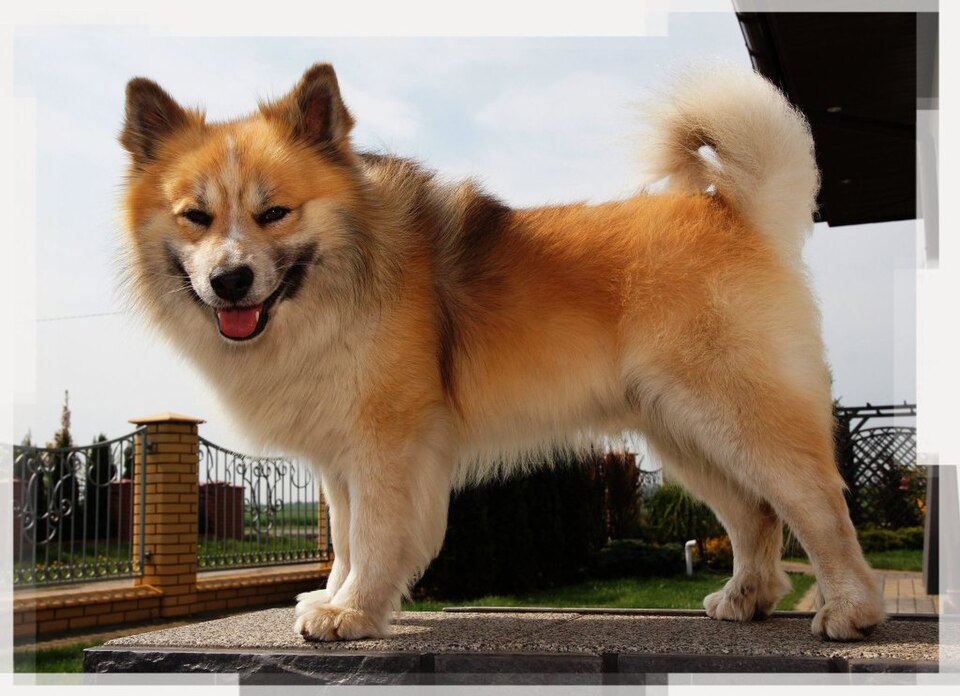
An Icelandic Sheepdog stands in profile. Kopieccy, Wikimedia Commons[5]

Look at the two dogs facing the camera below and follow the short hair on each cheek back to the longer hair around the neck. One ruff is fuller than the other, yet the faces have much the same outline. The ears stand upright with slightly rounded tips, and the muzzle tapers toward the nose. Those mobile ears can turn toward a sound. Icelandic Sheepdogs are generally curious, playful and friendly. When you come home from work and hear barking on the other side of the door, your dog may be announcing your arrival and greeting you in the same breath.[1][2]
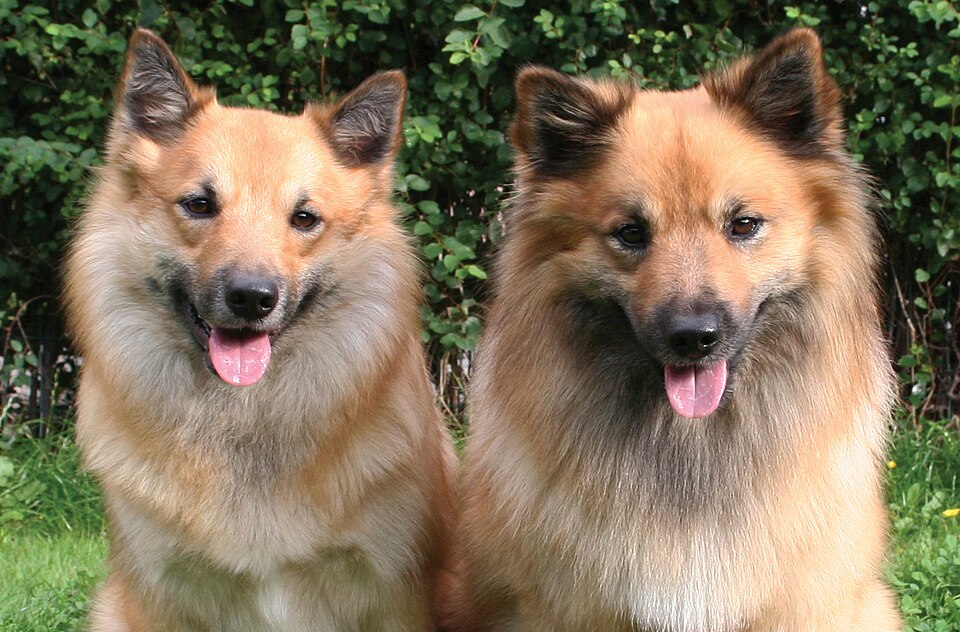
Both dogs have upright ears and a tapering muzzle. Disarut, Wikimedia Commons[6]

Practice a turn on a familiar walk
Icelandic Sheepdogs enjoy being outdoors and can be good companions on long walks and hikes. For an ordinary day, the AKC recommends moderate exercise, which can include walks and play. The breed can also take part in herding, tracking, agility and rally obedience. One movement from rally fits neatly into a neighborhood walk. You change direction, and your dog notices the cue and turns with you. A familiar corner gives a dog bred to work alongside people a chance to use its head as well as its legs.[1][3]
Start in a room your dog knows. Clip on the leash and choose a cue that comes naturally to everyone in the family, such as “let’s go.” Say it and start walking. When your dog follows for a few steps with the leash still loose, offer a small treat at your side. Before you turn, say your dog’s name. Once you have its attention, say “turn” as you change direction. Give the treat as soon as the dog comes around beside you, while you are both facing the new way. That timing helps the dog connect the reward with the turn you just made together.[3]
Once the turn feels easy indoors, try it on a quiet stretch of your route. Outside, there may be so much to look at that your dog only glances back at you once. Reward that glance. Choose a corner with room to maneuver and give your cue while there is still slack in the leash. Watch the leash as you round the corner. If it still hangs in a curve as your dog follows, you can see the cue at work. Afterward, stop somewhere safe and let your dog sniff. Part of the walk can be yours to direct, and part can belong to the dog that wants another moment with an interesting scent.[3]
Make room for company on a workday
When deciding whether an Icelandic Sheepdog would suit your family, picture your busiest weekday. Who has time in the morning to pause while the dog sniffs? How long is the gap between the last person leaving home and the first one getting back? If the person who usually takes the evening walk has to work late, who can pick up the leash? These dogs enjoy taking part in family life and can be unhappy if they regularly spend long stretches alone. Even a family that spends every weekend hiking needs someone who can cover that gap during the week.[1]
Think about your home from ear level, too. If your front door opens onto a shared staircase, each neighbor coming upstairs gives the dog another arrival to announce. If you are considering an adult dog, ask its current caregiver what happens after a knock. How long does the barking last? What does the dog do once a guest sits down? Those details tell you more about living together than the word “friendly” alone. For a puppy, plan for early socialization and puppy classes. Everyone at home can practice rewarding a response they want to see again, especially that moment when the dog hears something and looks back at a person. Harsh scolding is a poor fit for this breed.[1][2][3]
Brush through the ruff during shedding season
On the dog at left in the photograph below, the short white hair on the cheek gives way to a long fringe down the chest. Icelandic Sheepdogs come in longhaired and shorthaired varieties. Both have a fairly coarse outer coat over a thick, soft undercoat. In both, the hair is shorter on the face, ears and fronts of the legs, and longer around the neck, on the chest and down the backs of the thighs. You can follow that change in length with your fingers as you groom, feeling through the ruff for loose hair and small tangles. A smooth-looking back can be quite compatible with a chest that still needs brushing.[1][2]
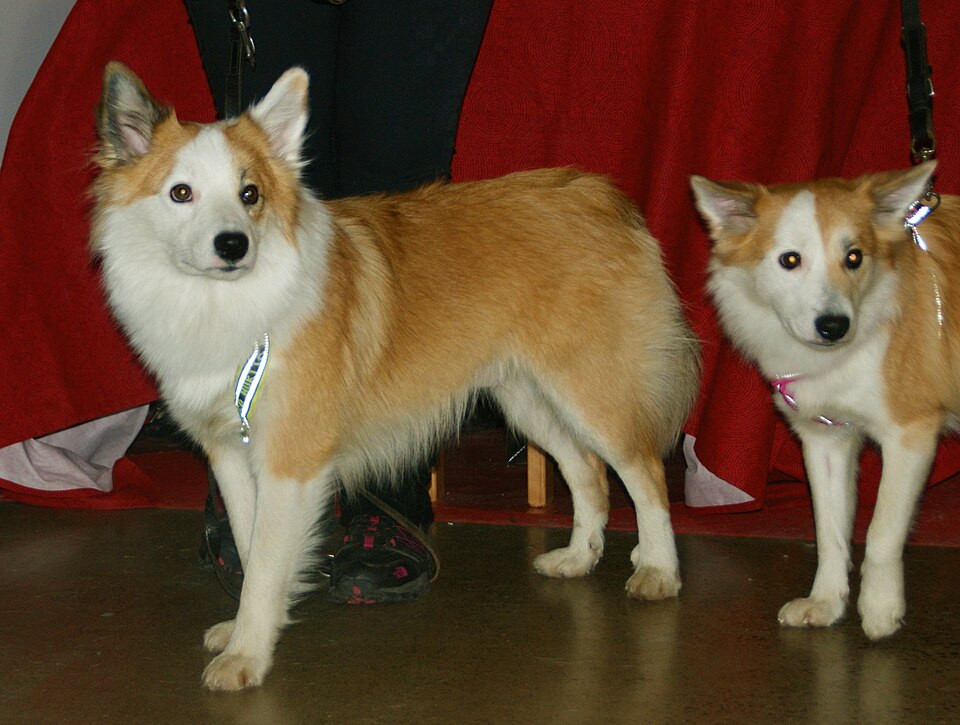
The ruff extends down the chest. Canarian, Wikimedia Commons[7]

Set aside time for a weekly brushing, increasing to daily brushing during the two heavy shedding seasons each year. A pin brush or metal comb can help work out tangles and remove loose hair and dirt. Keeping the tools where someone can reach them after a walk makes the routine easier to keep. Regular nail trims, ear checks and frequent toothbrushing with dog toothpaste also belong in the family schedule. A shorthaired Icelandic Sheepdog still needs that time with the brush.[1]
If you are choosing a puppy and already looking forward to long walks together, ask to see the hip evaluations and eye examination records for both parents. The Icelandic Sheepdog Association of America requires both screenings under its breeding guidelines. The interval between eye exams depends on the dog’s age, so read the date of the exam alongside its age at the time. The AKC also lists elbow dysplasia and patellar luxation, or a slipping kneecap, among the breed’s health concerns. The association lists screening for those two conditions as optional. The parents’ records tell you what the breeder had checked. To judge how comfortably your own dog walks and how far it can go with you, pay attention to its usual stride, how it manages activity and what your veterinarian finds on examination.[1][4]
References
-
[1] American Kennel Club. Icelandic Sheepdog.
-
[2] Fédération Cynologique Internationale. ÍSLENSKUR FJÁRHUNDUR (Icelandic Sheepdog). FCI Standard No. 289, English edition, 2018.
-
[3] American Kennel Club. Leash Training: How to Train a Dog or Puppy to Walk on a Leash.
-
[4] The Icelandic Sheepdog Association of America. Health Statement. 2024.
-
[5] Kopieccy. File:GRATIS GRETTIR.jpg.
-
[6] Disarut. File:Orri Hokki sitjaIgardinum.jpg.
-
[7] Canarian. File:Icelandic Sheepdogs.jpg.