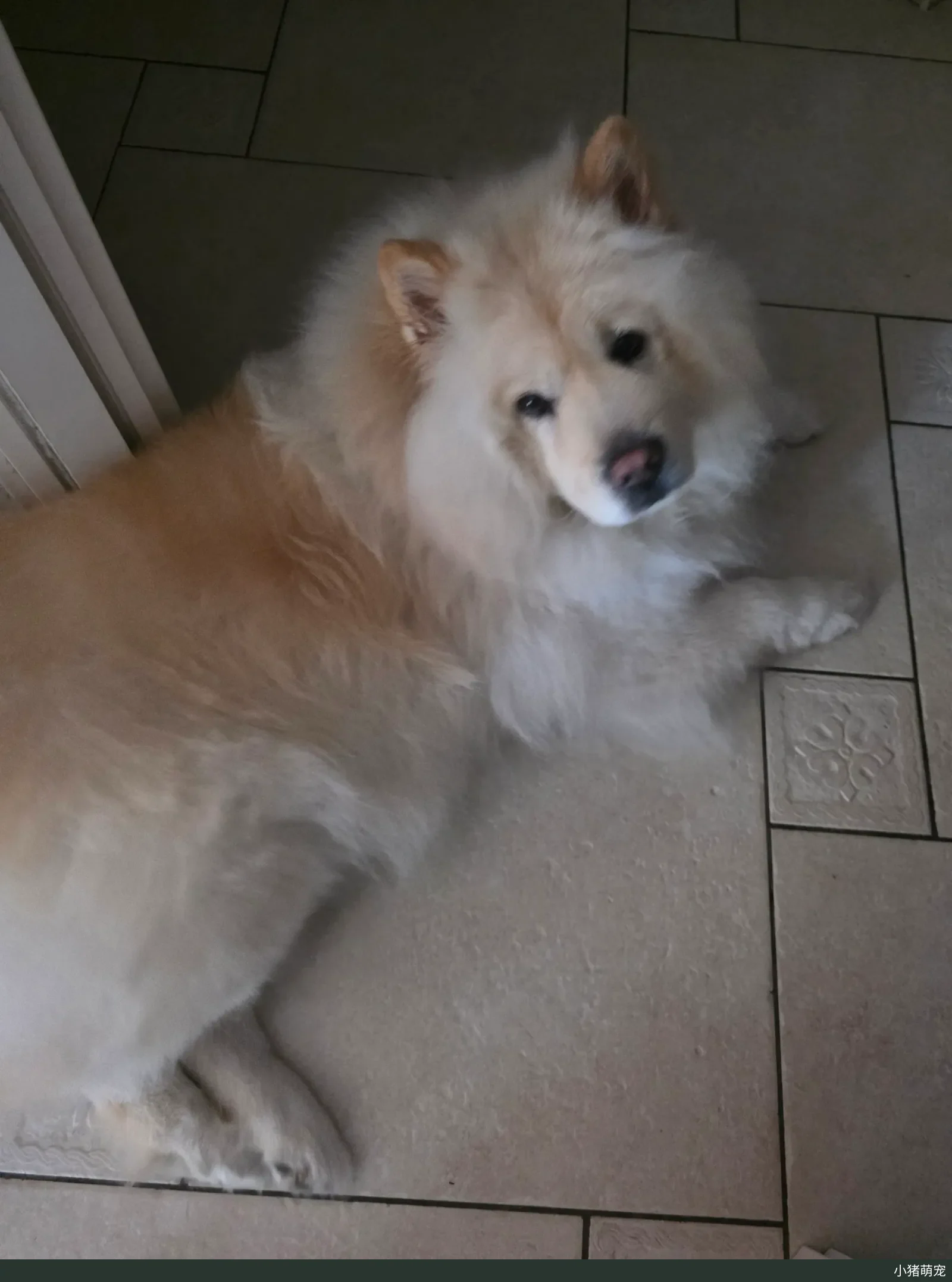
An adult female Chow Chow. Photo: Andrea Papaccio; source: Wikimedia Commons; license: CC0 1.0.

The Chow Chow is an ancient breed from northern China. Its most striking marks are a blue-black tongue, a “lion’s mane” around the head and neck, and a rather stiff gait. Loyal to family and reserved with strangers, it has moderate exercise needs but is very heat-sensitive. Drawing on AKC, FCI, The Kennel Club, and veterinary sources, this article covers origins, appearance, temperament, daily care, and health issues to know in advance.
Origins and History
Per the FCI breed nomenclature, the Chow Chow’s country of origin is China, the standard is in the care of Great Britain, and it sits in Group 5, Spitz and Primitive Types, Asian Spitz and related breeds; FCI formally recognized it in 1957. The AKC standard describes it as an ancient northern Chinese breed that was once an all-purpose dog for hunting, herding, drafting, and guarding; today it is mainly a companion, though judges should still remember its working past.
How old is it? The AKC breed page notes Chow Chow–like images in Han Dynasty artifacts and suggests the history may be older still. VCA Animal Hospitals materials are more cautious: exact origins are unclear, only that it has existed in China for hundreds or even thousands of years; DNA work places it among the 14 oldest AKC-recognized breeds.
Per VCA, Chows reached Britain in the late 18th century; the English name “Chow Chow” may come from a period term for Oriental odds and ends. Only with the late-19th-century rise of dog shows and fashion for exotic breeds did they truly catch on in the West—Queen Victoria was an enthusiast. The AKC formally recognized the breed in 1903.
Appearance and Coat Care
The Chow is a medium dog: square, compact, muscular, and heavily boned. The AKC standard gives an average adult height of 17–20 inches (about 43–51 cm) at the withers and stresses overall proportion over exact size; the AKC breed page lists weight at 45–70 lb (about 20–32 kg) and expected lifespan 8–12 years. Recognition comes from these details:
- Blue-black tongue: The AKC standard requires a solid blue-black tongue surface and edges, the darker the better; red, pink, or spotted tongue surface or edges is a disqualification.
- “Scowling” expression: Deep-set almond eyes, a broad flat skull, and brow folds give a serious, dignified, even aloof look.
- Small erect ears and curled tail: Ears are small triangles, stiff and upright; the tail is high-set and always carried close over the back.
- Stilted gait: Rear angulation is minimal, so steps are short and pendulum-like, straight up and down—a gait unique to the breed.
- Two coat types: Rough has a dense, upright, rather harsh outer coat forming a conspicuous mane at the neck; Smooth has a hard, smooth outer coat without a pronounced mane. Both have thick undercoat.
- Five colors: Red, black, blue, cinnamon, and cream, judged equally.
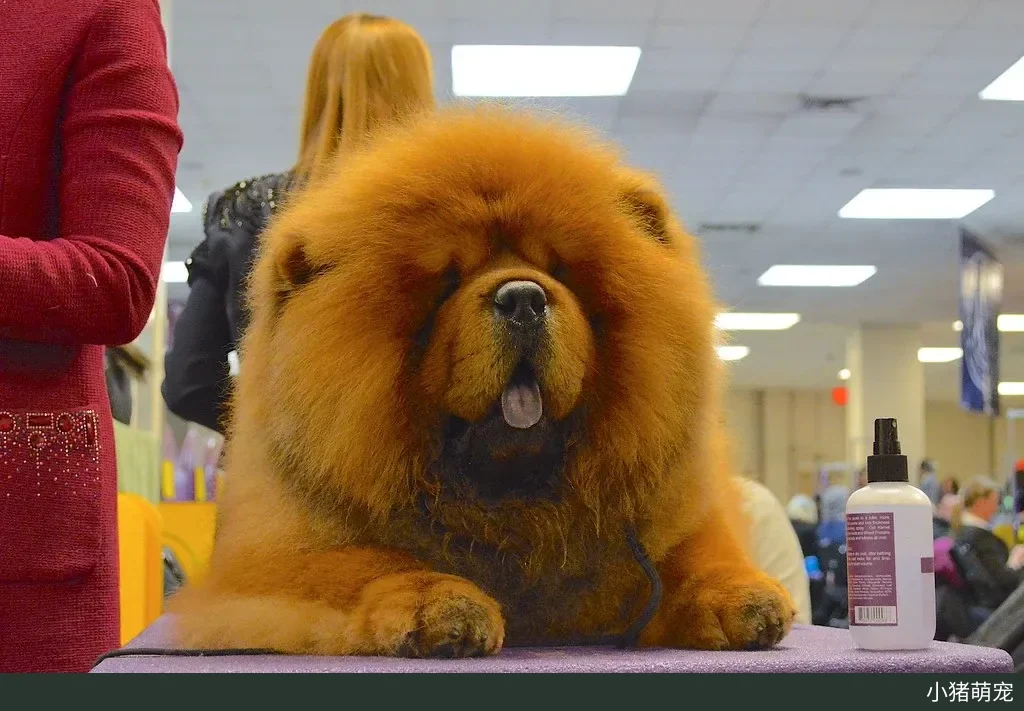
Chow Chow “Kun Lun Of Anna Kennel” at the 2015 Westminster Kennel Club Dog Show in New York, with a purple tongue extended. Photo: Petful.com; source: Flickr; license: CC BY 2.0.
That thick coat needs regular work. The AKC recommends thorough brushing at least twice a week and a monthly bath, preferably dried thoroughly with cool air afterward—puppy coat and hair around the head mat especially easily. VCA suggests brushing rough coats every other day and smooth coats once or twice a week, and notes shedding is heavier than in many breeds.
Temperament, Exercise, and Training
The AKC standard calls the Chow intelligent, independent, and naturally dignified—hence a somewhat aloof air; reserve and discretion with strangers are innate, but aggression or timidity are faults. It also notes that deep-set eyes limit peripheral vision, so approach from the front. That matters in homes with children or frequent visitors—reaching from the side or rear, the dog may not have seen you.
VCA describes a loyal, protective family member that is not very demonstrative, wary of strangers, and not especially friendly with unfamiliar dogs; it usually tolerates children but may not join wild play, and like any large dog needs adult supervision with kids. The AKC breed page adds that owners widely find Chows clean: they house-train readily and have little body odor.
On exercise, the AKC sees them as active and alert with moderate needs: daily walks and moderate toy play, avoiding rough or high-impact activity, and recommends four or more moderate-pace walks a day. Heat is the real concern—AKC advises avoiding the hottest part of the day because they tolerate heat and humidity poorly; VCA likewise notes they overheat easily and are not suited to very strenuous sport. The Kennel Club’s breed health plan cites a UK VetCompass study (Hall et al., 2020) finding Chow Chows at markedly higher heatstroke risk than other dogs, odds ratio about 16, though with a wide confidence interval (about 6–44) due to small sample size.
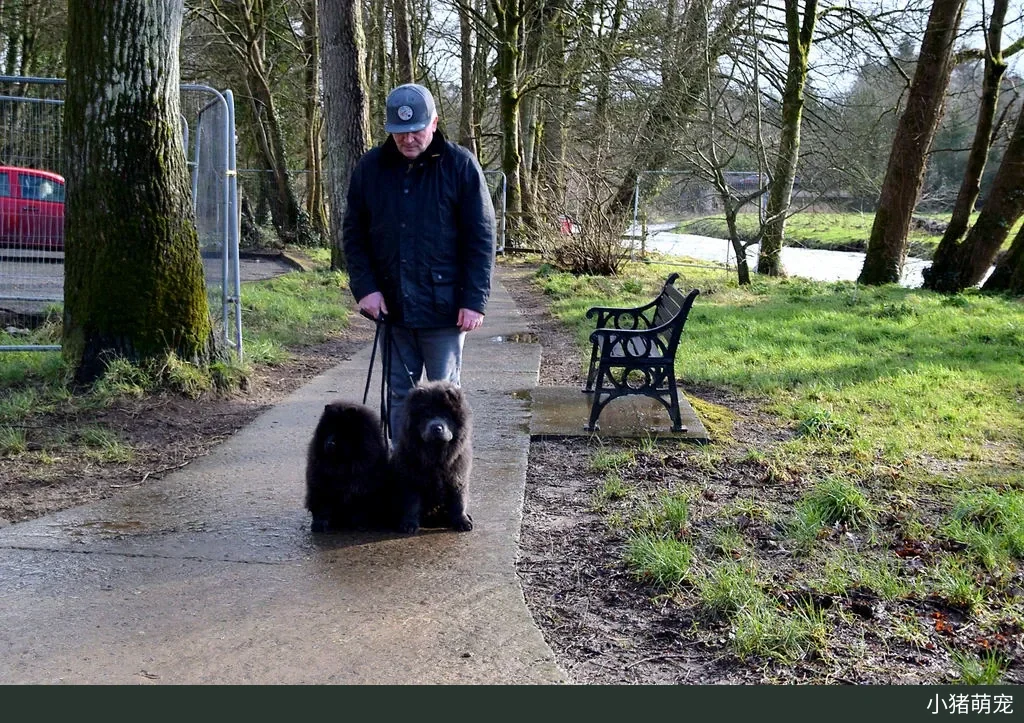
In February 2020, a dog walker in Cranny, Northern Ireland, out with Chow Chows. Photo: Kenneth Allen; source: Geograph Britain and Ireland via Wikimedia Commons; license: CC BY-SA 2.0.

On training, the AKC recommends early socialization and puppy classes with patient, positive, consistent reinforcement; Chows are smart but can be stubborn, and harsh methods only break trust. VCA likewise notes they resist forceful methods and suit owners who combine reward-based training with clear rules; obedience training is also good mental exercise beyond day-to-day management.
Common Health Issues
AKC-listed Chow health concerns include entropion, hip dysplasia, elbow dysplasia, allergies, and thyroid problems, which can be reduced through health screening, responsible breeding, and regular checkups; the Chow Chow Club of America recommends screening for patellas, hips, elbows, eyes, and thyroid. Issues worth knowing in detail:
- Entropion: The eyelid rolls inward so lashes and hair rub the cornea. A 2025 PLOS One UK study of 2019 VetCompass primary-care records found an annual entropion prevalence of 9.28% in Chows—second only to Shar Pei among breeds; versus mixed breeds the odds ratio was about 53. The AKC standard also lists entropion or ectropion as a serious fault.
- Hip and elbow dysplasia: The Kennel Club’s 2020 breed health plan summarizing U.S. veterinary teaching-hospital data found Chows at higher risk for both than controls; in UK BVA/KC elbow scoring, 61.1% of 149 examined Chows had some degree of elbow pathology (examined dogs may not represent the whole population).
- Cruciate ligament injury and bloat: The same plan notes elevated risk of cranial cruciate ligament disease; Britain’s breed health coordinator in 2019 ranked entropion, elbow dysplasia, and gastric dilatation-volvulus (GDV) as the three top health priorities for the breed.
- Heatstroke: As above, they handle heat poorly—extra care in summer.
If you plan to bring home a Chow, ask the breeder for parental eye, hip, and elbow screening results; if you see frequent tearing, squinting, limping, or difficulty rising, see a veterinarian promptly.