The English Toy Spaniel is an aristocratic companion with deep ties to Britain’s House of Stuart. By the sixteenth and seventeenth centuries, noble households cherished miniaturized sporting spaniels known as the “Spaniel Gentle” or “Comforter”—one reportedly accompanied Mary, Queen of Scots, to her execution in 1587, and both Charles I and Charles II made the dogs royal fixtures.[1][2] Much of today’s confusion stems from naming: the American Kennel Club (AKC, Toy Group, recognized 1886) calls this breed the English Toy Spaniel, whereas in its homeland, The Royal Kennel Club and the Fédération Cynologique Internationale (FCI Group 9, Standard No. 128, definitive recognition 1955) retain the title King Charles Spaniel after King Edward VII asked to preserve the royal name.[1][2][3] With small annual registrations, The Royal Kennel Club currently classifies it as a Vulnerable Native Breed.[3]
Recognizing an English Toy Spaniel begins with its unmistakable head and compact, cobby outline. Under AKC and FCI standards, the dog stands roughly 9 to 10 inches tall and weighs 8 to 14 pounds (3.6 to 6.3 kg in FCI), with a short, square, deep-chested body.[1][2] Its skull is comparatively large and prominently domed, curving full over the eyes into a deep stop, followed by a very short, wide, turned-up muzzle, plush cushioned cheeks, and a slightly undershot bite; large dark eyes sit squarely forward, framed by very long, low-set, heavily feathered ears.[1][2] The profuse, silky coat appears in four historic varieties: chestnut-and-white Blenheim (often marked with a thumbprint-like “Blenheim Spot” atop the skull), black-and-tan King Charles, tricolor Prince Charles, and solid chestnut-red Ruby.[1][2][3]

A Blenheim adult male in side profile showing the domed skull and very short muzzle. Canarian, Wikimedia Commons[6]

Head Shape, Size, and the History Behind the Breed Split
The English Toy Spaniel and the Cavalier King Charles Spaniel share seventeenth-century roots before diverging in modern show history. According to the AKC, FCI, and The Royal Kennel Club, Victorian and early twentieth-century British breeders crossed traditional toy spaniels with short-faced Eastern toy breeds—likely Pugs and Japanese Chin—producing the higher-domed, flatter-faced type that came to dominate dog shows before World War I.[1][2][3] In 1926, fanciers hoping to preserve the older, flatter-skulled, longer-nosed Restoration type broke away to breed selectively for it; the two types competed together until 1945, when The Kennel Club formally separated them—leaving the smaller, domed, short-faced dog as the King Charles Spaniel and naming the revived longer-muzzled cousin the Cavalier King Charles Spaniel.[1][3] Meanwhile in the United States, the AKC had already unified the four color varieties under the single name English Toy Spaniel in 1904.[1]
Telling the English Toy Spaniel apart from its cousin is straightforward once you focus on three traits. First is head architecture: the English Toy Spaniel displays a high, rounded dome, deep stop, and markedly short, upturned muzzle with full cushioned cheeks, whereas the Cavalier has a flatter skull and longer tapered muzzle.[1][2][3] Second is frame and ear set: the English Toy Spaniel is smaller and more square-set (capped at 14 pounds in AKC), with very long ears set low and close to the cheeks.[1][2][3] Third is temperament: both the AKC and The Royal Kennel Club describe the English Toy Spaniel as gentle, sedate indoors, and more reserved or selective with strangers while warmly affectionate with its chosen people; fused toes also occur occasionally and are accepted in the AKC standard.[1][3]
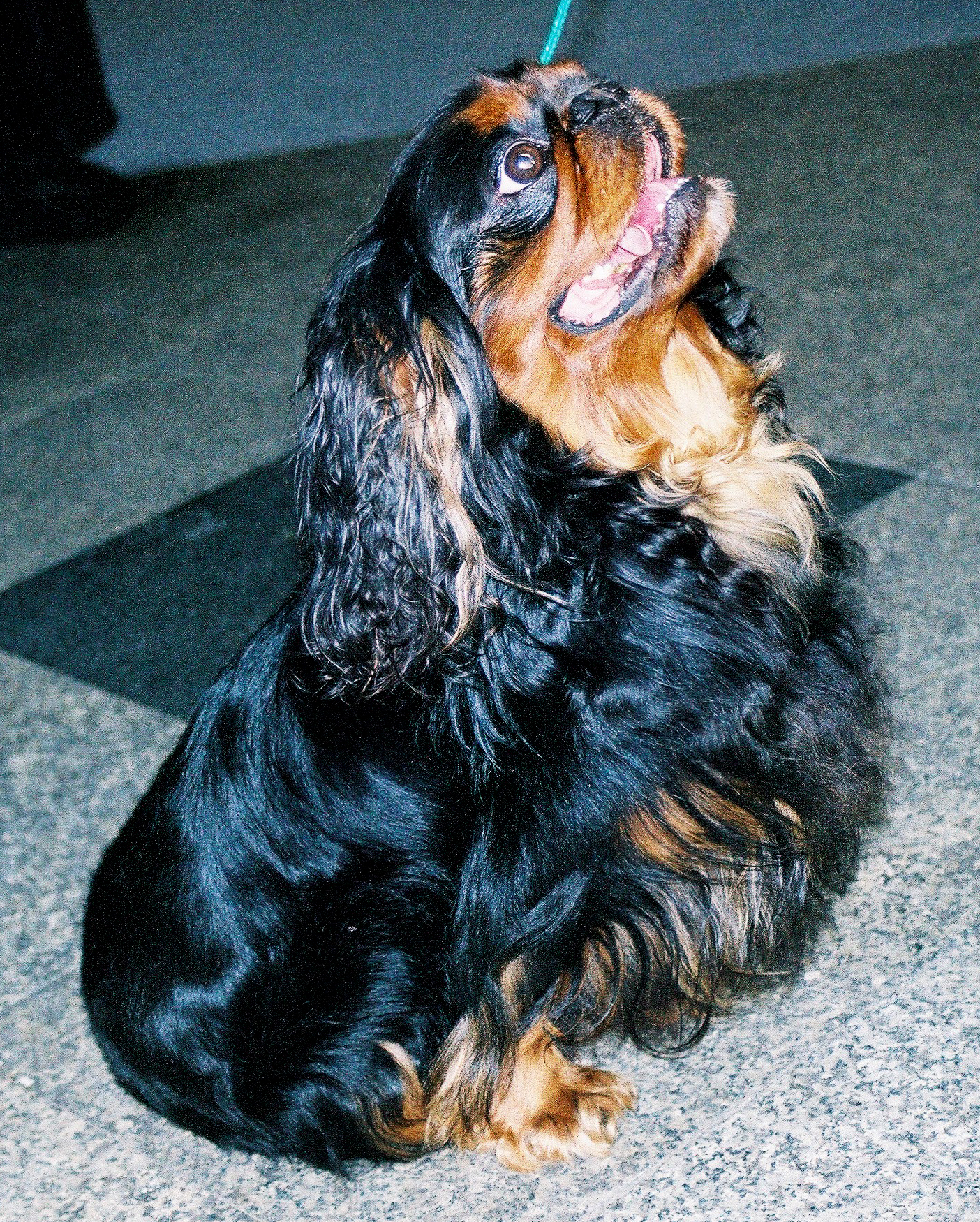
A black-and-tan adult looking upward showing its short face and long feathered ears. Pleple2000, Wikimedia Commons[7]

Brachycephalic Heat Care, Grooming, and Health Screening
That distinctive Victorian short muzzle brings real everyday care responsibilities. The AKC cautions that as a short-faced breed, the English Toy Spaniel does not tolerate hot weather and must never be left outdoors on warm or humid days.[1] As the University of Cambridge Department of Veterinary Medicine’s BOAS Research Group explains, extreme brachycephalic conformation predisposes dogs to upper airway obstruction and respiratory distress (BOAS); underscoring this priority, The Royal Kennel Club newly recognized breathing assessment via its Respiratory Function Grading Scheme for the King Charles Spaniel in August 2026, formally joining its health standard from January 2027.[3][5] Indoors the breed is calm, fastidious, and dignified while remaining alert and playful on cool outdoor outings; The Royal Kennel Club lists up to 30 minutes of gentle daily walking as a general guide, adapted to individual age, temperature, and breathing comfort—making it well suited to air-conditioned city apartments when fed a balanced small-breed diet and kept at a trim weight.[1][3]

A tricolor Prince Charles variety adult in show profile at Crufts 2013. Sagaciousphil, Wikimedia Commons[8]

Coat and routine care reward gentle consistency. Brush the silky, heavily feathered coat at least twice weekly with a pin or soft bristle brush and tease out tangles gently with a long-toothed metal comb so mats cannot irritate the skin; trim nails monthly, bathe every four to six weeks with a gentle canine shampoo, inspect long pendant ears regularly for signs of infection, and brush teeth often.[1] Sensitive and occasionally stubborn despite retaining a spark of sporting-spaniel curiosity, “Charlies” respond poorly to harshness and thrive with patient, positive puppy classes and early socialization.[1] Life expectancy runs roughly 10 to 12 years per the AKC (over 12 years in Royal Kennel Club guidance).[1][3] Core health tests recommended by the AKC and the English Toy Spaniel Club of America are cardiac and ophthalmologist evaluations, alongside awareness of patellar luxation, while The Royal Kennel Club specifies BVA/KC/ISDS eye screening and its newly added BOAS breathing grading.[1][3][4] Overall, the breed suits calm, air-conditioned homes seeking a devoted, low-barking lap companion and willing to maintain silky coat brushing and preventive health checks—rather than hot-climate outdoor enthusiasts.[1][3]
References
- American Kennel Club. English Toy Spaniel Dog Breed Information.
- Fédération Cynologique Internationale. FCI-Standard N° 128: King Charles Spaniel.
- The Royal Kennel Club. King Charles Spaniel Breed Information.
- English Toy Spaniel Club of America. Breed Health Testing Statement.
- University of Cambridge, Department of Veterinary Medicine. About BOAS (Brachycephalic Obstructive Airway Syndrome).
- Canarian. File:King Charles Spaniel Blenheim 1.jpg, Wikimedia Commons.
- Pleple2000. File:King Charles Spaniel 200.jpg, Wikimedia Commons.
- Sagaciousphil. File:Toy group winner, King Charles Spaniel, Crufts 2013 (cropped).jpg, Wikimedia Commons.