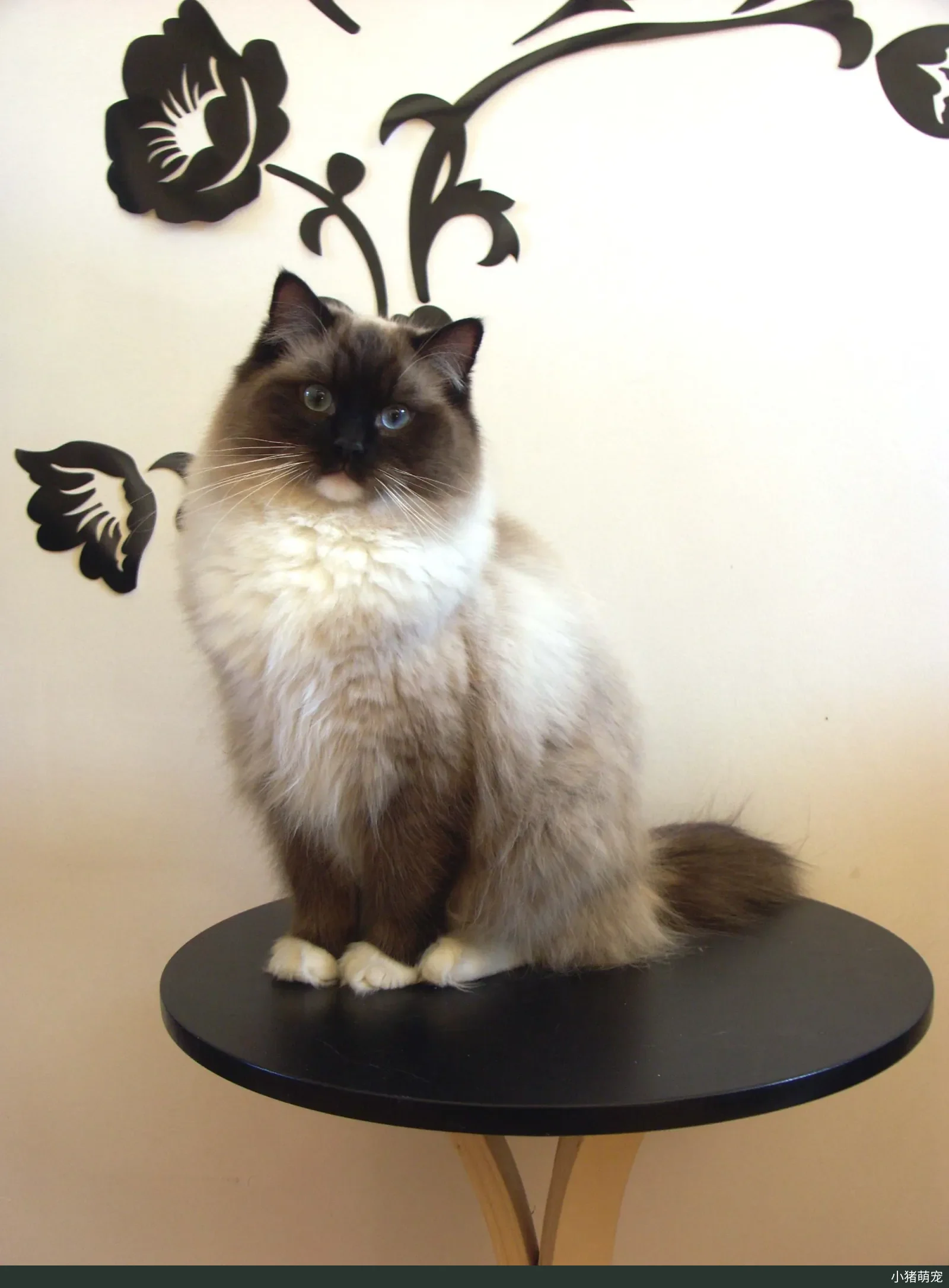
Uploader labeled this a seal-mitted female Ragdoll. Image: CalistaZ, from Wikimedia Commons, CC BY-SA 3.0 license.
The Ragdoll is a semi-longhaired pointed cat developed in California in the 1960s, with blue eyes, a large frame, and a gentle, people-oriented temperament. Major associations including CFA, TICA, and FIFe recognize the breed; standards stress that it has no extreme physical features. Its most important hereditary disease is hypertrophic cardiomyopathy (HCM): when choosing a cat, review the parents’ genetic tests; after it comes home, manage weight and keep up with regular checkups.
Origin and association recognition
The Ragdoll story begins in Riverside, California, in the 1960s. Breeder Ann Baker used a white longhaired cat named Josephine as a foundation cat; CFA describes Josephine as a domestic longhair carrying the pointed gene; TICA’s breed page also names two early studs: seal-mitted male Daddy Warbucks and black cat Blackie. Baker insisted that Josephine had been hit by a car, taken to a nearby medical facility, and that her genes were thereby “changed,” after which her kittens became floppy and especially affectionate. Association pages record this only as Baker’s own claim and offer no evidence. The image of a cat that “goes limp like a rag doll when picked up” likewise comes from Baker and gave the breed its name; CFA notes clearly, however, that this is not typical of most Ragdolls today.
Baker managed a small circle of partner breeders under a franchise model. As her practices grew stranger, some breeders left; among them, Denny and Laura Dayton did much to win recognition from major registries. Key dates: when TICA was founded in June 1979, Ragdolls were already eligible for championship competition; FIFe’s standard records recognition in 1991; CFA accepted Ragdoll registration in 1993 and championship status in 2000.
Size, pattern, and coat
Ragdolls are among the larger cat breeds: broad chest, long solid body, heavy bone. TICA’s reference weights are about 15–20 lb (about 6.8–9.1 kg) for adult males and about 10–15 lb (about 4.5–6.8 kg) for females; CFA notes that adult males at or above 20 lb are not uncommon. They mature slowly: CFA’s profile says coat color fills in around age two and full size around age four; TICA says color settles around three and body may take up to four years. So a Ragdoll over one year old that still looks “not filled out” is normal.
Most striking are the large, oval blue eyes. All Ragdolls are pointed: face, ears, legs, and tail dark; body light. The three common patterns are colorpoint (no white on the body), mitted (white “gloves” on the front feet, white “boots” on the hind legs, and a white chin connected to a white belly stripe), and bicolor (an inverted white “V” on the face and large white areas on chest, belly, and legs); CFA’s standard also lists van. Point colors include seal, blue, chocolate, lilac, red, and cream, which may show tortie or lynx variation; associations differ slightly—TICA, for example, also lists cinnamon and fawn.
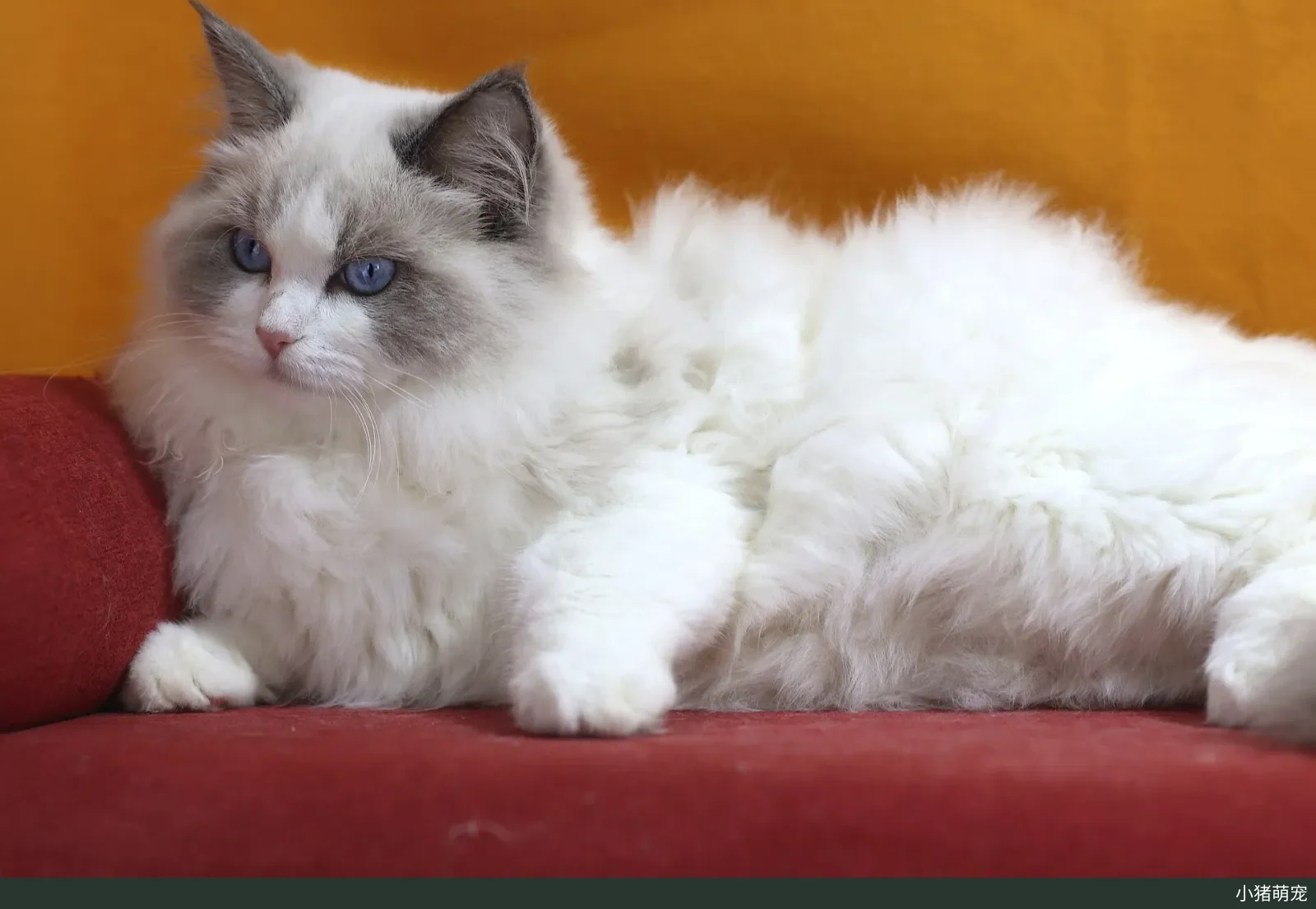
Uploader labeled this a bicolor blue Ragdoll. The bicolor pattern’s hallmarks are the inverted white “V” on the face and large white areas on chest and belly. Image: MOZZILAND, from Wikimedia Commons, CC BY-SA 4.0 license.
The Ragdoll coat is semi-long, mostly guard hair with little undercoat, smooth to the touch; the FIFe standard describes it as “cool silk,” longest at the neck, forming a bib-like ruff. Major associations stress overall balance without extremes: CFA’s standard says the ideal Ragdoll has “no extreme features” and lists non-blue eyes, crossed eyes, polydactyly, and a kinked tail as disqualifications; TICA likewise says the outline is made of soft curves “with nothing extreme or exaggerated.” In other words, Ragdolls are not among breeds such as folded-ear, short-legged, or flat-faced cats whose specialty conformation raises structural health debates; their main health topic is the heart, covered below.
Temperament and living together
Much of the Ragdoll’s reputation rests on temperament. CFA describes them as affectionate without demanding constant attention—gentle, calm, and social; many greet owners at the door, follow them around, and can learn to fetch and come when called; TICA notes they are often called “puppy cats,” like to trail people, and many are drawn to running water from a faucet or shower. Their voices are soft; they are not especially talkative.
“Laid-back” does not mean inactive. TICA especially notes that kittens and adolescents can be quite rowdy, and most adults still enjoy play; if you want a particularly high-energy or vocal cat, a Ragdoll may not be the best fit. With children and other pets, both associations describe high tolerance; CFA also warns that because Ragdolls trust easily, introductions to resident cats and dogs should be careful so a less gentle companion does not bully them. These are breed-level tendencies; individual variation remains large—meeting and interacting matters more than the breed label.
Health risks and care essentials
The clearest hereditary disease in Ragdolls is hypertrophic cardiomyopathy (HCM): abnormal thickening of the ventricular muscle, the most common heart disease in cats, which can cause sudden death. In 2007, Meurs et al. reported in Genomics a single-base mutation (R820W) in MYBPC3 in affected Ragdolls: all 20 affected cats in the study carried it (nine with two copies, eleven with one); none of the controls did. The mutation is not rare: a UK study of 2,018 Ragdoll samples submitted in 2009–2013 found a carrier rate of 27%, with 1.4% carrying two copies. Samples were skewed toward kittens and females, so they may not represent all Ragdolls.
Risk differs sharply between one and two copies. Per the UC Davis Veterinary Genetics Laboratory (VGL): cats with two copies (HCMrd/HCMrd) are high-risk, often showing severe signs at 1–2 years and more likely to die early, though some never develop disease; cats with one copy (N/HCMrd) are less likely to show signs and may have a normal lifespan. Borgeat et al.’s 2014 questionnaire study of 236 Ragdolls reached a similar conclusion: two-copy cats died of cardiac causes earlier; one-copy cats did not differ significantly from non-carriers. Note that this test only checks the R820W mutation; an N/N result does not mean a cat will never develop HCM. VGL advises against breeding two-copy cats; pairing two one-copy carriers is expected to produce about 25% high-risk two-copy kittens.
Kidney health also deserves attention. Egenvall et al. (2009) analyzed Swedish insured cats from 1999–2006 (including 5,939 Ragdolls) and found Ragdolls had the highest age-standardized mortality from “upper urinary tract problems” (mainly kidney and ureter disease) among breeds—141 per 10,000 cat-years, versus 76 for European Shorthairs and 20 for domestic cats. This is Swedish insurance data covering only insured cats under 13; the authors warn against casual extrapolation, so it only flags “watch the kidneys,” not today’s situation for Ragdolls everywhere.
Daily care is not complicated. With little undercoat, CFA says one or two weekly passes with a steel comb suffice; TICA recommends at least once a week, down to the skin, watching for mats under the armpits in shed season. TICA also suggests monthly nail trims and a dental check at the annual exam. They love to eat; CFA and TICA both warn about portion control and obesity; TICA notes obesity can lead to diabetes and other problems. A soft fat pad on the lower belly is normal; judge condition by feeling the spine and ribs, and ask a vet if unsure. Daily interactive play is companionship and calorie burn; a cat tree, scratchers, and wand toys are basics; for water, TICA cites feline behaviorists in placing bowls at least about 1 meter (3 feet) from food bowls, or using a circulating fountain.
If buying from a breeder, choose one who genetically tests all breeding cats for HCM and ask to see the parents’ results; genetic tests do not replace cardiac exams—if abnormalities appear later, still see a veterinarian. On lifespan, TICA says many Ragdolls live into the mid-to-late teens, depending on genetics and care.
References
-
The Cat Fanciers' Association (CFA). Ragdoll (breed profile and standard; accessed 2026-10-17)
-
The International Cat Association (TICA). Ragdoll (accessed 2026-10-17)
-
Fédération Internationale Féline (FIFe). Ragdoll (RAG) breed standard, version 01.01.2026
-
UC Davis Veterinary Genetics Laboratory. Hypertrophic Cardiomyopathy (HCM) in Ragdolls (accessed 2026-10-17)
-
Meurs KM, Norgard MM, Ederer MM, Hendrix KP, Kittleson MD. (2007). A substitution mutation in the myosin binding protein C gene in ragdoll hypertrophic cardiomyopathy. Genomics, 90(2), 261–264.
-
Casamian-Sorrosal D, Chong SK, Fonfara S, Helps C. (2014). Prevalence and demographics of the MYBPC3-mutations in ragdolls and Maine coons in the British Isles. Journal of Small Animal Practice, 55, 269–273.
-
Borgeat K, Casamian-Sorrosal D, Helps C, Luis Fuentes V, Connolly DJ. (2014). Association of the myosin binding protein C3 mutation (MYBPC3 R820W) with cardiac death in a survey of 236 Ragdoll cats. Journal of Veterinary Cardiology, 16(2), 73–80.
-
Egenvall A, et al. (2009). Mortality of Life-Insured Swedish Cats during 1999–2006: Age, Breed, Sex, and Diagnosis. Journal of Veterinary Internal Medicine, 23(6), 1175–1183.