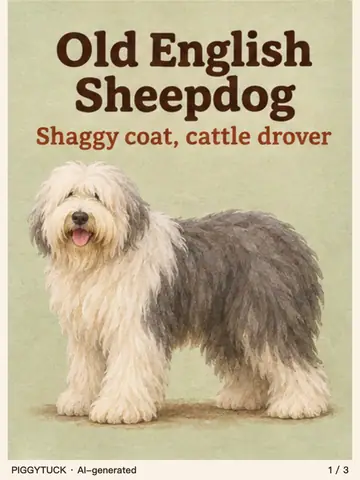
The Old English Sheepdog is known for a profuse, shaggy coat that covers its face and legs, so from a distance it looks like a walking ball of fur. Often called the “Bobtail,” it is a British breed in the American Kennel Club’s Herding Group.[1] The breed is lovely and demanding: the coat needs regular attention down to the skin, a puppy grows into a large shaggy dog, and the household rules have to grow up with it.
Named for sheep, working with cattle
The breed took shape in the late eighteenth century—not ancient by breed standards—most likely in Devon, Somerset, and Cornwall; Scotch, European, and Russian dogs may sit in the ancestry; and the real job was droving cattle from pasture to market towns along dusty roads, not herding sheep.[1] On some farms these dogs were sheared once a year so their blue-gray and white clippings could become yarn.[1] Stockmen showed the breed in England from 1865; the AKC registered its first in 1888; Westminster’s winner’s circle first saw one in 1914.[1] The large shaggy companion at home therefore comes from a compact, muscular road dog built for long drives.
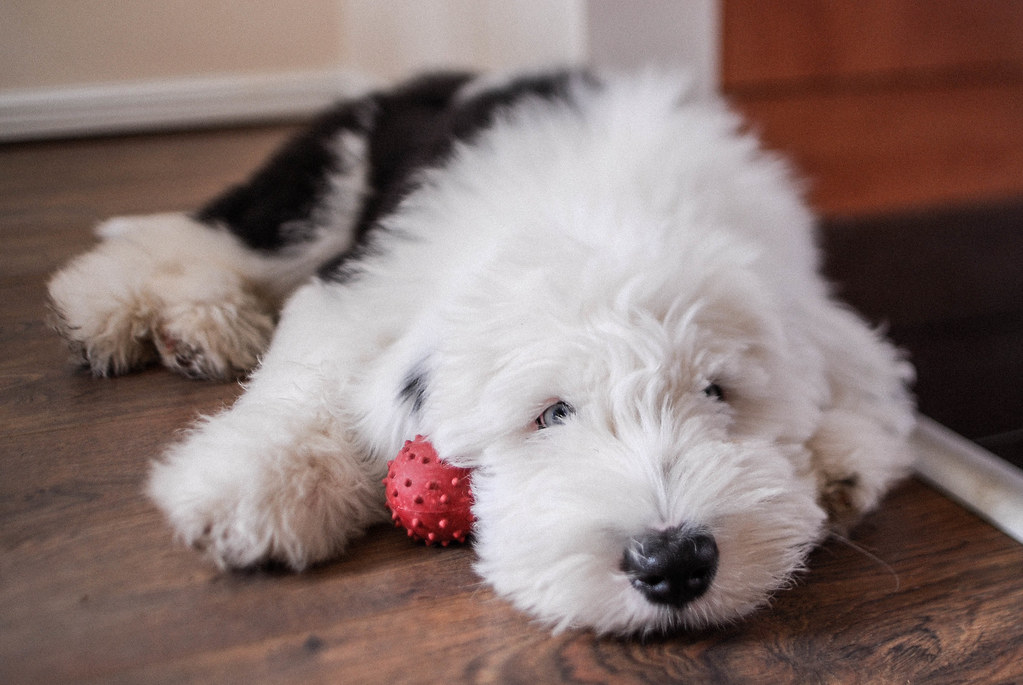
Figure: An Old English Sheepdog puppy lies chin down on a wooden floor beside a red rubber ball. David Martyn Hunt, Flickr[2]
A compact body under the long coat
Look for a compact, nearly square, muscular build about 21 or 22 inches at the shoulder; brown, blue, or odd eyes with a black nose; medium ears flat to the head; a hard, shaggy coat (not straight or curly) with waterproof undercoat, heaviest on the hams; a topline that rises from the withers to the loin; and a loud bark with the standard’s “pot-casse” ring.[1] Puppies do not show the full picture. The first photo shows a puppy chin-down on wood, white fur over the face, black nose and forepaws visible, dark back behind.[2] The second is the same puppy, head up, one paw forward.[3] Coat and face identify the breed; square build and rising topline wait for adulthood.
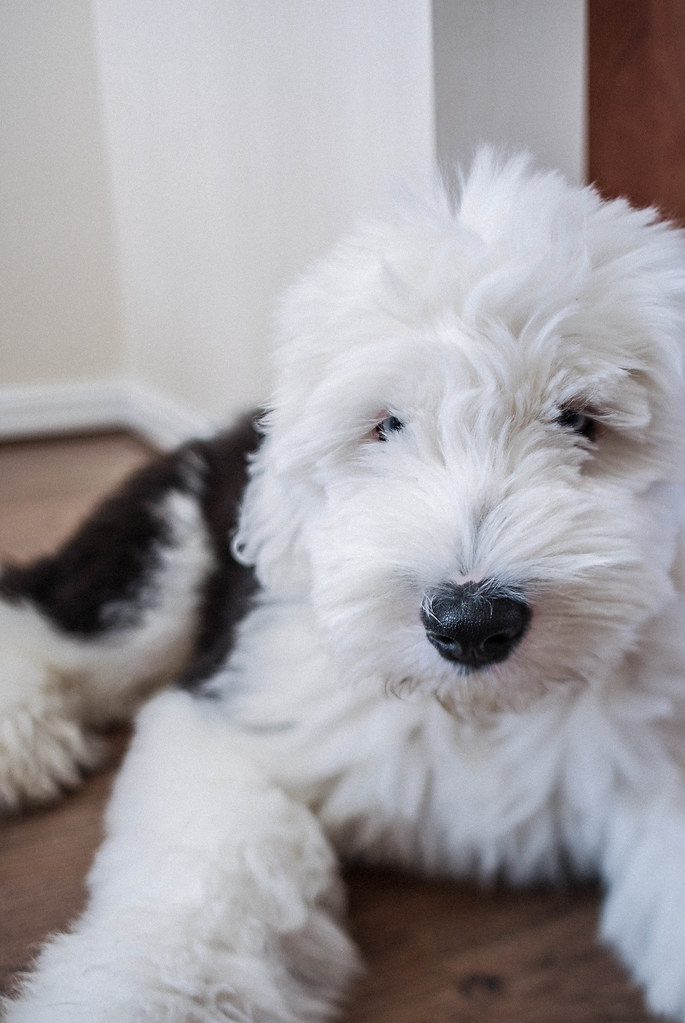
Figure: The same puppy in a different exposure, head raised toward the camera, one forepaw stretched out. David Martyn Hunt, Flickr[3]
Once a week, down to the skin
The coat is what draws most people in, and it is also the main ongoing cost. The double coat needs a full skin-deep brush over the whole dog at least weekly if you keep the full jacket.[1] A “puppy trim” is common for pets, yet brushing between baths and clips still matters; short feet cut mess; nails need regular trimming.[1] Plan for regular grooming throughout the dog’s life, at home or with a professional.[1] The third photo shows an adult grey-and-white dog on a purple grooming table while a handler works the back coat.[4] Head to hindquarters fill the frame; the coat hides limb outline and the tail is not clear; the photo has no scale for estimating the dog’s size.
The cute puppy becomes a large dog
Jumping on visitors or leaping onto the sofa may seem cute in a puppy. The same habits have more impact once the dog is grown, especially when the coat is muddy or wet. Decide which behaviours will still be welcome in an adult dog and practise those rules from puppyhood. Introduce people, places, and noises early, at a pace the puppy can handle.[1]
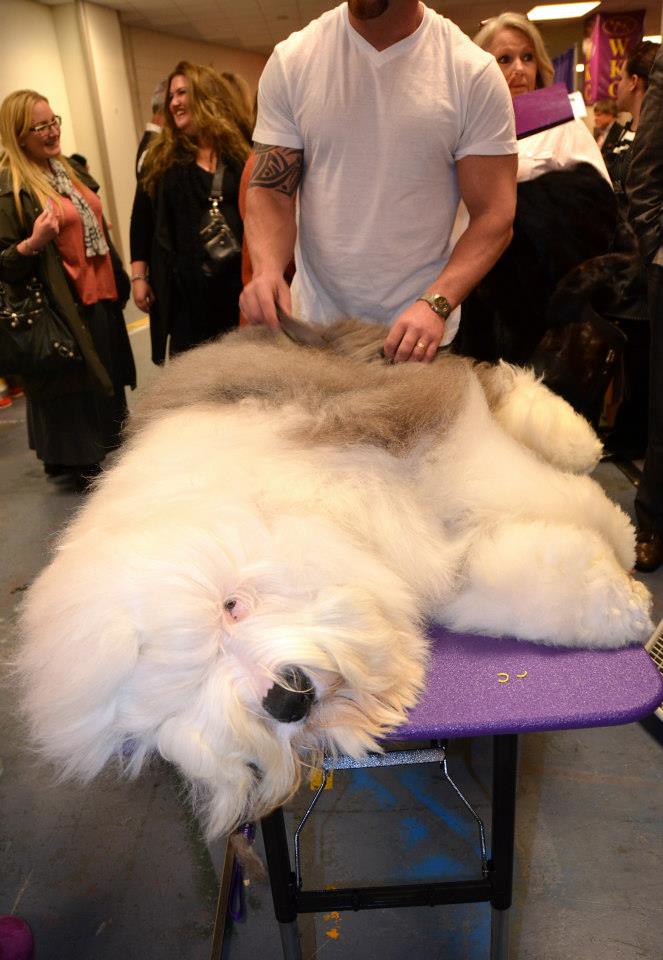
Figure: An adult Old English Sheepdog reclines on a purple grooming table while a handler tends the coat on its back. Andrea Arden, Flickr[4]
What it is like at home
Many Old English Sheepdogs are alert, friendly, and patient with children. They also have a loud bark and may announce the doorbell or people passing by.[1] Consider the amount of noise your home can absorb, and provide fresh water at all times.[1]
Exercise and training: moderate, and varied
Exercise needs vary by dog, but none thrive without regular work; the gait looks like a bear’s shuffle yet is famously nimble, and many have an indoor “off switch.”[1] Most learn well and remember, yet tire of robotic drills—vary the work if you want sports or formal obedience.[1] That matches droving: reading the road beats repeating one cue.
Weight and health screening
Feed a quality diet matched to age; some individuals pack on weight, so watch calories and treat volume.[1] Responsible breeders screen hips, eyes (PRA and hereditary cataracts), autoimmune thyroiditis, heart anomalies, and hereditary deafness; DNA tests also exist for cerebellar ataxia, primary ciliary dyskinesia, drug sensitivity, and exercise-induced collapse.[1] Ask about those panels when choosing a puppy—they are screening questions, not a diagnosis of your dog.
Recognise an OES by the square compact body and black nose under the long coat, then match on weekly coat-to-skin care, several grooming sessions a month, puppy-era house rules, regular exercise, and varied training.[1] Adjust exercise and training to your dog as it matures, and seek veterinary care when you notice changes.
References
-
AKC. Old English Sheepdog.
-
Hunt, D. M.. Old English Sheepdog Puppy.
-
Hunt, D. M.. Old English Sheepdog Puppy (second frame).
-
Arden, A.. Old English Sheepdog.