Start with the photograph of Chester standing in the grass. His head is turned toward the camera, but his body is angled just enough for the sunlight to pick out the edges of the dark spots along his ribs. That resemblance to a wild cat was part of the breeder’s aim for this domestic breed. Carol Drymon began developing the Cheetoh in 2001 by crossing Bengals with Ocicats. The first litter was born in 2003. [1–3]
The New Zealand cat registry CATZ Inc lists the Cheetoh as Provisional. Under its rules, the registry has adopted a breed standard, and Cheetohs can be shown only in the New Breed and Colour class. CATZ Inc describes a large, muscular cat and draws attention to its walk. The shoulders sit low as the cat steps forward, giving its stride the look of a stalk. Once you have taken in the markings of a Cheetoh standing still, watch how it walks toward something that interests it. [1]
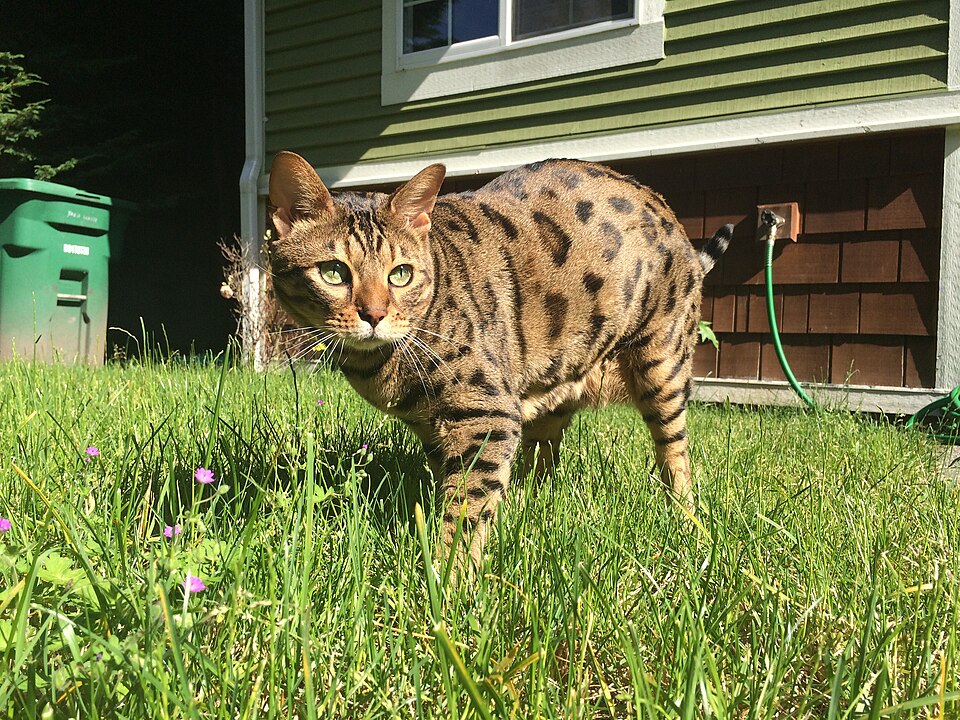
Dark spots mark Chester’s flanks. Chris Rue, Wikimedia Commons[3]

Where stripes give way to spots
Follow Chester’s markings back from his forehead. Several narrow stripes run lengthwise there. Dark lines curve over his shoulders, then break up into spots of different sizes farther along his sides. Stripes appear again, this time running across his front legs. CATZ Inc describes both spots and rosettes in the breed, with an exception for the colour it calls black marmalade. Look at the centre of an individual marking. A solid spot is dark throughout, while a rosette has a darker outline around a paler patch of coat. [1,3]
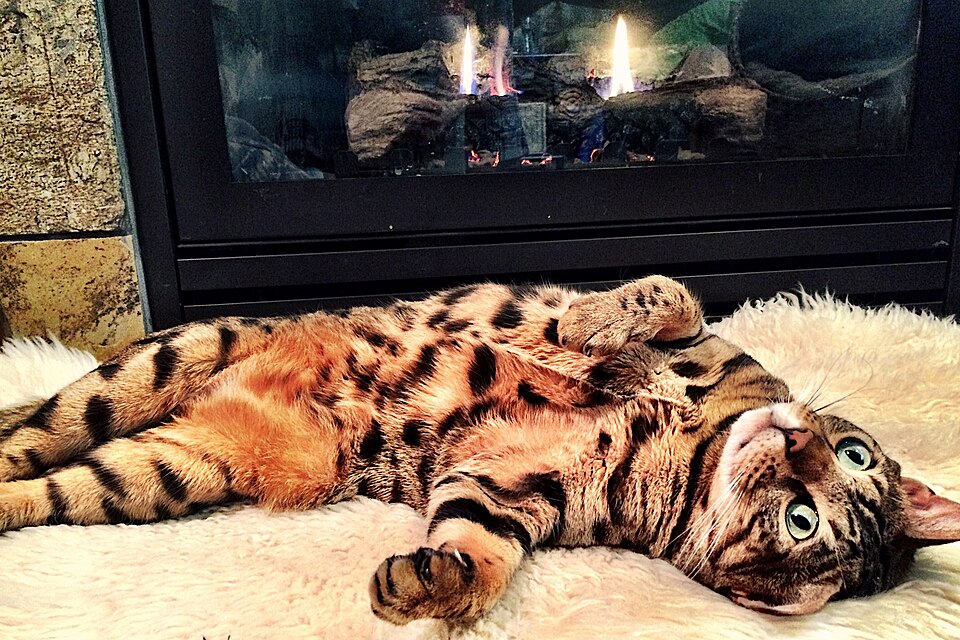
Spots run down Chester’s belly. Chris Rue, Wikimedia Commons[4]

The cat by the fireplace is Chester again. This time he has rolled partly onto his back and tucked his front paws toward his chest. You can see the spots down the middle of his belly alongside the broad stripes on his legs. In another photographer’s home, a Cheetoh named Sabor lies against a wall. From that angle, the stripes on his cheeks, his pale chin and the bands across his forelegs stand out. At home, wait for your cat to shift position on its own. A roll onto one side gives you a good view of the belly markings. Let the cat decide whether it wants closer contact. [3–5,8]
Stripes cross Sabor’s cheeks and forelegs. Mcelite, Wikimedia Commons[5]

Let the toy slip out of sight
A toy mouse on a wand and a cardboard box are enough to set up a stalk in the living room. Put the box at the edge of an open stretch of floor. Draw the mouse along the box so it crosses the cat’s line of sight, disappears around the corner and pauses. Let just a little of it peek out again. Hold the wand off to one side to leave the path to the mouse clear. From a few steps back, your cat has time to turn toward the movement, crouch, creep closer and choose the moment to spring. The Feline Veterinary Medical Association identifies stalking and catching as activities indoor cats need. Let the cat finish by pinning the mouse under its paws. [6,7]
Watch the cat to decide what happens next. If its eyes stay on the corner, bring the mouse out there again. If it turns and walks away, the game is over for now. CATZ Inc describes the Cheetoh as gentle, but each cat sets its own pace in play. In a home with several cats, play with them separately so the slower one gets to watch the mouse all the way around the box and make a catch of its own. Put away toys with strings or loose parts after play. A quiet window perch gives the cat something to watch between games. [1,7]
Trace the route from bed to water bowl
Start at your cat’s favourite sleeping spot. Which doorways must it pass through to reach water, food, a scratching post or a litter box? If both food bowls sit at the far end of the kitchen, one cat waiting in the doorway can block access to both. Set up feeding places in different parts of the home, with fresh water where each cat can reach it easily. That way a cat can give its housemate some space and still get a meal or a drink. Offer a choice of resting places, too. One might be a high perch with a view, another a sheltered spot with two ways in and out. When the cat retreats there, let the game end at the entrance. [6,8]
A roomy litter box is especially useful for a large cat. Look for one about one and a half times the cat’s body length, give it a quiet, accessible location and scoop it at least daily. In a home with several cats, a usual starting point is one box per cat plus one extra, spread around the home. Leave some familiar scents in place as you clean. The litter box needs regular attention, but the cat’s bedding can keep its familiar smell. Serve meals at roughly the same times each day. Occasionally set aside a little of the day’s food for a puzzle feeder so the cat can work pieces loose with a paw. [6–8]
Know your cat’s usual stride
During an ordinary game, notice how your cat rounds the box, turns after catching the toy and jumps back onto its favourite chair. The low shoulders in the breed description are a feature of the Cheetoh’s walk. What matters for a veterinary visit is a change in how your own cat moves. A cat that once jumped straight onto the chair may now pause repeatedly at its foot. One that used to walk downstairs easily may take stiff steps or put noticeably less weight on one leg. Tell your veterinarian promptly about changes like these. Describing which movement became difficult and when you first noticed gives the veterinarian more to go on than saying the cat has been quiet lately. [1,9]
Pay attention during petting and grooming, too. Tell your veterinarian if your cat suddenly draws away from a gentle stroke it used to enjoy, or if it grooms less and its coat begins to mat. While arranging an examination, you can bring water and a litter box onto the floor where the cat spends most of its time. A sturdy intermediate step can make a favourite raised bed easier to reach. If today your cat prefers to watch the toy while lying down, keep it low and move it slowly across its field of view. Let the movements that still come easily, and the ones that have lately become an effort, guide how you help. [9]
References
-
CATZ Inc. Cheetoh.
-
Wind Haven Cheetohs. The Cheetoh Cat.
-
Chris Rue. File:CheetohCatInGrass.jpg. Wikimedia Commons.
-
Chris Rue. File:CheetohCatStomachMarkings.jpg. Wikimedia Commons.
-
Mcelite. File:Cheetoh cat chilling.png. Wikimedia Commons.
-
Feline Veterinary Medical Association. New Feline Veterinary Medical Association Position Statement Reimagines Life for Indoor Cats. August 28, 2025.
-
Ken Lambrecht. Playing With Your Cat. Cat Friendly Homes.
-
Cat Friendly Homes. What Your Cat Needs to Feel Secure.
-
American Association of Feline Practitioners. Treating Chronic Pain with NSAIDs.