The Pug is an ancient companion breed that originated in China: small and compact, with a short blunt muzzle, deep facial wrinkles, and a tightly curled tail over the hips. Even-tempered, people-oriented, and playful, they suit households built around indoor companionship. The American Kennel Club (AKC) recognized the breed in 1885 and places it in the Toy Group. As a brachycephalic dog, respiratory and neurologic health especially deserve an owner’s attention.
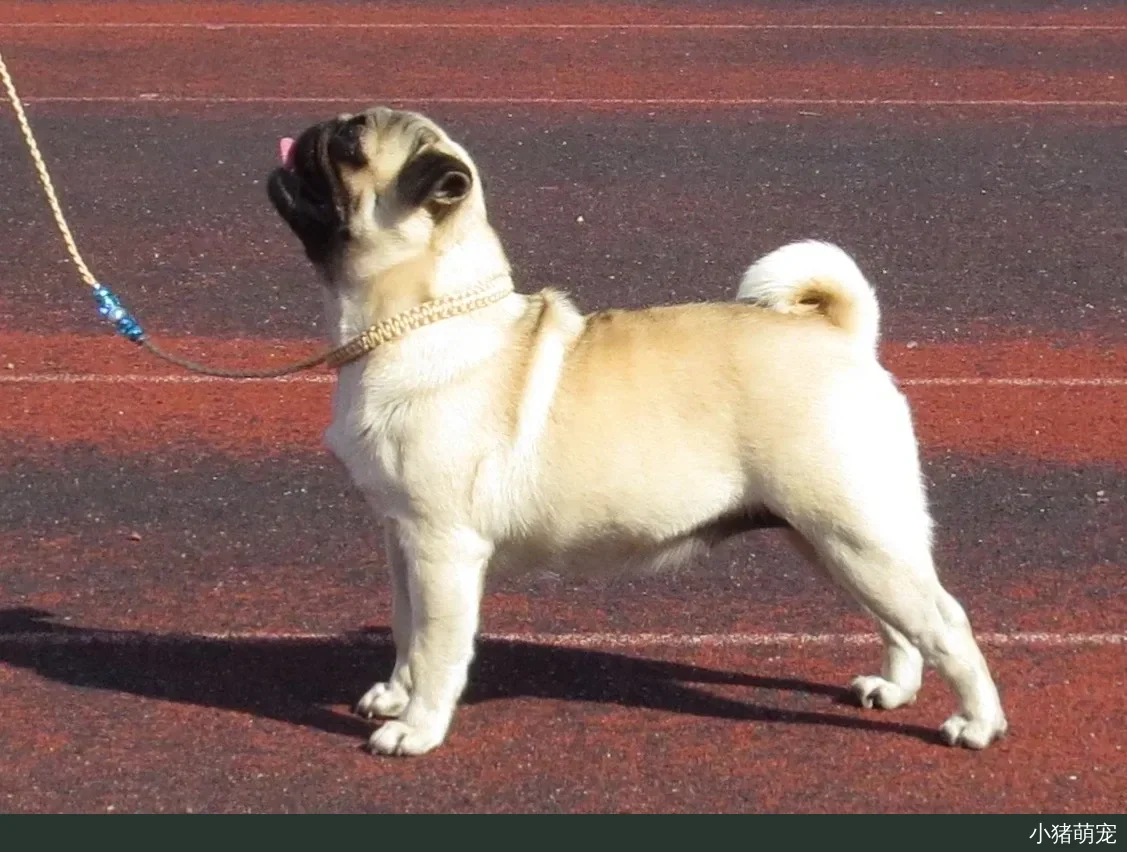
A Pug in the puppy class at the 2013 Tallinn dog show. Photo: Томасина; source: Wikimedia Commons; license: CC BY-SA 3.0.
Origin and club recognition
The Pug originated in China as a long-standing companion dog, historically kept by courts and wealthy households. Trade and royal exchange later brought them to Europe, where they grew popular—especially in Victorian Britain. AKC formally recognized the Pug in 1885 and currently places it in the Toy Group.
Stories about the English name Pug vary: some link the face to marmosets once called “pug monkeys”; others to Latin pugnus (fist), for a face like a clenched fist. There is no settled answer. Pugs are often grouped with Pekingese, French Bulldogs, and other short-muzzled companions, but proportions and breed standards differ.
Conformation standard and temperament
AKC’s current Pug standard was approved 8 April 2008 and effective 3 June that year. It calls for a square, compact, solid (“cobby”) dog; ideal weight about 14–18 pounds (about 6.4–8.2 kg) for both sexes. The head is large and round but not “apple-headed,” with deep, clear facial wrinkles; eyes large, round, and dark; ears thin and small, with button preferred over rose. The muzzle is short, blunt, and square, with a slight undershot jaw. The back is short and level, the chest broad; the tail should curl as tightly as possible over the hips, with a double curl ideal.
The coat is short, fine, soft, smooth, and glossy. AKC recognizes only fawn and black; other colors are a disqualification. Fawn dogs should also show clear black markings: a black mask, black ears, moles on the cheeks, a thumb mark or diamond on the forehead, and a black line (trace) along the spine.
On temperament, AKC describes the Pug as even and stable, playful and charming, with dignity, outgoing and affectionate. Exercise needs are moderate to low—suited to companion-focused homes—but that does not mean no activity: daily walks and short play with the family remain the base for body and mind.
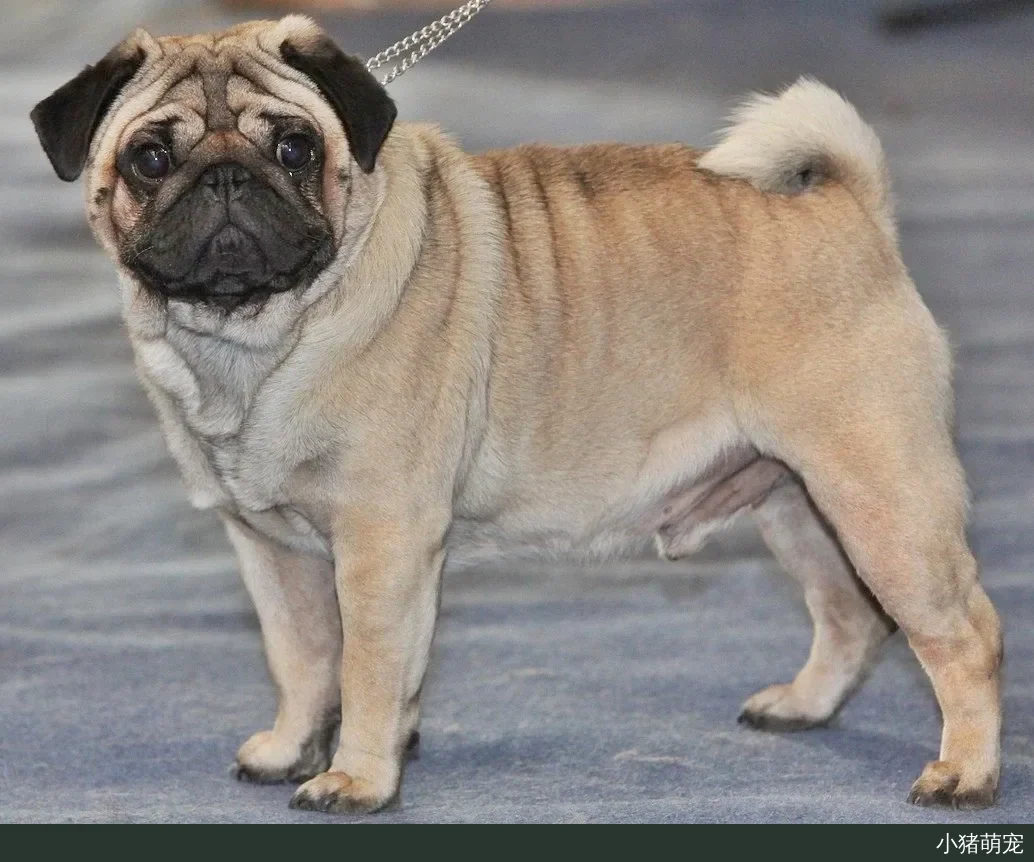
A Pug standing in profile. Photo: Dagur Brynjólfsson (adjusted by Anka Friedrich); source: Wikimedia Commons; license: CC BY-SA 2.0.
Health concerns and daily life together
The Pug’s short muzzle predisposes them to brachycephalic obstructive airway syndrome (BOAS). According to OFA, BOAS comes from excess soft tissue relative to the airway in the nose and throat, partly blocking airflow; it is progressive and may show as noisy breathing, poor exercise and heat tolerance, regurgitation, or difficulty swallowing. The Kennel Club (UK) and University of Cambridge developed the Respiratory Function Grading Scheme (RFGS), which uses auscultation and an about-three-minute brisk walk to grade function from 0 to III: grades 0 and I are considered clinically unaffected by BOAS; II and III are clinically affected and need ongoing watch and possibly veterinary care. OFA is authorized to run this screening in North America; the Pug is among breeds eligible for certification.
Another breed-linked risk is necrotizing meningoencephalitis (NME), commonly called Pug dog encephalitis (PDE). Per UC Davis Veterinary Genetics Laboratory (VGL), this is an inflammatory central-nervous-system disease, usually progressive and potentially fatal; signs include seizure-like episodes, depression, ataxia, gait changes, and blindness. About 1.2% of Pugs die of NME; fawn females under 7 years are relatively more often affected. The lab offers a susceptibility-marker test with results N/N, N/S, and S/S: lifetime risk for S/S dogs is about 12.75 times that of the other two classes, yet only about one in eight S/S dogs develops disease. The lab stresses that the test assesses risk and aids breeding choices—it does not diagnose NME.
Groups such as the Pug Dog Club of America also recommend evaluating hips, eyes, and patellas. Standards and health programs differ slightly among registries (e.g., AKC vs. the UK Kennel Club); BOAS and NME materials are mostly risk-assessment and screening frameworks with large individual variation—follow the cited pages and a licensed veterinarian. Seek care promptly for breathing difficulty, syncope, seizure-like episodes, or abnormal gait. This site is educational only: it does not replace veterinary care and does not give drug doses or surgical advice.
Day to day, Pugs are mainly indoor companions. Short-coat care is relatively simple, but facial folds trap moisture and dirt and need frequent cleaning and drying. Short-muzzled dogs generally overheat easily—avoid hard exercise in hot weather and walk in cooler hours. Weight management is a daily priority; base the diet on complete dog food adjusted for age, condition, and veterinary advice. Chew toys and short interactive play help burn energy and deepen bonds with the household.