In a photograph from Kozan, Turkey, goats are scattered across a grassy slope. A goatherd walks among them with an Anatolian Shepherd Dog at his side. The dog’s place beside the herd tells you something about its work. On the Anatolian plateau, herders grazing sheep and goats needed dogs that would notice an animal approaching and drive off a predator when necessary. A guardian could make that decision without waiting for instructions. At home, that independence gives the family something quite specific to teach. When footsteps sound outside, who goes to the door? [1][2]

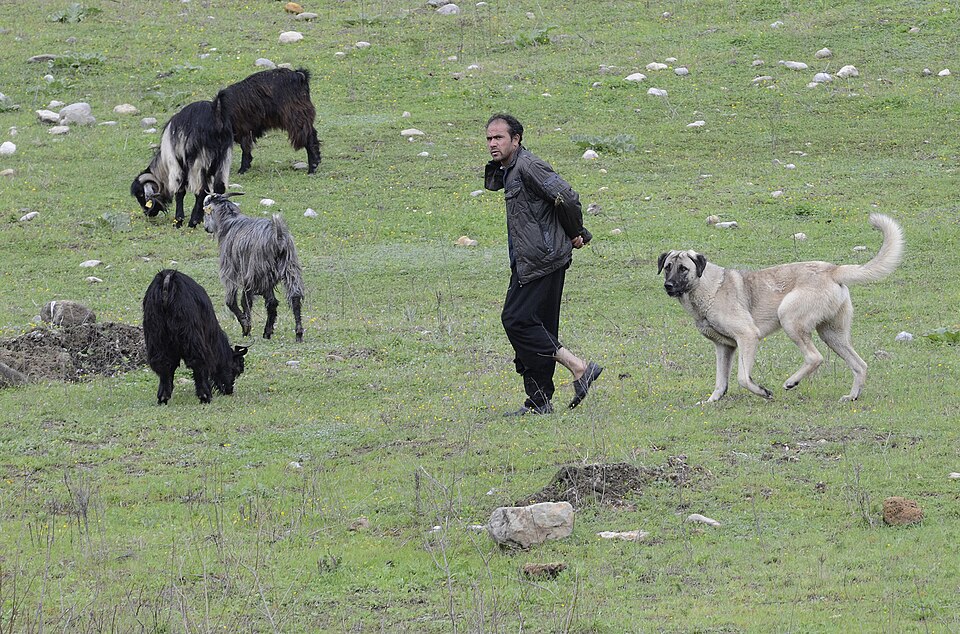
图:A flock guardian on a hillside in Kozan. Zeynel Cebeci, Wikimedia Commons[2]
The outline of a standing Anatolian
Look first at Varish, the male standing sideways on the grass. His chest reaches his elbows, and the line of his belly rises toward his waist. His front legs are long and straight, with well-developed muscle in the hindquarters. That build supports a substantial dog while allowing it to move lightly over uneven ground. The American Kennel Club (AKC) gives a shoulder height of about 69 to 74 cm (27 to 29 inches). An adult can weigh as much as 68 kg (150 pounds). If you are considering a puppy, picture a walk with the grown dog. Who can hold the leash steady when someone approaches? Is there room at your entrance for the dog and a visitor to pass comfortably? [1][3]

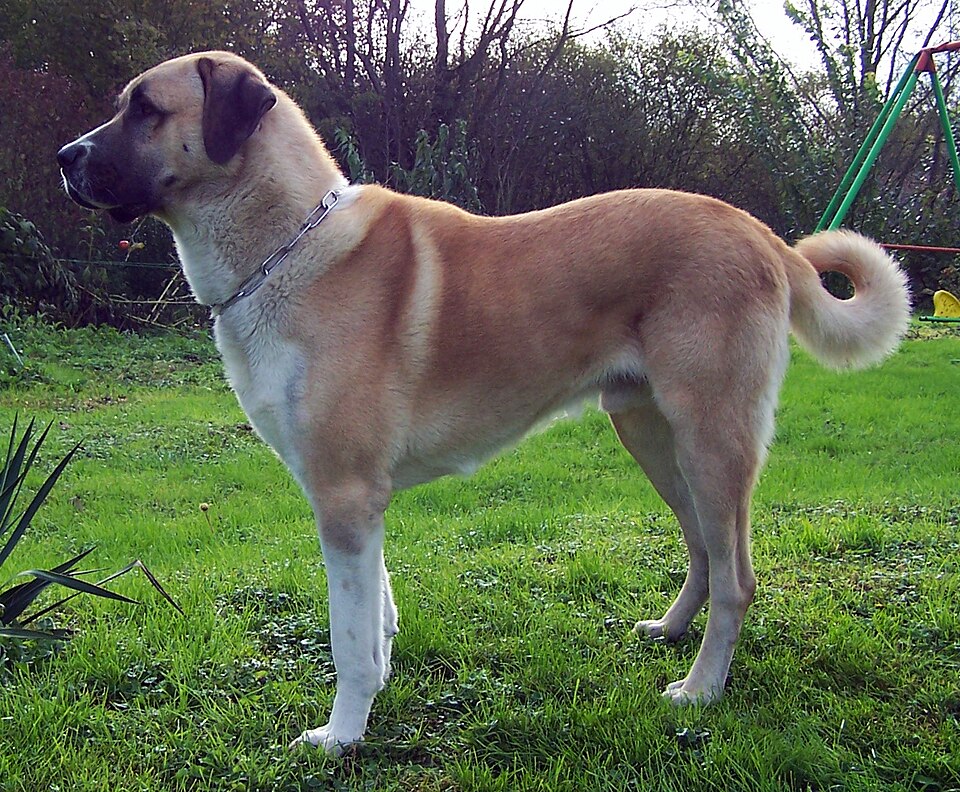
图:Varish in profile. Franck Balzar, Wikimedia Commons[3]
The female standing on sand has turned her head toward the camera. Her ears hang on either side of a broad head, her dark muzzle stands out against pale cheeks, and the hair around her neck is fuller than the hair on her legs. The breed standard describes V-shaped ears with slightly rounded tips. The long tail also helps you recognize the outline. At rest it can hang low with an upward curve at the tip. When the dog is alert, it can rise into a wheel. A change in posture alters even the same dog’s silhouette, which is why it helps to look at both full-body photographs before settling on a particular face color or tail carriage as your cue. [1][3][4]

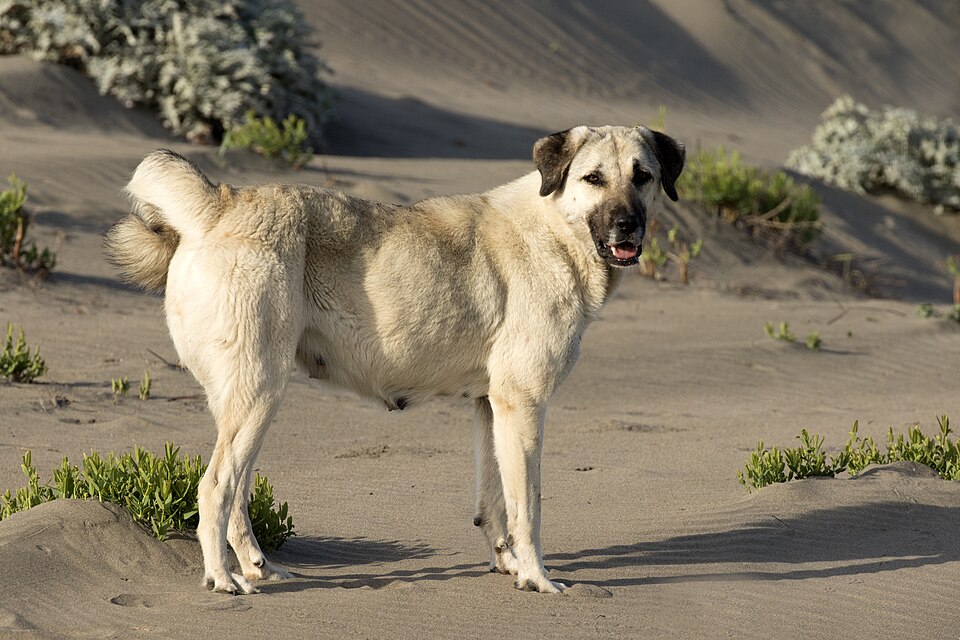
图:Head and neck of the female in Tuzla. Zeynel Cebeci, Wikimedia Commons[4]
A routine for the gate you use every day
Watching over a flock takes stamina, though the Anatolian’s daily exercise needs are moderate. The AKC describes time in a fenced yard and one or two longer walks on a leash. Start at your front door and trace a route you could regularly take. Where can you step aside for a pedestrian? Who has time for the walk on a weekday? Adjust the distance and pace to the dog’s age, fitness, and how it is moving that day. Even a dog that comes running every time you call in the yard should stay on a leash once you leave the enclosure. [1]
How well a yard works depends on how people use its gates. The AKC recommends a tall, sturdy fence with a gate that locks. Include the side gate if anyone uses it for deliveries, to reach the car, or to take out the trash. Clip the leash on while the gate is still closed, then open it for your walk. If someone needs to carry things through the gate, settle the dog indoors first and let it out again once the gate is shut. The person carrying the load can then use both hands. [1]
A familiar place to wait for visitors
An Anatolian can be affectionate with family and inclined to watch strangers from a distance. Choose a mat clear of the door’s swing and out of the path visitors take into the house. Begin when nobody is knocking. Give a short cue, reward the dog for going to the mat, then give a release cue that means it can leave. Use the same words each time. Once the dog knows the routine, take a step toward the door. Reward it for staying on the mat. Later, try touching the handle. Adding one small movement at a time lets you see exactly where the dog needs more practice. [1]
Next, ask someone the dog knows to knock softly. Have one person stay with the dog while another answers. The visitor can greet the person at the door and leave the dog room to watch. If the dog leaves the mat and heads straight for the visitor as soon as the door opens, go back to practicing just the knock. For an actual visit, the dog can settle in another room with the door closed. Take a similarly gradual approach to socializing a puppy. When it sees someone come in or hears an unfamiliar sound and can still respond to you, reward that response. The AKC recommends basic obedience training for this natural guardian and advises against protection or guard-dog training. [1]
To judge whether an Anatolian will fit into your household, picture the busiest part of your day. If a delivery arrives during the afternoon school pickup, is an adult free to settle the dog first? Will the relative who often walks the dog follow the same gate and leash routine? The breed’s loyalty may be part of its appeal. Caring for it also means taking on these small, recurring jobs. If you love leaving the gate open for neighbors to drop by or letting a dog run loose in an open field, those habits would need to change. [1]
The thick undercoat beneath the short outer coat
The Anatolian plateau has hot, dry summers and cold winters. The dogs that worked outdoors there year-round have a dense undercoat. Most have a short outer coat, though some have longer hair. Weekly brushing is usually enough for routine care. Twice a year, when the undercoat sheds heavily, a quick brush over the surface can leave loose hair underneath. Give the coat a thorough brushing with a short-bristled brush every few days during those periods, using a comb where the hair is thick. Make time for ear checks and regular nail trims, and brush the teeth more often. Teaching a puppy to stand quietly while you handle a paw or look inside an ear makes those jobs easier once the dog is full-grown. [1]
When asking a breeder about a puppy’s health history, request the parents’ hip and elbow evaluation records and ask about screening for entropion, a condition in which the edge of an eyelid rolls inward toward the eye. The records tell you which checks the parents had. Your veterinarian can assess the puppy itself during an examination. Before any procedure that requires anesthesia, discuss the breed’s possible sensitivity with the veterinarian, along with any reaction your dog has had to anesthesia in the past. [1]
Everyone in the household should recognize repeated, sudden attempts to vomit that bring nothing up. The dog may also have a swollen belly, drool, or seem unable to settle. These can be signs of gastric dilatation-volvulus. Call an emergency veterinarian and take the dog in immediately. Anyone who regularly walks the dog should know where the emergency clinic is and who can drive there. With an adult dog that may weigh 68 kg, planning how to get out of the house in an emergency deserves as much thought as teaching it to wait while someone comes in. [1][5]
References
-
[1] American Kennel Club. Anatolian Shepherd Dog.
-
[2] Zeynel Cebeci. Goatherd and his dog, Kozan 02.jpg. 2015.
-
[3] Franck Balzar. Anatolian shepherd dog.jpg. 2006.
-
[4] Zeynel Cebeci. Anatolian Shepherd Dog 01.jpg. 2020.
-
[5] American College of Veterinary Surgeons. Gastric Dilatation-Volvulus.