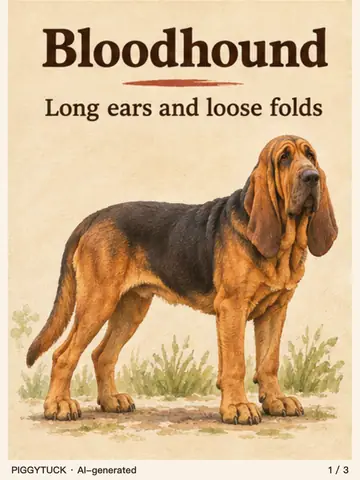
The Bloodhound, also called the Sleuth Hound, is a large scent hound known for finding people who are missing or hiding. Often gentle at rest, these dogs can be relentless once they pick up a trail.[1] Males typically stand 25–27 inches (64–69 cm) and weigh 90–110 pounds (41–50 kg). Females typically stand 23–25 inches (58–64 cm) and weigh 80–100 pounds (36–45 kg). Life expectancy is 10–12 years. The AKC recognised the breed in 1885 in the Hound Group.[1]
A scent hound bred in monasteries
The Bloodhound’s early origins are uncertain, though some accounts place it around the ancient Mediterranean; the third-century scholar Aelian wrote in Historia Animalium of a hound of unrivaled scenting power, so devoted it could not be pulled off a trail until the quarry was found.[1] It may be among the oldest surviving scent hounds.[1] The Bloodhound we know was perfected in Western Europe about a thousand years ago, credited to high-ranking figures of the pre-Reformation church: in medieval times even bishops rode to hounds, and well-funded monasteries in England and France kept packs; the monks carrying out the breeding program were so careful that the hounds became known as “blooded hounds,” meaning of aristocratic blood.[1] So the name points to carefully kept bloodlines, not to what the dog tracks.[1] Police departments around the world have since used it to follow human scent—a criminal, a lost child, a confused senior—on assignments that can last all day and night over hills and through swamps.[1] That history explains why the breed formed; it does not guarantee that every dog at home tracks well.
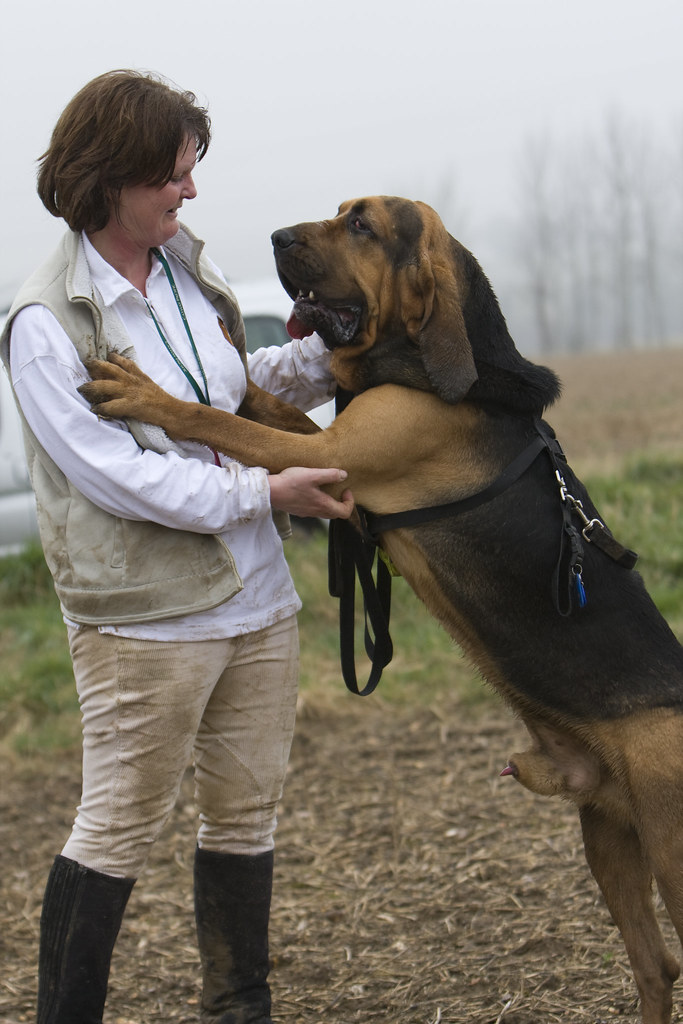
Figure: A black-and-tan Bloodhound stands up with its front paws on the woman beside it, wearing a harness. John Leslie, Flickr[2]
Loose skin, long ears and deep-set eyes
A Bloodhound is large and solid, 23–27 inches at the shoulder and up to about 110 pounds, best known for a wrinkled long face, loose skin, long pendulous ears, and deep-set eyes that give a solemn expression; colours are black-and-tan, liver-and-tan, and red.[1] For recognition, note the loose folds over the forehead and cheeks when the head is carried low, the very long low-set ears, and the short dense smooth coat—without memorising every measured line in the written standard.[1]
Nose-first walks and the leash
Bred to follow scents for hours, Bloodhounds benefit from long, daily walks. Use a well-fitted harness and strong leash, and leave time for sniffing. A dog on a scent may lose interest in your commands.[1] A yard can provide additional exercise if the fence is secure. Check for holes under the fence and make sure the gate latches, as Bloodhounds are skilled diggers.[1]
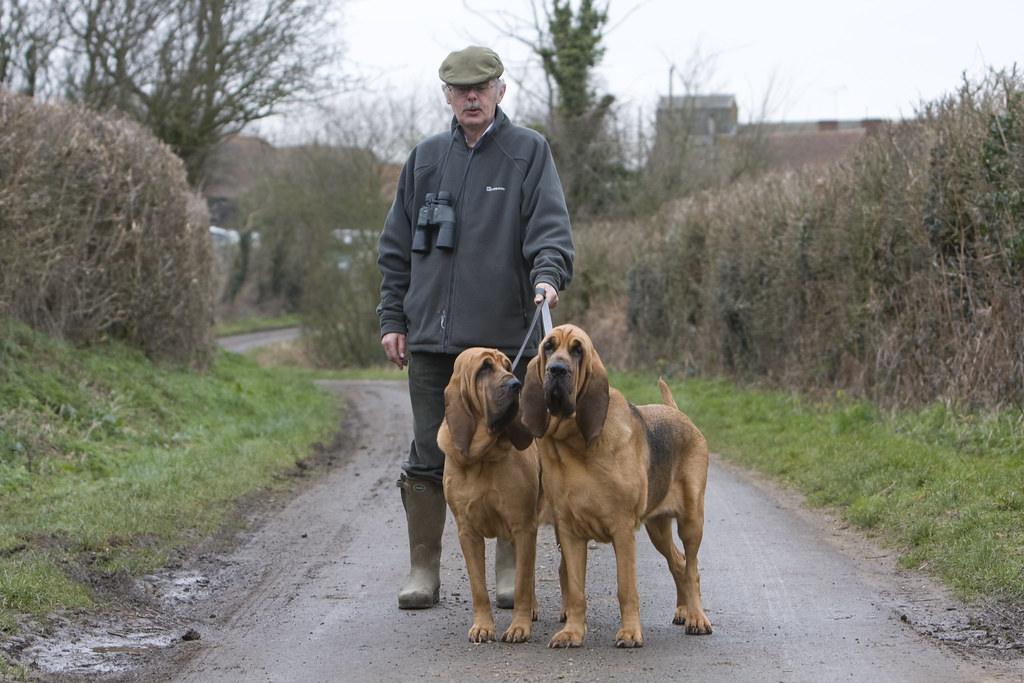
Figure: Two red Bloodhounds stand on a country lane, the leash held by the man behind them. John Leslie, Flickr[3]
Bloodhounds originally worked in packs, and many enjoy the company of people, children, and other dogs. They can be vocal and drool heavily, so it helps to keep a towel nearby. Supervise interactions with small children, especially around a dog that can weigh about 50 kg. Give the dog a quiet place to eat, sleep, and rest undisturbed.[1]
Patient training that starts early
Start socialisation and puppy classes early, so the Bloodhound can practise the habits you want it to keep as an adult.[1] They like to take charge, so the owner needs to be firm but kind, and positive rewards such as treats and praise are usually effective.[1] These affectionate dogs can be independent, so training takes patience and consistency.[1] Put that next to the leash advice: training goals can focus on what is done on the leash—walking, waiting, not eating things off the ground—rather than treating “comes back after being let off” as a standard that must be met.
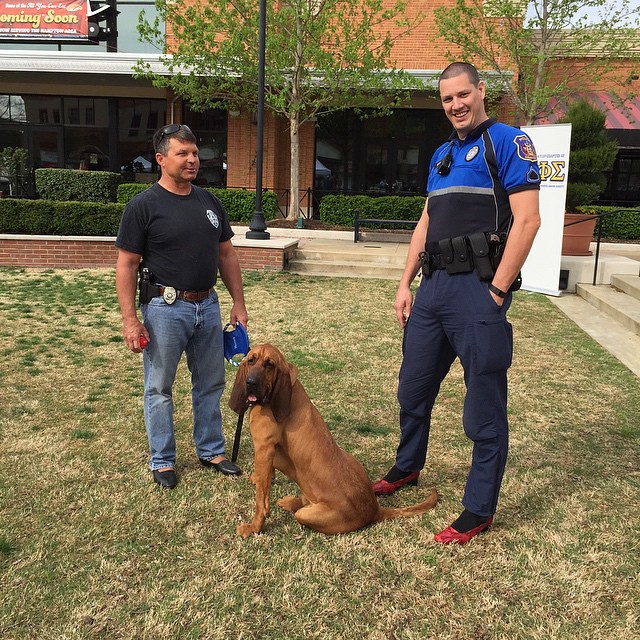
Figure: A red Bloodhound sits on grass with the leash held by the man on the left. Tony Alter, Flickr[4]
Daily checks of folds and ears
The Bloodhound has a short, dense coat shed once or twice a year; weekly brushing with a medium-bristle brush, rubber grooming mitt or hound glove removes dead hair before it lands on the furniture and promotes new growth.[1] It should be bathed regularly to avoid a doggy odor, and its nails trimmed regularly.[1] What sets this breed apart is the loose skin and long ears: check the low-hanging ears daily for signs of infection and the skin wrinkles daily for odor or irritation, wiping with a warm, wet cloth and drying thoroughly if needed.[1]
Bloat/GDV, scavenging, and health tests
Like other large, deep-chested dogs, Bloodhounds are at risk of bloat and gastric dilatation-volvulus (GDV). Smaller, more frequent meals, slower feeding for dogs that gulp, and quiet time around meals are common precautions.[1] Abdominal swelling, unproductive retching, heavy drooling, trouble breathing, or marked restlessness call for emergency veterinary care.[5]
Bloodhounds may swallow socks, stones, and other objects. Clear these from reach, feed a diet appropriate for the dog’s age, and watch weight and treat portions. Ask about hip, elbow, and heart screening in the parents. Have a veterinarian evaluate changes in appetite, energy, or gait.[1]
To recognize a Bloodhound, start with loose skin, deep-set eyes and very long, low-hanging ears, then remember a hound bred for scent tracking over a thousand years: walk it on a leash, give it a securely fenced yard, train early, patiently and with rewards, and check ears and folds daily.[1] If sudden abdominal swelling, unproductive retching, or clear restlessness appears, seek emergency veterinary care.[5] Get to know your own dog’s stamina and habits so you can adjust walks and notice changes early.[1]
References
-
AKC. Bloodhound.
-
Leslie, J. Bloodhound Trials Feb 2008 -63.
-
Leslie, J. Bloodhound Trials Feb 2008 -211.
-
Alter, T. WAMIHS. K9 Bloodhound.
-
VCA Hospitals. Bloat: Gastric Dilatation and Volvulus in Dogs.