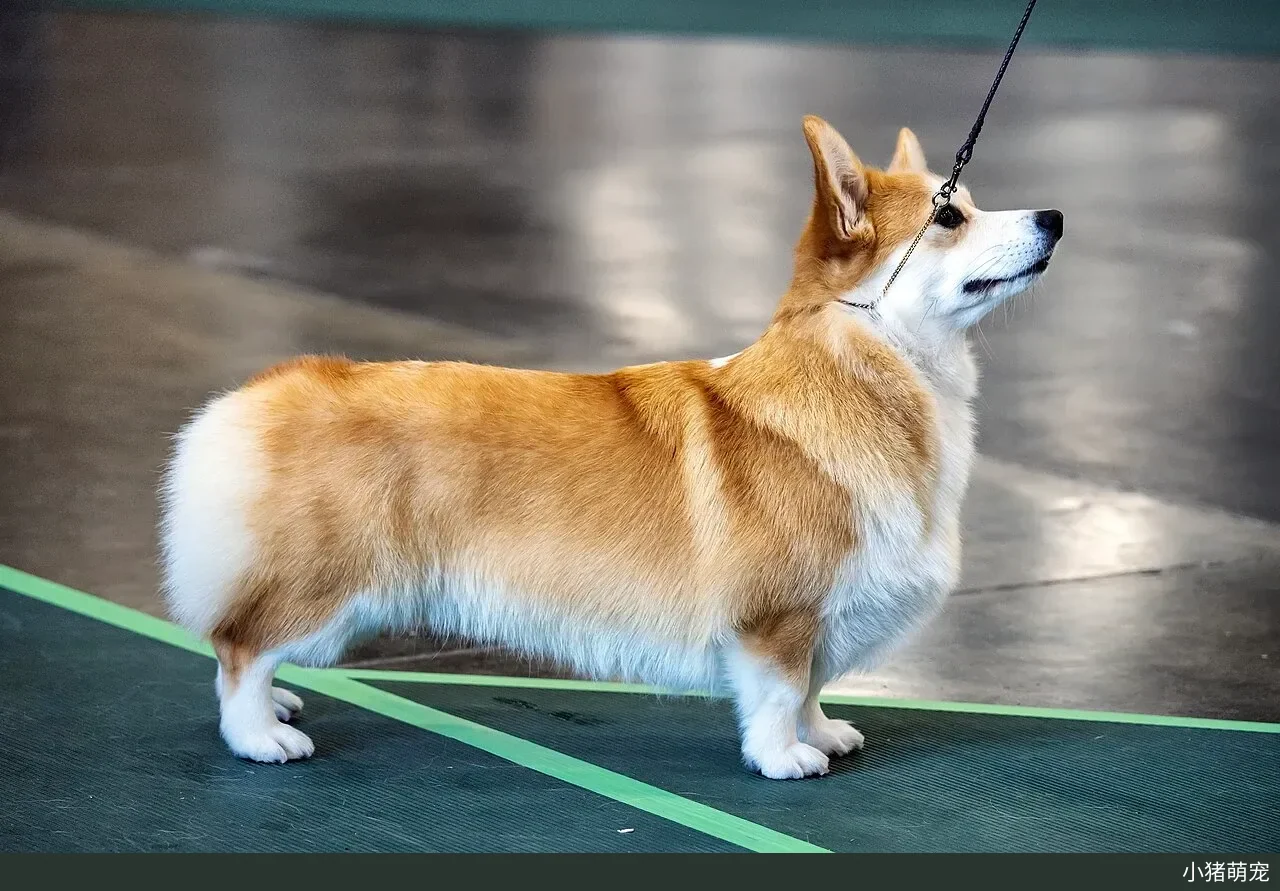
A light red-and-white Pembroke Welsh Corgi standing in profile in the show ring, photographed 6 July 2024 at a dog show in Washington State, USA. Photo: Mrkoww; source: Wikimedia Commons; license: CC BY 4.0.

The Pembroke Welsh Corgi comes from Pembrokeshire in southern Wales, where it was a compact farm dog that drove cattle and watched the homestead. It stands about 25–30 cm at the withers, long-bodied and short-legged, with erect ears and a fox-like face; temperament is bold, friendly, and eager to learn. Drawing on AKC and FCI breed standards and veterinary sources, this article covers origins, appearance, temperament, exercise and training needs, and common health issues.
Origins and history
Per American Kennel Club (AKC) breed-history writing, the Pembroke was a farm “all-rounder” in Wales: driving cattle to common pasture and watching them, bringing them home before milking, plus vermin control, tending other stock, and guarding the household. AKC places it in the spitz family—pointed muzzle, fox face, erect ears—and suggests Swedish Vallhund, Norwegian Buhund, and Schipperke as possible close relatives.
Both Pembroke and Cardigan Corgis are regarded as old types; some claims reach back to the tenth century, but that is unsettled. By the 1850s nearly every Welsh farm had Corgis: in the south, fox-type, often naturally short-tailed Pembrokes; in the north, longer-tailed Cardigans. The word “Corgi” is likewise disputed: one account joins Welsh cor (“dwarf”) and ci (“dog”); another traces it to curgi, related to “to watch/guard.” Later Welsh farmers shifted to fenced sheep pasture and needed longer-legged herding dogs; Border Collies gradually took over the Corgi’s farm work.
The same AKC article notes that The Kennel Club recognized Corgis in the 1920s and from 1934 treated Pembroke and Cardigan as separate breeds. That year the first Pembrokes reached the United States and AKC registration; the Pembroke Welsh Corgi Club of America (PWCCA) formed on 12 February 1936. AKC also records that the future Queen Mother kept a Pembroke for her daughters Elizabeth and Margaret—a royal pet that boosted the breed’s popularity in Britain. The Fédération Cynologique Internationale (FCI) formally recognized the breed in 1963, placing it in Group 1 “Sheepdogs and Cattledogs,” cattledog section, country of origin the United Kingdom.
Appearance
The Pembroke is the classic “short legs, long body.” The AKC standard calls for height at the withers (ground to highest point of the withers) of 10–12 inches (about 25–30 cm), with length from withers to base of tail about 40% greater than height. On weight, AKC caps dogs at 30 lb and bitches at 28 lb (about 13.6 and 12.7 kg), with ideal show condition around 27 and 25 lb; the FCI standard gives dogs 10–12 kg and bitches 9–11 kg. PWCCA notes that Pembrokes are chondrodysplastic “true dwarfs”: legs are short, but the rest of the structure resembles a normally proportioned dog.
The head is fox-like, with medium erect ears that swivel toward sound. The coat is a medium-length double coat: a short, thick undercoat that sheds weather, and a longer, coarser outer coat that does shed, with undercoat thinning in seasonal blows. Colors include red, sable, fawn, and black-and-tan, with or without white markings. Excessively long coats with exaggerated ear and leg furnishings—“fluffy” individuals—are a very serious fault under the AKC show standard.
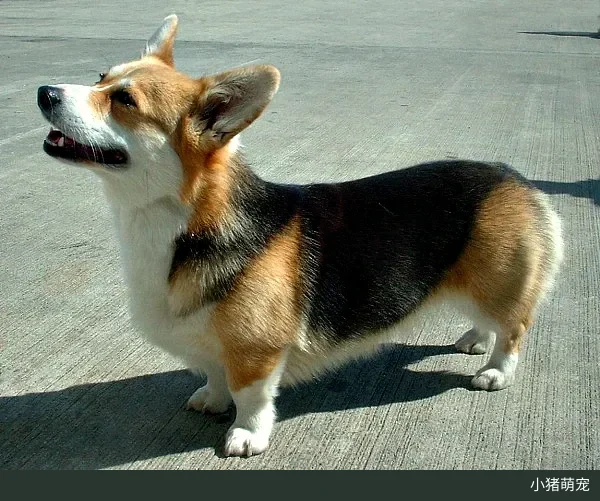
A black, tan, and white (standard “black-and-tan” with white markings) Pembroke Welsh Corgi in left profile; short legs, long body, and erect ears are clear, with no obvious tail visible in the frame. Photographed 30 August 2003 at the Birmingham City Championship Dog Show, UK. Photo: sannse; source: Wikimedia Commons; license: CC BY-SA 3.0.

Many people assume “Corgis are born without tails”; most tailless look comes from docking tradition. The AKC standard (approved 1972) still calls for the tail “docked as short as possible”; occasional naturally short-tailed puppies are acceptable if short enough. The FCI’s current standard published 8 September 2026 states the breed was “formerly customarily docked” and describes the undocked tail: set in line with the topline, carried naturally above or below the topline when moving or alert; naturally short tails also occur at various lengths. So some Pembrokes have tails and some do not—neither is surprising.
Temperament, exercise, and training
The AKC standard describes Pembroke temperament as “bold and kindly, never shy or vicious”; FCI writes “bold and workmanlike, outgoing and friendly, never nervous or aggressive.” UK veterinary charity PDSA calls Corgis friendly, cheerful, and playful, eager to please, and usually not hard to train. AKC breed history also cites PWCCA members: modern Corgis rarely drive cattle for real, but they are smart and energetic, responsive to their people, and strong in agility, obedience, tracking, herding, and conformation.
On exercise, PDSA suggests about one hour a day. The AKC standard likewise stresses that the Pembroke is a herding dog that must have the agility, flexibility, and stamina for its work. Beyond daily walks, obedience, tracking, agility, and similar sports give mental work.
Watch herding instinct in training. PDSA notes Corgis may nip at running children’s heels; early socialization and training help. When choosing a puppy, PWCCA suggests asking about parent temperament—noise sensitivity, reactions to new places, and so on. Grooming is not heavy: PDSA says brushing two or three times a week usually clears dead coat.
Common health issues
The PWCCA Health and Genetics Committee regards the Pembroke as a relatively healthy breed with only a few issues to watch, and a typical lifespan of 12–15 years. Many breeders screen breeding stock for hip dysplasia, eye disease, and von Willebrand disease (vWD); elbow dysplasia, cardiac, and degenerative myelopathy tests are optional for the breeder. PWCCA’s health statement posted via AKC on 5 November 2014 recommends OFA or PennHIP hip evaluation and eye exams by an American College of Veterinary Ophthalmologists (ACVO)–boarded ophthalmologist.
Degenerative myelopathy (DM) is often mentioned. A 2009 Proceedings of the National Academy of Sciences (PNAS) study used genome-wide association in 38 affected Pembrokes and 17 clinically normal related dogs and linked a SOD1 mutation (E40K) to the disease: dogs carrying two copies of the mutant allele were associated with clinical disease. The study describes a fatal progressive neurodegenerative disease that usually begins at eight years or later with rear-limb ataxia. Controls in the study also included dogs with two mutant copies and no signs; PWCCA likewise warns that many genetic tests are not black-and-white and results are best read with a veterinarian.
PDSA’s list of potential Welsh Corgi health issues also includes hip dysplasia, intervertebral disc disease, epilepsy, von Willebrand disease, bladder stones, cataracts, and lens luxation (PDSA’s page covers Pembroke and Cardigan together). PWCCA advises buyers to ask breeders directly whether parents had hip and eye screens, and to talk frankly about reproductive, cancer, cardiac, neurologic, and autoimmune issues. If someone answers that Pembrokes “have no genetic disease at all,” that is not the right answer.
References
-
American Kennel Club. Official Standard of the Pembroke Welsh Corgi. Approved 13 June 1972; reformatted 28 January 1993.
-
AKC Staff. Pembroke Welsh Corgi History: From Centuries-Old Cattle Herder to Family Pet. American Kennel Club, updated 3 May 2024.
-
Fédération Cynologique Internationale. FCI-Standard N° 39: Welsh Corgi Pembroke. Current valid standard published 8 September 2026.
-
Fédération Cynologique Internationale. WELSH CORGI (PEMBROKE) (39). FCI breed nomenclature page.
-
Pembroke Welsh Corgi Club of America. Health and Genetics. Page undated.
-
Pembroke Welsh Corgi Club of America. Health Statement: Pembroke Welsh Corgi. 5 November 2014.
-
Awano T, Johnson GS, Wade CM, et al. Genome-wide association analysis reveals a SOD1 mutation in canine degenerative myelopathy that resembles amyotrophic lateral sclerosis. PNAS, 2009, 106(8): 2794–2799.
-
PDSA. Welsh Corgi. Page undated.