
Crested gecko (Correlophus ciliatus). Figure: Lennart Hudel, from Wikimedia Commons (originally iNaturalist); license CC BY 4.0.
The crested gecko is native to New Caledonia in the South Pacific, named for the row of fine, spike-like crest that runs from above the eyes onto the neck and back. Including the tail it is about 20 cm long and can live 15–20 years in captivity; IUCN lists it as Vulnerable, but it is not on any CITES Appendix. Drawing on veterinary hospitals, the UK RSPCA, and conservation sources, this article covers habits, housing, diet, common disease, and the legal and ethical lines for keeping them in China.
Natural habits and wild status
The crested gecko (scientific name Correlophus ciliatus, often called crested gecko in English) is endemic to New Caledonia. IUCN assessment records place it at scattered sites in the southern half of Grande Terre and on Île des Pins, with recent finds also in the north of the main island. The RSPCA notes it was once thought extinct in the wild until a small population was rediscovered on Île des Pins after a tropical storm in 1994. Today crested geckos are widely bred in captivity and commonly seen in pet shops and reptile expos.
It is a classic arboreal gecko: hiding and sleeping by day, most active at night and at dawn and dusk. Specialized setae on the toe pads let it climb smooth vertical surfaces; the tail helps with gripping, and jumping ability is strong. Adults measure about 18–23 cm (7–9 inches) including the tail, with captive lifespan of 15–20 years. Body color can darken—“firing up,” keepers say. Remember especially: when startled a crested gecko may drop its tail, and unlike many geckos the lost tail does not regrow. Wild crested geckos eat both fruit and insects; the RSPCA notes they may also take small mammals and amphibians.
Housing
Because they live in trees, enclosure “height matters more than floor area.” RSPCA’s minimum for an adult is 45 cm wide × 45 cm deep × 60 cm high; Tree of Life Exotic Pet Medical Center in the U.S. suggests height of at least 61–76 cm (24–30 inches). Furnish enough branches, vines, and live or artificial plants for climbing and hiding, with hides on both warm and cool sides, plus a moist hide lined with damp sphagnum to aid shedding. Substrate can be easy-clean paper towel or newspaper, or moisture-holding coconut fiber; Warren Woods Veterinary Hospital warns against sand, calcium sand, wood shavings, and walnut shells, which can cause gut blockage if swallowed. RSPCA also advises running the enclosure empty for a week to settle temperature and humidity before bringing the gecko home.
On temperature, sources largely agree: RSPCA suggests a warm side of 26–28°C and a cool end of 20–24°C, with nights down to 18–20°C; all heaters must be on thermostats, with a digital thermometer at each end checked daily. Humidity advice varies more: RSPCA writes 40–50% routinely, briefly to 80% after misting; Warren Woods suggests 50–60%; Tree of Life 50–70%. The common points are measuring with a hygrometer, misting regularly, keeping ventilation, and avoiding waterlogged substrate—which breeds bacteria and invites skin or respiratory infection. On lighting, RSPCA and Tree of Life both recommend low-level UVB to help synthesize vitamin D3 and absorb calcium, with lights on about 12 hours by day and all off at night.
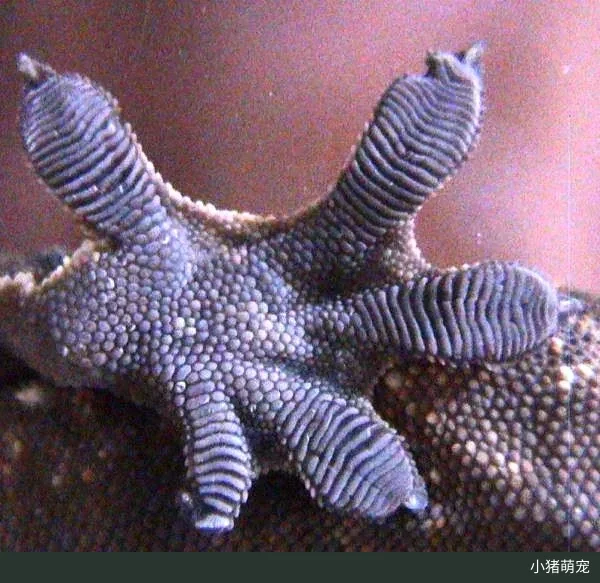
Underside of a crested gecko’s feet: toe pads let it climb securely on foliage and smooth surfaces. Figure: LA Dawson, from Wikimedia Commons; license CC BY-SA 2.5.
Crested geckos are best housed alone; males are territorial and will fight—never share a cage. Once settled they can tolerate handling, but RSPCA advises letting the gecko walk onto your hand for about 10 minutes at a time so body temperature does not drop; avoid handling in the first week home. Never grab the tail. Reptiles can carry Salmonella—wash hands after cleaning the enclosure or touching the gecko.
Diet and common health problems
Crested geckos are omnivores. A common approach is commercial “crested gecko diet” (powder mixed with water into a paste) as a base, plus live insects—but institutions disagree on how central that diet is: Tree of Life treats it as a complete staple, feeding three times a week; RSPCA prefers rotating fruit puree with supplements, live insects, and gecko diet, not diet alone, and avoiding products with wheat, rice, or bran. Mixed paste sours quickly—remove leftovers promptly. Live insects can include crickets and dubia roaches, no larger than the space between the gecko’s eyes; gut-load insects 24–48 hours beforehand and dust with calcium or vitamin powder at feeding. Remove uneaten live insects so they do not bite the gecko while it sleeps.
Fruit suits occasional treats. RSPCA lists safe fruits as blueberry, pear, papaya, strawberry, and mango, and advises against citrus and banana as interfering with calcium absorption—yet Warren Woods’ recommended list includes banana. When sources disagree, the safe path is advice from a reptile-savvy veterinarian for your animal. Keep a shallow dish of clean water available and mist daily; many crested geckos prefer licking droplets from leaves and glass. RSPCA also suggests regular weighing: growing animals should gain steadily, adults stay stable.
Crested geckos are good at “looking fine” when sick, so illness is easy to miss. Warren Woods lists common issues including gut blockage, metabolic bone disease (MBD), parasites, respiratory infection, and egg binding (dystocia) in females. MBD usually ties to lack of calcium, vitamin D3, or UVB; RSPCA describes typical signs as swelling or deformity of limbs, jaw, or spine—hard to treat, and late discovery can mean permanent deformity or death; seek care at once if suspected. Gut blockage often follows substrate ingestion; abnormal feces or weight loss also raise parasite concerns.
Several problems link directly to husbandry. With too little space or climbing structure, geckos may sleep hanging upside down on glass for long periods, bending and damaging the tail—“floppy tail syndrome.” Low humidity or poor nutrition can rob toe pads of stickiness. Incomplete sheds with stuck skin on toes can lead to toe loss: soak gently in shallow warm water and rub loose skin off—never tear; recurring cases need a vet. Several hospitals recommend annual checkups; Tree of Life also advises periodic fecal parasite checks. Ideally locate a nearby reptile veterinarian before bringing a gecko home.
Conservation status, domestic law, and ethics
First, the international picture. Queried on 17 October 2026 in the Species+ database maintained by UNEP-WCMC (which lists this species under the former name Rhacodactylus ciliatus), the crested gecko is on no Appendix of CITES; it is listed in Annex D of the EU wildlife trade regulations, current entry effective 29 June 2026, covering live animals and whole or substantially whole dead specimens. In the wild, IUCN Red List rates it Vulnerable (VU), assessed 11 December 2017, for a small range and ongoing declines in habitat area and quality and in numbers of mature individuals. In short, “not on CITES” only means international trade is not controlled by that convention—not that wild populations are safe.
Domestically, the crested gecko is not a native Chinese species. Article 40 of the current Wildlife Protection Law of the People’s Republic of China (revised 30 December 2022, effective 1 May 2023) requires that introducing wildlife species from abroad be approved by the State Council wildlife protection authority; after introduction, reliable measures must prevent escape into the wild, and illegal release or abandonment is forbidden. Violating introduction-approval rules means confiscation of the animals and a fine of 50,000–500,000 yuan (Article 58); releasing or abandoning introduced wildlife means an order to recapture within a deadline and a fine of 10,000–100,000 yuan (Article 59). Article 41 further requires that releases use local species suited to survival in the release area. This article has not checked every domestic list and local rule for crested geckos; for personal keeping, sale, and transport, confirm required procedures with local forestry and grassland authorities before purchase, and ask sellers for captive-bred origin documentation.
Finally, ethical reminders. First, a 15–20-year lifespan means a decade-plus care commitment—including heating equipment, regular UVB lamp replacement, and exotic veterinary costs. Second, wild populations are Vulnerable—choose only clearly captive-bred animals; do not buy or support wild-caught stock. Third, this is not a “living figurine” for frequent handling; a dropped tail never returns—handle moderately and gently. Fourth, even if you can no longer keep it, do not release it into neighborhood greenspace or the wild: that may kill the animal, risk local ecosystems, and break the law. Use reliable reptile rescue or rehoming channels instead.
References
-
RSPCA (Royal Society for the Prevention of Cruelty to Animals): Caring for your Crested Gecko (page undated; accessed 2026-10-17)
-
Warren Woods Veterinary Hospital: Crested Gecko: Care and Husbandry (page undated; accessed 2026-10-17)
-
Tree of Life Exotic Pet Medical Center: Crested Gecko Care (page undated; accessed 2026-10-17)
-
Sadlier, R.A. et al.: Correlophus ciliatus. The IUCN Red List of Threatened Species (assessment date 2017-12-11; published 2021)
-
UNEP-WCMC: Species+:Rhacodactylus ciliatus (queried 2026-10-17)
-
National People’s Congress of China: 中华人民共和国野生动物保护法 (revised 2022-12-30; effective 2023-05-01)