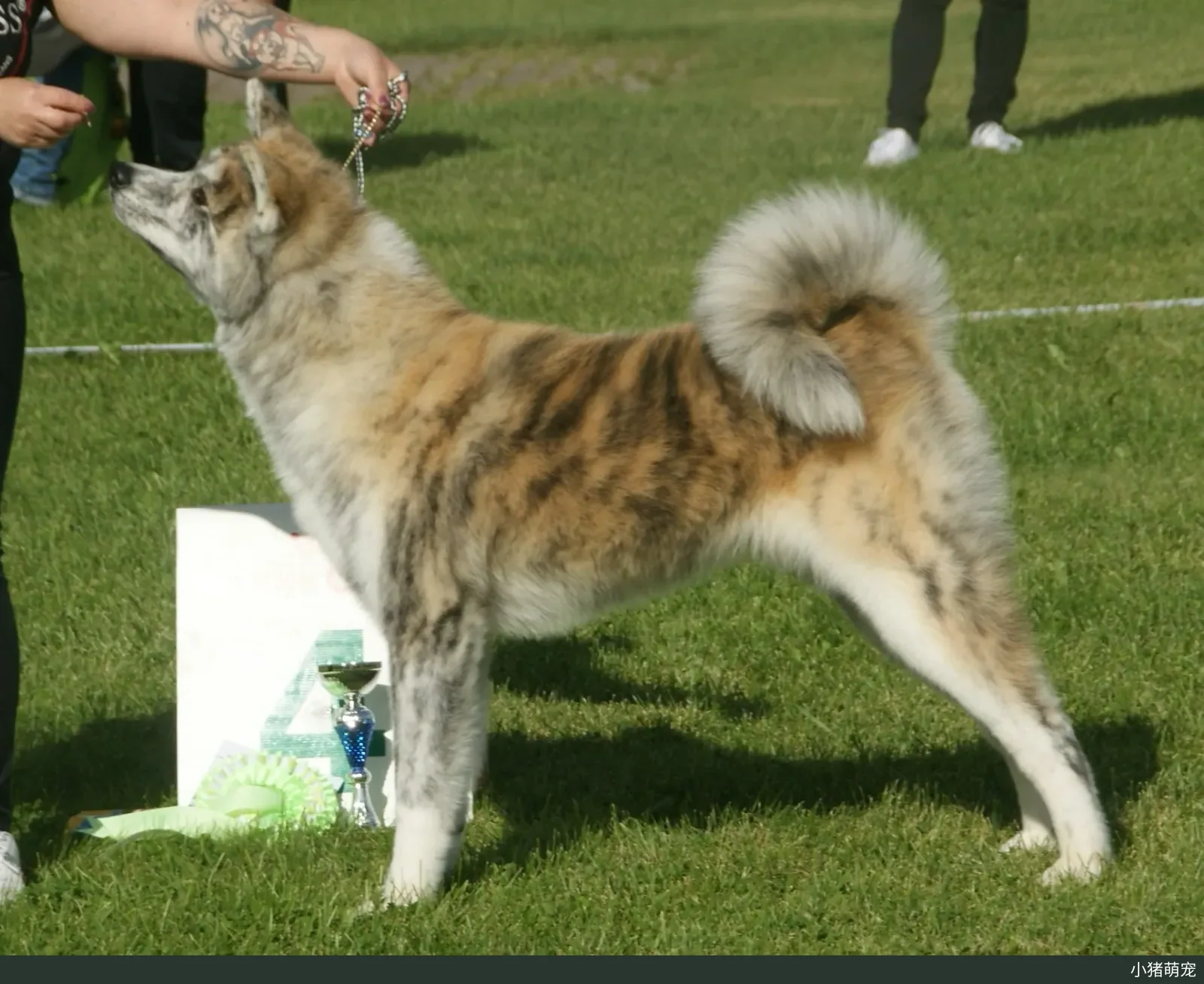
A red-brindle male Japanese Akita in a standing pose. Photo: Canarian, source page dated 23 August 2020; source: Wikimedia Commons; license: CC BY-SA 4.0.

The Akita is the largest of Japan’s native dogs. Its ancestors include the “Akita Matagi” dogs hunters in the Akita mountains used for bear; in 1931 it was designated a Japanese Natural Monument. It is quiet and clean, loyal to family, yet often reserved with strangers and other dogs. Drawing on kennel-club breed materials and veterinary literature, this article covers origins, appearance, temperament, exercise and training needs, and common health issues.
Origins and history
According to the brief history in the current Fédération Cynologique Internationale (FCI) standard, Japan originally had only small and medium dogs. From 1603, the Akita region used medium bear-hunting “Akita Matagi” dogs for dogfighting (matagi names traditional hunters of Japan’s northeastern mountains); after 1868 they were crossed with Tosa and mastiff-type dogs, growing larger but losing many Spitz-type traits. Japan banned dogfighting in 1908, and the type continued to be preserved and improved as a large Japanese dog. In May 1927 the then mayor of Odate helped found the Akita Inu Hozonkai; in 1931, nine outstanding individuals were designated Natural Monuments—the Agency for Cultural Affairs database records the designation date as 31 July 1931.
World War II nearly wiped the breed out. The FCI standard records that dogs were often used for military-uniform fur and that police ordered the capture of all dogs except military German Shepherds; some owners crossed their dogs with German Shepherds to save them. By war’s end numbers had collapsed into three mixed types—Matagi, fighting, and shepherd—and enthusiasts later stabilized today’s large purebred by backcrossing to the Matagi type. The most famous Akita, Hachikō, came from Odate: per the Odate city website, he was born in November 1923 and in January 1924 was sent to the home of Tokyo Imperial University professor Ueno Hidesaburō. The American Kennel Club (AKC) breed page notes that after his owner died suddenly, Hachikō waited at the station for nine years.
When reading sources, watch the names: FCI lists “Akita” (Standard No. 255, Japan) and “American Akita” (No. 344, originating in Japan, developed in the United States) as two breeds; The Kennel Club likewise has separate Japanese Akita Inu and Akita pages. AKC’s “Akita” is the larger type; the Japanese type is Japanese Akitainu, still in the not-fully-recognized Miscellaneous Class. This article focuses on the Japanese Akita and notes when citing material aimed at the American type.
Appearance
The FCI standard describes the Akita as a large, sturdy, well-boned yet balanced dog with clear sexual dimorphism. Ideal height is 67 cm for males and 61 cm for females, with ±3 cm allowed; height-to-length ratio is 10:11, bitches slightly longer. The forehead is broad and unwrinkled; eyes are relatively small, with outer corners upturned nearly triangular, the deeper brown the better; ears are small, thick, triangular, erect and slightly forward; the tail is set high, thick, and curled firmly over the back. FCI does not specify weight; AKC’s Japanese-type standard gives ideal weight about 65–75 lb (about 29–34 kg) for males and 55–65 lb (about 25–29 kg) for females, while AKC’s American-type Akita males can reach 100–130 lb (about 45–59 kg)—a sizable gap.
The outer coat is harsh and straight, the undercoat soft and dense; hair is slightly longer on the shoulders and rump and longest on the tail. FCI-accepted colors are red, sesame (red with black tipping), brindle, and white. Except white, all colors must show urajiro—whitish markings on the sides of the muzzle, cheeks, underside of the jaw, neck, chest, underside of body and tail, and insides of the legs. Per the FCI standard, long coat (fluffy coat), black mask, non-erect ears, and a hanging tail are disqualifying faults.
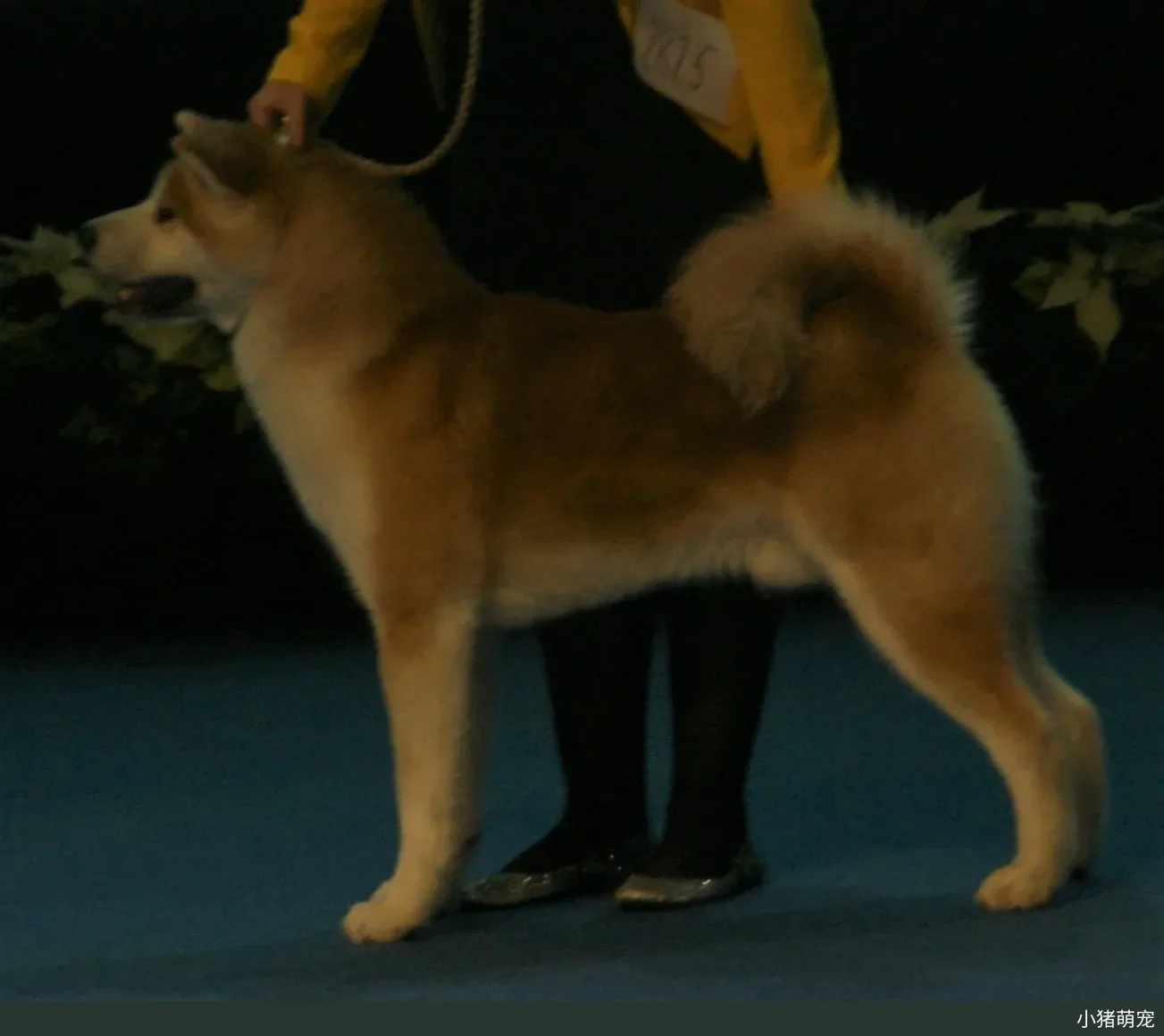
Profile stance of a red male Japanese Akita—compare body proportions and light urajiro markings with the text. Photo: Canarian, source page dated 15 December 2018; source: Wikimedia Commons; license: CC BY-SA 4.0.

Temperament, exercise, and training
FCI summarizes temperament as composed, faithful, docile, and receptive; AKC’s Japanese-type standard calls it alert, independent, dignified, and confident—loyal and protective of family, possibly aloof with outsiders especially strangers, with some individuals intolerant of other dogs. The Akita Club of America puts it more casually: Akitas save their goofy side for people they trust, but are naturally poor with other dogs—especially same-sex—best as a male–female pair or alone; their hunting background means strong prey drive, and they are not especially forgiving with children, so adult supervision is needed. For first-time dog owners they can be a real challenge.
On exercise volume, associations disagree. AKC on the American-type Akita says it is not especially high-energy but needs moderate exercise—at least one neighborhood jog or brisk walk daily for most individuals; The Kennel Club’s Japanese Akita Inu breed card marks more than two hours of exercise a day and recommends a large house and garden. That gap is a reminder that numbers are only a starting point; adjust for age, condition, and veterinary advice. Both kinds of sources agree: because of independence and prey drive, Akitas should not be off-leash in unfenced areas.
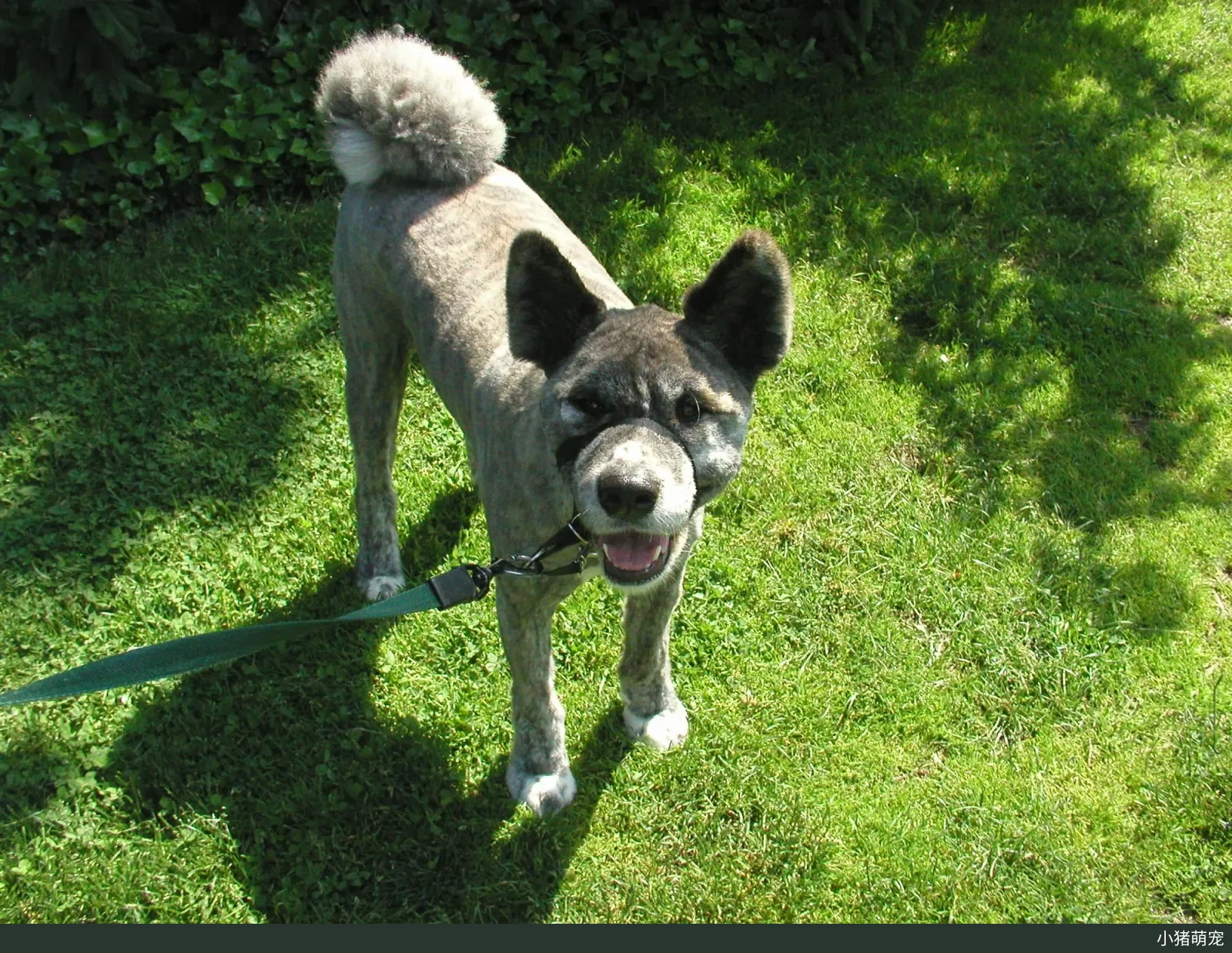
A brindle Akita in a head halter and leash looking up on grass. Per the source page, it is a long-coat (moku) variant; the coat in the photo is clipped short for summer. Photo: Malcolm Gin, source page dated 3 June 2006; source: Wikimedia Commons; license: CC BY-SA 3.0.

Training and daily care also take patience. AKC notes that Akitas are smart and loyal yet independent and stubborn; large and strong, they need consistent training from puppyhood and early, broad socialization so they learn to accept strangers rather than treat them as threats; some resource-guard food and should eat away from other animals and children. Akitas are usually clean with little body odor, but the dense double coat needs brushing at least weekly; during two heavy sheds a year the undercoat comes out in clumps and needs more frequent grooming, plus regular nail and dental care.
Common health issues
AKC gives expected lifespan as 10–14 years; The Kennel Club marks 10 years or more. Like many large breeds, Akitas can develop gastric dilatation–volvulus (“bloat”), an emergency owners should learn to recognize. The Akita Club of America notes predisposition to hip and elbow dysplasia, congenital eye disease, and thyroid problems, plus autoimmune disease—not all screenable by DNA tests. AKC therefore recommends choosing responsible breeders who have evaluated breeding stock for hips, eyes, and thyroid.
Sebaceous adenitis is a skin disease worth watching in Akitas. The Merck Veterinary Manual lists the Akita among predisposed breeds: an immune attack destroys sebaceous glands, leaving scale stuck to hair shafts (follicular casts), hair loss, dry skin, and coat-quality change; diagnosis needs skin biopsy. A 2001 Veterinary Dermatology study examined 97 purebred Akitas, confirming 23 histologically; lesions often began on the dorsal midline and ears, mainly affecting undercoat, possibly autosomal recessive. That rate is from a study sample and should not be treated as breed-wide incidence. The University of Minnesota veterinary dermatology handbook notes the disease can be managed but not cured, and affected dogs should not be bred.
Another condition strongly linked to Akitas is uveodermatologic syndrome (UDS, also called canine VKH-like syndrome). The Minnesota handbook notes that about 80% of published cases are Akitas, mostly young adults; ocular signs usually precede skin changes—bilateral uveitis that, if uncontrolled, can lead to retinal detachment, glaucoma, cataract, or acute blindness; the skin may depigment, lose hair, redden, and scale around eyelids, nose, and lips. A 2018 Journal of the American Veterinary Medical Association paper citing prior work says UDS may affect up to 4.1% of Akitas; DQA1*00201 is considered a risk allele, but there is still no simple genetic screening test. Because eyes often show problems first, red eyes or vision changes in an Akita warrant prompt veterinary care.
References
-
Fédération Cynologique Internationale. FCI-Standard N° 255 AKITA (current standard published 2001-03-13)
-
Fédération Cynologique Internationale. AMERICAN AKITA (344)
-
Agency for Cultural Affairs, Japan. National Designated Cultural Properties Database: Akita Inu
-
Odate City. Odate, the home of the faithful dog, Hachi. (Akita Inu)
-
American Kennel Club. Akita Dog Breed Information
-
American Kennel Club. Official Standard of the Japanese Akitainu (Miscellaneous Group standards)
-
American Kennel Club. Becoming Recognized by the AKC
-
The Kennel Club. Japanese Akita Inu | Breeds A to Z
-
Akita Club of America. Meet The Akita
-
Merck Veterinary Manual. Sebaceous Adenitis Affecting the Pinna in Dogs and Cats
-
Veterinary Dermatology (2001). Sebaceous adenitis in the Akita: clinical observations, histopathology and heredity
-
University of Minnesota. Sebaceous Adenitis – Dogs and Cats (Small and Large Animal Dermatology Handbook, Vol. 3)
-
University of Minnesota. Canine Uveodermatological Syndrome (Small and Large Animal Dermatology Handbook, Vol. 3)
-
Zarfoss MK, et al. Clinical findings and outcomes for dogs with uveodermatologic syndrome. JAVMA, 2018, 252(10):1263.