Pet rats are often called “fancy rats” in English. They are domestic descendants of the brown rat (Rattus norvegicus), with biology and behavior still close to their wild relatives. The Royal Society for the Prevention of Cruelty to Animals (RSPCA) describes them as highly intelligent, strongly social animals that form close bonds with cage mates and with people.[1] Lifespan is usually only two to three years, but the RSPCA stresses that this is still a substantial responsibility.[1]
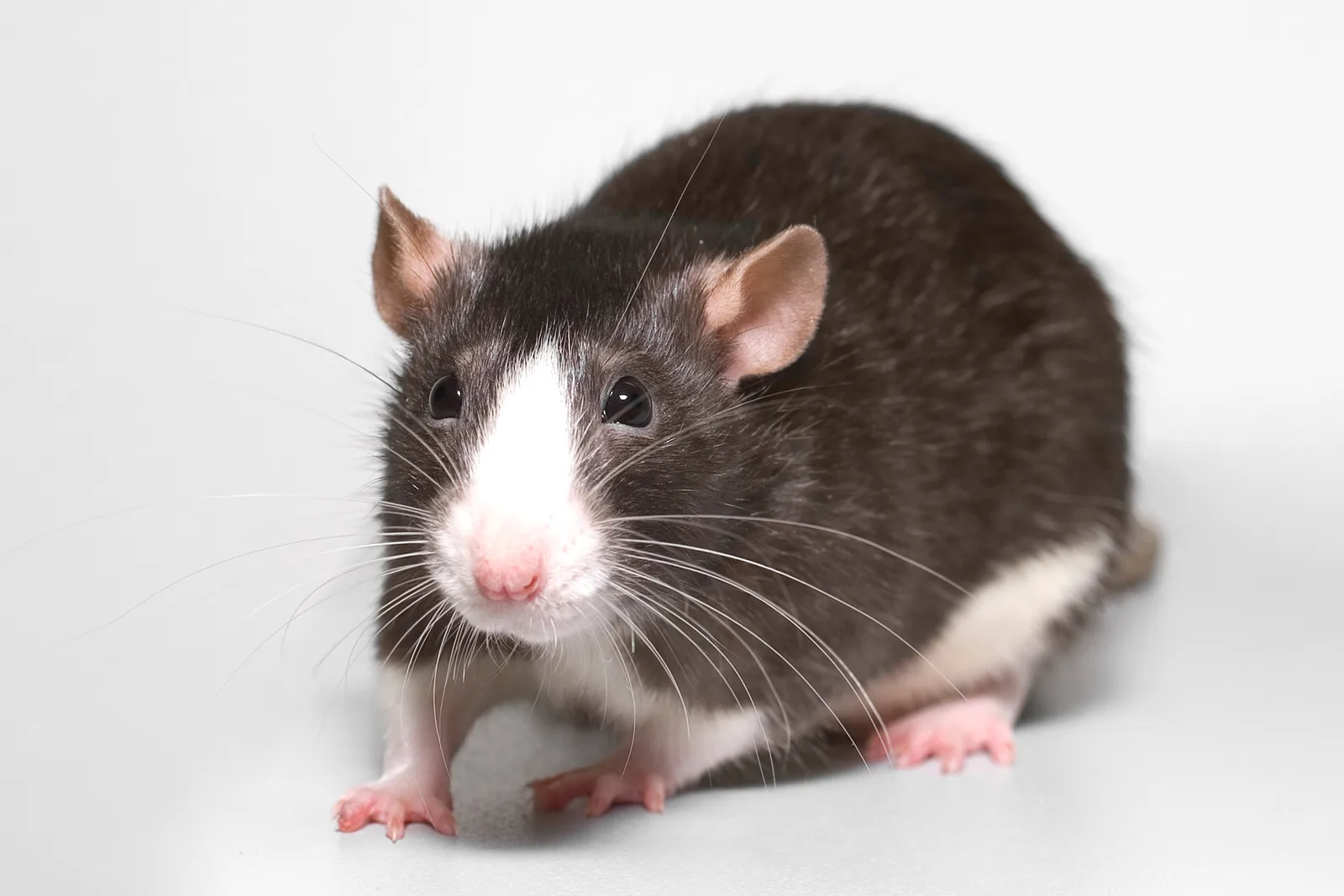
Figure: A pet rat; the white blaze on this individual does not represent every coat color. Source: AlexK100, Wikimedia Commons. License: CC BY-SA 2.0. Changes: converted to WebP and width-limited only.
What kind of animal they are
Rats have poor eyesight. They navigate, find food, and communicate through very sensitive smell, touch, and hearing, and they can hear ultrasonic calls beyond human hearing. They cannot vomit; their incisors grow for life and must be worn to the right length and shape by chewing. The tail helps with balance and heat loss: rats neither sweat nor pant; they have sweat glands only on the footpads and mainly regulate body temperature with the bare tail.[1]
They learn quickly, remember routes, and recognize people. The RSPCA notes that Belgian scientists have trained rats to detect landmines and tuberculosis; at home you can play scent games with them or teach a “high five.”[1]
Rats are nocturnal—most active at night and at dawn and dusk, asleep by day—so feeding and interaction work best morning and evening.[1]
One is not enough—keep at least two
The RSPCA is direct: rats play together, eat together, care for older companions, and sleep in a pile; they should never be kept alone. They do bond with people, but they still need same-species company throughout life. The RSPCA recommends adopting two or three same-sex rats that already get along; if you keep opposite sexes, neuter first.[1] Neutering can also reduce aggression and lower the risk of mammary tumors in females.[1]
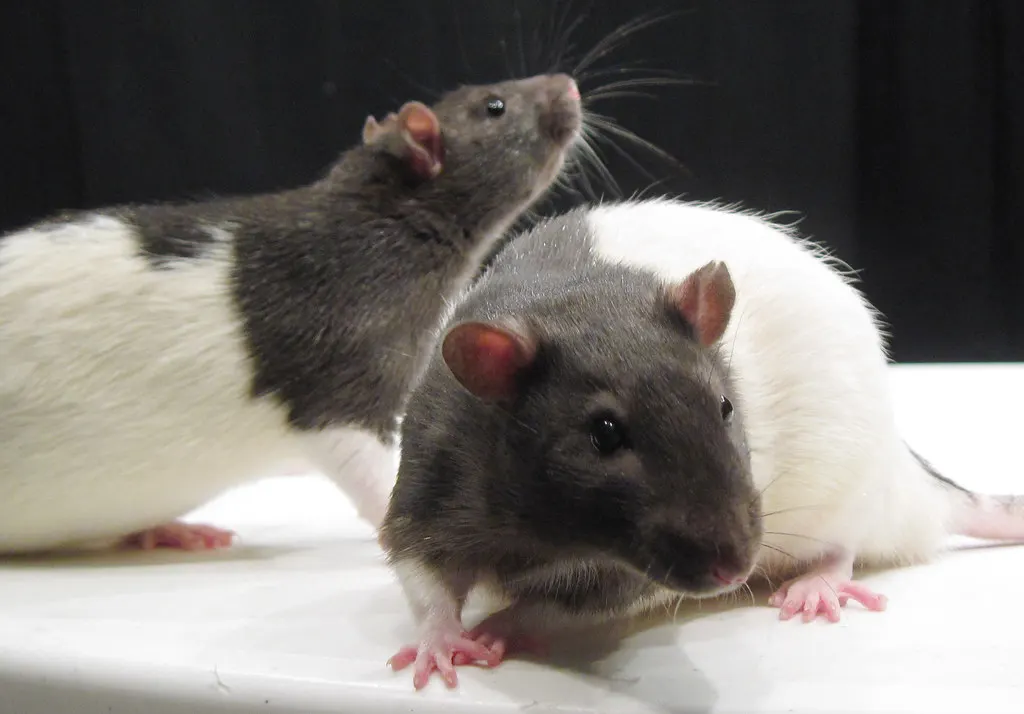
Figure: Two domestic brown rats together. This is a laboratory coat-color comparison photo, not a home-cage setup demo. Source: Functional Neurogenesis, Flickr. License: CC BY 2.0. Changes: converted to WebP and width-limited only.
Reading their emotions
Rats show emotion with body language. The RSPCA lists several cues:[1]
- When tickled they make high-frequency calls humans cannot hear—equivalent to “laughter”—and remember and prefer people who have played with them.
- Happy ears turn pink.
- When excited they bounce and dash around—“popcorning.”
- When content they grind their teeth, similar to a cat’s purr; grinding can also signal tension, anxiety, or pain, so judge it in context.
- When very happy they may tremble lightly with bulging eyes—“eye boggling.” If the eyes bulge more than usual or cannot retract into the sockets, that may signal stress or disease—seek a vet at once.
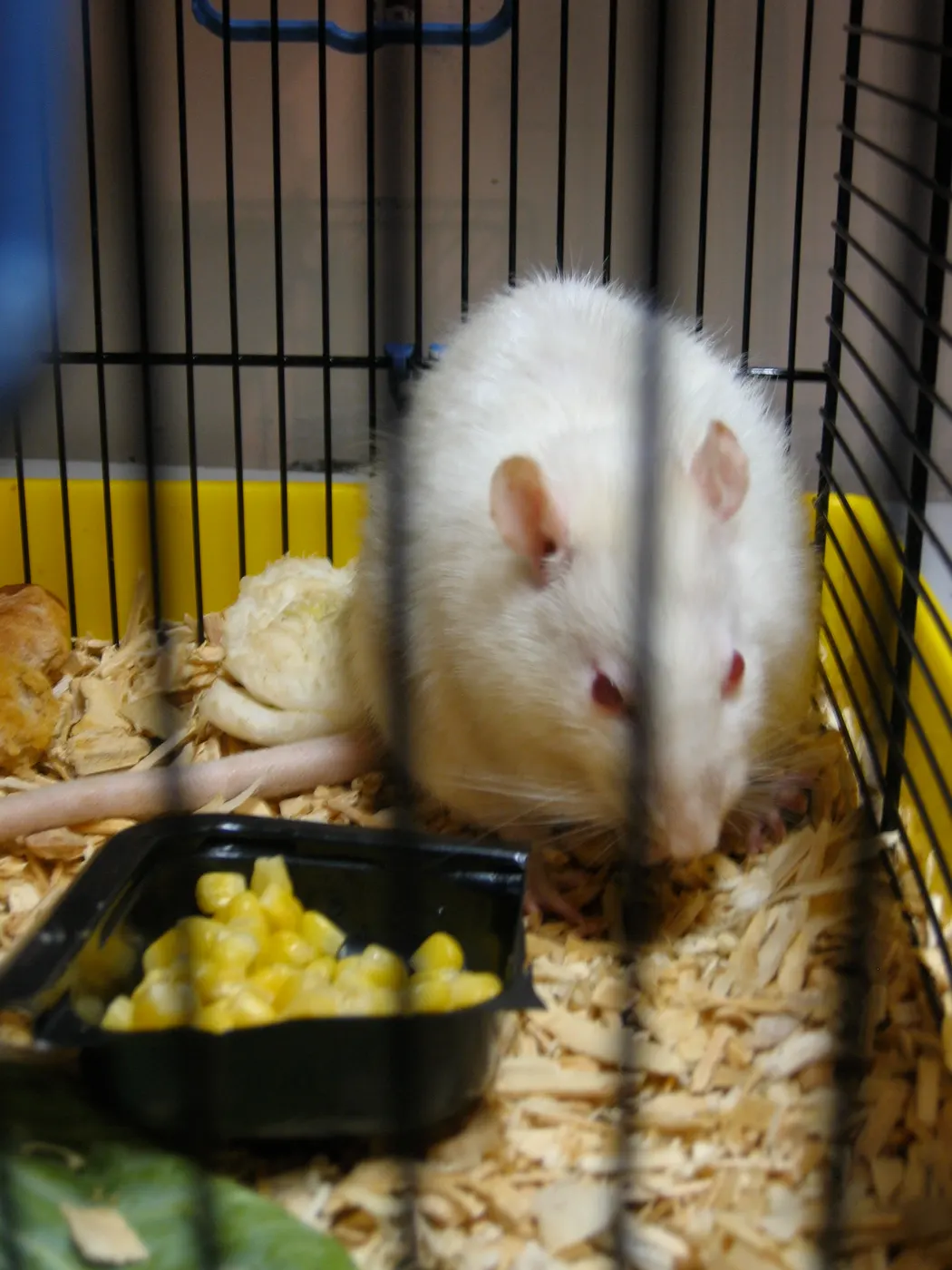
Figure: A white pet rat in a cage. The corn, bread, and cage in the frame are not husbandry demos for this article. Source: John Ruby, Wikimedia Commons. License: CC0. Changes: converted to WebP and width-limited only.

How to set up the cage
RSPCA housing guidance boils down to a few points:[2]
- As large as possible. Rats need room to run, stand on their hind legs, climb and explore, and choose where to toilet.
- Levels. Platforms, tunnels, ropes, hammocks, and ladders make a complex 3-D space—without packing the whole cage full.
- Solid floors. No wire mesh bottoms; wire floors easily injure feet.
- Escape-proof. Bar spacing must be too tight for a rat’s head—if the head fits, the body can follow. Rats can chew through wood and some plastics; check often.
- One more hide than rats. Every rat must always be able to enter a safe, dark hide; hides need multiple exits and must be large enough for the whole group to sleep together. Large cardboard tubes work for both hiding and chewing.
- Bedding. Use non-aspen wood shavings, cellulose pellets, or shredded filter paper; avoid dusty sawdust and aspen bedding, which may contribute to respiratory and other problems.
Placement matters too. The RSPCA’s ideal temperature is 19–23 °C; keep cages out of sunrooms, garages, or sheds; away from bathroom damp and air-conditioned dryness; ventilated but out of drafts; out of direct sun; dark at night. Bright light stresses rats and can harm eyes—especially red-eyed albino lines. Keep cages away from vacuum cleaners, stereos, doorbells, TVs, and computer screens that emit high-frequency or sudden noise, and not next to air fresheners.[2] Once the cage is in place, move it only when necessary.[2]
For cleaning, deep-clean the whole cage weekly and spot-remove feces, soiled bedding, and leftover food as you go. Leave a small handful of clean used bedding to keep familiar scent; clean when rats are awake, not while they sleep by day.[2]
What to feed
Use a rat-specific pellet diet as the staple—not rabbit, guinea pig, or hamster food, which have the wrong nutrition. Rats are omnivores; within the daily ration you can add small amounts of fruit, vegetables, cooked egg, grains, and seeds, but do not pile on extras or they will gain weight easily.[3]
Foods the RSPCA lists to avoid: onion, citrus fruit, walnuts, rhubarb, grapes, raisins, and chocolate. High-sugar, high-fat foods such as dairy products are training treats only.[3]
Feed morning and evening, remove leftovers, and adjust portions to what they finish. Use open ceramic bowls; metal bowls can produce ultrasonic noise. Offer water from bottles rather than bowls, with several bottles so all rats can drink at once; check and refill morning and evening, and watch for blockages and leaks.[3]
Rats like to hold and handle food with their paws. Scatter food around the cage, mix it into fresh bedding, or hide it in cardboard tubes for them to find; occasionally offer a cooled, unpeeled hard-boiled egg and let them figure out how to open it.[3]
When there are children at home
The RSPCA considers rats easier to handle than smaller rodents such as hamsters, and they often enjoy interacting with people—but they bite when startled. An adult should supervise when a child holds a rat and teach gentle handling. The RSPCA also cites CDC advice: households with children aged 5 or under, pregnant people, or people with weakened immune systems are advised not to keep pet rodents including rats, because they are more likely to become seriously ill from pathogens animals may carry.[1]
References
- RSPCA. Rats. Accessed 2026-11-13.
- RSPCA. Creating a good home for rats. Accessed 2026-11-13.
- RSPCA. What to feed rats. Accessed 2026-11-13.