The World Cat Federation’s standard for the Selkirk Rex Shorthair, abbreviated SRX, describes a medium to large, stocky cat with a broad chest, shoulders and back. Muscular legs end in thick, round paws. Seen from the front, the face has full cheeks and large, round eyes set well apart. In profile, the nose is short, broad and straight, while the outline of the head curves. Over that sturdy frame sits the shorthair’s most distinctive feature: a short, plush double coat with a dense undercoat and clearly defined curls. The standard accepts all colours and patterns.[1]
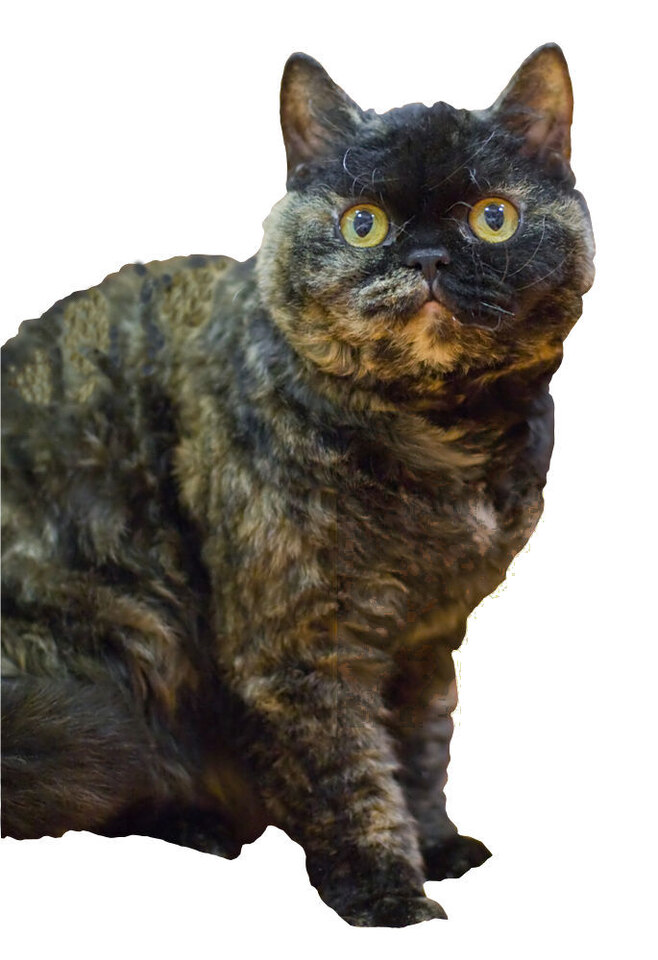
Figure: The shorthair’s build. Heikki Siltala / Desaix83, Wikimedia Commons[6]

For a clue to coat length, look at the tail and then the sides of the neck. The Cat Fanciers’ Association describes both coat lengths in its Selkirk Rex standard. On a shorthair, the curls sit close around the tail, and the hair on the neck is about as long as the hair on the body. A longhair’s tail fans out into a plume, and longer hair around the neck frames the face. In either variety, neighbouring locks can curl in different directions. Even on one cat, the neck, belly and tail can be curlier than the back.[2]
Those separate locks give your fingers a natural place to start. When the cat welcomes a stroke, follow one lock with the pads of your fingers. Ease it away from the next and look at the skin where the hairs emerge. A brush can fluff up the ridges on the surface while passing over a tangle underneath. If the locks come apart easily, let them fall back into their curl. The Cat Fanciers’ Association suggests using fingers to loosen the curls and a comb to lift out shed hair. There is no need to pull each lock straight.[2–3]
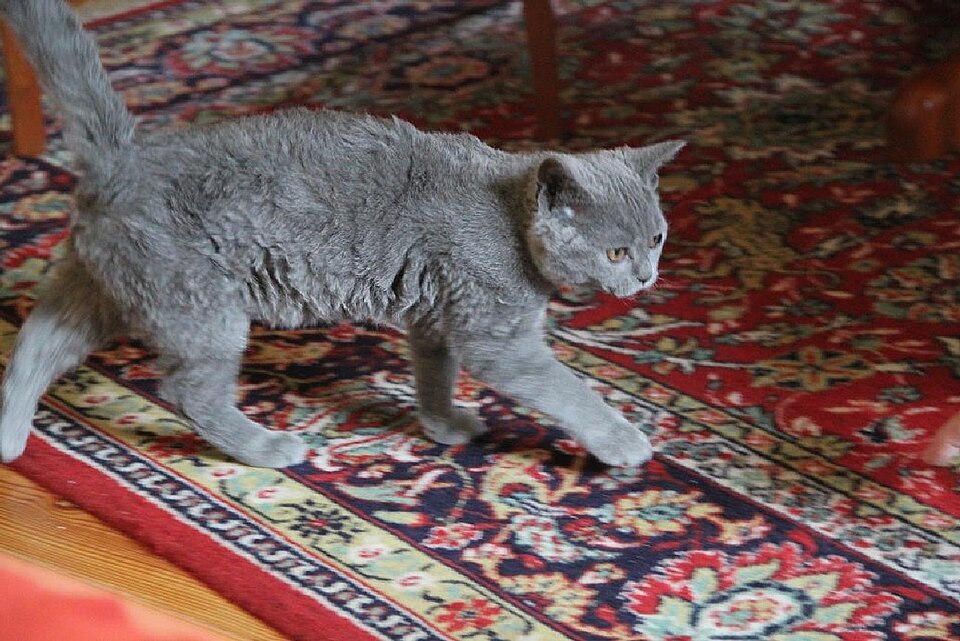
Figure: Curls along the flank. Leinwand, Wikimedia Commons[7]

During a daily coat check, give some attention to places your hand might miss on an ordinary stroke down the back. VCA Animal Hospitals singles out the areas behind the ears, under the front legs, in the groin and along the backs of the hind legs. A patch tucked under a foreleg is easier to see when the cat stretches and is happy to let you touch it. A tight-looking curl may part readily. A smooth-looking patch may catch at your fingertips where hairs have tangled beneath the surface. Remember where this happens on your cat so you can find the next knot while it is small.[2–3]
A small, loose tangle may comb out gently while the cat is comfortable. Stop if the teeth catch and the skin moves with the comb. Keep scissors away from a mat close to the body, where it is hard to see the edge of the skin. An experienced groomer or veterinarian can help with a tight mat or a larger area of felted fur. Have tangles dealt with before a bath, since wetting them can make them harder to loosen. Most healthy adult cats keep themselves clean. For everyday care, prepare a comb suited to the coat length and choose a quiet spot the cat can leave freely.[3]
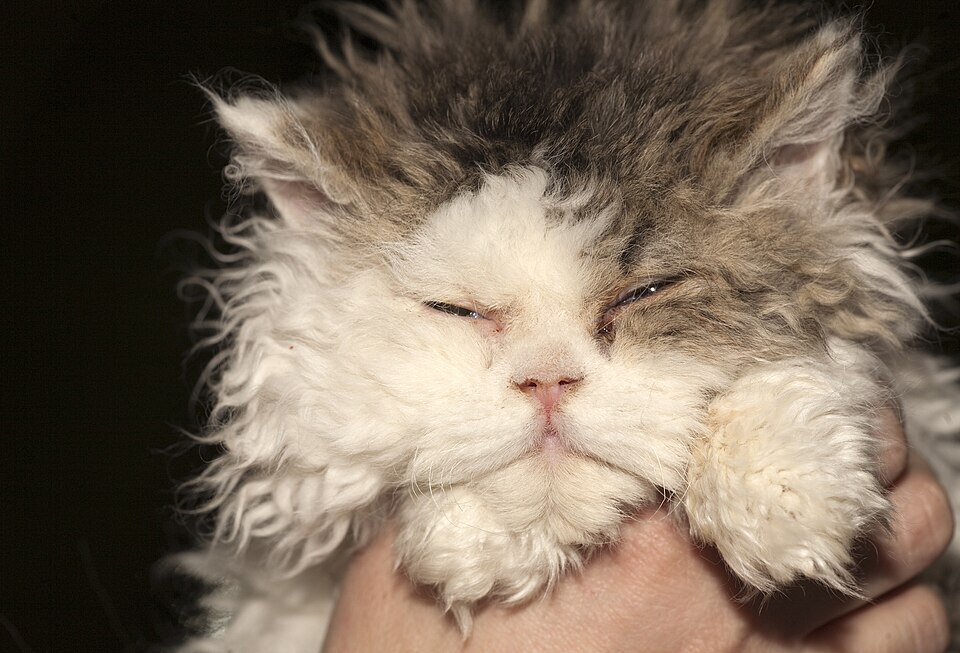
Figure: Curls on the forehead and cheeks. Nickolas Titkov, Wikimedia Commons[8]

To plan the rest of an indoor cat’s day, trace a route from its favourite sleeping spot. Can it reach water and a litter tray easily? Is there a steady perch where it can watch from above, and somewhere to retreat when voices get loud? The Feline Veterinary Medical Association includes safe resting places, separate resources and opportunities for play among an indoor cat’s needs. In a home with several cats, the routes matter as much as the destinations. Two beds offer a timid cat little choice if reaching either one means passing through a doorway another cat habitually guards.[4]
Give the cat a choice when it approaches you, too. Offer a hand to sniff and see whether it settles beside you or follows a moving toy. For a game, draw the toy away along the floor and pause it at the edge of a hiding place, giving the cat time to watch, stalk and pounce. Let the game end when the cat walks away. The same approach works for grooming: begin somewhere the cat usually enjoys being stroked. Leave room for visits that involve nothing more than quiet company, so coming within reach does not always mean being picked up for a combing session.[3–4]
Parting a few curls each day also helps you recognise a change in the skin beneath them. You might feel a new firm patch close to the skin where the coat used to feel soft, or notice the cat pulling away when you touch a spot it usually lets you stroke. If the skin under a mat looks red or broken, or the area seems painful, stop grooming and have a veterinarian examine it. Tell the vet where you first noticed the change, when you found it and how the cat reacted to your touch.[3]
One question about a Selkirk Rex’s health is best answered by looking at its family and screening records. Langford Vets lists the Selkirk Rex among breeds at low risk for autosomal dominant polycystic kidney disease. Its laboratory offers a test for a specific PKD1 variant associated with the disease. If you receive a screening report when you bring a kitten home, check whose name is on it: the kitten’s, its father’s or its mother’s. A negative result means the laboratory did not detect that variant in the cat it tested. Bring the report to your vet so you can discuss the kitten’s family history and whether it needs testing itself.[5]
References
-
[1] World Cat Federation. Selkirk Rex Shorthair (SRX). Updated 25 January 2022.
-
[2] The Cat Fanciers’ Association. Selkirk Rex.
-
[3] Courtney Barnes, Ryan Llera, Tammy Hunter and Cheryl Yuill. Grooming and Coat Care for Your Cat. VCA Animal Hospitals.
-
[4] Feline Veterinary Medical Association. New Feline Veterinary Medical Association Position Statement Reimagines Life for Indoor Cats. 28 August 2025.
-
[5] Langford Vets. Polycystic Kidney Disease.