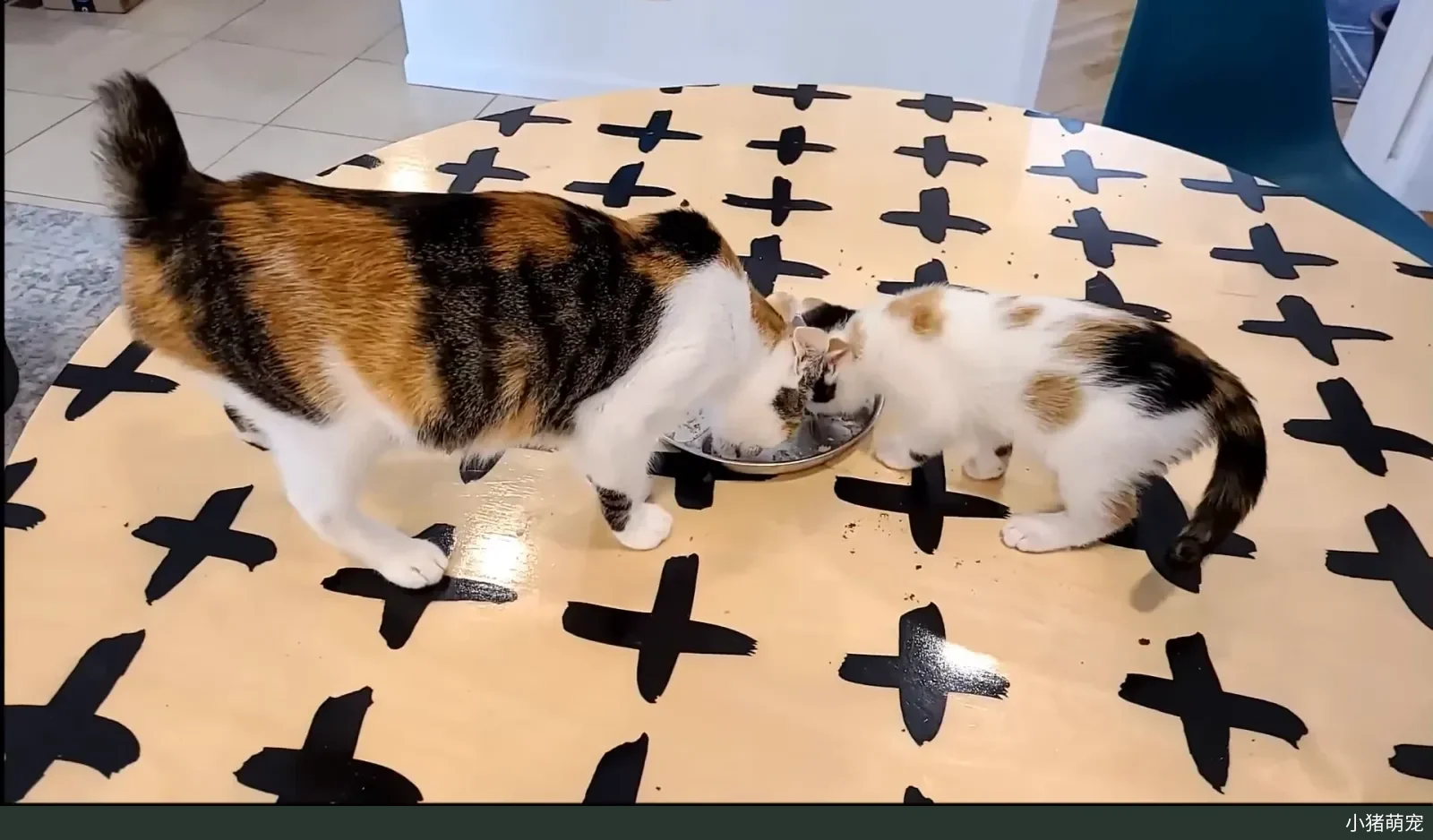
Callie (left) and daughter Holiday (right) eating wet cat food from a plate. Source: Kitten Academy video still via Wikimedia Commons, license CC BY 3.0.
At its August 2026 annual meeting, the Association of American Feed Control Officials (AAFCO) passed revisions to cat-food calcium and phosphorus nutrient profiles: phosphorus not more than 5 grams per 1,000 kcal of metabolizable energy, of which phosphorus from highly soluble phosphates not more than 1 gram, and a calcium-to-phosphorus ratio of at least 1:1. The final position paper released in October then recommends that states give manufacturers the same transition period as for “pet food label modernization.”
From expert review to annual-meeting vote
The revision was three years in the making. Per the background in AAFCO’s position paper, in 2023 its Pet Food Committee (PFC) convened an expert group to review new research on calcium and phosphorus in feline nutrition; the group presented conclusions at the midyear meeting in January 2025. On 26 August 2026, at the annual-meeting business session in San Diego, members voted to adopt the PFC’s proposed cat-food calcium–phosphorus revisions and also adopted the Enforcement Issues Committee (EIC) recommendation on “enforcement discretion.”
AAFCO then posted the final enforcement-discretion position on its website; industry outlet PetfoodIndustry reported on 14 October. According to that report, AAFCO Executive Director Austin Therrell told members and partners by email that implementing the new profiles requires “formula review, nutritional adequacy verification, analytical testing, quality-system updates, and production adjustments,” so AAFCO recommends one shared timeline rather than a separate track. Note that AAFCO is composed of U.S. state feed-control officials; its recommendations depend on state agencies to enforce, and states retain their own judgment.
What the new profiles require and the transition plan
Per the August annual-meeting minutes, the AAFCO Cat Food Nutrient Profiles add three requirements: a total phosphorus ceiling of 5 grams per 1,000 kcal metabolizable energy; of that 5 grams, phosphorus from highly soluble phosphates not more than 1 gram; and a minimum calcium-to-phosphorus ratio of 1:1. “Highly soluble” means phosphorus-containing minerals of which at least 80% dissolves within 1 minute in water; examples listed in the minutes include disodium phosphate, monosodium phosphate, phosphoric acid, sodium hexametaphosphate, sodium tripolyphosphate, trisodium phosphate, and sodium acid pyrophosphate. AAFCO will also add footnotes in the mineral section of feed-ingredient definitions noting combined use of these ingredients in complete cat foods.
“Per 1,000 kcal metabolizable energy” is calculated by energy, not by weight. By analogy: the same bowl of dry food has less moisture and more calories, while wet food has more moisture and fewer calories—comparing by grams is like comparing sugar in a cup of concentrate versus a diluted drink; converting to “how much phosphorus per 1,000 kcal of energy intake” puts dry and wet food on the same ruler.
Cat Remus “helping” while the owner photographed dry cat food. Photo: Anne Jea., source: Wikimedia Commons, license CC BY-SA 4.0.
On the transition, the position paper recommends that states not set a separate calcium–phosphorus timetable, but fold it into the enforcement-discretion period already established for Pet Food Label Modernization (PFLM): during that period, products not yet immediately meeting the new calcium–phosphorus profiles would not face enforcement action, while regulators work with manufacturers on assessment, reformulation, testing, and market entry. Under AAFCO’s 2023 PFLM position, that discretion period is six years, counted from when the print edition of the 2024 Official Publication became available. The new profiles also apply to both old-style labels and PFLM new labels; manufacturers need not change labels early solely for this. For products reformulated only to meet the profiles, AAFCO recommends that states not treat them as new products requiring re-registration and extra fees. The PFC will periodically review analytical methods, lab capacity, ingredient supply, and other implementation issues. AAFCO stresses that the recommendation “should not be construed as delaying implementation of the new nutritional science.”
Research background for limiting highly soluble phosphates
AAFCO’s public rationale for the revision is that the new profiles aim to “better reflect current scientific understanding of feline nutritional needs and health outcomes.” The expert-group report appears in the annual-meeting minutes only as a QR code; we could not obtain the full text, so we cannot list every piece of evidence the group relied on.
Related signals appear in the open literature. A 2019 study in the British Journal of Nutrition ran two long-term feeding trials in healthy adult cats: the first diet had total phosphorus of 4.8 g per 1,000 kcal, about 3.6 g from inorganic monosodium phosphate, with a calcium-to-phosphorus ratio of 0.6, and was stopped early at week 4 because of declining glomerular filtration rate and changed renal ultrasound echogenicity; the second diet had total phosphorus 3.6 g (about 1.5 g inorganic), calcium-to-phosphorus ratio 0.9, and by week 28 mean glomerular filtration rate was unchanged, but 36% of trial cats showed renal echogenicity changes. The authors also note that both groups developed kidney stones, complicating interpretation, and that effects of inorganic phosphorus sources and calcium-to-phosphorus ratio need further study. The work was done under controlled conditions and cannot be read straight onto any specific commercial cat food.
What this means for cat owners
Bottom line first: do not rush to change your cat’s food because of this news alone. The new profiles are formula requirements with a multi-year transition; current foods will not vanish overnight, and the revision itself does not mean any particular product on shelves is defective. AAFCO is a U.S. standards system; cat foods sold elsewhere that do not claim to meet AAFCO nutrient profiles may not be affected by this change.
If your packaging says it meets AAFCO nutrient profiles, the formula may be adjusted over the next few years. To look ahead, you can check whether the ingredient list includes the phosphates named above—but remember: ingredients are listed by amount order without exact levels, so seeing those names does not equal excess. A more direct approach is to ask the maker for total phosphorus per 1,000 kcal metabolizable energy, the share from highly soluble phosphates, and the calcium-to-phosphorus ratio. For senior cats or cats already diagnosed with kidney disease, discuss diet changes with a veterinarian; this revision is for routine complete cat-food nutrient profiles, not a disease treatment plan.
Editorial note on threshold notation
The same AAFCO annual meeting minutes[2] use different boundary symbols in two committee items. The Ingredient Definitions Committee item (page 5) says less than 1 gram per 1,000 kcal ME and more than 80% solubility after one minute; the Pet Food Committee item (page 7) says at most 1 gram and at least 80%. Both motions are recorded as carried. Consult the final applicable text and the relevant state regulator for the exact interpretation.
References
-
AAFCO. AAFCO Position on Enforcement Discretion Related to Feline Calcium and Phosphorus Nutritional Profile Updates (final version, uploaded October 2026). https://www.aafco.org/wp-content/uploads/2026/10/EIC-AAFCO_Enforcement_Discretion_Postion_Related_to_Feline_Ca-P_Changes.pdf
-
AAFCO. 2026 AAFCO Annual Meeting Business Meeting Minutes (26 August 2026). https://www.aafco.org/wp-content/uploads/2026/09/August_2026_Business_Meeting_Minutes.pdf
-
AAFCO. AAFCO Position on Enforcement Discretion Related to Pet Food Label Modernization Changes (2023). https://aafco.org/wp-content/uploads/2023/07/AAFCO-PFLM-Enforcement-Recommendation-Letter-FINAL.pdf
-
Lisa Cleaver. AAFCO aligns feline calcium, phosphorus enforcement with PFLM. PetfoodIndustry, 2026-10-14. https://www.petfoodindustry.com/safety-quality/pet-food-regulations/news/15837431/aafco-aligns-feline-calcium-phosphorus-enforcement-with-pflm
-
Alexander J, et al. Effects of the long-term feeding of diets enriched with inorganic phosphorus on the adult feline kidney and phosphorus metabolism. British Journal of Nutrition, 2019. https://doi.org/10.1017/S0007114518002751