The World Cat Federation (WCF) lists the Mekong Bobtail under the breed code MBT. One way to recognize its pointed coloring is to follow the contrast from the face down to the chest. The face, ears, feet, and tail are darker than the body. In the seated cat pictured below, the darker fur forms stripes across the forehead and cheeks, just above the pale neck and chest. This tabby pattern is one of several possibilities. The WCF accepts all point colors without white markings. It also describes large, oval eyes of an intense blue, set almost level with each other. [1]
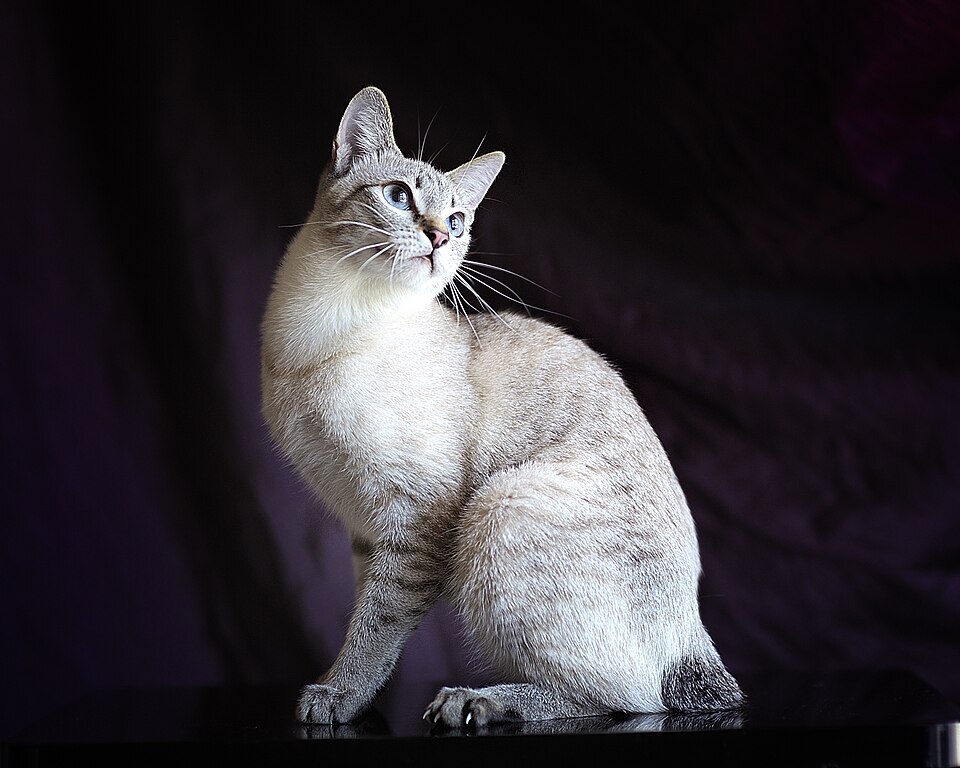
Figure: Tabby markings on the face. Alex Opryatin, Wikimedia Commons[5]

The second cat is looking up, giving a good view of the gently rounded head and the large ears. Each ear sits high, broad at the base and slightly rounded at the tip, with the opening turned a little to the side. To see the outline of the body, wait until the cat lowers its head and walks past. The WCF describes a medium-sized, muscular cat with a slender, rectangular body. Seen from the side, the back is nearly straight and the rump sits a little higher than the shoulders. The legs are slim and of medium length, and the paws are oval. [1]
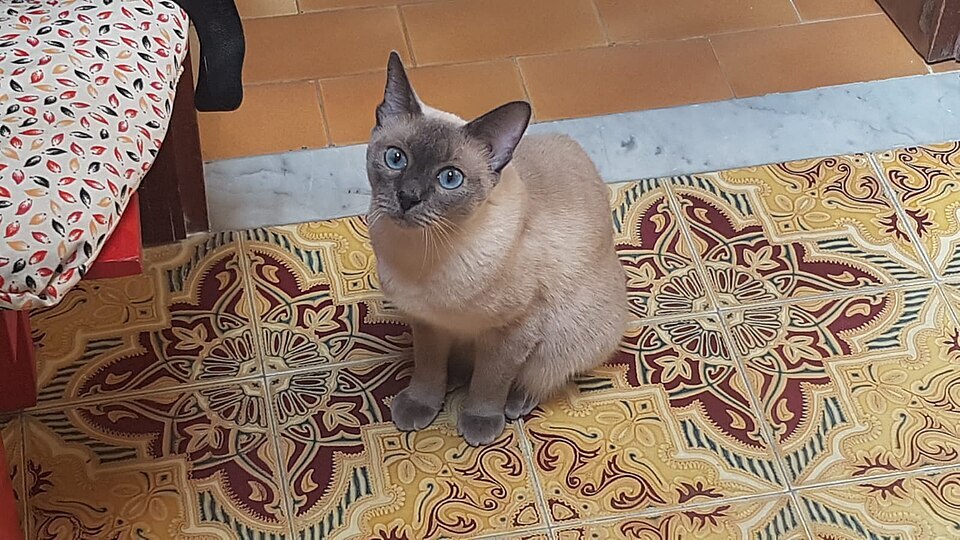
Figure: Ear shape of the Mekong Bobtail. Shirto, Wikimedia Commons[6]

The short tail can have kinks, curves, or a combination of the two, beginning at the base. The WCF standard specifies at least three tail vertebrae and a tail no longer than a quarter of the body length. That leaves room for quite different tail shapes in two cats of the same breed. In the third photograph, the kitten leans forward and lifts its tail, making its length easy to see against the body. At home, let the cat carry its tail naturally. Avoid pressing along it to locate the joints or pulling a bend straight to measure it. [1]
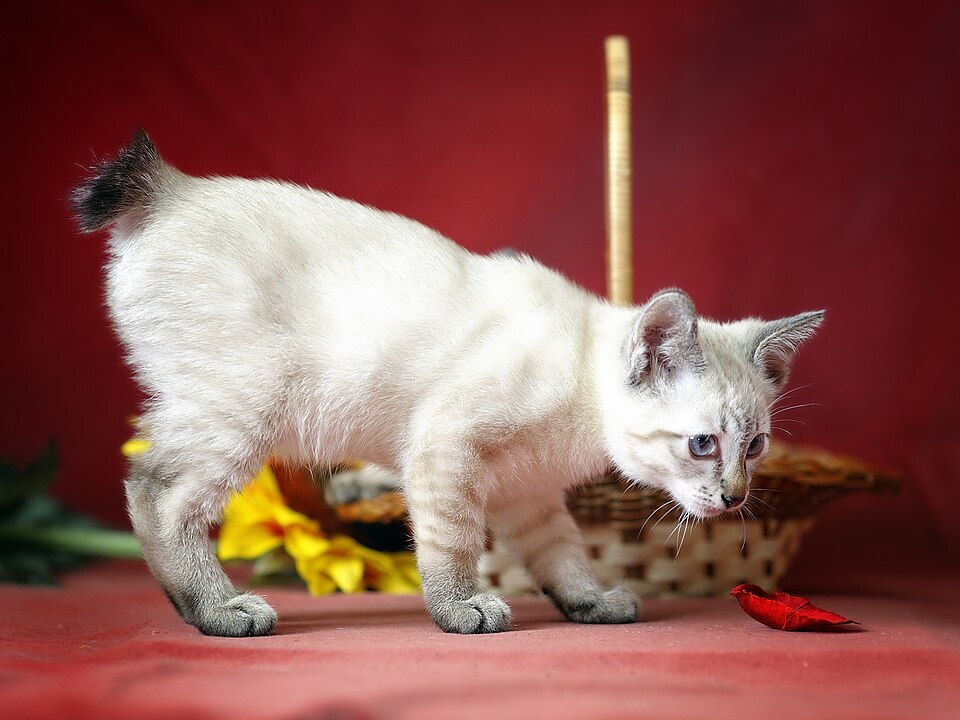
Figure: The kitten’s raised tail. Alex Opryatin, Wikimedia Commons[7]

As you get to know your cat, watch how it moves through a familiar room. Getting up from a nap, rounding a table leg, and stopping at the water bowl give you a chance to see its usual stride and turns. If it likes a cushion by the window, notice where it jumps from and how it gets down. Let it choose those movements without coaxing it higher with a toy or putting it back to repeat a jump. Once you know its favorite routes, an empty chair can be a clue that it has quietly given up an activity it used to enjoy. [4]
The Mekong Bobtail has a short, glossy coat that lies close to the body, with very little undercoat. The WCF describes the texture as silky with a slight crispness. Choose a comb suited to short fur and start somewhere your cat already enjoys being touched. When it is sitting or standing comfortably, try a few gentle strokes around the head or neck, then pause. Short sessions give it time to get used to grooming. Many cats are more sensitive around the hind legs, belly, and underside of the tail. If yours turns away, let it leave and try again another time. [1][2]
When setting up a room, look at it from the cat’s height. Can it walk quietly from its bed to water or a litter box? When someone passes, is there somewhere it can slip out of sight and emerge again on its own? The Feline Veterinary Medical Association includes both a sense of safety and opportunities for ordinary feline behavior in its guidance for indoor cats. A sturdy cardboard box on its side offers cover. For a cat that likes watching outdoors, a stable window perch with a clear route up and down gives it another place to spend a quiet afternoon. [3]
In a home with several cats, watch whether each one can reach what it needs. Several bowls at the far end of a narrow passage may all be out of reach for a cat that waits at the doorway whenever its housemate settles in the entrance. Try placing a bowl in another room, then watch whether the waiting cat takes that route on its own. The same principle applies to resting places and litter boxes. The layout that works will depend on the paths through your home and how much room the cats give each other when they pass. [3]
During play, draw a wand toy away from the cat, close to the ground. That gives it room to watch, stalk, crouch, and pounce. If it pauses to watch, give it a moment without bringing the toy up to its face. You can offer the same choice when your cat comes over for company. Stroke a spot it usually enjoys, lift your hand, and see whether it comes back for more. A familiar greeting from family members helps it anticipate what happens next. Its response will tell you whether it wants to chase, sit nearby, or head back to bed. [3]
Contact your veterinarian promptly if getting up becomes difficult, your cat repeatedly hesitates at a familiar step, or a touch it once enjoyed now makes it flinch or cry out. Mention other changes you have noticed, such as eating less, hiding more, grooming less, or a change in urination or bowel movements. When you call, say when the change began and describe the movement itself. A cat that used to jump straight onto a chair may now walk up to the seat and stop. That detail helps the veterinarian decide what to examine, and you can describe it without asking your cat to repeat an uncomfortable movement. [4]
References
-
[1] World Cat Federation. Mekong Bobtail (MBT). January 1, 2010.
-
[2] Debra Givin. Grooming Tips. Cat Friendly Homes.
-
[3] Feline Veterinary Medical Association. New Feline Veterinary Medical Association Position Statement Reimagines Life for Indoor Cats. August 28, 2025.
-
[4] Cat Friendly Homes. How Do I Know If My Cat Is In Pain?.