In the grass, an Irish Setter named Giulla O’Conloch stands facing right, muzzle extended, tail held level. The photographer tells us what caught the dog’s attention: a pheasant. That moment of stillness is a good place to start with this breed. Irish Setters once covered open ground at speed, using their noses to locate game birds. On finding a bird, a setter would stop or crouch low to signal its position to the hunter. The work called for a dog that could range widely, pick up a scent, and hold still while a person caught up.[1][2]

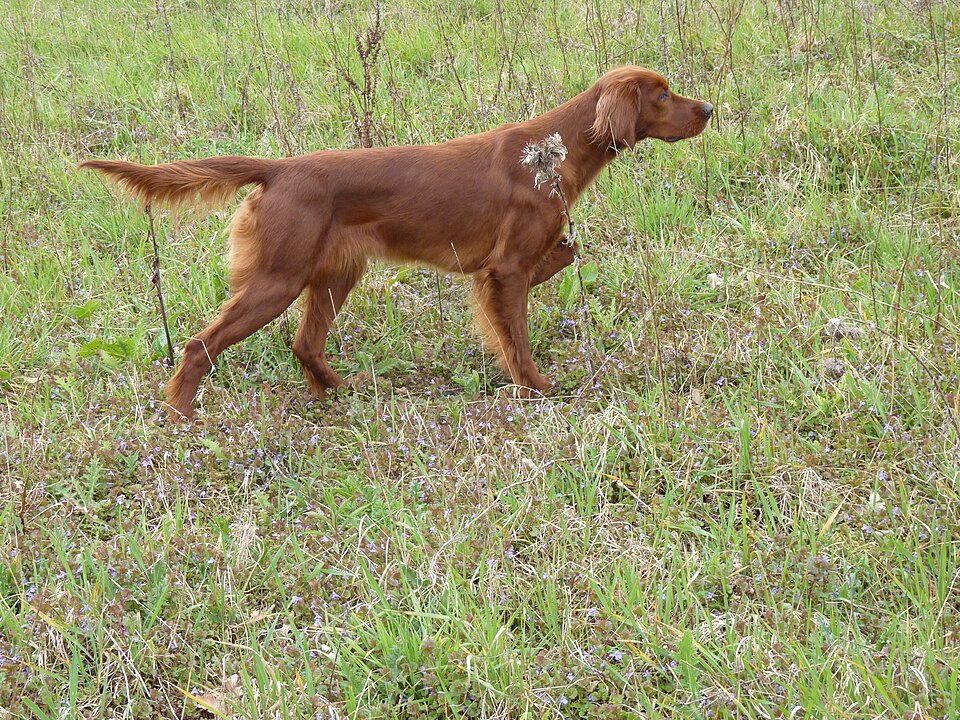
Giulla O’Conloch points a pheasant. Henktenklooster, Wikimedia Commons[2]
Nineteenth-century Irish hunters wanted a dog with the stride to cover flat, open country. You can still see that build in a side view. The chest reaches about to the elbows, the forelegs are long and straight, and the back slopes gently toward the base of the tail above powerful hind legs. Look more closely at the head and you can see a long muzzle, clean contours beneath brown eyes, and low-set ears hanging close to the cheeks. The coat ranges from chestnut to deep mahogany. On the face, the hair is short and fine enough to show the outlines of the eyes, the bridge of the nose, and the folds of the ears.[1][3]

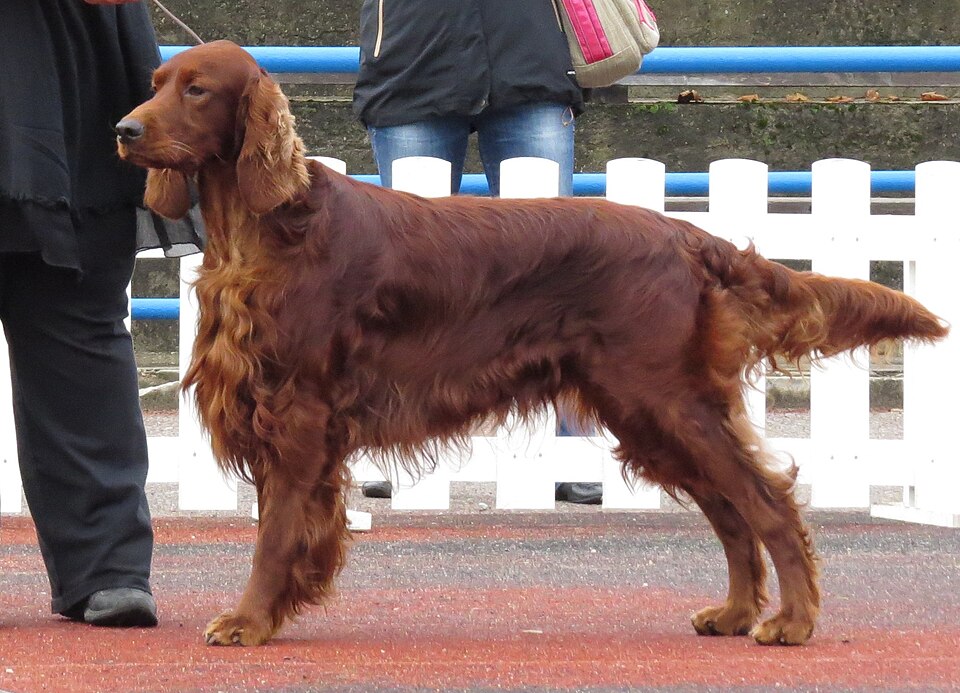
An Irish Setter stands in profile. Томасина, Wikimedia Commons[3]
Where can your setter stop to sniff?
Think of a route you could walk most days. Where is there a stretch long enough for both of you to settle into a stride? Is there a grassy edge away from traffic where dogs are welcome? Slow down there and let your setter choose a scent within reach of the leash. If the dog doubles back along the grass, give it time to investigate. The American Kennel Club (AKC) recommends long daily walks and games with the family. It also suggests tracking as an activity that puts the setter’s nose to work.[1]
Before bringing a setter home, try fitting that walk into your family’s busiest weekday. If the morning allows for only a quick toilet break, who can take the longer outing? Count the time it takes to reach the grass, let the dog explore, and walk home again. A yard gives you another place to play. You might hide a toy there for the dog to find and still have a familiar route for walks together. Irish Setters generally enjoy company. Opening the back door gives the dog access to the yard. Stepping outside and joining the game gives it company, too.[1]
If you’re getting to know a particular setter, ask to join the person who usually walks the dog. Notice where the dog likes to stride out, where it slows down, and which cue gets it moving with its companion again. Ask how far they usually go, what games the dog enjoys, and how it settles down afterward. Picture that walk alongside your commute, school pickups, or shift schedule. Those details tell you more about how this dog would fit into your life than a mileage target for the whole breed.
Practice moving on together
A walk with time to sniff goes more smoothly when the dog knows the cue to move on. Start somewhere quiet. Let your setter investigate a small patch of ground. When the dog looks up at you, say “Let’s go,” take a few steps, and reward the dog as soon as it follows. At the next suitable patch of grass, give it time to sniff again. Coming along with you now leads to another scent worth exploring. Once the routine is familiar, try it on a stretch with a little more going on. Have everyone use the same cue and keep practice short and playful, with just a few repetitions at a time.[1]
Irish Setters tend to be outgoing, playful dogs, ready to join in when someone invites them. A child can help by placing a familiar toy somewhere easy to find, with an adult supervising. The child sets the puzzle, the adult holds the leash and sets the pace, and everyone gets to celebrate when the dog finds the toy. For a family that enjoys classes, puppy socialization and reward-based training offer a starting point. Tracking or agility can come later if the dog takes to it. The activity that lasts is often the one someone in the family looks forward to as much as the dog does.[1]
Where should you brush after a walk through grass?
In the side view below, the red coat lies fairly close along the back. Longer hair, called feathering, hangs from the chest, belly, backs of the legs, and underside of the tail. The ears carry silky feathering, too. After a walk through grass, use your fingers to part those fringes in the direction they hang and pick out any bits of grass caught inside. Remember the backs of the legs. From the front, the smooth hair on the forelegs can hide the long strands just behind them.[1][4]

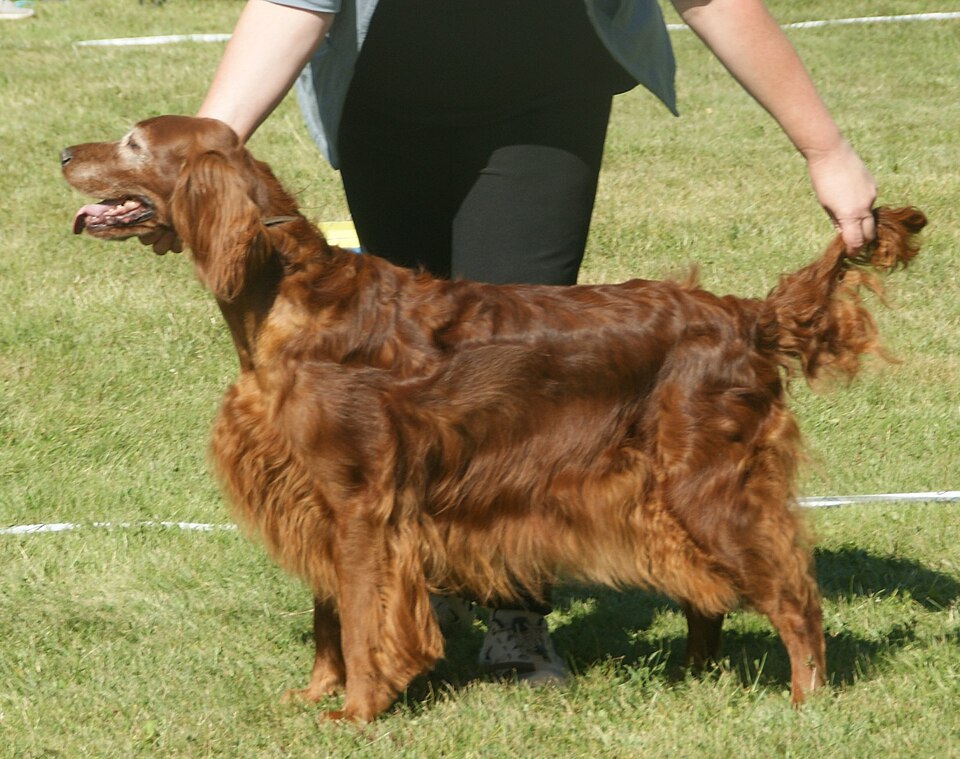
A side view shows the Irish Setter’s feathering. Canarian, Wikimedia Commons[4]
Make room for brushing in the weekly routine. The AKC recommends brushing at least twice a week. Use a pin brush or a soft-bristled brush to smooth the coat, then gently work through any small tangles with a long-toothed metal comb. As you reach each ear, lift the flap and look for anything unusual. Parting the hair on the chest and backs of the legs also gives you a chance to spot new lumps or changes in the skin. Brush the teeth regularly with dog toothpaste and trim the nails about once a month. Along with someone who enjoys the walk, the dog needs someone willing to sit down afterward and do this quieter work.[1]
Plan outings around meals. The Irish Setter’s deep chest puts the breed at risk of bloat, in which the stomach expands and may twist, a condition called gastric dilatation-volvulus. Divide the day’s food into several smaller meals and schedule vigorous exercise away from mealtimes. If your dog repeatedly tries to vomit but brings nothing up, or its belly suddenly swells, call an emergency veterinarian and take the dog in immediately. The dog may also seem restless or drool. The condition can progress quickly, even on a day when meals and exercise have followed the usual routine.[1][5]
If you’re asking a breeder about a puppy, ask to see both parents’ hip and thyroid evaluations and their DNA test results for a form of progressive retinal atrophy called PRA-rcd1. These records help you understand inherited risks. Once the dog comes home, the person who takes the daily walk will get to know its usual stride and enthusiasm. If a setter that normally looks forward to the grassy stretch stays listless, or its appetite changes noticeably, tell your veterinarian when the change began and how the dog’s behavior differs from its usual routine. That familiar walk gives you a chance to learn what’s normal for the dog beside you.[1]
References
-
[1] American Kennel Club. Irish Setter Dog Breed Information.
-
[2] Henktenklooster. File:Irishsetteronpoint.JPG. Wikimedia Commons, 2010.
-
[3] Томасина. File:Irish Setter in Tallinn 2.JPG. Wikimedia Commons, 2013.
-
[4] Canarian. File:IrishRedSetter4.jpg. Wikimedia Commons.
-
[5] American College of Veterinary Surgeons. Gastric Dilatation-Volvulus.