The “pointer” in German Shorthaired Pointer describes a moment in a bird hunt. The dog catches a bird’s scent in a field and stands still, showing the hunter where to look. When it is time to retrieve, the dog is on the move again, searching through grass or water and carrying the bird back. German hunters in the 19th century bred these dogs for their ability to do all three jobs. There is a rhythm here that still works on a walk. Give the dog a stretch where it can lengthen its stride, with chances along the way to pause and turn its attention back to you.[1]
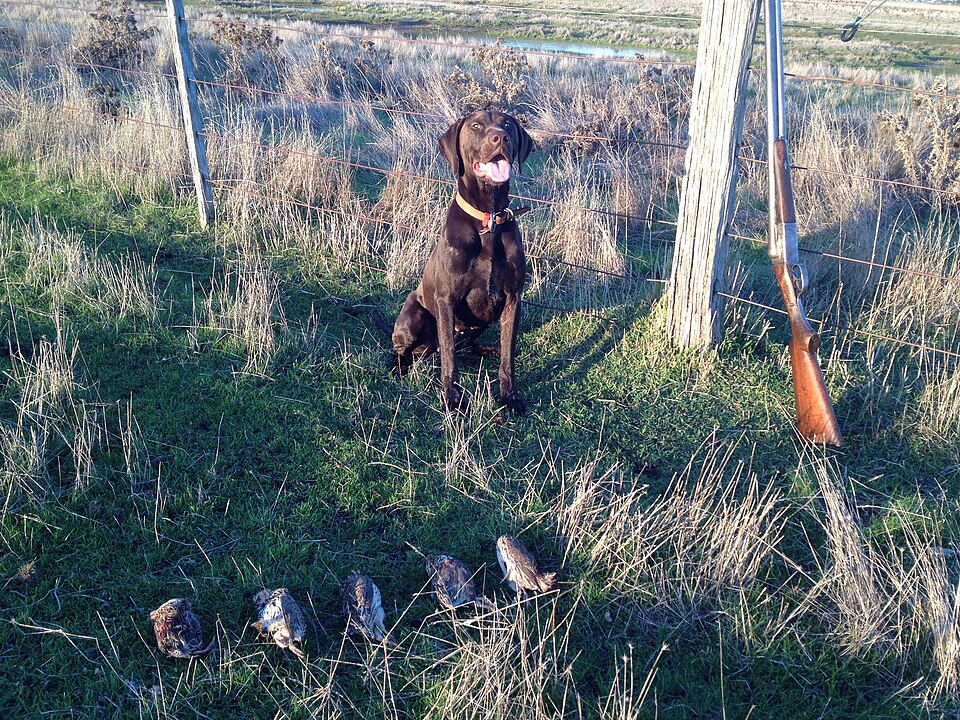
A German Shorthaired Pointer sits in the field. Cavalryman, Wikimedia Commons[3]

Seen from the side, the chest reaches down to the elbows and the back is relatively short. The neck is muscular, and the broad ears hang close to the cheeks. An adult male stands about 58–64 cm at the shoulder and weighs about 25–32 kg. Females are usually a little smaller.[1] In the show photograph, Kappahegyi Furia’s dark, close coat makes it easy to trace the shoulder, the depth of the chest, and the rising line of the belly. The dog pictured later in the snow has a different pattern, with fine speckles between large dark patches. When identifying the breed, look first at the dog’s build, then at the texture and markings of the coat.
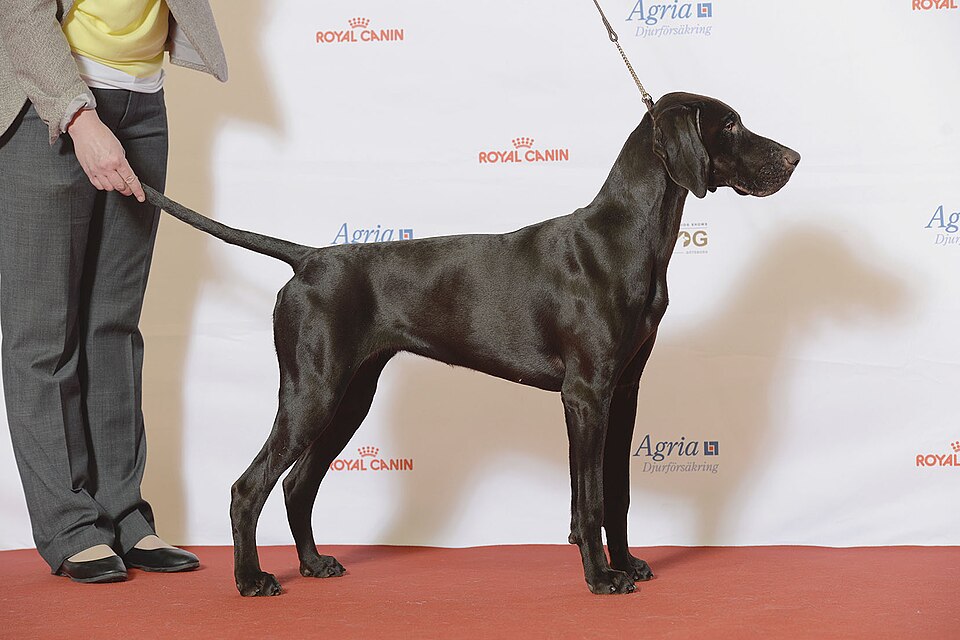
Kappahegyi Furia stands in profile. Svenska Mässan, Wikimedia Commons[4]

Fitting two outings into a workday
The American Kennel Club (AKC) gives a concrete example of daily exercise for the breed. A brisk walk of about half an hour in the morning and another in the evening is one option. Running and playing in a securely fenced area is another.[1] Try penciling those outings into your household’s busiest workday. Where can you walk before work, and when would you need to turn for home? Who can take the evening outing, and will the space still be usable after dark? Count the time it takes to get there. Once both outings have a place in the weekday schedule, a weekend hike can be an extra pleasure.
For the morning walk, choose a route where you and the dog can settle into a comfortable stride. Allow time for a toilet break and some sniffing, then pick up the pace on a quieter stretch. If a patch of grass catches the dog’s interest, use it to practice coming back to you. Call while the leash is still slack. When the dog turns and comes toward you, offer a small reward and walk on together. The grass itself can be the reward, too. Once the dog responds, walk back together and let it sniff for a while. That turn toward you is a skill you can use at the next crossing.[1]
Try a different game in the evening. Take a familiar toy to a fenced space where you can see the gates and check that they are closed. Ask the dog to wait beside you while you place the toy in short grass, then give the cue to go and find it. On the first turn, let the dog see where the toy lands. On the next, change only the spot. When the dog brings the toy back, take it and pause before deciding whether to play again. Watch which part holds the dog’s interest. One dog may love the run out and back, while another spends longer searching with its nose down. Next time, give the dog more time for the part it wants to repeat with you.[1]
German Shorthaired Pointers have a strong instinct to chase. A bird taking flight can draw a dog a long way from you. Keep the leash on in open green spaces and save off-leash runs for places with a secure fence.[1] Even with a yard at home, it is worth asking who will pick up the toy and go outside before dinner. A yard gives the dog somewhere to run. Learning to wait, go on cue, and come back takes someone out there to practice with.
Teaching recall before the chase begins
Start in a quiet spot when the puppy comes home. Two family members can stand a few steps apart and take turns calling. Each time the puppy reaches the person who called, it gets a reward. Once the cue is familiar, try it in an enclosed outdoor space, again starting just a few steps apart. With new scents all around, even that short distance can be hard. Move closer so the puppy has a good chance of succeeding. For a young puppy, exploring a new place at ease and coming when called a few times can be enough for one outing. Adjust the length and intensity of exercise to the dog’s age, fitness, and health.[1]
The AKC singles out the period from about six months to three years as a particularly demanding time. These dogs can learn cues quickly. They are equally quick to find something to do on their own, which can mean chewing up household belongings when left alone with little to occupy them.[1] If several people share the walks, take one outing together so everyone gets a turn handling the leash, calling the dog, and rewarding its return. At handover, tell the next walker where the dog could still respond to a call and how close you got to the birds before it fixed its gaze on them. Those details help the next person choose a route.
Brushing the short coat after a walk
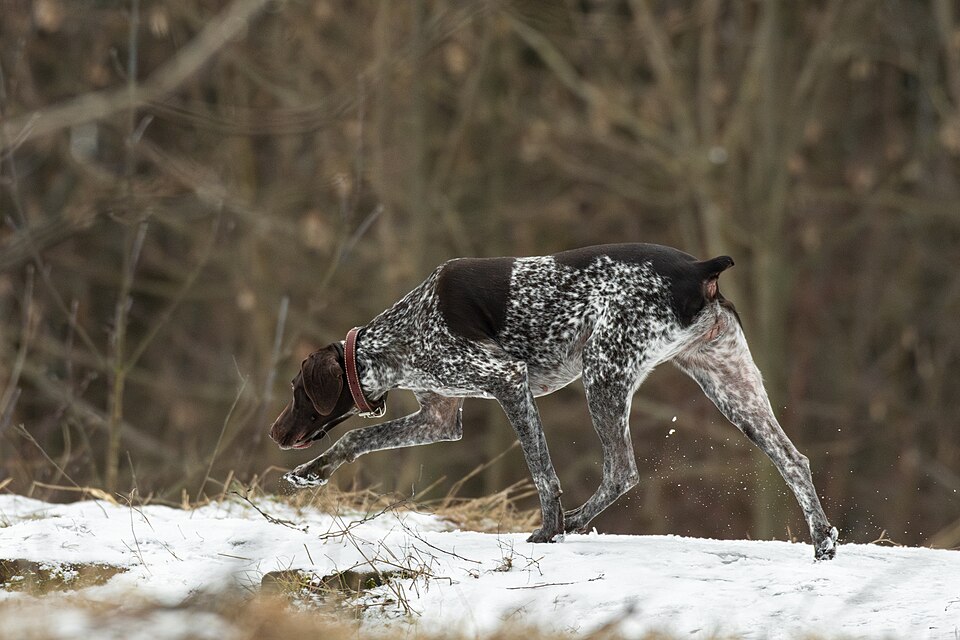
The snow sets off the pointer’s speckled coat. Горбунова М.С., Wikimedia Commons[5]

The close coat has one practical drawback. Loose, short hairs work their way into upholstery and carpets and can be hard to remove. Go over the whole coat with a brush or grooming glove every few days, and brush more often when shedding picks up. Keep the glove by the leash so it is handy when you return from a walk and the dog is standing quietly. Use a mild dog shampoo when a bath is needed. Lift the broad ear flaps regularly to check underneath, clean the ears as needed, and keep the nails trimmed.[1]
Before bringing a puppy home, ask the breeder which health screenings each parent has had. The AKC breed profile lists hip, elbow, heart, and eye evaluations, along with a DNA test for cone degeneration. Ask the breeder to match each report to the parent it belongs to and explain the result. As your own dog grows, its condition will guide its exercise routine and veterinary checkups.[1]
Leave room in the evening for meals and rest. The AKC advises letting the dog rest after vigorous exercise before serving dinner, then keeping running and strenuous play off the schedule for at least an hour after the meal.[1] Everyone at home should also recognize signs that call for emergency care. A dog may repeatedly try to vomit without bringing anything up, or its belly may suddenly swell. It may drool or keep looking anxiously at its abdomen. These can be signs that the stomach has expanded and may have twisted. Call an emergency veterinary clinic and go there immediately, even if the belly has yet to swell visibly.[2] To judge whether this breed fits your household, picture the whole day, from the person who picks up the leash in the morning to the one who puts away the food bowl at night.
References
-
[1] American Kennel Club. German Shorthaired Pointer Dog Breed Information.
-
[2] American College of Veterinary Surgeons. Gastric Dilatation-Volvulus.
-
File:BIR Grupp 7- KORTHÅRIG VORSTEH, Kappahegyi Furia (24271901285).jpg