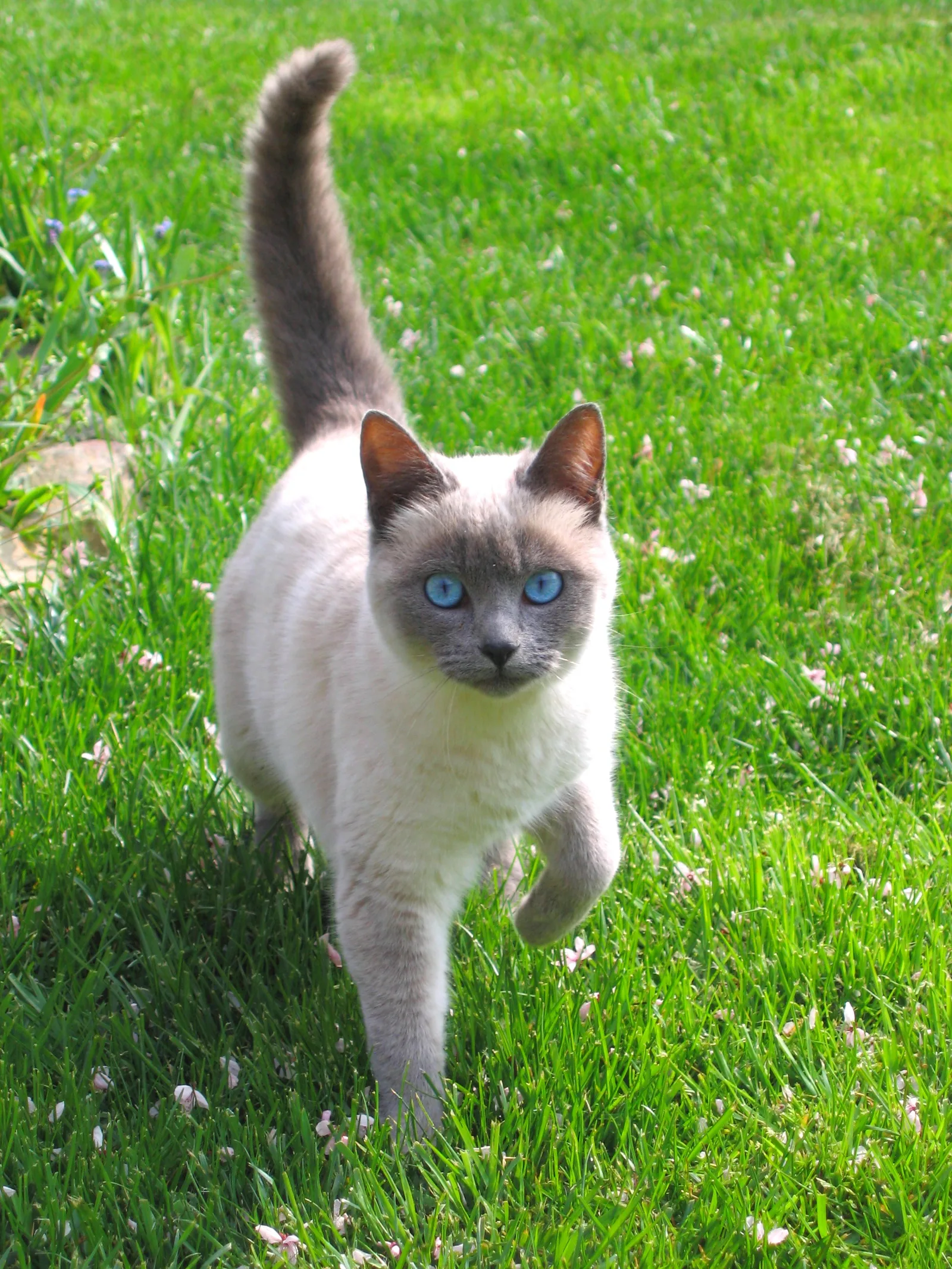
A pointed Siamese walking on grass. Photo: Dorothée Taverne (2009-03-22), CC BY-SA 3.0, source: Wikimedia Commons.

A classic Oriental breed with centuries of history, the Siamese is widely loved for its elegant, elongated build, vivid points, and deep sapphire-blue eyes. Warm and expressive, they communicate with a rich voice and are often ranked by The Cat Fanciers’ Association (CFA) among the most intelligent breeds. This article covers breed origin, appearance standards, temperament and care, and genetic health points for families keeping Siamese cats.
Ancient Siam: history and the path to the wider world
Siamese history reaches back to Thailand’s Ayutthaya period (1350–1767). CFA records that a historic Thai cat-poem manuscript of that era already describes pale-bodied cats with dark extremities; The International Cat Association (TICA) calls the same manuscript the Cat Book Poems and dates it to 1350. In the later nineteenth century the breed entered Western view. In Europe, TICA notes a formal debut at the 1871 Crystal Palace cat show in London; CFA materials also place the breed in Crystal Palace show records of that period. On arrival in the United States the two associations differ slightly: CFA says that in 1878 the U.S. consul in Bangkok presented a cat named “Siam” to President Hayes; TICA records the gift to Mrs. Hayes in 1879.
In modern pedigreed breeding the Siamese is foundational. When CFA was founded in 1906 it listed the breed among its first recognized breeds, and in 1907 the first Best in Show Siamese appeared. For decades only seal point was formally accepted; as genetics and breeding advanced, blue point was recognized in 1934, chocolate point in 1952, and lilac point in 1955.
A tubular Oriental silhouette and a cool-to-warm mask aesthetic
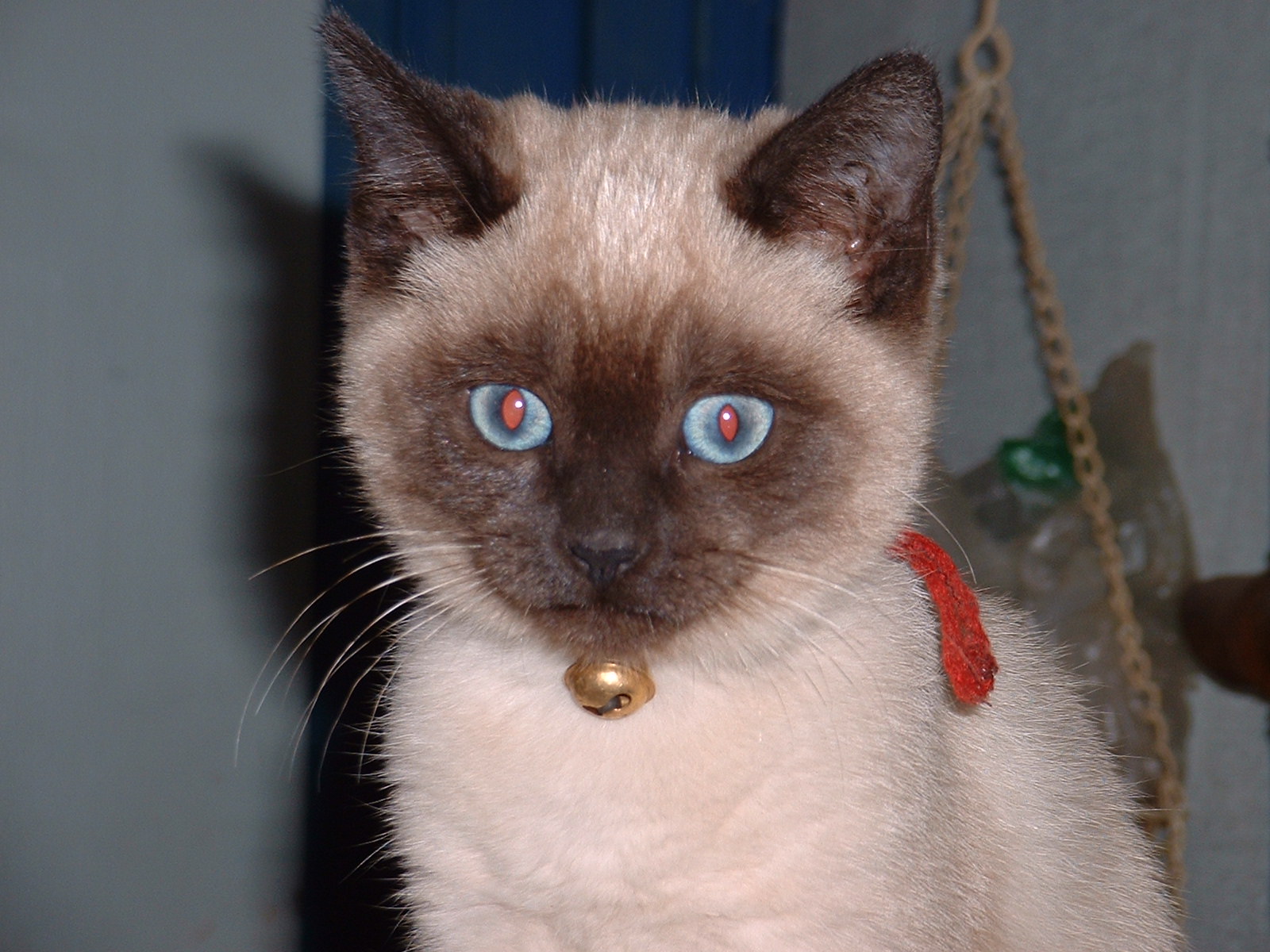
Close-up of a seal-point Siamese. Photo: Achileos (2007-09-15), CC BY-SA 3.0 / GFDL, source: Wikimedia Commons.

Modern show Siamese show a sharply Oriental outline: medium size, fine bone with firm muscle, and a long, tubular line overall. The head is a refined wedge that flows smoothly from the nose tip to the tips of large, flared ears; ear bases are broad and set upright on the sides of the head; almond-shaped eyes slant slightly toward the nose and glow a deep, vivid sapphire blue. Per the TICA breed standard, adult queens typically weigh 5–8 lb (about 2.3–3.6 kg) and adult males 8–12 lb (about 3.6–5.4 kg).
The coat is short, fine, glossy, and close-lying. Signature points cover the mask, ears, legs, and tail—deep in color and clearly defined against a lighter body. Under CFA standards the body usually darkens with age, but a clear contrast between body and points must remain. Associations differ on which points are allowed: CFA recognizes only the four traditional colors—seal, blue, chocolate, and lilac—while TICA also accepts cinnamon, fawn, red, cream, lynx point, tortie point, and white spotting among other variants.
Affectionate, talkative temperament and everyday care
Siamese cats have a strong social drive and a need to express emotion. CFA describes them as extremely communicative and among the smartest cats; they talk often with varied, loud, rising-and-falling calls—true “chatty cats.” They love joining family life and will seek laps and close company. TICA notes they dislike long stretches alone and may pout and pine without companionship and attention.
Short coats are relatively easy to maintain, though normal seasonal shedding still occurs. CFA’s care tip: during daily handling, stroke the cat with damp hands with the lie of the coat until the hands dry—this lifts loose hair. TICA also suggests regular combing; many cats link grooming with attention. Energetic and athletic jumpers, they need tall cat trees, wand toys, and similar outlets for exploration and activity.
Lifespan expectations, anesthesia caution, and genetic health screening
Siamese are generally lean and long-lived, commonly living well past 10 years; TICA records many individuals reaching 20 years or more with careful care. TICA breed materials specifically note possible greater sensitivity to anesthetic drugs, so owners should flag that trait before spay/neuter, dental work, or other surgery.
On hereditary eye disease, Siamese carry risk for progressive retinal atrophy (PRA-rdAc). UC Davis Veterinary Genetics Laboratory (VGL) links the condition to a CEP290 mutation, an autosomal recessive trait. Vision is usually normal at birth; electroretinography (ERG) can detect photoreceptor dysfunction around 7 months of age, and most affected cats progress to complete blindness between 3 and 5 years. VGL data put the allele frequency of the causative mutation in Siamese at about 33% (carrier frequency, not disease prevalence). DNA testing can classify cats as clear (N/N), heterozygous carriers (N/rdAc), or homozygous affected (rdAc/rdAc), guiding breeding and home care.
Amyloidosis also needs attention. CFA notes that amyloidosis can cause liver problems, that related genes are still under study, and that buyers should ask breeders about family history. TICA likewise notes breed sensitivity but no available test yet.