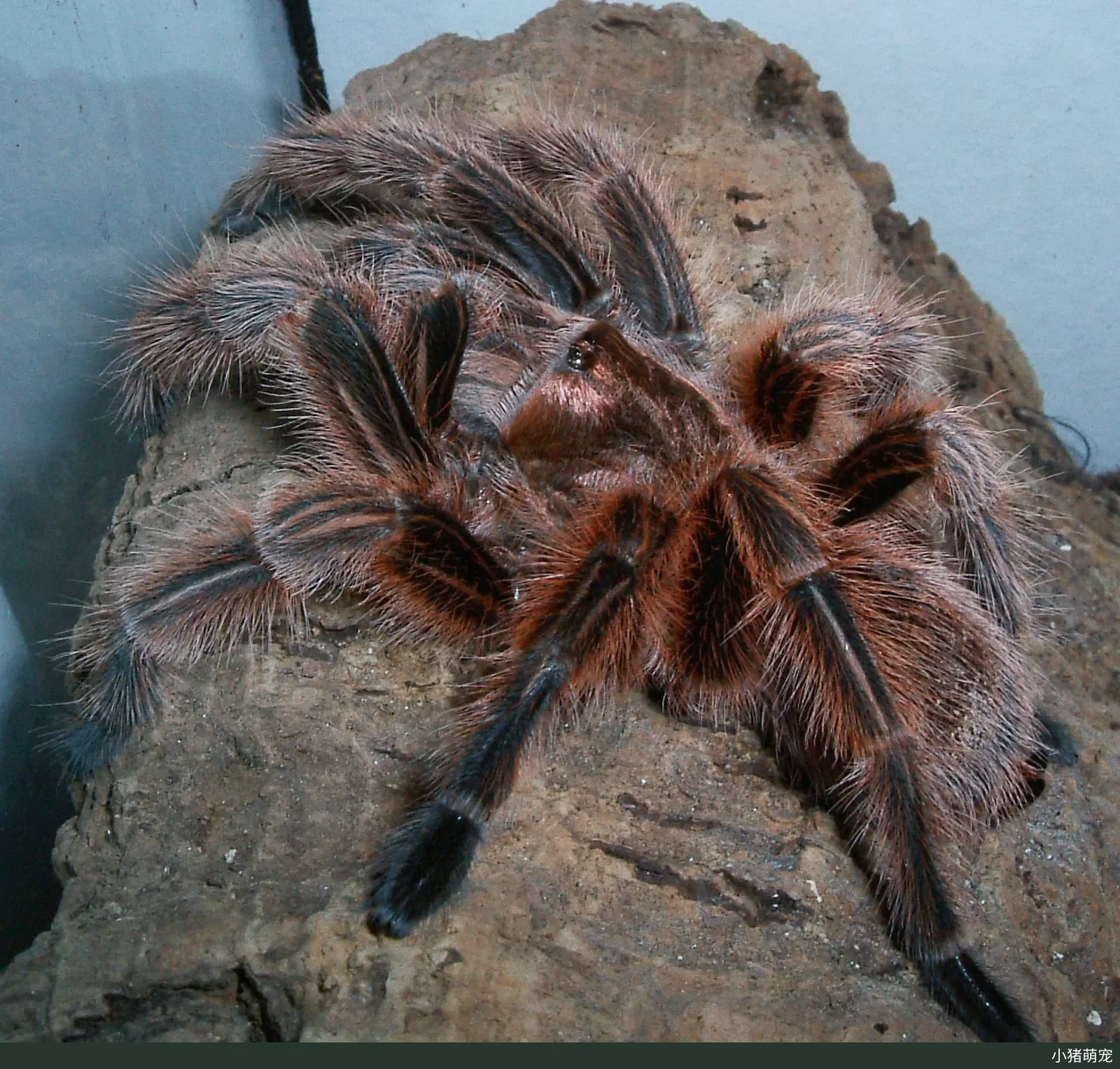
An adult female Chilean rose tarantula. Photo: Viki; EXIF shows photographed 8 September 2003; source: Wikimedia Commons; license: CC BY-SA 3.0.

The Chilean rose tarantula (Grammostola rosea) is native to Chile and also Argentina and Bolivia. It is a terrestrial tarantula often treated as an entry-level exotic pet because of its generally mild temperament. From 5 March 2026 it is listed on CITES Appendix II, so international trade requires permits. This article covers wild habits, housing, diet, and common health issues, plus legal and ethical points to clarify before keeping one in China.
Natural habits and range
First, the name. The World Spider Catalog lists Grammostola rosea as a valid species ranging in Bolivia, Chile, and Argentina. The “G. porteri” often heard in the pet trade is, after Aguilera, Montenegro, and Casanueva’s 2022 taxonomic revision, treated as a junior synonym of G. rosea—so “rosea” and “porteri,” long treated as two kinds, are the same species in taxonomy. The Chinese edition of the new CITES Appendices uses the name “智利红玫瑰蛛” (Chilean rose spider).
In the wild it lives in lowlands from 0–1500 m elevation, with a fragmented distribution from near Vallenar in Chile’s Atacama Region (about 28.5°S) south to Angol in the Biobío Region (about 37.8°S). Species materials from Chile’s Ministry of the Environment note that it mainly occurs in sclerophyllous forest and habitats dotted with espino (Acacia caven) scrub. A 2019 field study in Ecology and Evolution observed that females dig burrows up to about 40 cm deep, usually a straight tunnel with a chamber at the bottom and sometimes a second chamber about two-thirds of the way down, the entrance often covered with silk; males also live in ground burrows or under large rocks. Researchers recorded more mature male activity from September through March (southern-hemisphere spring and summer) and inferred that as the reproductive activity period.
Adult females reach a maximum leg span of about 14–15 cm; males are slightly smaller but have relatively longer legs and a smaller abdomen; mature males have tibial spurs on the first pair of legs and a bulb at the end of the pedipalp—clues for sexing. In the wild it mainly eats other arthropods and may also take conspecifics. It is solitary and mostly nocturnal. On lifespan, University of Kentucky Department of Entomology materials say females may live more than 15 years, males at most 4–5 years—keeping a female often means more than a decade of companionship.
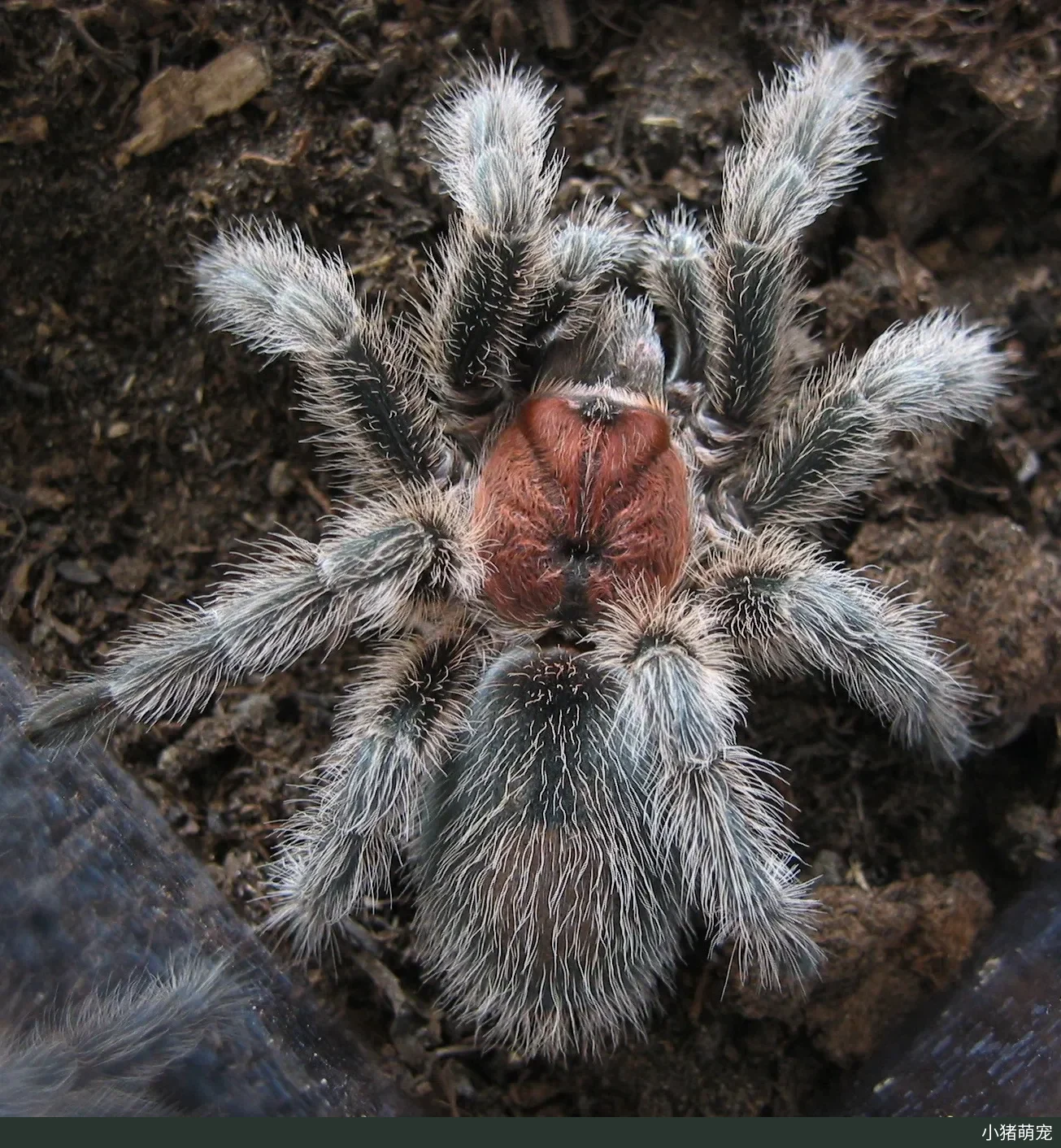
A subadult Chilean rose tarantula; the original page notes it was about 6 years old. Photo: Rollopack; EXIF shows photographed 8 April 2008; source: Wikimedia Commons; license: CC BY-SA 3.0.

Housing and diet
Enclosure rules are “low, stable, escape-proof, one spider per box.” Care sheets from the Royal Veterinary College (RVC) Beaumont Sainsbury Animal Hospital remind keepers that tarantulas must be housed alone to avoid cannibalism; for terrestrial species, enclosure height is best kept about equal to body length, because a spider that climbs high and then falls can be injured—veterinary reviews also note that falls can even be fatal for large, heavy individuals. Lids must be secure: the University of Illinois College of Veterinary Medicine recommends lockable lids against escape; RVC notes that mesh tops can catch claws and prefers glass or plastic enclosures (with ventilation holes). Provide a hide, such as a half flowerpot on its side; substrate can be fertilizer- and pesticide-free coconut fiber or potting soil, kept mostly dry. Avoid rocks, cactus, and other décor that could injure the spider.
On temperature, client materials from a U.S. exotic pet hospital give 21–26°C—typical room temperature is often enough; RVC stresses that avoiding large swings matters more than a precise number, recommends a min–max thermometer, and prefers warming the room in winter over heating pads or heat lamps on the enclosure, which can dry out substrate and spider alike. Humidity guidance varies slightly: the exotic hospital groups Grammostola, including the Chilean rose, as arid/grassland types at about 50%–60%; RVC gives 60%–65% for most common species. What they share: mostly dry substrate, good ventilation, and a shallow water dish always present. The dish must be shallow—Illinois veterinarians warn that deep dishes can drown spiders; RVC suggests changing water at least twice a week, and whenever soiled, and not replacing the dish with wet cotton or sponge, which readily grow bacteria.
Diet is live prey only. Veterinary sources recommend captive-bred crickets, dubia roaches, locusts, and similar insects, and advise against wild-caught insects; prey should be no larger than the spider’s abdomen length. Frequency guidance: spiderlings and juveniles about three times a week; subadults and adults every 7–14 days. Remove uneaten prey within 24 hours, and remove it at once if a molt seems imminent—hungry crickets may bite the spider, so do not dump in a pile for convenience. RVC does not recommend feeding pinkie mice or other vertebrate meat, which can lead to obesity and other problems; mealworms are low in nutrition and burrow into substrate, so they are generally not recommended. Refusing food for a period before molt is normal; after molt, wait until the new fangs harden before feeding—usually 7–14 days for adults.
Common health problems
The first time you see your spider lying on its back, many people think it is dead—most often it is molting. Illinois veterinarians warn: do not move it then. But molt is also when problems are most likely: a 2023 tarantula medicine review in the UK veterinary journal In Practice notes that abnormal molts are among the most common tarantula problems—failure to start, partial retained exuvia, and complete failure to emerge. Normal molts range from about an hour in spiderlings to 12 hours in large adults; the author considers adult molts lasting more than 3–6 hours an emergency needing close watch and, if needed, veterinary intervention. Dehydration, poor nutrition, wrong humidity, stress, and trauma can all contribute; trying to “help” peel the old skin yourself readily tears legs and causes heavy blood loss.
Another common problem is oral nematode infection. The same review describes pathogens usually suspected to belong to the family Panagrolaimidae, with anorexia, progressive lethargy, abnormal posture, characteristic white discharge around the mouthparts, and possible secondary bacterial infection and tissue necrosis; until the nematode’s life cycle is clear, the author does not rule out zoonotic potential. Illinois veterinarians note that veterinarians can remove nematodes under anesthesia, sometimes needing multiple treatments, and that captive-hatched individuals are less often affected.
Also watch for dehydration and falls. Exotic hospital materials list dehydration signs including a shriveled abdomen, lethargy, and legs curled under the body in a “death curl”; falls can cause internal injury and hemolymph loss—heavy bleeding is an emergency. The veterinary review also describes a “dyskinetic syndrome” with tremor-like leg movements, linked to insecticide exposure, bacterial sepsis, systemic fungal infection, or moderate-to-severe dehydration—it is a symptom, not a diagnosis, and needs veterinary investigation. So avoid spraying insecticides in the keeping room; when transporting for care, use a covered double container and keep the animal warm.
Conservation status, Chinese rules, and ethical notes
The Chilean rose’s path onto the CITES Appendices was eventful. At the 20th Conference of the Parties in Samarkand, Uzbekistan, 24 November–5 December 2025, Bolivia, Argentina, and Panama submitted Proposal 38 to list G. rosea together with 14 other tarantulas on Appendix II. CITES meeting records show the proposal failed in Committee I by 72 yes, 54 no, and 9 abstentions. Supporters argued the species is inherently vulnerable to over-collection and that a precautionary listing would help gather population and trade data; IUCN and TRAFFIC argued wild trade was limited, most trade was captive-bred, and evidence did not meet Appendix II criteria. Per a Canadian government outcomes summary, proponents later reopened discussion in plenary, narrowed the scope to G. rosea alone, and achieved consensus adoption. Per a CITES Secretariat notification, these Appendix amendments took effect on 5 March 2026; on China’s Endangered Species Scientific Commission species list, “智利红玫瑰蛛” is Appendix II with no delayed-entry note.
In Chile, the Ministry of the Environment’s species classification committee recommended Vulnerable (VU A3cd) at its 21 October 2020 meeting, citing an inferred more than 30% decline in area of occupancy over the next 18 years (about three generations) and rising pet-collection pressure; in one comparative study, density in clearly disturbed plots was about half that in better-protected plots. The assessment itself, though, acknowledges sparse population data and that plot densities represent local conditions only.
Back in China. Article 37 of the Wildlife Protection Law of the People’s Republic of China (2022 revision, in force 1 May 2023) requires that import and export of wildlife listed under the Convention be approved and covered by permits issued by the national endangered-species import–export authority; Article 40 requires State Council wildlife-protection authority approval to introduce wildlife species from abroad, forbids unlawful release or discard, and Article 59 provides for orders to capture within a time limit and fines of 10,000 to 100,000 yuan. Separately, a 1993 Ministry of Forestry notice published on the National Forestry and Grassland Administration website (Lin Hu Tong Zi [1993] No. 48) treats non-native wildlife on CITES Appendices I and II as nationally first- and second-class protected wildlife respectively; if that applies, sale, purchase, and use require provincial authority approval and special markings (Article 28), and transport and mailing require corresponding documents (Article 34). We have not found a dedicated official interpretation for domestic keeping and trade of Chilean rose tarantulas, so before buying, transferring, or transporting, consult local forestry and grassland authorities and keep proof of lawful origin.
Finally, a few ethical and safety notes. First, know the source: prefer individuals proven captive-bred; do not buy animals of unclear origin or suspected wild-caught—that matters for wild populations and for parasite risk. Second, they suit “watching” more than “handling”: exotic hospital materials discourage handling to reduce stress and injury risk to both sides; abdominal urticating hairs flicked off can irritate skin and eyes—veterinary reviews especially urge eye protection; one drop from a slip can seriously injure the spider. Third, this is a long commitment—a female may stay with you more than a decade—and must never be released if you cannot keep it. For abnormal signs, see a veterinarian experienced with exotic pets.
References
-
CITES Secretariat. Appendices I, II and III valid from 5 March 2026. 2026-03-05.
-
CITES Secretariat. Notification to the Parties No. 2026/032. 2026-03-05.
-
CITES. CoP20 Com. I Rec. 12 (Rev. 1) – Summary record. CoP20, 2025.
-
Environment and Climate Change Canada. Outcomes of species proposals: 20th Conference of the Parties.
-
National Endangered Species Import and Export Management Office. Announcement (2026 No. 2). 2026-03-06.
-
Endangered Species Scientific Commission of the People’s Republic of China. New CITES Appendices officially published. 2026-04-01.
-
National People’s Congress. Wildlife Protection Law of the People’s Republic of China (2022 revision). 2022-12-30.
-
Ministry of Forestry. Notice approving certain endangered wildlife as nationally key-protected wildlife (Lin Hu Tong Zi [1993] No. 48). 1993-04-14.
-
World Spider Catalog. Grammostola rosea (Walckenaer, 1837). Natural History Museum Bern.
-
Aguilera M. A., Montenegro V., Casanueva M. E. Impact of disturbed areas on Theraphosidae spiders diversity (Araneae) and first population data of Grammostola rosea (Walckenaer) in Panul Park. Ecology and Evolution, 2019.
-
Ministerio del Medio Ambiente de Chile. Ficha final de antecedentes de especie: Grammostola rosea (17mo Proceso RCE). 2020.
-
University of Illinois College of Veterinary Medicine. When Your Pet Has Eight Legs. 2019-12-10.
-
Royal Veterinary College, Beaumont Sainsbury Animal Hospital. Tarantula Care. 2023.
-
Tree of Life Exotic Pet Medical Center. Tarantula Care.
-
Kennedy B. Theraphosid medicine: what to do when something is peculiar with the tarantula. In Practice, 2023.
-
University of Kentucky Department of Entomology. Exotic Bugs: Care and Feeding.